We use FLAMES to prioritize 180 schizophrenia risk genes. We find that these genes are highly enriched in synaptic functions.
Clustering these genes based on relative expression throughout the lifetime shows that about one third of these genes are expressed strongest prenatally.
11.02.2025 09:58 β π 1 π 0 π¬ 1 π 0
We benchmark our method against multiple tools, in different datasets (2 largest in fig). We find that FLAMES consistently outperforms other current gene prioritization methods.
Expert-curated = subset from: pubmed.ncbi.nlm.nih.gov/34711957/
ExWAS implicated from: pubmed.ncbi.nlm.nih.gov/37009933/
11.02.2025 09:58 β π 0 π 0 π¬ 1 π 0
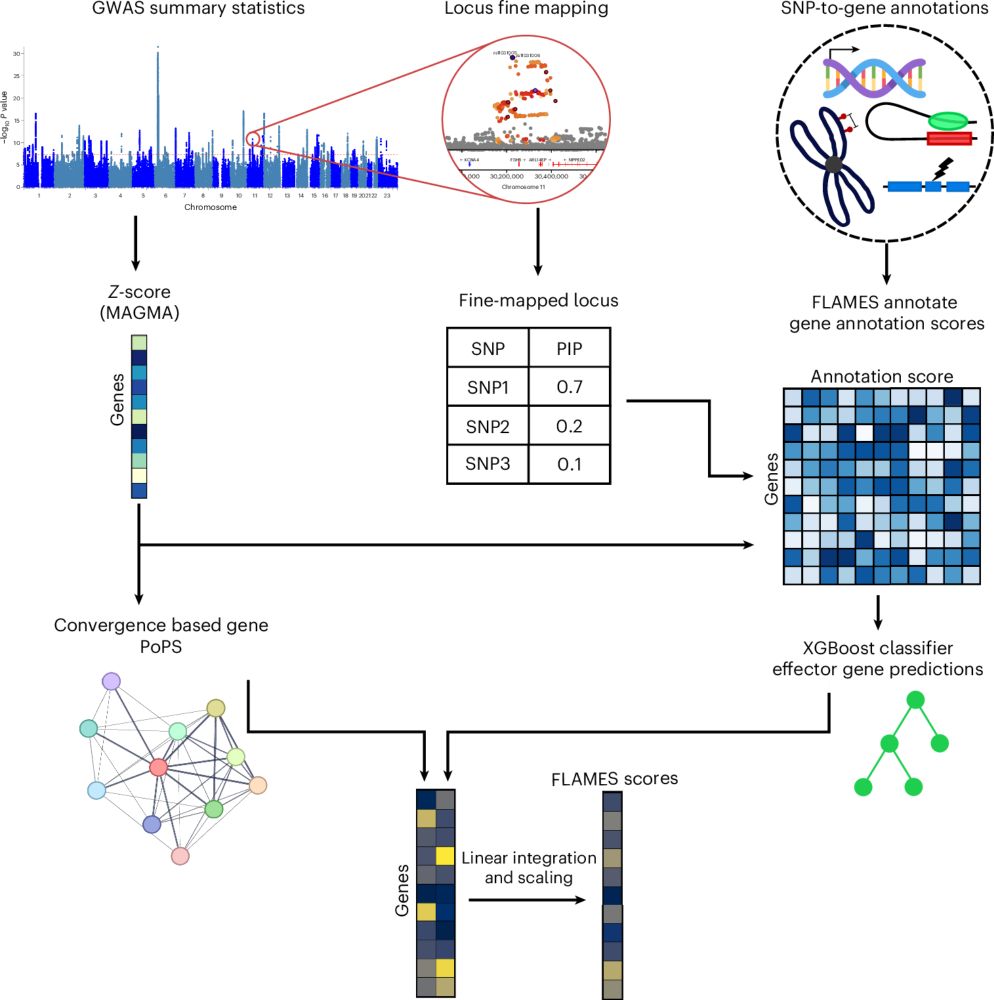
We trained an XGBoost classifier to predict the ExWAS gene in these loci based only on the SNP-to-gene annotations. Effectively asking the classifier what a causal gene looks like based on functional evidence.
We then reweight the XGBoost predictions with convergence-based evidence from PoPS.
11.02.2025 09:58 β π 1 π 0 π¬ 1 π 0
FLAMES annotates 95% credible sets from fine-mapped GWAS loci with functional data linking SNPs to genes from over 20 sources.
We did this with 1181 loci which contain a gene also implicated by rare pLoF variants. We find these pLoF ExWAS genes enriched in functional annotations from GWAS SNPs.
11.02.2025 09:58 β π 0 π 0 π¬ 1 π 0
Current integrative prioritization methods use either functional data (L2G, cS2G) or network convergence of GWAS signal (PoPS).
FLAMES combines both, by combining XGBoost predictions using functional evidence in the GWAS locus with PoPS predictions.
11.02.2025 09:58 β π 2 π 1 π¬ 1 π 0
Prioritizing effector genes at trait-associated loci using multimodal evidence
Nature Genetics - FLAMES is a machine learning approach combining variant fine-mapping, SNP-to-gene annotations and convergence-based gene prioritization scores to identify candidate effector genes...
Incredibly proud to see our latest work out in Nature Genetics: www.nature.com/articles/s41...
Here we share our FLAMES framework, which predicts the effector genes in GWAS loci with state-of-the-art precisionπ₯
Special thanks to @daniposthu.bsky.social
A full thread describing findings below!

11.02.2025 09:58 β π 17 π 8 π¬ 1 π 0
Offical BlueSky profile for the Dutch Society of Human Genetics
Website: https://www.nvhg.nl
The NHGRI-EBI Catalog of genome-wide association studies (GWAS)
www.ebi.ac.uk/gwas
Submit your #gwas data on http://bit.ly/38rNSjx
#OpenAccess #FAIRprinciples
Statistical geneticist. Professor of Human Genetics and Biostatistics at the University of Pittsburgh. Assiduously meticulous.
PhD student in statistical genetics at Vrije Universiteit Amsterdam
Trained as a geneticist, trying to become a neuroscientist. Also raising two boys and three dogs, dogs are better behaved.
Researcher at University of Oslo
Likes to be where population neuroimaging and psychiatric genetics meet
Statistical geneticist interested in complex traits @ripkelab.bsky.social and @broadinstitute.org π§¬βοΈ
Professional dungeon master @home
https://www.geneticsnetworkamsterdam.org
Statistical and psychiatric geneticist at Aarhus University
Associate Research Prof. at USC. Economics/statistical-genetics researcher. Board gamer. (Who wants to play a hand of Hanabi?) he/him/his
paturley.com
Genetics - Statistics - Psychiatry.
Depression pharmacogenetics.
SGDP Centre, Kingβs College London. Psychiatric Genomics Consortium.
MBBS, MD, PhD | GWAS storyteller | Scientist at Regeneron | Human genetics & drug discovery in Neuroscience & Psychiatry
Professor of Genetic Epidemiology, University of Bristol at: uob-ieu@bsky.social
Director of the UKRI Mental Health Platform & VP of ISPG. Prof of Biological Psychiatry and NHS Consultant
Psychology & behavior genetics. Author of THE GENETIC LOTTERY (2021) and ORIGINAL SIN (coming 3.3.2026). Speaking as an individual
Assistant Prof at D-BSSE, ETH Zurich, studying genetics of psychiatric disorders
www.nacailab.com
Assistant Professor at CU Boulder interested in multivariate genomic methods development and their application to understanding shared and unique signal across human disease and risk factors. Lab website: https://www.p-badger-lab.com/
Statistical geneticist. Associate Prof at Dana-Farber / Harvard Medical School.
www.gusevlab.org