The cover of a book titled “Probing Plant Structure” with a very phallic black and white microscopy image of a plant apical meristem

A book opened to a page titled “The Apical Meristem”, showing Plate #69 with a very phallic black and white microscopy image of a plant apical meristem
Free pile score! Awesome plant apical meristem electron microscopy!
#scicomm #botany #plants
05.05.2025 22:19 — 👍 4 🔁 0 💬 0 📌 0
…then an electron avalanche is triggered, resulting in the excitation of Nitrogen in the low-pressure upper-atmosphere - which can be seen as a glowing red color, often forming streaks across the sky! 🧵2/2
11.03.2025 02:57 — 👍 3 🔁 0 💬 0 📌 0

Strange phallic-shaped red lightning above a haze of clouds over a golden field with a windmill in it
Red Sprites are a form of high-atmosphere lightning, extending upward from lightning clouds. When lightning strikes, it sends electrons from the bottom of the cloud to the ground. If the pull of electrons to the ground is strong enough… 🧵1/2
📸 @paulmsmithphoto.bsky.social
11.03.2025 02:57 — 👍 2 🔁 0 💬 1 📌 0

Photo of a terracotta owl sculpture that is very minimalist and phallic

Photo of a surprised looking long eared owl on a tree branch
Similarly, the town of Kikinda, Serbia erected this statue to celebrate their esteemed community members that are the world’s largest roosting population of the Long Eared Owl (Asio otus)
📸 @reuters.com & Brian Sullivan / Macaulay Library
#scicomm #SuperbOwlSunday
09.02.2025 18:12 — 👍 3 🔁 0 💬 0 📌 0

Photo if a white phallic owl sculpture

Photo of an owl holding a possum in its claws
Wishing everyone a very Happy #SuperbOwl Sunday!
Sometimes artistic depictions of these incredible creatures doesn’t always go as planned… like this statue of Australia’s largest owl, the Powerful Owl (Ninox strenua)
📸 ABC News & Stephen Mudge
#scicomm #SuperbOwlSunday
09.02.2025 18:12 — 👍 4 🔁 0 💬 1 📌 0
#botany #scicomm #roots #phallicscience
08.02.2025 17:49 — 👍 0 🔁 0 💬 0 📌 0

Photo showing many dark brown phallic roots growing from the base of a palm tree in a forest

Close-up photo of one of these buttress roots further illuminating it’s phallic nature
How do tall plants keep their footing in shallow, saturated soils? Buttress Roots! A common adaptation in tropical regions - our favorite example is the palm tree, Iriartea deltoidea, which produces a shapely bouquet of buttress roots at the base of its stem to help stabilize it.
📸 Alexey Yakovlev
08.02.2025 17:49 — 👍 4 🔁 0 💬 1 📌 0
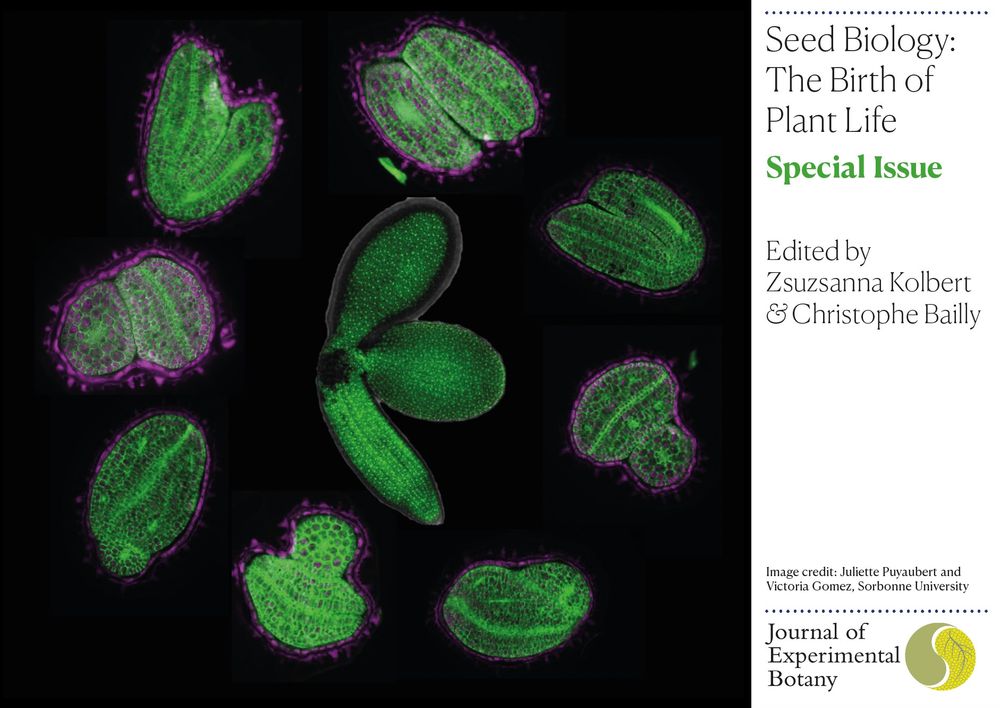
Front cover of a special issue of the Journal of Experimental Botany titled "Seed Biology: The Birth of Plant Life". The issue is edited by Zsuzsanna Kolbert and Christophe Bailly. The image shows germinating seeds (credit: Juliette Puyaubert & Victoria Gomez, Sorbonne University).
**SPECIAL ISSUE OPEN**
𝐒𝐞𝐞𝐝 𝐁𝐢𝐨𝐥𝐨𝐠𝐲: 𝐓𝐡𝐞 𝐁𝐢𝐫𝐭𝐡 𝐨𝐟 𝐏𝐥𝐚𝐧𝐭 𝐋𝐢𝐟𝐞
Guest editors: Zsuzsanna Kolbert & Christophe Bailly
Deadline: 28th February 2025
Email us if you'd like to submit a paper - there's still time!
#JXBspecialissue #seeds #plantscience 🧪
@sebiology.bsky.social
03.12.2024 10:15 — 👍 26 🔁 15 💬 0 📌 0

Black and white photos of fossils and a diagram explaining different body parts present in the fossils
This is what the actual fossils look like! …our extremely ancient ancestor 🥹
🧵 3/3
#scicomm #evolution #evo
20.01.2025 03:50 — 👍 3 🔁 0 💬 0 📌 0

Black and white drawing of an ancient phallic organism with a curled tail, holdfast, and fern-like crown
This incredible illustration from Marianne Collins depicts is a reconstruction based on a particular soft-bodied organism that’s prevalent in Middle Cambrian fossil. Its odd body plan has historically placed it among phylum Problematica (a.k.a. Incertae sedis) 🧵 1/3
20.01.2025 03:50 — 👍 9 🔁 3 💬 1 📌 0


...but WHY did the King Fire end up shaped like that?! The fire began downslope (yellow) and then quickly ran upslope (orange > red). Since heat rises, slopes become a natural path of least resistance allowing fires to move easily and rapidly upslope.
🧵2/2
📸 Natural Hazards by Keller & DeVecchio
10.01.2025 22:02 — 👍 1 🔁 0 💬 0 📌 0

As our hearts ache for everyone in LA, we're reminded of the heaviness that can come with inhabiting fire-adapted landscapes. It can be difficult to find light in a moment of such darkness, but I hope this map of the 2014 King Fire is a moment of levity. Fire can be such a dick sometimes. 🧵1/2
10.01.2025 22:02 — 👍 2 🔁 0 💬 1 📌 0
You may have noticed the spiciest part of the pepper is the seeds and the pith round the seeds - this is no accident. Capsaicin is an anti-fungal that evolved to protect the next generation (in the seeds) from fungal pathogens. More pathogenic fungi = more capsaicin. …🧵
12.12.2024 16:31 — 👍 1 🔁 0 💬 1 📌 0

A pepper plant with a very phallic orange-green pepper in the foreground and a green pepper in the background

A pepper plant with a very phallic red pepper
The Peter Pepper is an heirloom chili pepper (Capsicum annuum var. annuum) with a spice level of 10,000-23,000 Scoville Units, making it slightly hotter than a jalapeño. This spice is caused by the molecule Capsaicin, which evolved as part of an evolutionary arms race: fungi vs. pepper… 🧵
12.12.2024 16:31 — 👍 3 🔁 0 💬 2 📌 0

A photo of erect pitcher plants
If you ever find yourself without potable water in a jungle, just look for some pitcher plants with young, unopened pitchers, like this Nepenthes bokorensis in Cambodia. They have pure water inside!
29.11.2024 04:49 — 👍 6 🔁 0 💬 0 📌 0

Account deletion confirmation from The Other Place
Well that was cathartic. Thanks and welcome to my new followers! Onwards to a brighter, bluer, skyier future full of silly, yet very serious #scicomm 🤗
21.11.2024 16:51 — 👍 2 🔁 0 💬 0 📌 0
Oh yes! Please DM me! Especially if you can tell me who to credit/cite and the scientific context or fun science fact related to the photo!
21.11.2024 00:51 — 👍 1 🔁 0 💬 1 📌 0
Hi! I’d love to be added! This account might seem silly at first glance, but we’re all about the science and #scicomm!
19.11.2024 15:06 — 👍 2 🔁 0 💬 0 📌 0
Once I hit 50 followers here, I’ll delete my account on That Other Site
#scicomm #sciart #funnyscience
18.11.2024 19:24 — 👍 4 🔁 0 💬 2 📌 0

Microscopy image of the brain of a fruit fly larva with the cytoskeletal tubulin network highlighted in a bright rainbow of color on a black background
One of my favorite photos from Nikon’s Small World competition. This is the brain of a fruit fly larva. Those psychedelic rainbow colors are photoconvertible EOS-tagged tubulin cytoskeleton showing neuronal connections.
📸 @vgelfand.bsky.social & Wen Lu from Northwestern U.
17.11.2024 16:38 — 👍 11 🔁 0 💬 0 📌 1
Hi! Thanks for putting this together! …add me please?!
12.11.2024 17:57 — 👍 0 🔁 0 💬 0 📌 0
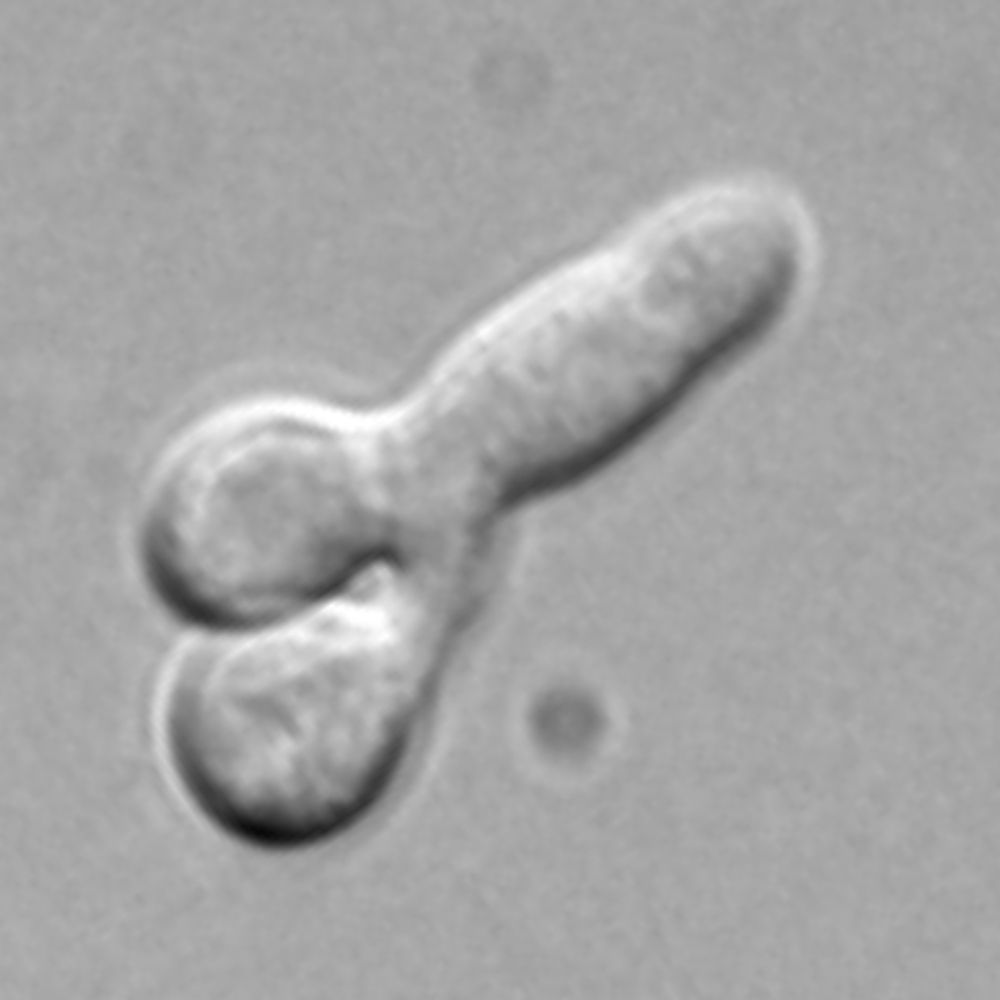
...the name of this fungus is Neurospora crassa. It's most famous for nearly 100years of basic genetics and cell bio research. It's also among the very first organisms to thrive following wildfires, and it's edible (e.g. oncom)! No matter the venue, it begins with two spores fusing together...🍆🍄🟫
12.11.2024 00:42 — 👍 0 🔁 0 💬 0 📌 0

...since they're genetically identical, they made the quick decision to collaborate and completely fuse together so they end up growing as one individual from that point onwards. Thus two spores become one tube, or hypha. These fun guys will eventually grow up into a cute pink fluffy mold... 🧵
12.11.2024 00:42 — 👍 1 🔁 0 💬 1 📌 0
Hello BlueSky! Excited to be here. This is a lighthearted #scicomm account that's all about the science, though at first glance you may think you saw something else 👀 ...come for the uncanny images, stay for the random facts you didn't even know you needed to know!
11.11.2024 23:29 — 👍 8 🔁 0 💬 0 📌 1
Geoscientist & science writer, first-gen PhD, Editor-in-Chief @sciworthy.bsky.social, Research Scientist @bluemarblespace.bsky.social, she/her 🌍🪐🌋👽
Discover groundbreaking news and research from PNAS Nexus, the sibling journal to @pnas.org - both official research journals of the U.S. National Academy of Sciences. Visit www.pnasnexus.org for more information.
Explore groundbreaking news and research from PNAS, one of the world's most-cited scientific journals. Discover its sibling journal, @pnasnexus.org, both official research journals of the U.S. National Academy of Sciences. Visit www.pnas.org for more info.
Fiction. Poetry. Nonfiction.
Memoir: Something in the Woods Loves You - Timber Press Sept 2024
New Fantasy Novel: Strange Animals - Ballantine Books Feb 2026
Poetry: The Haunted Forest Trilogy
Podcast: The Cryptonaturalist
https://linktr.ee/jarodkanderson
Assistant Professor at UNC Chapel Hill. Astrocyte cell biology and brain development. Mom. Mountain biker. Michigander. She/her. Views are my own.
GenX Physical Therapist, wife, NYUmom, taco lover, golf, student of life. Creator of online Pilates inspired workouts for bodies that have “been places.” www.bewellstaywell.net. Movement & cultural retreats in #PuertoVallarta, #golffitness #PilatesSky
Them: You're the father of the xbox!
Me: If it moves back in, it’s paying rent.
theoretical physics | CEO | gastroegyptology | cacao | CHM trustee
👽 butch Frizzle 👽 〰 journalist 〰 sculptor 〰 they/them 〰 https://reveleth.com/
→ → → Please listen to TESTED https://www.tested-podcast.com/
@coyotemedia.org co-founder
Nature comics (Bird and Moon). Books about nature. Talks. Bird facts. rosemarymosco.com She/her.
Just a bunch of crabs in a trench coat, but also a professional marine biologist. My social media is separate from, and does not represent, my employer. Please bring croissants 🥐
https://linktr.ee/rebeccarhelm
Space archaeologist | Vice-chair, Global Expert Group for Sustainable Lunar Activity | Asteroid 551014 Gorman | Author, Dr Space Junk vs the Universe. https://mitpress.mit.edu/9780262539654/dr-space-junk-vs-the-universe/
Marine biologist, writer, policy nerd. Co-founder Urban Ocean Lab, think tank for the future of coastal cities. In love with climate solutions.
Independent conservation journalist writing a book about fish. Author of CROSSINGS, on #roadecology, and EAGER, on beaver belief.
Ecologist, entomologist, writer. Chair of Academic Senate and Professor at CSU Dominguez Hills. ScienceForEveryone.science and I'm the Small Pond Science guy.
he/him
Black Lives Matter. In favor of DEI, justice, access, opportunity. Abolish ICE.
environmental seismologist - doctor of glacier vibes - geoscience educator - she/her - opinions only my own - puns only my worst - www.crlabedz.net
Your friendly neighborhood spider scientist!|ADHD & autistic|Cohost of the BBC Earth Podcast|Designed Crash Course Zoology|Find me across the web @ https://spiderdaynightlive.carrd.co/
Psychology prof at UniMelb, co-director of MetaMelb (interdisciplinary metascience lab).
Live (mostly) in Sydney.
Study credibility of science & how to improve it.
“The Gar Guy” Fish Scientist & Prof | 🌎Freshwater Conservation | SciComm • GarLab | Views mine | he/him | #GarWeek
📍Saint Paul, Minnesota
Wherever you go, there you gar
https://linktr.ee/solomonrdavid • @garlab.bsky.social