The alpha rhythm: from physiology to behaviour | Physiological Reviews | American Physiological Society
The alpha rhythm, first identified by Hans Berger 100 years ago, is the dominant non-invasive electrophysiological signature of the healthy human brain in the awake state. For decades, it was believed that the alpha rhythm reflected rest or idling; however, this perspective changed in the 2000s when researchers found that alpha oscillations increase with cognitive demands. This discovery led to a paradigm shift, demonstrating that alpha oscillations reflect the functional inhibition of brain regions that are not needed for a specific task, thereby directing information to task-specific areas. We have reviewed the physiological mechanisms involved in generating alpha oscillations, which has informed computational models explaining how these oscillations emerge within physiologically realistic networks. At the behavioural level, alpha oscillations are strongly modulated across nearly all cognitive paradigms tested in humans, reflecting the allocation of computational resources within the active brain network. Research in individuals with attention-related issues has highlighted their impaired ability to modulate alpha oscillations, which is associated with performance deficits. Therefore, further exploration of alpha oscillations has the potential to uncover causal mechanisms underlying attention problems, such as those related to ADHD and ageing. Lastly, advancements in technology are opening new avenues for characterising alpha oscillations in ecologically valid settings and across the lifespan. This progress sets the stage for exploring the role of alpha oscillations in cognitive development and their functioning in natural environments.
Curious about our good old alpha rhythm, but not sure where to start or how to deepen your understanding? Dive into the newly released extensive review paper by Ole Jensen & Mathilde Bonnefond! It offers an overview of the field and highlights the key questions that will shape future research
10.02.2026 10:26 — 👍 4 🔁 1 💬 0 📌 0
Thrilled to share this work, spearheaded by the Danc lab (led by James Bonaiuto) @danclab.bsky.social, in collaboration with us, especially Matteo Maspoli @mattgmasp.bsky.social and Danila Shelepenkov @shpen.bsky.social, and other groups who share the belief that MEG still has untapped potential!
07.02.2026 15:55 — 👍 9 🔁 8 💬 0 📌 0
Portail Emploi CNRS - Offre d'emploi - Post-doctorat - Bouffées bêta & MEG laminaire (H/F)
Check out this exciting postdoc opportunity in James Bonaiuto’s lab in Lyon!
The project focuses on laminar MEG, beta bursts, and comparisons with laminar e-phys in monkeys.
emploi.cnrs.fr/Offres/CDD/U...
07.10.2025 15:14 — 👍 2 🔁 0 💬 0 📌 0
elifkoksal
We are seeking a highly motivated PhD candidate for an exciting potential INRIA-Inserm project on:
Multiscale brain rhythms in healthy and epileptic conditions: computational modeling insights for clinical applications.
More information here: elifkoksal.github.io/positions.html!
22.05.2025 10:38 — 👍 0 🔁 0 💬 0 📌 0
This paper describes a way to incorporate beta bursts in pipelines of motor imagery BCI and shows that beta bursts outperform signal power in terms of classification accuracy and information transfer rate
18.12.2024 12:00 — 👍 0 🔁 0 💬 0 📌 0
Here is the free access version (until the 31st of January) authors.elsevier.com/a/1kFXN_V1r-...
12.12.2024 09:09 — 👍 0 🔁 0 💬 1 📌 0
Unfortunately, we could not cite all the papers we wanted to cite.
12.12.2024 08:21 — 👍 0 🔁 0 💬 1 📌 0
We also discuss alternative mechanisms, also based on alpha oscillations, that help resist distraction. Some of these mechanisms involve alpha oscillations in the parietal region and the ventral attention network.
12.12.2024 08:16 — 👍 0 🔁 0 💬 1 📌 0
In this paper, we discuss the ongoing debate regarding whether alpha oscillations play a role in suppressing the processing of distractors by modulating gain in early sensory regions. We hope it is considered balanced and provides guidance for future work
12.12.2024 08:13 — 👍 0 🔁 0 💬 1 📌 0
Redirecting
Hi all,
We are happy to announce that our paper regarding the roles of alpha oscillations in resisting distraction is now online doi.org/10.1016/j.ti...
12.12.2024 08:07 — 👍 3 🔁 1 💬 1 📌 1
This paper describes a neural mass model that integrates plasticity under epileptic activity. The model helps to better understand the formation of epileptogenic networks in the presence of an epileptic focus
04.12.2024 11:24 — 👍 1 🔁 0 💬 0 📌 0
Homepage - MEGUKI
MEG-UKI 2024 is coming to Birmingham! Mon 28th - Thu 31st October We are teaming up with our colleagues in the world of OPMs to bring you four days of cutting-edge neuroscience and Magnetoencephalography.
More info below, and on our site: (t.co/tSKytguX61)
Thanks in advance!
14.07.2024 19:10 — 👍 1 🔁 0 💬 0 📌 0
Neural Traces 2024 | About
On Thursday, don't miss out Sotirios Papadopoulos, who will present his work on motor imagery decoding using beta beta bursts at Neural Traces 2024! Neuraltraces2024.org
08.04.2024 15:10 — 👍 4 🔁 1 💬 0 📌 0
How to address spatial normalization challenges when creating an MRI atlas of the pituitary gland? A solution is proposed in this new article
19.03.2024 17:24 — 👍 0 🔁 0 💬 0 📌 0
🚨Job alert!🚨 Are you curious about curiosity, and looking for a post-doc position? Then please consider applying: www.ru.nl/en/working-a...
Feel free to e-mail/DM me if you have questions.
Thanks very much for sharing/re-posting!
19.03.2024 12:46 — 👍 28 🔁 36 💬 1 📌 1
Recent findings suggest that beta band brain activity occurs in bursts rather than sustained oscillations. In this study we analyze EEG recordings of hand motor imagery BCI tasks and show that on the single-trial level beta burst rate modulations are advantageous to beta power in terms of decoding.
21.02.2024 15:58 — 👍 0 🔁 0 💬 0 📌 0
New article from Sotirios Papadopoulos, Jérémie Mattout, @maciekszul.bsky.social @danclab.bsky.social et al.: iopscience.iop.org/article/10.1..., more info below ⬇️
21.02.2024 15:58 — 👍 2 🔁 0 💬 1 📌 0
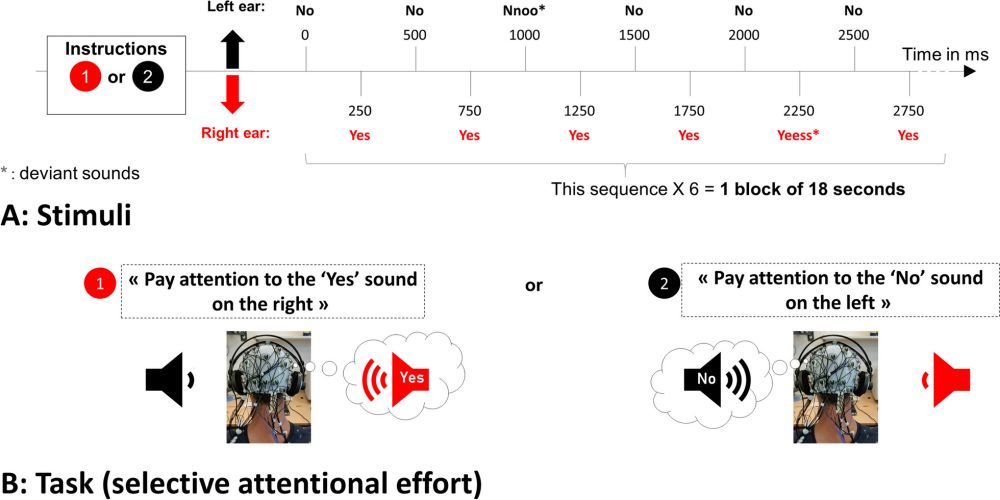
New article from our team! 📰 Bonnet, P., Bonnefond, M., & Kosem, A. (2024). What is a Rhythm for the Brain? The Impact of Contextual Temporal Variability on Auditory Perception. Journal of Cognition, 7(1): 15, pp. 1–16. DOI: doi.org/10.5334/joc.344
19.02.2024 17:33 — 👍 0 🔁 0 💬 0 📌 0
Thank you! 🤗
16.02.2024 15:29 — 👍 1 🔁 0 💬 0 📌 0

The Cophy team is now on Bluesky!
16.02.2024 15:00 — 👍 11 🔁 0 💬 1 📌 1
Cognitive neuroscience of speech, timing, and rhythm https://kosem-anne.weebly.com/
Chercheuse en neurosciences, j'utilise iel, toustes, voire le point médian.
We study cognitive neuroscience, in particular perception, attention, memory, and sleep. Part of the CRNL. https://pam-lyon.cnrs.fr
Interested in how brains make decisions and maintain motivation over time. All opinions expressed are my personal ones.
websites:
https://sites.google.com/view/ecc-team/home
CNRS researcher in neuroscience, team leader at the Lyon Neuroscience Research Center (CRNL)
Metascience, statistics, psychology, philosophy of science. Eindhoven University of Technology, The Netherlands. Omnia probate. 🇪🇺
Cognitive neuroscientist interested in decision-making, dopamine and addiction. Working at Inserm.
Neuroscientist interested in (laminar) MEG, quantitative MRI, OPMs, speech rhythms, dance and open science
PI of the Brain Rhythms and Cognition group https://www.bcbl.eu/en/research/research-groups/brain-rhythms-cognition
“Science is a way of thinking much more than it is a body of knowledge.”
Ernest E Roth Professor. Dept Bioengineering, University of Pittsburgh.
BionicLab.org
Neural Engineering; Neural Interfaces: Neurostimulation; Neurocomputation
🧠 Neuroscientist at INSERM SBRI Lyon 🧠
Prefrontal neural dynamics, learning to learn, oscillations, occasional 🐒 chat.
🇬🇧 in 🇫🇷; Conductor; horn player; slow cyclist.
Lab head: @sparsity.bsky.social
tu.berlin/uniml
The vOICe? OIC? Oh I see! Think different: vision for the blind through sound-guided mental imagery. https://x.com/seeingwithsound, feedback@seeingwithsound.com
https://www.seeingwithsound.com
Free software for creating experiments for psychology, neuroscience, economics and more. psychopy.org
Supported by opensciencetools.org and The University of Nottingham.
Host your study online using Pavlovia.org.
Cognitive and Social Neuroscientist in Lyon 🧠- MEEG and Beta Bursts 💥 Postdoc at the DANC Lab 👨🏻🎓 - Basketball fan 🏀
https://www.danclab.com/member/member17/
Postdoctoral researcher - Psychophysics & Neural Dynamics lab, Lausanne University Hospital, University of Lausanne (@unil.bsky.social) & The Sense (@thesensech.bsky.social).
Cognitive neurosciences, brain imaging, visual perception.
Research on Communication: Voice, Face, Dyslexia, Prosopagnosia, Thalamus, Multisensory | Chair of Cognitive and Clinical Neuroscience @TU Dresden | Vice-Dean Faculty of Psychology | More info on: https://tu-dresden.de/mn/psychologie/ifap/kknw?set_langua
CNRS researcher. Cognitive science, Alzheimer's Disease, eye-tracking, spatial navigation, citizen science.
webpage: https://perso.liris.cnrs.fr/acoutrot/
La science. Le monde (et inversement)
Inscrivez-vous ! themeta.news/inscription