I guess the real question is why did our elected leaders choose to believe Uber and Lyft when they made these claims?
07.12.2025 03:24 — 👍 2 🔁 1 💬 0 📌 0
The obvious 20/20 hindsight is to keep the good but not great QB until AFTER the new kid demonstrates that he's a) ready to play in the NFL and dare I say b) has more upside than the former. E.g. 49ers
06.12.2025 18:18 — 👍 0 🔁 0 💬 0 📌 0
Agricultural soil carbon sequestration gets a lot of attention but let’s not forget that the best way to keep carbon in soils is to stop further expansion of agriculture into natural ecosystems.
#WorldSoilDay
06.12.2025 02:11 — 👍 108 🔁 26 💬 3 📌 1
Who's gonna bail out the raiders tho
05.12.2025 22:03 — 👍 1 🔁 0 💬 0 📌 0
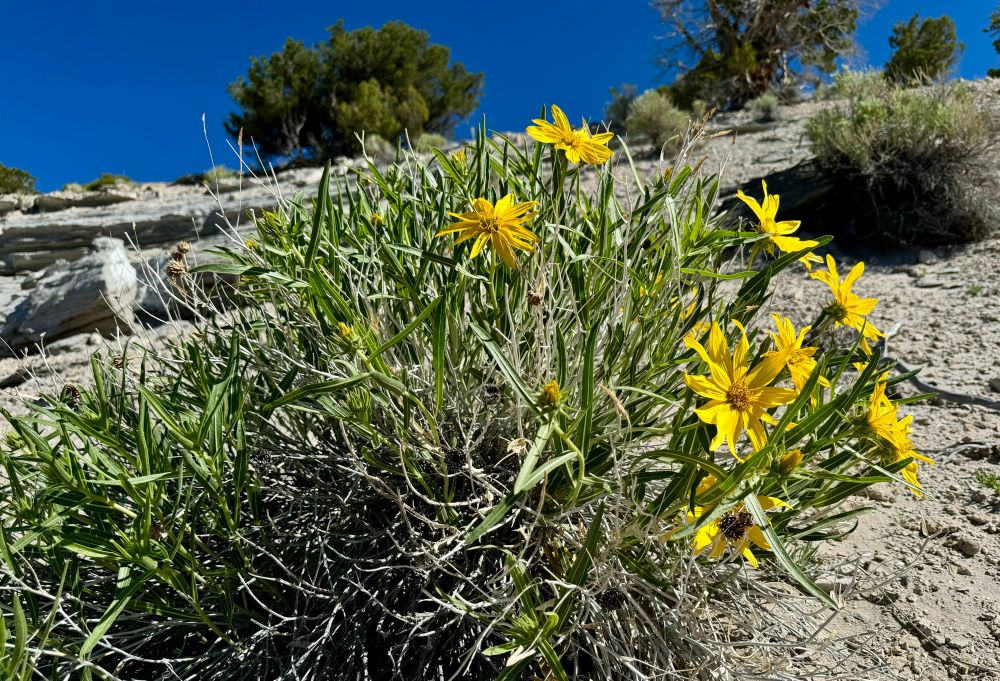
Yellow sunflowers clinging to a rocky cliff face
Wyethia scabra, our Whitestem Sunflower, blooming above Vermillion Falls #nativeplants
#FallBackFlowers #FallBack to June 5 🌿
05.12.2025 14:53 — 👍 48 🔁 5 💬 0 📌 0
Well he was nominated for the Nobel peace prize...
05.12.2025 00:18 — 👍 0 🔁 0 💬 0 📌 0
Trade secret: Put on some headphones, then don't listen to music. Carte blanche to ignore everyone and work in peace
04.12.2025 18:43 — 👍 1 🔁 0 💬 0 📌 0

Two hot pink cactus flowers atop a mostly buried spiny cactus body
Pediocactus simpsonii, our Mountain Ball Cactus, blooming in North Park #nativeplants It’s not unusual to find them half-buried in soil or sand like this one.
#FallbackFlowers #Fallback to June 1 🌿
01.12.2025 23:22 — 👍 162 🔁 25 💬 3 📌 0
Or actually have policies that people would be excited to vote for
30.11.2025 17:20 — 👍 0 🔁 0 💬 0 📌 0
Haters like @edzitron.com will point to this as evidence that AI is *not* the future
29.11.2025 14:51 — 👍 0 🔁 0 💬 0 📌 0
They also have really good spikes on their benches
28.11.2025 20:45 — 👍 0 🔁 0 💬 0 📌 0
Exactly!!
28.11.2025 14:21 — 👍 2 🔁 0 💬 0 📌 0
What are the chances that the peer reviews are also AI slop?
28.11.2025 14:20 — 👍 1 🔁 0 💬 0 📌 0
If only there was a safer way to transport large amounts of people
28.11.2025 02:13 — 👍 1 🔁 0 💬 1 📌 0
For only $2690 you too can publish any kind of ai-generated garbage you want in a Nature journal
27.11.2025 22:19 — 👍 5 🔁 0 💬 0 📌 0

Infographic with AI slop published in Nature Scientific Reports
"Runctitiononal features"? "Medical fymblal"? "1 Tol Line storee"? This gets worse the longer you look at it. But it's got to be good, because it was published in Nature Scientific Reports last week: www.nature.com/articles/s41... h/t @asa.tsbalans.se
27.11.2025 09:30 — 👍 2260 🔁 739 💬 206 📌 472
Good stuff!
25.11.2025 12:50 — 👍 0 🔁 0 💬 0 📌 0
Does this mean that JJ is good now?
25.11.2025 02:31 — 👍 0 🔁 0 💬 0 📌 0
Ready for the Winston era next year🤞🤞🤞🤞🤞🤞🤞
25.11.2025 00:42 — 👍 0 🔁 0 💬 0 📌 0
We show that DAFNEE journals compare favourably to non-DAFNEE ones in terms of editorial and financial policy, while offering similar citation rates. Finally, we offer several recommendations aimed at encouraging authors, reviewers, and evaluators to adopt more responsible publishing practices.
22.11.2025 22:32 — 👍 1 🔁 0 💬 1 📌 0
DAFNEE includes information on over 600 journals (co)run by academic or non-profit institutions, aiming at helping to keep publishing funds within the academic community. The database details these journal’s business models, article processing charges, citation rates and partnerships.
22.11.2025 22:31 — 👍 0 🔁 0 💬 1 📌 0

Focus North America | University of Helsinki
The University of Helsinki’s North America Programme 2025-2035 focuses on our interaction with partners in Canada and the United States to create meaningful impact and address global challenges throug...
The U of Helsinki is offering 2-4 month visiting research fellowships for USers to come to do research and develop collaborations across borders. I did it and it worked out great for me. Interested in collaborating and moving to Helsinki? Please reach out!
www.helsinki.fi/en/innovatio...
22.11.2025 16:35 — 👍 1 🔁 0 💬 0 📌 0
🤌🤌🤌
17.11.2025 14:36 — 👍 0 🔁 0 💬 0 📌 0
HIS NAME IS 9. GET IT RIGHT
16.11.2025 21:39 — 👍 2 🔁 0 💬 0 📌 0
Redirecting
doi.org/10.1016/j.bi...
16.11.2025 13:06 — 👍 0 🔁 0 💬 0 📌 0

Mama capybara and five babies

Baby capybara eating leaf
Baby capybaras @ the Sacramento zoo #healing #love #hope
15.11.2025 21:57 — 👍 31 🔁 4 💬 3 📌 0

Vegetation change in dry grasslands in NE Germany was studied across 20–25 years.There were early signs of biodiversity decline. Increase in competitive, mesophytic species and decline in disturbance-tolerant specialists was found. Highest diversity was associated with intermediate levels of grazing
15.11.2025 20:56 — 👍 8 🔁 2 💬 1 📌 0

An oil painting of a handful of yuccas at White Sands in New Mexico. The sand takes on the oranges and blues of the sun and the sky, and the sky is bright and cloudless.
The yuccas at White Sands are so striking 🌵
#BlueskyArtShow #Bright #BotanicalArt #OilOnCanvas
15.11.2025 22:12 — 👍 86 🔁 14 💬 0 📌 0

A table showing profit margins of major publishers. A snippet of text related to this table is below.
1. The four-fold drain
1.1 Money
Currently, academic publishing is dominated by profit-oriented, multinational companies for
whom scientific knowledge is a commodity to be sold back to the academic community who
created it. The dominant four are Elsevier, Springer Nature, Wiley and Taylor & Francis,
which collectively generated over US$7.1 billion in revenue from journal publishing in 2024
alone, and over US$12 billion in profits between 2019 and 2024 (Table 1A). Their profit
margins have always been over 30% in the last five years, and for the largest publisher
(Elsevier) always over 37%.
Against many comparators, across many sectors, scientific publishing is one of the most
consistently profitable industries (Table S1). These financial arrangements make a substantial
difference to science budgets. In 2024, 46% of Elsevier revenues and 53% of Taylor &
Francis revenues were generated in North America, meaning that North American
researchers were charged over US$2.27 billion by just two for-profit publishers. The
Canadian research councils and the US National Science Foundation were allocated US$9.3
billion in that year.

A figure detailing the drain on researcher time.
1. The four-fold drain
1.2 Time
The number of papers published each year is growing faster than the scientific workforce,
with the number of papers per researcher almost doubling between 1996 and 2022 (Figure
1A). This reflects the fact that publishers’ commercial desire to publish (sell) more material
has aligned well with the competitive prestige culture in which publications help secure jobs,
grants, promotions, and awards. To the extent that this growth is driven by a pressure for
profit, rather than scholarly imperatives, it distorts the way researchers spend their time.
The publishing system depends on unpaid reviewer labour, estimated to be over 130 million
unpaid hours annually in 2020 alone (9). Researchers have complained about the demands of
peer-review for decades, but the scale of the problem is now worse, with editors reporting
widespread difficulties recruiting reviewers. The growth in publications involves not only the
authors’ time, but that of academic editors and reviewers who are dealing with so many
review demands.
Even more seriously, the imperative to produce ever more articles reshapes the nature of
scientific inquiry. Evidence across multiple fields shows that more papers result in
‘ossification’, not new ideas (10). It may seem paradoxical that more papers can slow
progress until one considers how it affects researchers’ time. While rewards remain tied to
volume, prestige, and impact of publications, researchers will be nudged away from riskier,
local, interdisciplinary, and long-term work. The result is a treadmill of constant activity with
limited progress whereas core scholarly practices – such as reading, reflecting and engaging
with others’ contributions – is de-prioritized. What looks like productivity often masks
intellectual exhaustion built on a demoralizing, narrowing scientific vision.

A table of profit margins across industries. The section of text related to this table is below:
1. The four-fold drain
1.1 Money
Currently, academic publishing is dominated by profit-oriented, multinational companies for
whom scientific knowledge is a commodity to be sold back to the academic community who
created it. The dominant four are Elsevier, Springer Nature, Wiley and Taylor & Francis,
which collectively generated over US$7.1 billion in revenue from journal publishing in 2024
alone, and over US$12 billion in profits between 2019 and 2024 (Table 1A). Their profit
margins have always been over 30% in the last five years, and for the largest publisher
(Elsevier) always over 37%.
Against many comparators, across many sectors, scientific publishing is one of the most
consistently profitable industries (Table S1). These financial arrangements make a substantial
difference to science budgets. In 2024, 46% of Elsevier revenues and 53% of Taylor &
Francis revenues were generated in North America, meaning that North American
researchers were charged over US$2.27 billion by just two for-profit publishers. The
Canadian research councils and the US National Science Foundation were allocated US$9.3
billion in that year.

The costs of inaction are plain: wasted public funds, lost researcher time, compromised
scientific integrity and eroded public trust. Today, the system rewards commercial publishers
first, and science second. Without bold action from the funders we risk continuing to pour
resources into a system that prioritizes profit over the advancement of scientific knowledge.
We wrote the Strain on scientific publishing to highlight the problems of time & trust. With a fantastic group of co-authors, we present The Drain of Scientific Publishing:
a 🧵 1/n
Drain: arxiv.org/abs/2511.04820
Strain: direct.mit.edu/qss/article/...
Oligopoly: direct.mit.edu/qss/article/...
11.11.2025 11:52 — 👍 609 🔁 435 💬 8 📌 62
One third of The Athletic Football Show. League of Legends and R6 enjoyer.
Vikings for StarTribune.com out of Minneapolis ... also on the Access Vikings podcast and Star Tribune's YouTube channel
Don't tell me the sky's the limit when Gary Kubiak once called a successful, fourth-down QB sweep for Kirk Cousins
Newsletter-er: readoptional.substack.com | Writer: The Guardian | 🎙️ NFL Daily | Previously: NFL/CFB Scout; recruiting analyst
I cover the NFL
- wideleft.football -
- arifmhasan@gmail.com -
Minnesota Vikings beat writer at Star Tribune; track/cross country ass't coach at Apple Valley and Augsburg. Husband, girl dad, sinner saved by grace.
Subscribe to the Access Vikings newsletter: https://pages.e2ma.net/pages/1788361/5824
dumb laws deserve my thoughts on them
https://linktr.ee/ugarles
i will do your podcast
ALABSeries.com with @helldude.bsky.social @wyattprivilege.bsky.social & @garliccorgi.bsky.social
City Saint/Country Saint with @lronmexico.bsky.social
Horrifying, ignoble ape. Yapper on Kill The Computer, football dummy on 60 Minute Drill. Big Dumb Dumb PNW + Luddite + Friend
Kill The Computer is a show by Caleb and June about how the internet spills into the real world
One of the longest-running grassland biodiversity experiments worldwide (since 2002).
Uncovering the mechanisms that drive biodiversity-ecosystem functioning (BEF) relationships over time.
https://the-jena-experiment.de
Funding: @dfgpublic.bsky.social
Assistant Prof at UChicago | Sociologist | Columnist @Inthesetimesmag.bsky.social | Co-author of revolutionary sci-fi novel: Everything for Everyone | Subject of documentary film "Coming Around"
Aguila News is your source for curated news relating to issues of relevance to the Mexican American community.
Eos is a leading source for trustworthy news and perspectives about the Earth and space sciences and their impact. Published by the American Geophysical Union (@agu.org).
Scientist | Arctic ecosystems & plants | snow & remote sensing | Mountain lover & biogeographer
| #Arctic | #geography | #biogeography | #snow | #RemoteSensing | #plants | #scicomm | #microclimate | #SDM | #botany | #ecology | #Finland | #rstats |
Associate Prof at Durham University. Born and bred in the #HappyValley. Lover of #microclimate ecology, R and GIS, plus dogs🐶 and fell running 🌄🏃♀️
Plant ecologist researching land use and climate change effects through data synthesis, transplant experiments, and demography.
Postdoc at University of Copenhagen.
https://scholar.google.dk/citations?user=EHoaYJMAAAAJ&hl=da
Postdoc at Western Sydney University ~ Co-leader of #BugNet (bug-net.org) ~ global change ecology ~ community & interactions ecology ~ mum 🤍
Postdoc KU Leuven | Microclimate 🌡 | Forest plants 🌲🌳🌿 | Species distributions
Plants | Climate change | Ecology | Biodiversity | Professor @ForNaLab.bsky.social @fbwugent.bsky.social @ugent | Runner | Associate Editor @jappliedecology.bsky.social
Ecologist, teacher, educator, researcher, science communicator, mom, dogmom, and crossfiter 🌍👩🏫👶🐶🏋♀️
PhD (2022) in alpine plant ecology (functional traits, population ecology, interactions) 🏔🌱
Currently postdoc in biologydidactics, University of Bergen👩🎓👩🏫