GESIS Workshop
Introduction to Conjoint Survey Experiments
05 to 07 May | Online
Franziska Quoß (GESIS) & Lukas Rudolph (University of Konstanz)
Need causal insights into how people make decisions?
Conjoint survey experiments let you unpack complex choices in realistic settings. Learn to design and implement them in our #GESISworkshop with @phanxi.bsky.social & @lukrudolph.bsky.social.
Book Now ➡️ t1p.de/intro-experi...
@gesis.org
05.02.2026 12:34 — 👍 6 🔁 6 💬 0 📌 0
OSF
Looking forward to a surely insightful talk by @moritz-marbach.com today on "Compositional Effects, Internal Migration and Electoral Outcomes" at the Center for Data and Methods Colloquium @uni-konstanz.de. Join at 12.00-13.00 (D351) if you are around. Read his paper here: osf.io/pq3bd
28.01.2026 09:40 — 👍 0 🔁 0 💬 0 📌 0
Great that German public broadcasting reports on our new study (with F. Haggerty/P. Thurner) in Nature Communications, "Examining public support for Ukraine's defense against autocratic aggression" -- listen in here: www.br.de/radio/live/b... (in German). Thanks to Jan Kerckhoff for the interview.
28.01.2026 09:34 — 👍 0 🔁 0 💬 0 📌 0
Client Challenge
Just out in Nature Communications: "Examining public support for Ukraine’s defense against autocratic aggression". With F. Haggerty and P. Thurner, we show that Western citizens back Ukraine’s fight, but moral and strategic concerns, as well as internal divisions, impose restraints. rdcu.be/eYKAr
13.01.2026 13:28 — 👍 4 🔁 2 💬 1 📌 1

NEW SKILLS Training
📣 New month, new chances!
Explore our latest #GESISworkshop:
"Introduction to Conjoint Survey Experiments" with
@phanxi.bsky.social & @lukrudolph.bsky.social
Register Now!
➡️ t1p.de/WebTrackingD...
Our entire workshop program at gesis.org/workshops
01.12.2025 10:18 — 👍 2 🔁 2 💬 0 📌 0
⏰ Two weeks left to apply for SekMethoden 2026 — the annual meeting of the DVPW Section "Methods of Political Science"!
⬇️ See below for the CfP and link to the application portal.
@gessler.bsky.social @lukrudolph.bsky.social @donyhu.bsky.social @dvpw.bsky.social
24.11.2025 13:08 — 👍 15 🔁 11 💬 0 📌 0

A screenshot of the CfP for SekMethoden 2026
🚨 CfP: SekMethoden 2026
🗓️ March 12-13, 2026
🗺️ Hannover, Germany
⏰ DL Dec 07, 2025
👉 Apply here: sosci.sowi.uni-mannheim.de/sekmethoden2...
👥 @gessler.bsky.social, @lukrudolph.bsky.social, @donyhu.bsky.social, Jona Baumert, Morten Harmening and I look forward to your submissions!
03.11.2025 13:09 — 👍 6 🔁 8 💬 0 📌 2
We thank @aklin.bsky.social, @retobuergisser.bsky.social, T. Shibaike, A. Uji and @epgonline.bsky.social / EPG / EPSA participants for comments and the Swiss Federal Ministry of the Environment for funding.
03.06.2025 20:40 — 👍 1 🔁 0 💬 0 📌 0
Together, NIMBYism of residents who feel they face localized negative consequences of 5G antennas in their immediate vicinity, and a large share of citizens against this technology on principled terms can help account for the strong contestation of 5G in Switzerland at the time of our survey.
03.06.2025 20:40 — 👍 0 🔁 0 💬 1 📌 0
Especially those in close proximity to antennas exhibit NIMBYism. This tendency is, against our expectations, stronger among those ex ante positively inclined toward 5G in principle. In additional experiments, we show that proximate respondents have a high willingness to pay for tangible opposition.
03.06.2025 20:40 — 👍 0 🔁 0 💬 1 📌 0

We draw on a survey experiment in which we reveal maps with real-world, household-specific information on 5G antenna placement to a random set of Swiss residents. Survey respondents were previously largely unaware of antenna locations, and relevantly increase worry for proximity under treatment.
03.06.2025 20:40 — 👍 0 🔁 0 💬 1 📌 0
Great the media is picking our paper up, indeed (also at tagesschau.de, see www.tagesschau.de/inland/regio... ). Find our paper (with @aleininger.bsky.social) online at JOP @thejop.bsky.social via www.doi.org/10.1086/732945
30.05.2025 11:52 — 👍 0 🔁 0 💬 0 📌 0
📢 Our latest research (with L. Rudolph, @uni-konstanz.de) on operationalizing natural experiments, particularly extreme weather, has just been accepted @thejop.bsky.social 🌦️Natural experiments offer a unique way to analyze causal effects in real-world settings. But operationalization is often messy:
31.03.2025 08:55 — 👍 24 🔁 11 💬 2 📌 0
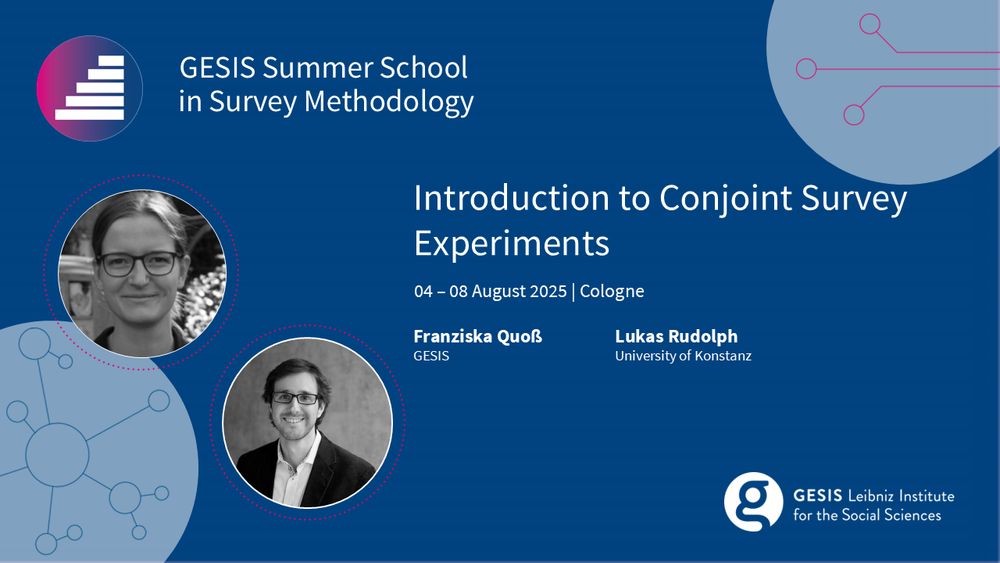
GESIS Summer School in Survey Methodolgy
Introduction to Conjoint Survey Experiments
04 to 08 August | Cologne
Franziska Quoß (GESIS) & Lukas Rudolph (University of Konstanz)
Need causal insights into how people make decisions? Conjoint survey experiments let you unpack complex choices in realistic settings. Learn to design, implement, and analyze them in our #GESISsummerschool course with @phanxi.bsky.social & Lukas Rudolph.
Book Now ➡️ t1p.de/GSS25-C6
13.05.2025 13:47 — 👍 8 🔁 7 💬 0 📌 0

New 📰: In "Can Individual MPs Damage Their Party’s Brand? Quasi-Experimental Evidence from a Public
Procurement Corruption Scandal" out in @thejop.bsky.social @lukrudolph.bsky.social and I show that the "mask affair" cost the CDU 4%-points in elections. www.journals.uchicago.edu/doi/10.1086/... 1/
08.05.2025 10:43 — 👍 26 🔁 9 💬 1 📌 1
Social Data Science @UKonstanz, musician, professional Australian Shepard. Previously PoliSci @LUHannover.
Cluster of Excellence @uni-konstanz.de. We study how people perceive inequality, how this leads to collective mobilization, and how political actors respond to it.
PhD student at GESS, University of Mannheim | Political science | Computational social science | Studying party competition on climate change & Trade-Offs associated with climate politics. More: https://davidschweizer.netlify.app/
John Zwaanstra Professor of International Studies and of Government at Harvard University | International relations 🤝 political psychology
jkertzer.sites.fas.harvard.edu
Political Scientist at ETH Zürich. Previously University of Konstanz.
Digital policy, European integration, International solidarity.
Professor of Computational Social Science, University of Munich | Text & Images | Data Scraping | Data Visualization
https://www.carstenschwemmer.com/
Political Scientist | Comparative Political Behaviour, Political Parties, Empirical Democracy Research | Experiments, Surveys, Text-as-Data
https://www.markus-kollberg.net
PhD student in comparative politics @uni-konstanz.de | environmental policy, comparative politics, politicians
Die DFG ist die größte Forschungsförderorganisation und die Selbstverwaltungsorganisation der Wissenschaft in Deutschland.
www.dfg.de
Impressum: https://www.dfg.de/de/service/kontakt/impressum
Social Media-Netiquette: https://www.dfg.de/de/service/presse
WZB Berlin, Humboldt University, TCD
https://macartan.github.io/
Politics, conflict, inequality, political economy of development, causal inference
NYU Politics prof. Methods to inform policy. Governance, conflict, institutions. cyrussamii.com
Phd student @ipz.bsky.social
Prof Research Methods | PolSci Uni Muenster | enjoys sound & transparent empirical research in #polpsych, #polcomm, #polsoc, & IR
Publishing original and substantial contributions to the study of comparative European politics.
A journal from @ecpr.bsky.social and @cambup-polsci.cambridge.org
European Political Science Review (EPSR) is an #OpenAccess journal of the European Consortium for Political Research (ECPR).
Studying political violence, conflict, state repression. Professor at University of Mannheim. Currently Director Mannheim Centre for European Social Research (MZES). she/her
Professor of Political Science, University of Konstanz, Germany. https://www.polver.uni-konstanz.de/cnc/people/weidmann/
Postdoctoral researcher, @excinequality.bsky.social @unikonstanz.bsky.social
Protest & repression, civil society, social networks, Central Asia
Professor of Political Science at the University of Mannheim.
Co-PI of the German Longitudinal Election Study (GLES). Editor-in-chief, Politische Vierteljahresschrift/German Political Science Quarterly.
International relations and IPE prof at the University of Zurich and Co-Director of the UZH Crisis Competence Center. Research on globalization backlash, IPE, international (non-)cooperation, and IOs.
Optimist expecting the worst.