🧐 What if metabolic defects are not just a consequence of inflammatory disease - but actively contribute to it?
Inflammation and metabolism are deeply intertwined, but the molecular links remain unclear.
Our new paper in Cell Death & Differentiation uncovers one. 🧵👇
nature.com/articles/s41...
16.02.2026 12:00 — 👍 22 🔁 8 💬 2 📌 0
Thanks, Leo
16.02.2026 15:03 — 👍 1 🔁 0 💬 0 📌 0
...Brent Ryan, Joern Dengjel, @gyrd-lab.bsky.social, @elliottlab.bsky.social, Lisa Frankel, @nievespeltzer.bsky.social, and Geert van Loo.
16.02.2026 12:00 — 👍 0 🔁 0 💬 0 📌 0
Huge congratulations to Camilla Elbæk, co-authors, and amazing collaborators on this effort 👏 @keisakamoto.bsky.social @labsakamoto.bsky.social, @annikameinander.bsky.social, Grahame Hardie...
16.02.2026 12:00 — 👍 0 🔁 0 💬 1 📌 0
💡 This links inflammatory ubiquitin signalling directly to metabolic control.
Could metabolic dysfunction be a driver - not just a consequence - of inflammatory disease?
16.02.2026 12:00 — 👍 0 🔁 0 💬 1 📌 0
🔬 Using cell lines 🧫, mice 🐁, flies 🪰, and patient cells 🏥, we found:
✔️ LUBAC + OTULIN regulate AMPK during energetic stress
✔️ M1-linked ubiquitination promotes AMPK activity and metabolic adaptation
✔️ Loss of this axis reduces cell and organism resilience to starvation
16.02.2026 12:00 — 👍 0 🔁 0 💬 1 📌 0
👉 We show that M1-linked ubiquitination by LUBAC directly regulates AMPK, the master energy sensor of the cell.
LUBAC and M1-linked ubiquitin are best known for regulating inflammatory signalling and cell death 💀☠️.
But they also control metabolic signalling and adaptation.
16.02.2026 12:00 — 👍 0 🔁 0 💬 1 📌 0
🧐 What if metabolic defects are not just a consequence of inflammatory disease - but actively contribute to it?
Inflammation and metabolism are deeply intertwined, but the molecular links remain unclear.
Our new paper in Cell Death & Differentiation uncovers one. 🧵👇
nature.com/articles/s41...
16.02.2026 12:00 — 👍 22 🔁 8 💬 2 📌 0
M1-linked ubiquitination by LUBAC regulates AMPK signalling and the response to energetic stress
#Drosophila
PubMed link
M1-linked ubiquitination by LUBAC regulates AMPK signalling and the response to energetic stress
#Drosophila
14.02.2026 11:23 — 👍 1 🔁 1 💬 0 📌 0
Tomato? or tomahto?
13.02.2026 19:44 — 👍 1 🔁 0 💬 0 📌 0

💡 Ciliary homeostasis turns out to depend on an unexpected tug-of-war between UFMylation and ubiquitination.
In a recent editorial in Cell Death & Differentiation,
@jnpruneda.bsky.social and I highlight new work from Wang et al. 🧵👇
29.01.2026 14:49 — 👍 8 🔁 2 💬 1 📌 0
Mechanistically, UFMylation and ubiquitination compete for the same lysine on IFT88, forming a mutually exclusive modification switch that controls protein stability and ciliary integrity across tissues.
29.01.2026 14:49 — 👍 2 🔁 0 💬 1 📌 0
While ubiquitination is a well-known regulator of protein stability, the roles of many ubiquitin-like modifiers remain unclear. Here, UFL1-mediated UFMylation emerges as a protective signal for the ciliary protein IFT88.
29.01.2026 14:49 — 👍 0 🔁 0 💬 1 📌 0
💡 Ciliary homeostasis turns out to depend on an unexpected tug-of-war between UFMylation and ubiquitination.
In a recent editorial in Cell Death & Differentiation,
@jnpruneda.bsky.social and I highlight new work from Wang et al. 🧵👇
29.01.2026 14:49 — 👍 8 🔁 2 💬 1 📌 0

🚨 Postdoc position in my lab!
A project on protein binder discovery for K6-linked #ubiquitin to investigate their role in infection is available.
📍 DTU, Copenhagen, Denmark
⏰ Deadline: 18 December 2025
Apply here: efzu.fa.em2.oraclecloud.com/hcmUI/Candid...
21.11.2025 16:44 — 👍 8 🔁 14 💬 1 📌 0
🚨 Postdoc position in my lab!
A project on protein binder discovery for K6-linked #ubiquitin to investigate their role in infection is available.
📍 DTU, Copenhagen, Denmark
⏰ Deadline: 18 December 2025
Apply here: efzu.fa.em2.oraclecloud.com/hcmUI/Candid...
21.11.2025 16:44 — 👍 8 🔁 14 💬 1 📌 0

A #postdoc position in atypical #ubiquitin signalling and protein binder engineering is opening soon in my lab at DTU Bioengineering! Get in touch if you are interested.
30.10.2025 14:13 — 👍 7 🔁 3 💬 0 📌 1
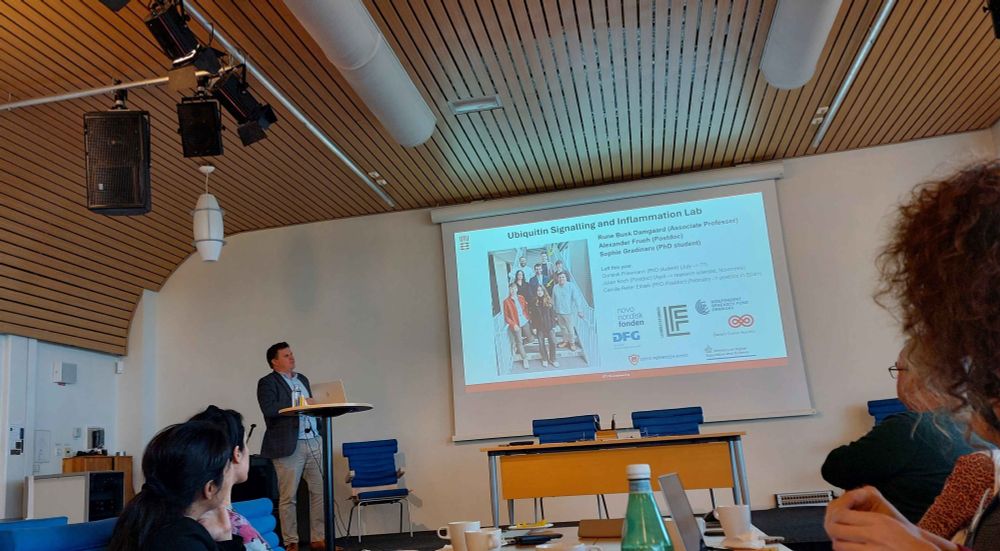
🚀 Off to our Research Retreat with the Section for Medical Biotechnology, DTU Biotechnology and Biomedicine.
Two days of science, ideas & innovation 🧬💡
12 faculty pitches, 30+ PhDs & postdocs, and endless opportunities for new collaborations 🔬🤝✨
07.10.2025 10:06 — 👍 2 🔁 0 💬 0 📌 0

A few months ago, our review “The Molecular Toolbox for Linkage Type-Specific Analysis of Ubiquitin Signaling” 🧬🧰🛠️ came out in ChemBioChem. Time to give it a spotlight!
chemistry-europe.onlinelibrary.wiley.com/doi/full/10....
16.09.2025 07:45 — 👍 19 🔁 9 💬 1 📌 0
Hope this serves as a useful overview for anyone working on ubiquitin signalling or PTMs. Big thanks to those who did the heavy lifting in the writing process: Julian Koch, Camilla Reiter Elbæk & @dompri.bsky.social 🙌😊
16.09.2025 07:45 — 👍 0 🔁 0 💬 0 📌 0
We also highlight:
✅ Trade-offs between specificity, throughput, & sensitivity
✅ Gaps in the current toolbox where innovation is needed
✅ The value of combining orthogonal methods for robust insight
16.09.2025 07:45 — 👍 0 🔁 0 💬 1 📌 0
…alongside analytical platforms such as:
✅ Immunoblotting 🧫📊
✅ Fluorescence microscopy 🔬🌈
✅ Enzymatic assays 🧪⏱️
✅ Mass spectrometry ⚡📈
16.09.2025 07:45 — 👍 0 🔁 0 💬 1 📌 0
In the review, we summarise state-of-the-art tools for probing linkage-type specificity:
🎯 Antibodies & antibody-like molecules
🎯 Affimers
🎯 Engineered Ub-binding domains
🎯 Catalytically inactive deubiquitinases
🎯 Macrocyclic peptides
16.09.2025 07:45 — 👍 0 🔁 0 💬 1 📌 0
Why this matters ⬇️
Ubiquitin chain diversity, i.e. different linkage types, mixed or branched chains, is central to cell signalling.
But analysing these chain types specifically remains a big challenge.
16.09.2025 07:45 — 👍 0 🔁 0 💬 1 📌 0
A few months ago, our review “The Molecular Toolbox for Linkage Type-Specific Analysis of Ubiquitin Signaling” 🧬🧰🛠️ came out in ChemBioChem. Time to give it a spotlight!
chemistry-europe.onlinelibrary.wiley.com/doi/full/10....
16.09.2025 07:45 — 👍 19 🔁 9 💬 1 📌 0
Is it still useful to insist that authors spell out every protein name in research papers? Many names are long, obscure, and say nothing about function... we might as well call them James, Joan, and John.
14.08.2025 12:09 — 👍 3 🔁 0 💬 0 📌 0
The goal of a PhD is not to learn some facts or read a few papers or learn a bunch of techniques. The goal of a PhD is to learn independence, problem solving, how to finish things you start, resilience, & gain the ability to adapt & think creatively. Learning these things is hard.
13.08.2025 17:28 — 👍 335 🔁 87 💬 4 📌 5
Predoctoral Research Assistant at the Llorca lab @cniostopcancer.bsky.social working on mTORC1 signaling and cryo-EM ❄️🔬. Intrigued by the structural mechanisms of protein assemblies involved in endomembrane signaling and trafficking 🧪.
Postdoc @UW-Madison Weeks Lab | Ph.D. @Umich Narayan Lab
Neuroscientist at the Federal University of Rio de Janeiro 🇧🇷
Interested in neuroimmunology, glial cells, and neurological disorders.
Automatically posts newly uploaded #Drosophila papers from Pubmed every hour.
Admin: @tkmkmym.bsky.social
A supportive network for the cilia and centrosome research community to share research and expertise.
https://www.cilianetwork.org.uk/
Postdoc in the Meissner lab at the Institute for Innate Immunity in Bonn. Previously DTU Bioengineering. Interested in innate immune signaling with a focus on ubiquitin and other post-translational modifications.
The MRC Protein Phosphorylation & Ubiquitylation Unit is a world leader in finding the causes of neurodegeneration, cancer, hypertension & immune disorders
https://www.ppu.mrc.ac.uk/
Sir Henry Wellcome Fellow | Oxford with Ivan Ahel & Harvard with Steve Gygi
Molecular mechanisms of cysteine modifications | GlcNAc and ADP-ribose
Previously: The Francis Crick Institute/Imperial College London (postdoc), University of Dundee (PhD)
Chemical Biologist with passion for Cancer Research, Targeted Protein Degradation & Transcription.Scientific Founder of Proxygen & Solgate. Pats Fan. Dad.
winter-lab.com
The Department of Biochemistry at the University of Oxford
Catalysing discovery by bringing the physical sciences into the cell.
Oxford University's Medical Sciences Division is an internationally recognised centre of excellence for biomedical and clinical research and teaching, comprised of 16 core departments and the School of Medicine and Biomedical Sciences. www.medsci.ox.ac.uk
We're the Crick, a biomedical research lab in London working to figure out how life works.
Home to more than 2,000 scientists and a free public exhibition space.
https://www.crick.ac.uk/
At the Department of Biochemistry, University of Oxford, UK. Structural biology. Ubiquitination pathways. elliottlab.web.ox.ac.uk
Postdoc at Simon Bekker-Jensen lab
CGEN, University of Copenhagen
Studying ribosome surveillance pathways is cell adaptation and disease
Assistant Professor at Yonsei University. Trying to Understand Ubiquitin Biochemistry, Molecular Signaling. Formerly @iDikic2 @MPIBP
We publish research in molecular biology, reviews, and science & society commentaries. Posts by the editors.
https://www.embopress.org/journal/14693178
EMBO is the organization of more than 2,100 leading researchers that promotes excellence in life sciences in Europe and beyond.
https://www.embo.org/