ESSGN doctoral candidate Asya Bülbül reflects on what political scientists can learn from integrating genetics.
13.02.2026 12:18 — 👍 3 🔁 3 💬 0 📌 0
@fqinya.bsky.social
PhD in political science from @uu-polisci.bsky.social. Political psychology, social science genetics. https://qinyafeng.github.io/
ESSGN doctoral candidate Asya Bülbül reflects on what political scientists can learn from integrating genetics.
13.02.2026 12:18 — 👍 3 🔁 3 💬 0 📌 0Even with so much already written in political science and political theory, sociology and social psychology, the evolving dynamics around trust, immigration, and everything in between remain deeply important and fascinating!
13.02.2026 17:05 — 👍 1 🔁 0 💬 0 📌 0My article also discusses different interpretations of trust:
as a moral value,
as psychological security,
and as cognitive sophistication.
This is a reflection on “what we mean when we talk about trust”.
That said, I also find that, Trust may not have a clear link to value-laden integration related preferences such as language tests (which Sweden will soon require).
13.02.2026 17:05 — 👍 0 🔁 0 💬 1 📌 0
This in a way echoes a key point in Kustov’s thought provoking and rich post: humanitarian oriented frames like “Immigration is about helping the vulnerable” could be misleading and ineffective.
open.substack.com/pub/alexande...
Therefore, a pro-immigration stance seems tied less to willingness to help others in need.
Rather, pro-immigration is perhaps more about the willingness to accept some vulnerability, and give the benefit of the doubt.
Both trust and prosociality correlate with approval for more open immigration policies, but
– Only trust remains strong once accounting for family confounding.
– Neither rank-based SES nor sector level non-EU employee proportion appears to moderate the trust–attitude link.
Glad that my article is finally out in Political Studies!
In it, I examine generalised trust as a source of immigration policy preferences, distinguishing it from prosociality, with Swedish twin data.
The main points👇
New paper out! Working with geospatial data is cool.
11.02.2026 09:53 — 👍 15 🔁 3 💬 1 📌 0Liberal support can be selective when values clash: when elites frame liberal values as conflicting, citizens can trade off between these values.
In this case, gender equality > Iiberal immigration inclusion, producing policy preferences that appear illiberal and exclusive.

An extraordinary paragraph. www.theatlantic.com/ideas/2026/0...
27.01.2026 22:44 — 👍 55 🔁 32 💬 1 📌 3
Abstract According to intergroup contact theory, meaningful interactions between members of different social identity groups can lead to decreases in prejudice. However, the literature on intergroup contact has generally emphasized contact-based interventions that involve positive contact experiences in highly controlled environments like research laboratories or classrooms, or infrequent intimate intergroup contact experiences, like intergroup friendships. In this Perspective, we review the literature on how intergroup contact manifests in everyday settings, which challenges established views that contact is readily available, positive and leads to consistently positive within-person changes. We describe how variations in contact valence and environmental affordances for self-selection influence individual- and macro-level segregation dynamics, which create conditions for stable trajectories of contact and intergroup bias, or contact habits. We then propose a habit–rupture model of contact, according to which changes in intergroup relations through lifespan and macro-level disruptions act as ruptures, leading to the development of new contact habits. Considering contact and its effects through a habit and rupture lens identifies realistic and ecologically valid opportunities to apply intergroup contact in the service of the social good.
New work by Stefania Paolini & Patrick Kotzur (@durhampsych.bsky.social) and international team proposes a rupture-habit model to make sense of emerging findings in everyday intergroup contact.
Paywall: doi.org/10.1038/s441...
Free Access Link: trebuchet.public.springernature.app/get_content/...
For more context, see also the @nature.com News & Views article about this work, where I unpack what it means when genetic risk for psychiatric disorders overlaps with normal-range traits, including some positive associations with education-related outcomes: rdcu.be/eT4U7
10.12.2025 17:42 — 👍 40 🔁 16 💬 1 📌 5Genuinely generous and free research environment! Apply!!!
08.12.2025 15:02 — 👍 2 🔁 1 💬 0 📌 0Stay tuned for years of exploration into how genes 🧬 and social environments jointly explain inequality and individual differences! With a UNIVERSE 🤯 of data and collaborations!!!
05.12.2025 10:16 — 👍 4 🔁 0 💬 0 📌 0
MASSIVE Japanese genetics of child health and development study: www.medrxiv.org/content/10.1...
28.11.2025 17:14 — 👍 10 🔁 6 💬 0 📌 0Maybe the 1st study to show gene(PGI)–environment interaction in political participation? Using unique Swedish data, Oskar finds that high-SES & politically active families and early life neighbourhoods can weaken genetic influences on voting.
14.11.2025 14:23 — 👍 6 🔁 1 💬 0 📌 0
There’s a new kid in town!
Companies are now selling IVF and embryo selection based on genetic testing for traits related to health and even intelligence.
We outline methodological and ethical concerns, and warn against risks for social inequality.
With the fantastic @gaiaghirardi.bsky.social

1/ 🚨New paper in Nature Genetics
Genetic factors are associated with the educational fields people study, from arts to engineering.
Article: www.nature.com/articles/s41...
FAQ: www.thehastingscenter.org/genomic-find...

BJPolS sbstract from a paper discussing the impact of diversity quotas in schools on national cohesion and identity, using Kenya's expanded diversity quota policy as a case study.
NEW -
Can Student Body Diversity Foster Inter-ethnic Trust, Tolerance, and National Identification Prioritization? The Role of Friendship in Kenya - https://cup.org/3LaSCCl
- Jaimie Bleck, Robert Dowd, @daniceguzman.bsky.social, John Mugo & Jackline Oluoch-Aridi
#OpenAccess
We built the openESM database:
▶️60 openly available experience sampling datasets (16K+ participants, 740K+ obs.) in one place
▶️Harmonized (meta-)data, fully open-source software
▶️Filter & search all data, simply download via R/Python
Find out more:
🌐 openesmdata.org
📝 doi.org/10.31234/osf...


After the 5th defence&party attended this year: what are the odds in life, how marvellous to see our explorations on digital transformation, Polish diaspora policy, Swedish twins and trust, climate change and fish, sex in willows, face the world alongside brilliant friends. No straight road behind🥂
20.09.2025 09:06 — 👍 6 🔁 0 💬 0 📌 0
💥🧠🧬Finally out!! Our new paper on the overlapping genetic basis of brain structures and psychiatric disorders has been published in Nature Mental Health. The full list of shared genetic loci is also available online. Thank you so much, Aaron and all co-authors.
www.nature.com/articles/s44...
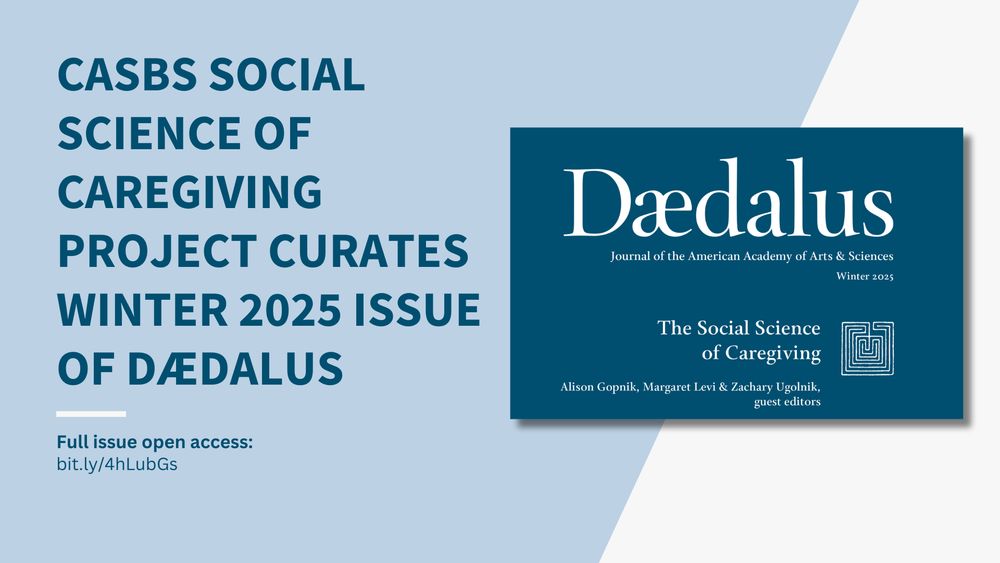
NEW RELEASE
@alisongopnik.bsky.social, leader of CASBS's Social Science of Caregiving project, edits the new issue of Dædalus w/ @mlevi.bsky.social & Zachary Ugolnik
16 essays rethink the philosophical, psychological, biological, political & economic foundations of care
OPEN ACCESS bit.ly/3Qm49ha

In this study, @anatperry.bsky.social @desmond-ong.bsky.social et al show that human-attributed responses are rated as more empathic than AI-attributed ones, especially when conveying shared experience and care.
www.nature.com/articles/s41...
🥹🤓
10.06.2025 21:32 — 👍 1 🔁 0 💬 0 📌 0