Why Slop Matters | ACM AI Letters
AI-generated “slop” is often seen as digital pollution. We argue that this dismissal
of the topic risks missing important aspects of AI Slop which deserve rigorous study.
AI Slop serves a social funct...
New paper on Why Slop Matters w/ great group of co authors (@hoytlong.bsky.social @eduede.bsky.social @ari-holtzman.bsky.social + others not on Bluesky) from ACM AI Letters. We try to move the debate re: AI Slop past normative, neg claims & towards parsing its social uses. dl.acm.org/doi/10.1145/...
04.02.2026 18:03 — 👍 22 🔁 8 💬 1 📌 7
Postdoc Research Assoc/Sloan Fdn
Postdoc Research Assoc/Sloan Fdn
Excited to recruit a 🚨 postdoc 🚨 for projects on #AI and evolving scientific practice, norms, and impact! Interdisciplinary work across science of science, philosophy of science, math with creative Purdue/Argonne/CMU/Chicago/Princeton collaborators! *pls repost*! careers.purdue.edu/job/Postdoc-...
23.01.2026 15:15 — 👍 15 🔁 16 💬 1 📌 1
New on the Archive:
Avigad, Jeremy (2026) Mathematical Understanding. [Preprint]
https://philsci-archive.pitt.edu/27708/
02.01.2026 16:19 — 👍 1 🔁 1 💬 0 📌 0
New on the Archive:
Duede, Eamon and Friedman, Daniel (2025) Epistemic Gaps and the Attribution of (AI) Discovery. [Preprint]
https://philsci-archive.pitt.edu/27719/
03.01.2026 03:18 — 👍 4 🔁 1 💬 0 📌 0
A Priori Knowledge in an Era of Computational Opacity: The Role of Artificial Intelligence in Mathematical Discovery | Philosophy of Science | Cambridge Core
A Priori Knowledge in an Era of Computational Opacity: The Role of Artificial Intelligence in Mathematical Discovery
Excited this piece is finally out in Philosophy of Science. We argue that, paradoxically, we can have certainty about theorems in math, the proofs of which we can never understand. That's weird and tells us something important about why we do math in the first place #philsky tinyurl.com/3dxxb98a
07.01.2026 14:23 — 👍 4 🔁 1 💬 0 📌 0
Reviewer 2 may have used the autopen during the final days of the Biden administration
02.12.2025 14:17 — 👍 1 🔁 0 💬 0 📌 0
Philosophy paper pitchbot
30.11.2025 17:27 — 👍 4 🔁 0 💬 0 📌 0
Factor Fexcectorn
28.11.2025 18:51 — 👍 2 🔁 0 💬 0 📌 0
I've long felt that there's something about working through logic (particularly mathematical logic) that is clarifying for thought in ways that turning the formal crank more generally isn't... like having to prove out an actual argument form using only syntactic rules is forceful learning
26.11.2025 19:47 — 👍 4 🔁 0 💬 1 📌 0

AI Surrogates and illusions of generalizability in cognitive science
Recent advances in artificial intelligence (AI) have generated enthusiasm for using AI simulations of human research participants to generate new know…
Can AI simulations of human research participants advance cognitive science? In @cp-trendscognsci.bsky.social, @lmesseri.bsky.social & I analyze this vision. We show how “AI Surrogates” entrench practices that limit the generalizability of cognitive science while aspiring to do the opposite. 1/
21.10.2025 20:24 — 👍 288 🔁 120 💬 9 📌 26
Tell us about the singer songwriters who hurt you, Jonathan
15.11.2025 15:34 — 👍 0 🔁 0 💬 0 📌 0

Three schematic diagrams. The first illustrates selective publishing of internal resection, the second selective causal focus, and the third selective access and funding for researchers.
1. We ( @jbakcoleman.bsky.social, @cailinmeister.bsky.social, @jevinwest.bsky.social, and I) have a new preprint up on the arXiv.
There we explore how social media companies and other online information technology firms are able to manipulate scientific research about the effects of their products.
24.10.2025 00:47 — 👍 759 🔁 356 💬 16 📌 21

After science
Twenty-five years ago, Ted Chiang wrote a prescient science fiction short that began: “It has been 25 years since a report of original research was last submitted to our editors for publication, makin...
New piece w/ James Evans in Science explores what we call 'science after science', an era where our ability to control nature may exceed our ability to understand it; a new struggle to sustain curiosity & understanding under AI's predictive dominance. #ai #science
www.science.org/doi/10.1126/...
14.11.2025 18:23 — 👍 24 🔁 10 💬 0 📌 0
Twin cities friends: I'll be speaking tomorrow at the Minnesota Center for Philosophy of Science on how AI disrupts the sometimes precarious balance of scientific incentives.
13.11.2025 21:02 — 👍 52 🔁 21 💬 3 📌 0

BSPS Annual Conference 2026
The BSPS Annual Conference takes place on 21–23 July 2026 at the University of Leeds
One of the best #philsci conferences in one of the best cities: the 2026 BSPS Annual Conference is taking place in Leeds 21–23 July.
Keynotes by Robin Hendry, Tarja Knuuttila & Eleanor Knox.
More info: www.thebsps.org/news/bsps-an...
#philsky
12.11.2025 14:53 — 👍 9 🔁 3 💬 0 📌 0
it’s crazy because no one knows what the aim of science is
09.11.2025 01:54 — 👍 116 🔁 12 💬 24 📌 3
"Coming back to life" is also surprising because it's nothing like them and also great
29.10.2025 01:55 — 👍 1 🔁 0 💬 0 📌 0
Most underrated Floyd album
28.10.2025 18:38 — 👍 1 🔁 0 💬 1 📌 0
thank you for your careful engagement with the arguments of the paper...
03.10.2025 18:07 — 👍 0 🔁 0 💬 0 📌 0
Apriori Knowledge in an Era of Computational Opacity: The Role of AI in Mathematical Discovery | Philosophy of Science | Cambridge Core
Apriori Knowledge in an Era of Computational Opacity: The Role of AI in Mathematical Discovery
In 1977 computers proved the 4Color Theorem. Human's can't check that proof, but trust it because they understand it. Now #AI can generate proofs we'll never understand. Can we trust those? In a new paper out in PhilSci @philscijournal.bsky.social, we argue yes! with a catch: tinyurl.com/yhmnrx5m
03.10.2025 15:50 — 👍 7 🔁 1 💬 2 📌 0
I'm seeing this, too!
24.09.2025 18:01 — 👍 1 🔁 0 💬 0 📌 0

AI use & coverage are growing quickly & recently across academic fields
arxiv.org/pdf/2405.15828
22.08.2025 23:23 — 👍 1 🔁 1 💬 0 📌 0
1. The philosophy of science sometimes gets an unearned reputation as a purely academic exercise that offers little by way of concrete tools for advancing research.
This is wrong.
And today, as we grapple with how AI is changing the nature of scientific activity, it's desperately wrong.
19.08.2025 04:59 — 👍 802 🔁 243 💬 19 📌 23
"the bar is on the floor and, if you're going to make it in the hard tech era, you can no longer ooze under it"
04.08.2025 13:15 — 👍 3 🔁 0 💬 0 📌 0
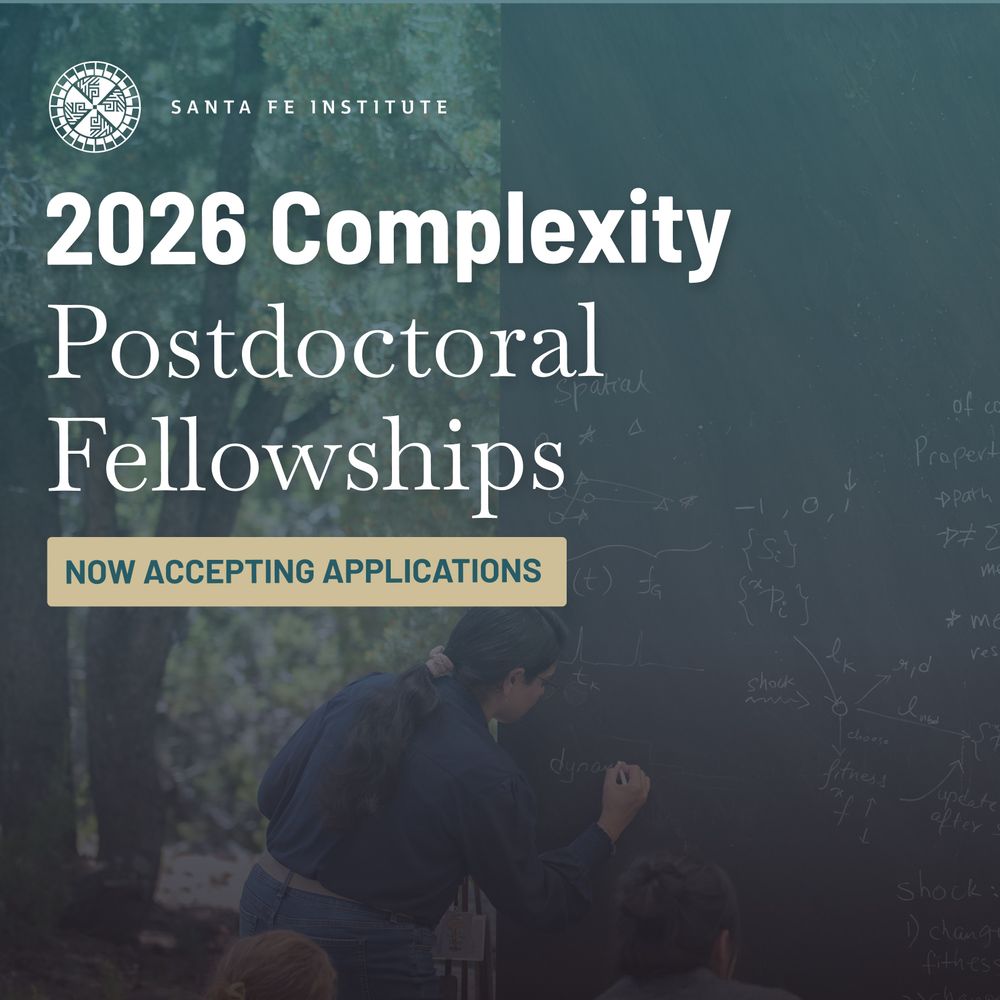
Applications are open for SFI's 2026 Complexity Postdoctoral Fellowships
If you’ve recently earned a Ph.D. in any scientific field and want to pursue independent, transdisciplinary research, consider applying.
Deadline: October 1, 2025
Apply here: santafe.edu/sfifellowship
28.07.2025 17:50 — 👍 66 🔁 69 💬 0 📌 3
Can we talk about how fantastic that grounds crew is? Look at that cut!
31.07.2025 15:11 — 👍 1 🔁 0 💬 0 📌 0
Tennis one point, no difference. Chess a pawn, game over. White moves twice initially, game over. Black gets two moves after white's first move... I thought I could just set that up on the computer but it occurred to me that if black knows they'd get to move twice, then they might find a novel first
24.07.2025 15:14 — 👍 4 🔁 0 💬 0 📌 0

AI, peer review and the human activity of science
When researchers cede their scientific judgement to machines, we lose something important.
A few months ago, Nature published how-to guide for using ChatGPT to write your peer reviews in 30 minutes.
This is, of course, a horrible idea. Here’s my response with @jbakcoleman.bsky.social .
25.06.2025 13:01 — 👍 593 🔁 233 💬 16 📌 25
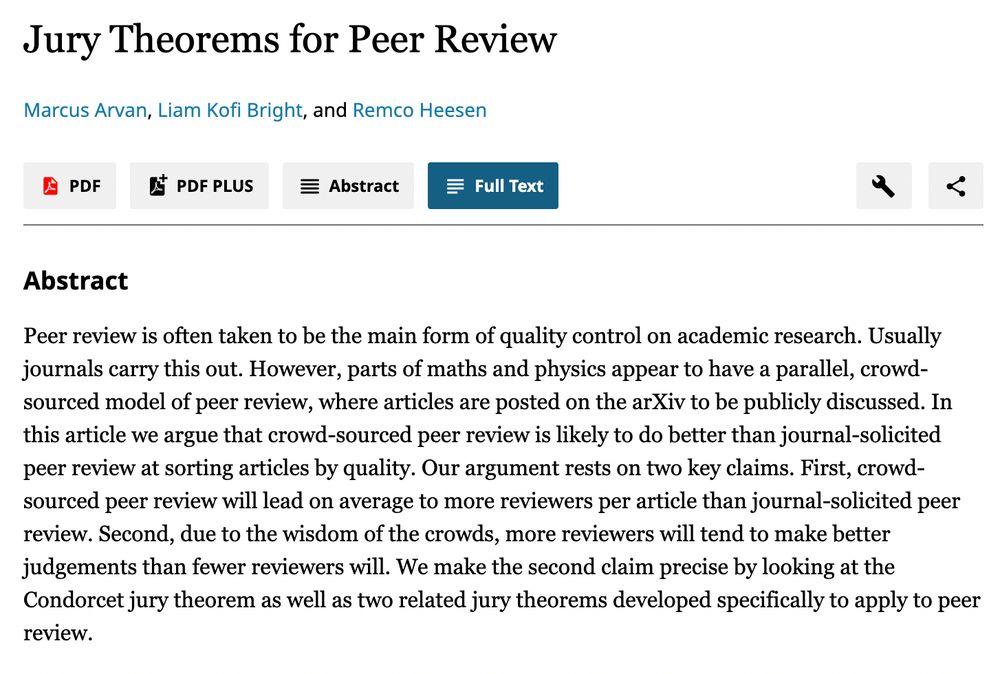
Jury Theorems for Peer Review
Marcus Arvan, Liam Kofi Bright, and Remco Heesen
Abstract:
Peer review is often taken to be the main form of quality control on academic research. Usually journals carry this out. However, parts of maths and physics appear to have a parallel, crowd-sourced model of peer review, where articles are posted on the arXiv to be publicly discussed. In this article we argue that crowd-sourced peer review is likely to do better than journal-solicited peer review at sorting articles by quality. Our argument rests on two key claims. First, crowd-sourced peer review will lead on average to more reviewers per article than journal-solicited peer review. Second, due to the wisdom of the crowds, more reviewers will tend to make better judgements than fewer reviewers will. We make the second claim precise by looking at the Condorcet jury theorem as well as two related jury theorems developed specifically to apply to peer review.
Paper is finally up and open access (www.journals.uchicago.edu/doi/10.1086/...), it's a sequel to an earlier paper where we'd argued that there's not good evidence that pre-publication peer review is a net benefit (www.journals.uchicago.edu/doi/10.1093/...). So in this one we suggest an alternative.
14.06.2025 08:28 — 👍 236 🔁 87 💬 15 📌 8
Scientific Director Centre for Science and Technology Studies (CWTS), Leiden University; Open Science Ambassador Leiden University; Co-chair Research on Research Institute (RoRI); President ASAPbio; Editor-in-Chief MetaROR (MetaResearch Open Review)
Assistant Professor @ UChicago CS & DSI UChicao
Leading Conceptualization Lab http://conceptualization.ai
Minting new vocabulary to conceptualize generative models.
Duke Professor directing https://scai.duke.edu, https://sicss.io & https://polarizationlab.com. Author of Breaking the Social Media Prism.
Associate Professor @ UBC
computational sociology
machine learning is feminist
You only have to look at the Medusa straight on to see her. And she’s not deadly. She’s beautiful and she’s laughing.
www.lauraknelson.com
Asst Professor Psychology & Data Science @ NYU | Working on brains & climate, separately | Author of Models of the Mind: How physics, engineering, and mathematics have shaped our understanding of the brain https://shorturl.at/g23c5 | Personal account (duh)
Editor at @physicstoday.bsky.social. Historian studying Nazi science by night. Passionate about Philadelphia urbanism, sports, and politics. All opinions my own.
https://ryandahn.com
International Conference on Learning Representations https://iclr.cc/
This is the Bluesky account of the philosophy department at the University of Nottingham. We like philosophy!!
An International Journal for Theory, History and Foundations of Science is a non-profit editorial venture. It is a diamond open-access journal.
🔗: https://ojs.ehu.eus/index.php/THEORIA/index
PhD📍University of Zurich
🔍 hominin cognition & behavior
🧠 neuroscience of Paleo crafts @nccrlanguage.bsky.social
An archive for preprints in philosophy of science. This is an automated feed of new uploads. More info & contact: https://philsci-archive.pitt.edu/
Fulbright scholar and Wallenberg Postdoctoral fellow @uclamath | PhD in applied math from @uppsalauni | Interested in mathematical biology, collective behaviour and complex systems | linneagyllingberg.github.io
Duke English Prof, Rhodes Chair in DH
Cultural Analytics | Digital Humanities | AI Research
Book: FAST CULTURE, SLOW JUSTICE (Columbia UP, forthcoming)
New Paper: "The Social AI Author" (AI & Society, Dec 2025)
https://richardjeanso.github.io/
Philosophy and Psychology professor at University of Cincinnati. Embodied cognition, AI, social cognition, phenomenology, critical theory. Against fascism, like everyone should be.
(he/him)
🤠 Philosopher at Purdue 🤓
• Mind, neuro, cognitive science, AI •
Follow these accounts for Phil science of the mind + brain related stuff:
🧠 @socphilneuro.bsky.social &
🎂 @caic-at-purdue.bsky.social
📚 daniellejwilliams.com
Sentientism, food policy for desired/anticipated consumption patterns, plant-based food for climate, consumption behaviour, history and reporting of global goals, framing.
I wrote a book.
Free pdf: http://trustworthymachinelearning.com
Paperback: http://amazon.com/dp/B09SL5GPCD
Posts are my own and don't necessarily represent IBM.
Philosopher at the University of Osnabrück 📚 Working on the philosophy of (Neuromorphic) AI, computation, and science.
We fund research, engagement and education in science, technology, engineering, mathematics and economics. Based in NYC. More here: https://sloan.org/