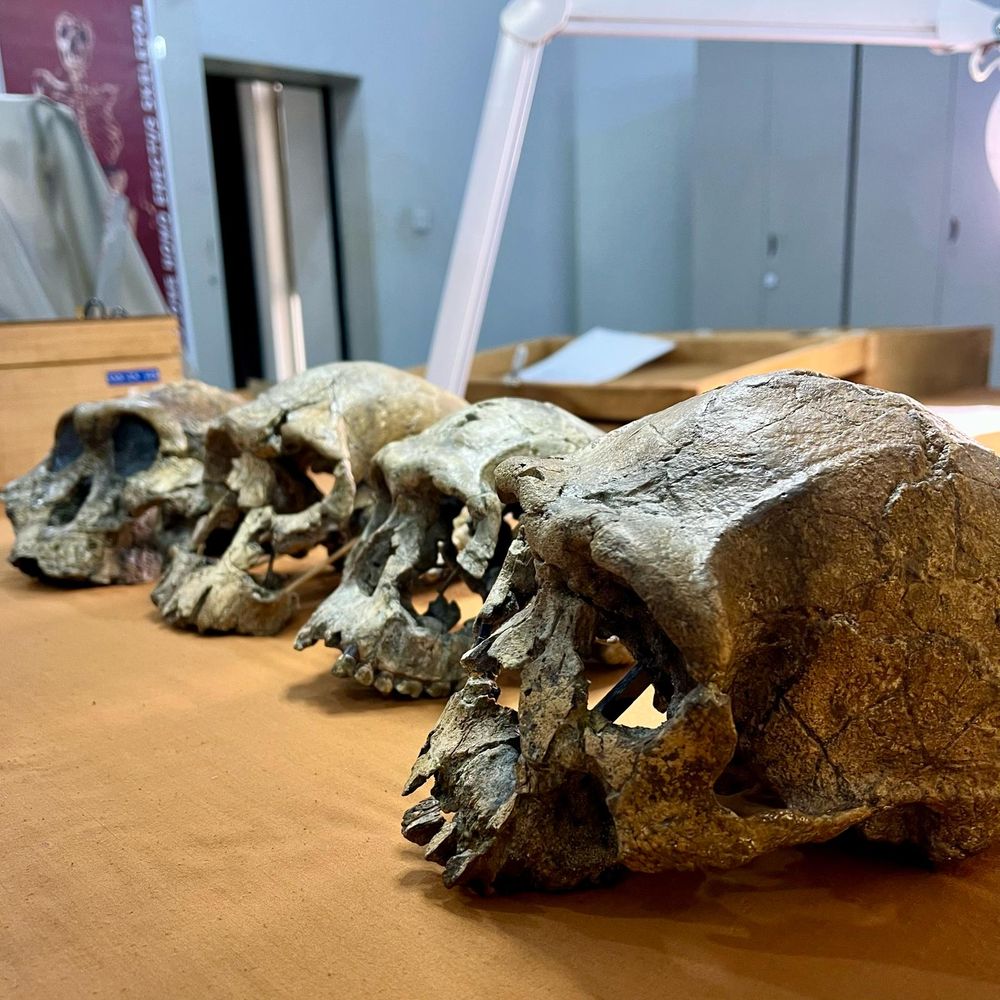
Fantastic paper and very exciting results. Small weight but much higher stature for Homo habilis than other individuals!
13.01.2026 14:07 — 👍 3 🔁 0 💬 0 📌 0

Porträtfoto von Christian Drosten. Text im Bild auf rotem Hintergrund: 'Professor Christian Drosten erhält die Auszeichnung „Rede des Jahres 2025“ des Seminars für Allgemeine Rhetorik'.
Christian Drosten erhält die Auszeichnung „Rede des Jahres 2025“ der #UniTübingen. Das Seminar für Allgemeine #Rhetorik zeichnet den Virologen für dessen Plädoyer für eine engagierte Wissenschaft aus: 👉 uni-tuebingen.de/universitaet/…
15.12.2025 11:01 — 👍 29 🔁 7 💬 2 📌 0

Grüner Text auf weißem Hintergrund: Hochschulen zeigen Haltung: Wissenschaftsfreiheit schützen
Für Offenheit, Vielfalt und den freien Austausch von Ideen 🌍📚: Die Universität Tübingen beteiligt sich gemeinsam mit vielen weiteren Hochschulen an der Kampagne #HochschulenZeigenHaltung. 👉 uni-tuebingen.de/universitaet... #UniTübingen
24.11.2025 11:36 — 👍 4 🔁 2 💬 0 📌 0

A table showing profit margins of major publishers. A snippet of text related to this table is below.
1. The four-fold drain
1.1 Money
Currently, academic publishing is dominated by profit-oriented, multinational companies for
whom scientific knowledge is a commodity to be sold back to the academic community who
created it. The dominant four are Elsevier, Springer Nature, Wiley and Taylor & Francis,
which collectively generated over US$7.1 billion in revenue from journal publishing in 2024
alone, and over US$12 billion in profits between 2019 and 2024 (Table 1A). Their profit
margins have always been over 30% in the last five years, and for the largest publisher
(Elsevier) always over 37%.
Against many comparators, across many sectors, scientific publishing is one of the most
consistently profitable industries (Table S1). These financial arrangements make a substantial
difference to science budgets. In 2024, 46% of Elsevier revenues and 53% of Taylor &
Francis revenues were generated in North America, meaning that North American
researchers were charged over US$2.27 billion by just two for-profit publishers. The
Canadian research councils and the US National Science Foundation were allocated US$9.3
billion in that year.

A figure detailing the drain on researcher time.
1. The four-fold drain
1.2 Time
The number of papers published each year is growing faster than the scientific workforce,
with the number of papers per researcher almost doubling between 1996 and 2022 (Figure
1A). This reflects the fact that publishers’ commercial desire to publish (sell) more material
has aligned well with the competitive prestige culture in which publications help secure jobs,
grants, promotions, and awards. To the extent that this growth is driven by a pressure for
profit, rather than scholarly imperatives, it distorts the way researchers spend their time.
The publishing system depends on unpaid reviewer labour, estimated to be over 130 million
unpaid hours annually in 2020 alone (9). Researchers have complained about the demands of
peer-review for decades, but the scale of the problem is now worse, with editors reporting
widespread difficulties recruiting reviewers. The growth in publications involves not only the
authors’ time, but that of academic editors and reviewers who are dealing with so many
review demands.
Even more seriously, the imperative to produce ever more articles reshapes the nature of
scientific inquiry. Evidence across multiple fields shows that more papers result in
‘ossification’, not new ideas (10). It may seem paradoxical that more papers can slow
progress until one considers how it affects researchers’ time. While rewards remain tied to
volume, prestige, and impact of publications, researchers will be nudged away from riskier,
local, interdisciplinary, and long-term work. The result is a treadmill of constant activity with
limited progress whereas core scholarly practices – such as reading, reflecting and engaging
with others’ contributions – is de-prioritized. What looks like productivity often masks
intellectual exhaustion built on a demoralizing, narrowing scientific vision.

A table of profit margins across industries. The section of text related to this table is below:
1. The four-fold drain
1.1 Money
Currently, academic publishing is dominated by profit-oriented, multinational companies for
whom scientific knowledge is a commodity to be sold back to the academic community who
created it. The dominant four are Elsevier, Springer Nature, Wiley and Taylor & Francis,
which collectively generated over US$7.1 billion in revenue from journal publishing in 2024
alone, and over US$12 billion in profits between 2019 and 2024 (Table 1A). Their profit
margins have always been over 30% in the last five years, and for the largest publisher
(Elsevier) always over 37%.
Against many comparators, across many sectors, scientific publishing is one of the most
consistently profitable industries (Table S1). These financial arrangements make a substantial
difference to science budgets. In 2024, 46% of Elsevier revenues and 53% of Taylor &
Francis revenues were generated in North America, meaning that North American
researchers were charged over US$2.27 billion by just two for-profit publishers. The
Canadian research councils and the US National Science Foundation were allocated US$9.3
billion in that year.

The costs of inaction are plain: wasted public funds, lost researcher time, compromised
scientific integrity and eroded public trust. Today, the system rewards commercial publishers
first, and science second. Without bold action from the funders we risk continuing to pour
resources into a system that prioritizes profit over the advancement of scientific knowledge.
We wrote the Strain on scientific publishing to highlight the problems of time & trust. With a fantastic group of co-authors, we present The Drain of Scientific Publishing:
a 🧵 1/n
Drain: arxiv.org/abs/2511.04820
Strain: direct.mit.edu/qss/article/...
Oligopoly: direct.mit.edu/qss/article/...
11.11.2025 11:52 — 👍 641 🔁 453 💬 8 📌 66
I wonder if anyone ever got rejected from MDPI
11.11.2025 14:27 — 👍 12 🔁 3 💬 4 📌 0

Latest paper: Boxgrove is a key European site dating to 480,000 years ago. At GTP17, hominins knapped handaxes and then butchered an adult female horse. A fragment of the horse's scapula appeared to have evidence of impact from a wooden spear.....
www.sciencedirect.com/science/arti...
08.11.2025 09:01 — 👍 69 🔁 23 💬 2 📌 4
Just finished my 100th review for a journal article - not sure if I should celebrate this anniversary or not 👀 #academia #reviewernumber2
27.10.2025 13:41 — 👍 6 🔁 0 💬 1 📌 0

Evolutionäre Anthropologie: Gemeinsame Berufungen beschlossen, neuer Studiengang geplant
Universität Leipzig, Max-Planck-Gesellschaft und -Institut für evolutionäre Anthropologie schließen Vereinbarung über gemeinsame Berufungen
Die @unileipzig.bsky.social, @maxplanck.de & @mpi-eva-leipzig.bsky.social bauen ihre Zusammenarbeit in Forschung & Lehre aus: 5 gemeinsame Professuren & geplanter Master-Studiengang f. evolutionäre Anthropologie an der Fakultät f. #Lebenswissenschaften der Uni Leipzig. www.eva.mpg.de/de/presse/ak...
26.09.2025 07:41 — 👍 10 🔁 6 💬 0 📌 0
The #ESHE2025 meeting in Paris starts tomorrow (please use this hashtag for sharing). If you are interested in the program, you find it here mcusercontent.com/9347aa3598d5... - Members have received an email for accessing the live stream! We hope you all enjoy the conference in person or online. /MW
24.09.2025 10:30 — 👍 20 🔁 10 💬 0 📌 1

You've heard of the human "cognitive revolution" around 40 kya—a moment when our species suddenly became "behaviorally modern." Have you also heard that this story is wrong?
From the archive, our episode w/ @elliescerri.bsky.social & @manuelwill.bsky.social!
Listen: disi.org/revisiting-t...
09.09.2025 16:47 — 👍 16 🔁 9 💬 1 📌 2

Ökologische Anpassung: Aufbruch nach Eurasien
Vor 50.000 Jahren gelangten erstmals Menschen aus Afrika nach Eurasien. Wie haben sie das geschafft? Womöglich durch ökologische Anpassung.
For my German-speaking followers: A 20-minute Podcast episode in which I discuss the results of our recent paper in Nature within the wider context of the global dispersal of our species in the Pleistocene! detektor.fm/wissen/forsc... #archaeology #evolution #podcast #scicom
26.08.2025 10:22 — 👍 3 🔁 0 💬 0 📌 0
Independent Junior Research Group Leader (m/f/d, 100%)
Job Alerts!🚨 We are looking to fill three Independent Junior Research Group Leader positions in the 'HUMAN ORIGINS' Cluster of Excellence at the University of Tübingen
Application deadline: Sept. 10, Starting Jan. 1, 2026
1. Genotype-Phenotype interactions:
uni-tuebingen.de/universitaet...
07.08.2025 14:58 — 👍 25 🔁 25 💬 1 📌 3

ZOOGESTURES has a web presence now! 🐒🦥🐻❄️
zoogestures.uni-koeln.de
with @nakedprimate.bsky.social @mesh-research-hub.bsky.social
🏺🗃️📕
18.08.2025 12:07 — 👍 15 🔁 6 💬 1 📌 0

ZEIT Wissen3 stellt heute die Initiative PD Prekär vor. Mehr dazu gab es vor kurzem im Wiarda-Blog. Sehr erhellendes Gespräch u.a. zu den Absurditäten der Titulaturlehre als Grundbedingung dafür, den Titel ‚Privatdozent*in‘ behalten zu dürfen. www.jmwiarda.de/blog/2025/07....
24.07.2025 07:57 — 👍 9 🔁 5 💬 0 📌 0
Where do the Dmanisi hominins fit on the human evolutionary tree?
dx.doi.org/10.1101/2025...
21.07.2025 17:38 — 👍 19 🔁 4 💬 0 📌 0
Looking forward to see you there and here about new results! Which session(s) are you in!?
17.07.2025 08:40 — 👍 1 🔁 0 💬 1 📌 0
Exactly my problem with recent humans as well!
17.07.2025 08:39 — 👍 0 🔁 0 💬 1 📌 0
Sure, and your opinion is absolutely valid. This is not an in-field consensus though and browsing through recent papers, modern human is still everywhere. Also, I think we need to be careful distinguishing between a valid academic discussion (what even means "modern"?!) and scientific communication.
16.07.2025 07:34 — 👍 0 🔁 0 💬 0 📌 0
Happy to share my perspective! I do think that some in my field don't like the term (in general "modern/modernity" has some issues - with some people discussing this all the way to Bruno Latour) but there is no consensus to not use it.
16.07.2025 07:31 — 👍 1 🔁 0 💬 0 📌 0
From my point of view, from inside the field, I still use modern humans (though I don't like 'archaic' humans!) and I think science writers etc. can and should still use it. "Sapiens" really looks odd! Who said or told you that you shouldn't?
15.07.2025 14:04 — 👍 2 🔁 0 💬 2 📌 0

"Der Traum verliert an Anziehungskraft"
DHV-Präsident Lambert Koch über Wissenschaftlerkarrieren, Tenure Track, die Rolle der Habilitation – und warum verbindliche Befristungsquoten an Hochschulen für ihn keine Lösung sind, sondern neue Probleme schaffen könnten.
www.jmwiarda.de/blog/2025/07...
09.07.2025 08:02 — 👍 17 🔁 8 💬 5 📌 6
Fantastic, congrats! Will get a copy for myself :)
08.07.2025 12:00 — 👍 2 🔁 0 💬 0 📌 0
Palaeoanthropology research group led by @martamlahr.bsky.social combining multiple projects that investigate human evolution, largely focused in the Turkana Basin.
Administered by the Ng'ipalajem team
The MATRIX project – Into the Sedimentary Matrix: Mapping the Replacement of Neanderthals by early Modern Humans using micro-contextualized biomolecules – is a European Research Council (ERC) starting grant attributed to Dr. Vera Aldeias.
Reader Physical #Geography | #Quaternary #Drylands | #Geoarchaeology | #Luminescence | #USeries | #Hydrogeology | #cyclist | #swimmer |🏳️🌈 | parent | (she/her)
🌐 https://research.manchester.ac.uk/en/persons/abi.stone
PANS & RivER https://shorturl.at/p2iNi
Updates from research into the Palaeolithic archaeology and its palaeoenvironmental context in the northern Namib Sand sea... #PANS (funded by The Leverhulme Trust) and #RiVER fieldwork expedition (funded by RGS Thesiger Oman Fellowship)
Archaeologist | Stone tools | MSA | Africa - Postdoc at @archeosciences-bordeaux.fr | @people-erc-stg.bsky.social
Anthropologist interested in hunter-gatherer egalitarianism | Asst Prof @BaylorAnthro.bsky.social | Editor-in-Chief, Hunter-Gatherer Research | Spelling errors my own
Offizieller Account der Universität Tübingen.
Impressum: https://uni-tuebingen.de/impressum/
Datenschutz: https://uni-tuebingen.de/impressum/bluesky-hinweise/
Paleoanthropologist passionate about the three big B's of human evolution and development: Birth, Brain and Behavior. Loves honesty, music and books.
Palaeoanthropology PhD candidate @CSHO_NYU and @TheRealNYCEP, @NSF GRFP. Interested in phylogenetics, virtual anthropology, and the philosophy of biology.
(Finally made the move from the o t h e r place)
Archaeologist; Curator Prehistory at RMO; Professor of Public Archaeology Leiden University; 2025-2026 Dubois chair professor at Maastricht University; FSA; Limburg
Research and other fun things at the intersection of past and play | Co-founder of the VALUE Foundation | Director at Leiden University Centre for Digital Humanities | Seeking the bubble reputation.
Lecturer at the Palaeo-Research Institute, University of Johannesburg. Co-director of field research at Swartkrans Cave, Amanzi Springs and Wonderboom.
Archaeologist | Earlier Stone Age | Beer enthusiast
Interested in ancient proteins & Human Evolution | @Welkergroup.bsky.social | Globe Institute, University of Copenhagen | 🦷🦴💀
Official Bluesky account for PaleoAnthropology
Published jointly by the Paleoanthropology Society and the European Society for the Study of Human Evolution (ESHE)
paleoanthropology.org
Official bluesky account of the European Society for the study of Human Evolution. Email us communication@eshe-conference.eu
www.eshe.eu
News from the 🇪🇺 @erc.europa.eu Starting Grant project "PalaeoEcology and OPen-LandscapE adaptations of Pleistocene humans in South Africa" (PEOPLE) — PI: @michaeltoffolo.bsky.social
Archaeologist in Patagonia, Argentina. Full professor at Universidad de Buenos Aires/ Researcher at Consejo Nacional de Investigaciones Científicas y Técnicas - CONICET. Hunter-gatherers, landscape archaeology. Born and raised in Buenos Aires
Dutch Ancient History Nerd -
Content creator on Youtube. Creating videos on Human Evolution, Ancient Structures, Ancient Inventions, Archaeological Discoveries and more!
Subscribe & Join Me❤