Catapult Grant
The funding window for ITEF’s catapult grants closes Friday!
innovteched.com/catapultgrant/
29.10.2025 13:26 — 👍 1 🔁 0 💬 0 📌 0
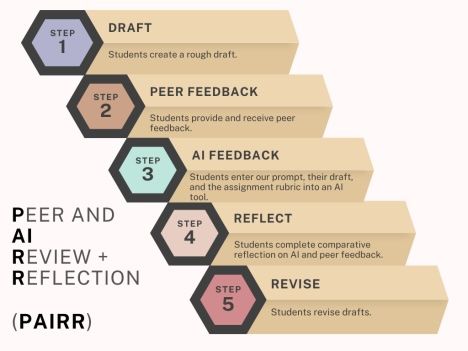
A step-by-step visual representation of the PEER AND AI REVIEW + REFLECTION (PAIRR) process. The graphic consists of five staggered steps, each in a hexagonal shape with a number and description: 1. Draft – Students create a rough draft. 2. Peer Feedback – Students provide and receive peer feedback. 3. AI Feedback – Students enter their prompt, draft, and the assignment rubric into an AI tool. 4. Reflect – Students complete a comparative reflection on AI and peer feedback. 5. Revise – Students revise.
How can AI support rather than replace student writing and thinking? How can we encourage confidence and skepticism of AI outputs? Our approach, developed at UC Davis, combines peer review with AI feedback, emphasizing reflection and agency. 1/3
08.04.2025 17:46 — 👍 60 🔁 13 💬 8 📌 2
This sounds like an interesting approach to testing AI’s role in peer review. Appreciate the framing and transparency here and I’m curious to see how PAIRR gets implemented and assessed in these contexts.
08.04.2025 20:30 — 👍 2 🔁 1 💬 0 📌 0


What percentage of students are you willing to falsely accuse of cheating with AI?
There is a trade-off between false accusations and detection rates for AI. At a 10% false positive rate, detectors find 80% or less of AI content. At a 1% rate most find 60% or less.
Don’t trust AI detectors!
06.01.2025 14:30 — 👍 131 🔁 43 💬 4 📌 9

Would your classroom AI policy survive an ethics tournament? I asked 50 students to follow a "think-pair-merge" process to distill everyone's ideas down to 4 semifinalists, resulting in some solid guidelines (and a lively debate along the way) blog.still-water.net/pooling-idea... 🐘♻️
12.12.2024 16:59 — 👍 6 🔁 2 💬 2 📌 0
Instructional Designer and college educator. PhD in English. Interested in course design, digital pedagogy, and digital literacy. also digital humanities, public humanities/history, poetry, horror, comics, aesthetics.
https://linktr.ee/jimmc_grath
Non-reformed FDR Democrat. Inner city dweller in the most liberal ward in Missouri. Rescue dog life.
Blue as the ocean and wiser over time.
Too many stories to include in a rhyme. Cook, gardener, writer and more.
Optimistic and kind, but never a bore.😂
🏳️🌈 Award-winning learning experience designer, first-gen college grad, inclusive-learning fan, and artsy MFA degree holder with a weird affinity for spreadsheets. Adjunct prof, freelance instructional tech consultant, and faculty developer.
Professor, researcher, maker of things
~Book: Atlas of AI
~Installation: Calculating Empires
~NYT video: AI's Real Environmental Impact https://www.nytimes.com/2025/09/26/opinion/ai-quartz-mining-hurricane-helene.html
The Oxford Martin School at the University of Oxford is a centre of pioneering research that aims to find solutions to the world's most urgent challenges.
https://linktr.ee/oxmartinschool
Writer, observer, educator, anthropologist, sourdough baker, gardener, linguistic anthropologist. Obsessive about the planet, politics, justice, health. Fascinated by humans.
Photo by jan_huber on unsplash
Senior Director of the University of Mississippi's CETL & Assistant Professor of Teacher Education | Author: Failing Our Future (https://bit.ly/3UUdctd) and How Humans Learn (2018) | Speaker: http://bit.ly/jeyler | https://josheyler.wordpress.com | he/him
E-learning dev & AI educator at U of Arizona Libraries. Former head of UX at MIT Libraries. Winner of MIT Excellence Award. nicolehennig.com. Digital nomad from 2013-17, locationflexiblelife.com.
- vegetarian
- car-free
- universal basic income: yes
How does tech empower and frustrate creators—writers, programmers, media makers—and how do we keep their work alive in the long run? UMaine Professor of New Media, Director of Digital Curation; former Guggenheim Curator of Media Art https://jonippolito.net
PhD candidate and consultant working with and sometimes against AI in education. Leonfurze.com / practicalaistrategies.com
Equity/care. Open connected educator. @bali_maha 🐦. Mahabali@mastodon.social
Blog: https://blog.mahabali.me Dismantle injustice 🇵🇸 #EduSky #highered
Professor of Practice, American Univ in Cairo
Educator? Writer? PhD! Learner! Runner! Bi! #OpenAccess #EdTech #OpenPedagogy #AcademicPiracy #AIEducation posts=my own. Follow me at https://aiedusimplified.substack.com/
Educator, author, consultant. Associate director at the University of Virginia Center for Teaching Excellence. Author of Intentional Tech from West Virginia University Press. Host of the Intentional Teaching podcast. Birder.
Academe’s most trusted resource for independent journalism, career development, and forward-looking intelligence.
Website: www.chronicle.com
Professor at Wharton, studying AI and its implications for education, entrepreneurship, and work. Author of Co-Intelligence.
Book: https://a.co/d/bC2kSj1
Substack: https://www.oneusefulthing.org/
Web: https://mgmt.wharton.upenn.edu/profile/emollick
Psychologist. Sr Assoc Director Teaching & Learning @simmonsuniversity.bsky.social. Author of SPARK OF LEARNING, HIVEMIND, & MIND OVER MONSTERS
Writes about emotions, teaching, brains. Enjoys speculative fiction, Halloween, and the sea. sarahrosecav.com
✍🏽 • RACE AFTER TECHNOLOGY: Abolitionist Tools for the New Jim Code • VIRAL JUSTICE: How We Grow the World We Want • IMAGINATION: A Manifesto 📚www.ruhabenjamin.com