
A big chunk of my postdoctoral work on cell-state dependent metabolism is now out at @cp-molcell.bsky.social: www.cell.com/molecular-ce... 1/
26.02.2026 17:27 — 👍 27 🔁 14 💬 2 📌 3
@lucasbsullivan.bsky.social
Associate Professor @ Fred Hutch Studying metabolic constraints of cancer cell proliferation https://research.fredhutch.org/sullivan/en.html On a mote of dust suspended in a sunbeam
A big chunk of my postdoctoral work on cell-state dependent metabolism is now out at @cp-molcell.bsky.social: www.cell.com/molecular-ce... 1/
26.02.2026 17:27 — 👍 27 🔁 14 💬 2 📌 3
For ~century, we’ve asked: why do proliferating cells ferment glucose even when O2 is around? I’m thrilled to share our latest work @natmetabolism.nature.com, led by @thebiokimist.bsky.social. By leveraging conditional essentiality in HPLM, we propose a provocative new answer to this classic Q. 🧵
16.01.2026 16:26 — 👍 56 🔁 27 💬 3 📌 2
new out in Nature www.nature.com/articles/s41...
07.01.2026 17:30 — 👍 20 🔁 9 💬 0 📌 1cc: @olivernewsom.bsky.social
13.10.2025 21:07 — 👍 1 🔁 0 💬 0 📌 0
Comparison of proliferation rates in serum free vs 10% FBS media formulations. Transformed cells maintain proliferation in both contexts while non-transformed cells proliferate slower in serum free conditions.
One new reviewer-initiated experiment: Unlike cancer cells, non-transformed cells grow poorly in serum free conditions. Highlights the fact that cancer cells are defined, in part, by the lack of requirement for exogenous growth factors. Makes fetal serum use for cancer cells all the more absurd!
13.10.2025 21:06 — 👍 2 🔁 0 💬 2 📌 0
Our work detailing the metabolic roles of serum for cancer cell proliferation is now out at JBC, @asbmbjournals.bsky.social!
Congrats to Oliver and Eric and many thanks to the editor and reviewers for a thoughtful and efficient review process.
See here:
www.sciencedirect.com/science/arti...
Check out this great interview with a true rising star in metabolism research (and lab alumni)! 🙌
15.07.2025 04:14 — 👍 11 🔁 1 💬 0 📌 0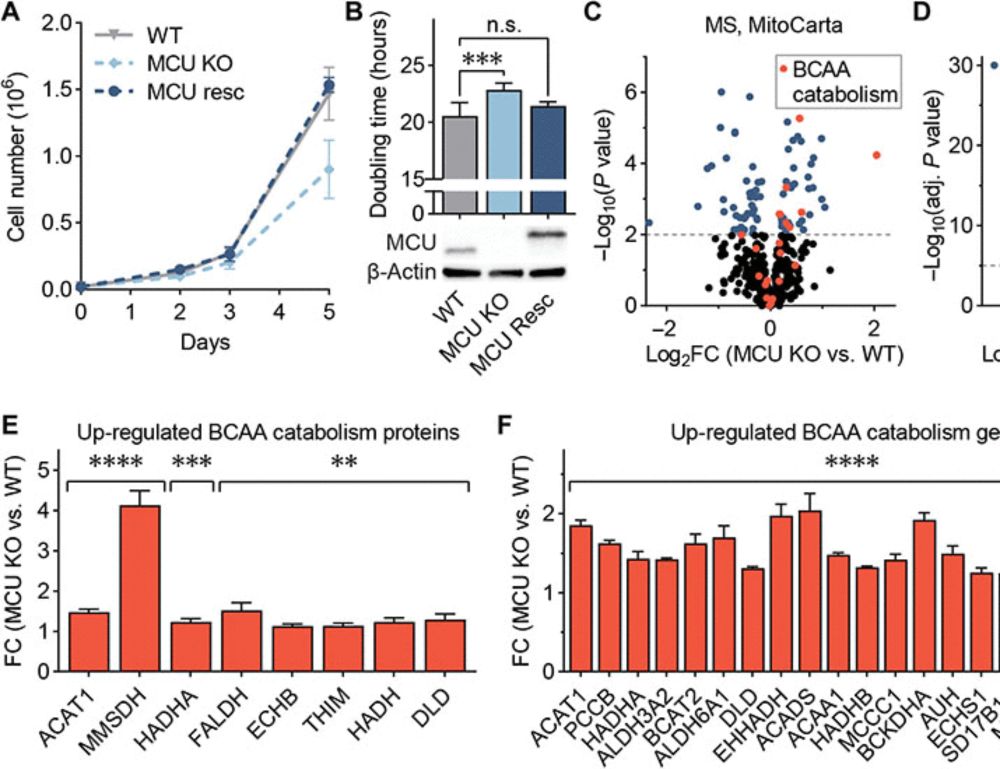
Our paper on regulation of BCAA catabolism by mitochondrial calcium signaling is out!
Mitochondrial calcium signaling regulates branched-chain amino acid catabolism in fibrolamellar carcinoma | Science Advances www.science.org/doi/10.1126/...
![[Person with ponytail wearing lab coat hands balloon to another person in front of a springboard, a magnet hanging from above, and then a target] PERSON WITH PONYTAIL to Person 2: Rub this balloon against your head, then go jump past that magnet toward the target on the wall. [caption] Before the bathroom scale was invented, the only way to weigh people was mass spectrometry.](https://cdn.bsky.app/img/feed_thumbnail/plain/did:plc:cz73r7iyiqn26upot4jtjdhk/bafkreid7lnvd7afmasx3nxi6anxmyhbatpaw54za3kiw3eaoclrf722faq@jpeg)
[Person with ponytail wearing lab coat hands balloon to another person in front of a springboard, a magnet hanging from above, and then a target] PERSON WITH PONYTAIL to Person 2: Rub this balloon against your head, then go jump past that magnet toward the target on the wall. [caption] Before the bathroom scale was invented, the only way to weigh people was mass spectrometry.
Mass Spec
xkcd.com/3094/
Niemi lab graduate student Hannah Pletcher recently joined @prelights.bsky.social and wrote nice highlight of recent work from @lucasbsullivan.bsky.social - check it out here!
26.05.2025 16:10 — 👍 19 🔁 6 💬 0 📌 2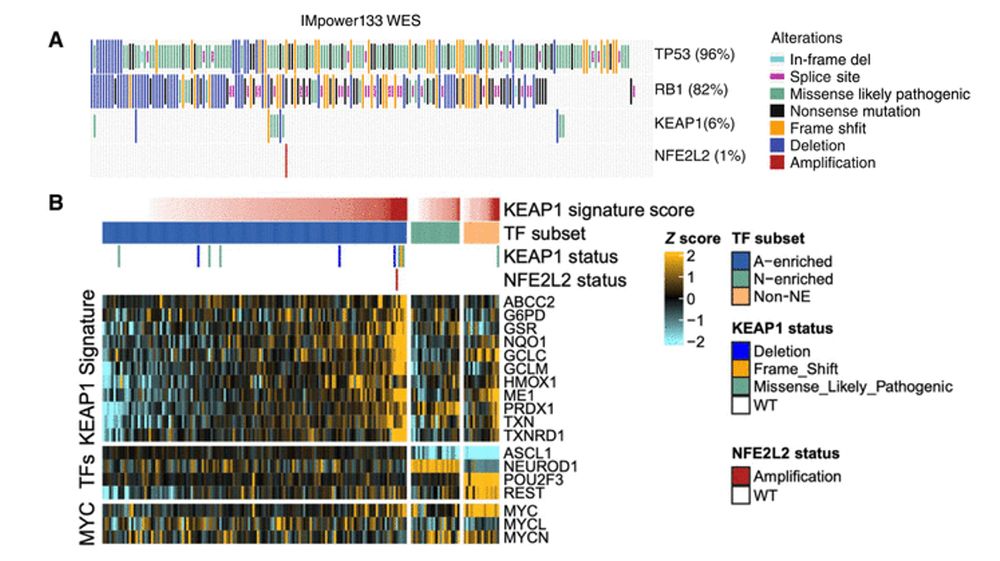
Our latest, in Science Advances: In vivo CRISPR screen revealed sgRNAs that switch chemosensitive SCLC PDXs to become resistant.We validated KEAP1 as key hit and found KEAP1 alterations in IMpower133 trial, where active NRF2 links to reduced survival in chemo arm www.science.org/doi/10.1126/... 1/2
29.04.2025 22:10 — 👍 18 🔁 6 💬 1 📌 1Overjoyed to have the opportunity to present my work orally at the Cancer Metabolism Showcase! Hope to see you there virtually!
25.04.2025 03:15 — 👍 4 🔁 2 💬 0 📌 0
From Nobel prize winning cancer researcher Bill Kaelin
Killing the Science Golden Goose - The American Journal of Medicine www.amjmed.com/article/S000...

Obliteride registeration opens today!!! Join the @lucasbsullivan.bsky.social team and help to CURE CANCER FASTER! See you August 9th at the starting line!! @obliteride.bsky.social #Obliteride #Obliteride2025 secure.fredhutch.org/goto/sulliva...
03.04.2025 16:26 — 👍 2 🔁 2 💬 0 📌 0Hello, can you add me please?
30.03.2025 22:31 — 👍 2 🔁 0 💬 1 📌 0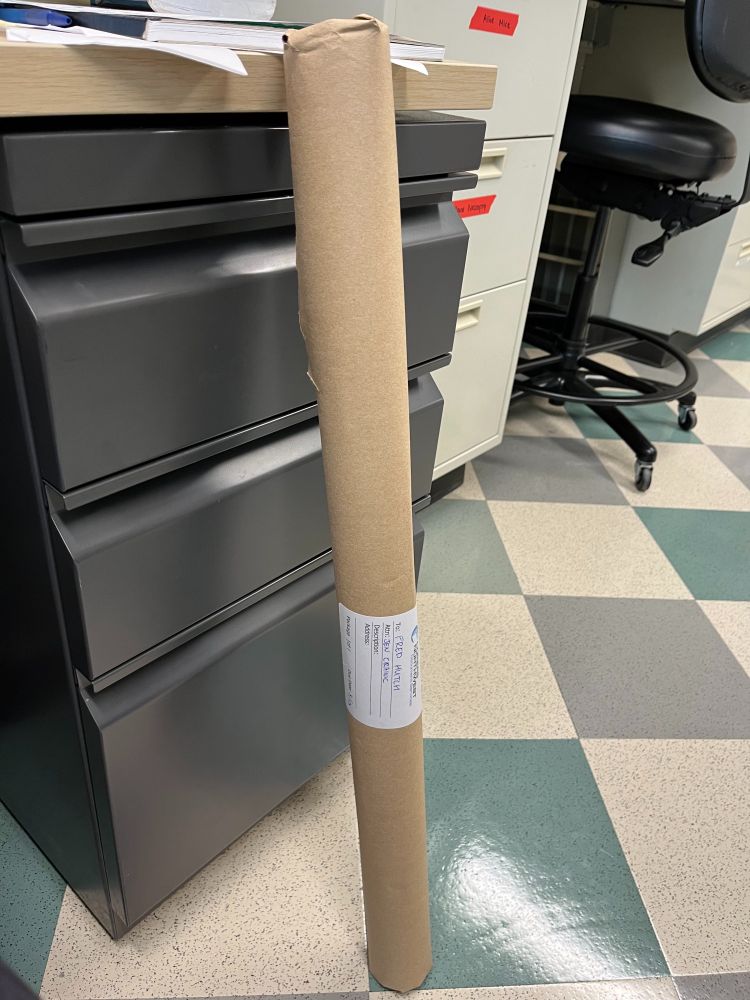
Poster is printed! Looking forward to going to the Keystone Tumor Metabolism meeting next week in Vancouver. Come talk to me about NRF2, cysteine, and novel metabolite discovery! #KSTumorMetab25 #cancermetabolism #keystonesymposia
13.03.2025 21:27 — 👍 11 🔁 1 💬 0 📌 0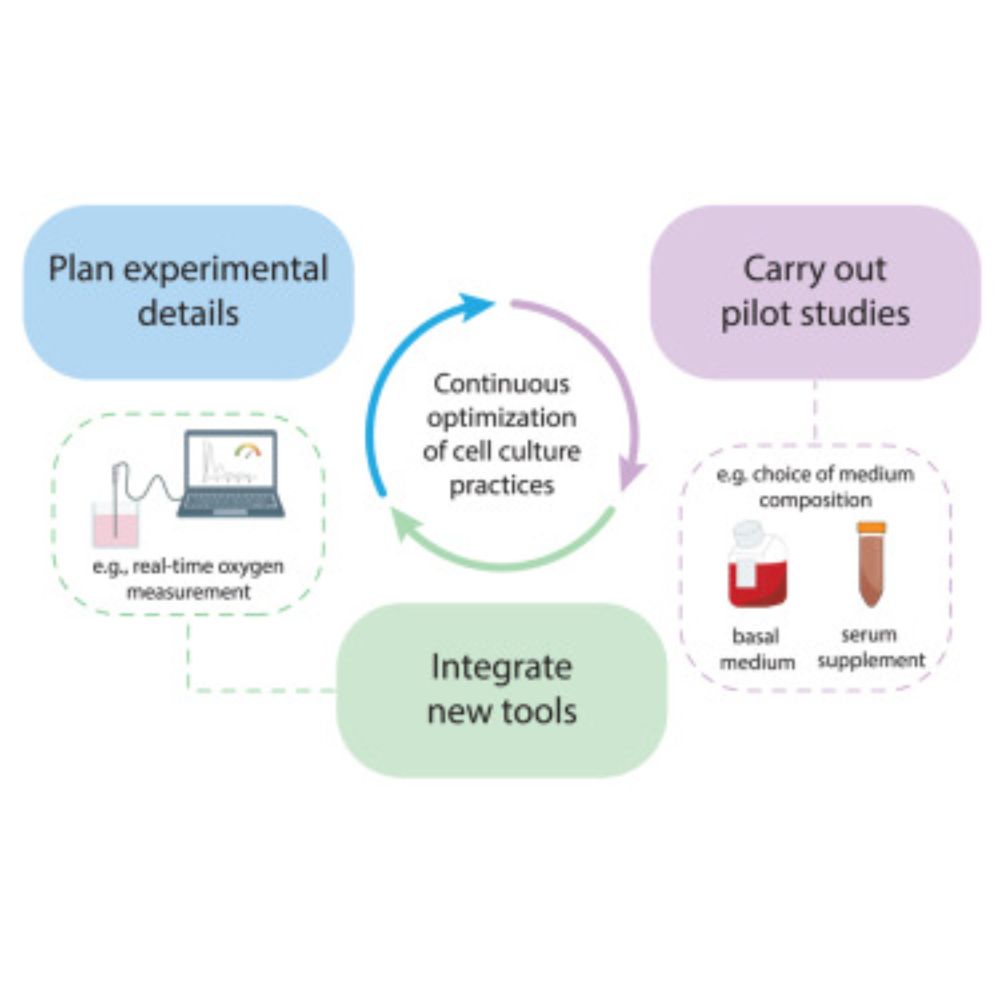
happy to share our forum now online @Cell_Metabolism! fun for us (Guy & myself) to collaborate with @dfazakerley.bsky.social, Joycelyn, & Sam in putting together what we hope will be a useful piece for the broad metabolism community re: in vitro modeling! www.cell.com/cell-metabol...
12.03.2025 15:54 — 👍 34 🔁 14 💬 1 📌 2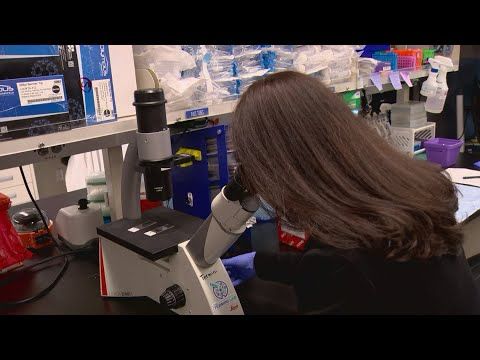
We were delighted to have @king5news.com.web.brid.gy visit us in the Termini Lab to discuss how NIH funding cuts could affect cancer research:
m.youtube.com/watch?v=Szo9...
We NEED indirect costs to provide funding needed complete research studies that will lead to life saving discoveries.
Thanks Jakub!
22.02.2025 22:58 — 👍 0 🔁 0 💬 0 📌 0Thank you!
22.02.2025 22:58 — 👍 0 🔁 0 💬 0 📌 0Thanks to Madeleine for wanting to stick around post-graduation to figure out “the boomerang” and the rest of the team for support, esp Kristian for quantitative efforts. Thanks to NIGMS and NCI for funding. Also, watch out for Madeleine's next act with @saranowinski.bsky.social!
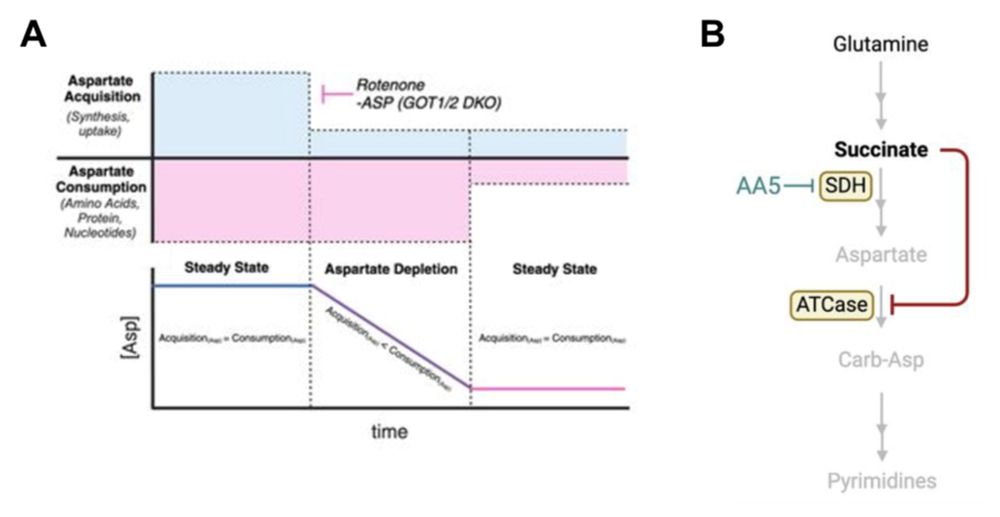
20.02.2025 22:25 — 👍 2 🔁 0 💬 1 📌 0TLDR – we find that, upon SDH loss, the combined effects of ASP depletion and succinate accumulation profoundly inhibit ATCase. Pyrimidine loss impairs ASP consumption for biosynthesis, causing ASP to accumulate until it outcompetes succinate to restart pyrimidines/biosynthesis once again.
20.02.2025 22:25 — 👍 0 🔁 0 💬 1 📌 0The full paper has plenty more (ASP flux measurements, succinate sufficiency, replication stress), so I invite you to give it a full read. There are also fun phenotypes that epitomize some of the logical pitfalls that we metabolism nerds often warn about (e.g. levels =/= flux).
20.02.2025 22:25 — 👍 0 🔁 0 💬 1 📌 0
We found SDH impaired cells can reach >10 mM!
Conclusion: succinate competes with diminished ASP at ATCase, blocking pyrimidine synthesis. To our knowledge the first description of this relationship in cells + revealing another potential regulatory function of succinate.

A literature search found a goldmine: E Coli ATCase was a workhorse of biochemistry for decades (e.g. ⬇️) One compound used to impair its function in vitro? Succinate! While the concentrations needed to impair ATCase in vitro seemed unrealistic at ~1+ mM...
pubmed.ncbi.nlm.nih.gov/3894357/
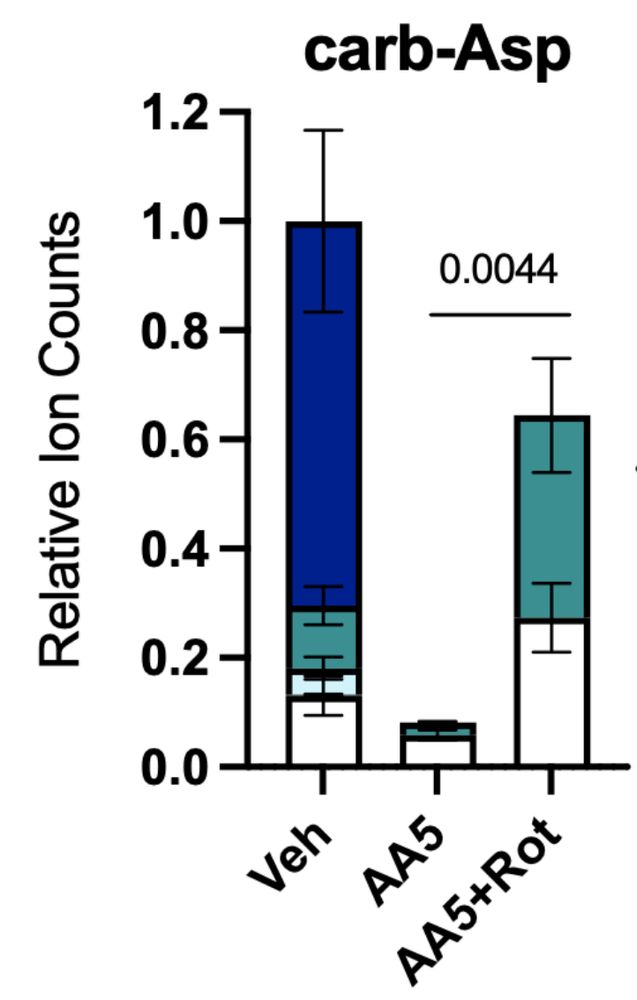
Rotenone treatment restores carb-Asp levels in AA5 treated cells (at a time point where Asp levels are near identical).
SDH inhibition is distinct from other mitochondrial impairments due to the accumulation of succinate, which we hypothesized to play a role. First, we decreased succinate production by cotreating with the CI inhibitor rotenone. Result: restoration of pyrimidine synthesis, even with comparable ASP.
20.02.2025 22:25 — 👍 0 🔁 0 💬 1 📌 0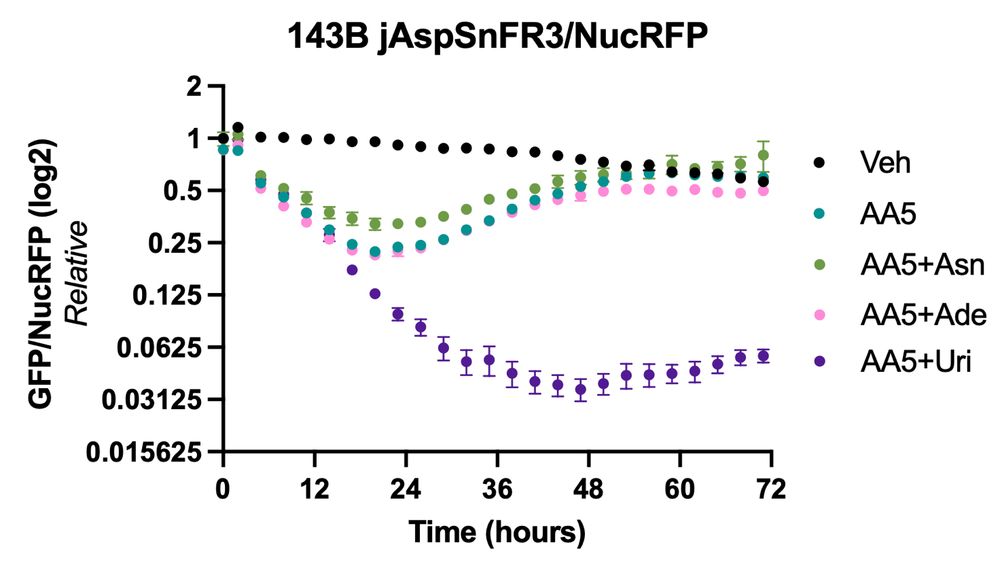
Supplementing AA5 treated cells with uridine (Uri) but not asparagine (Asn) or adenine (Ade) prevents the ASP rebound effect.
So, what happens if we restore pyrimidines to these cells?
A complete loss of the ASP rebound and a return to the (very reasonable) phenotype of monotonic ASP depletion.
So, SDH loss causes a disproportionate effect on pyrimidine synthesis by impairing ATCase, but why?
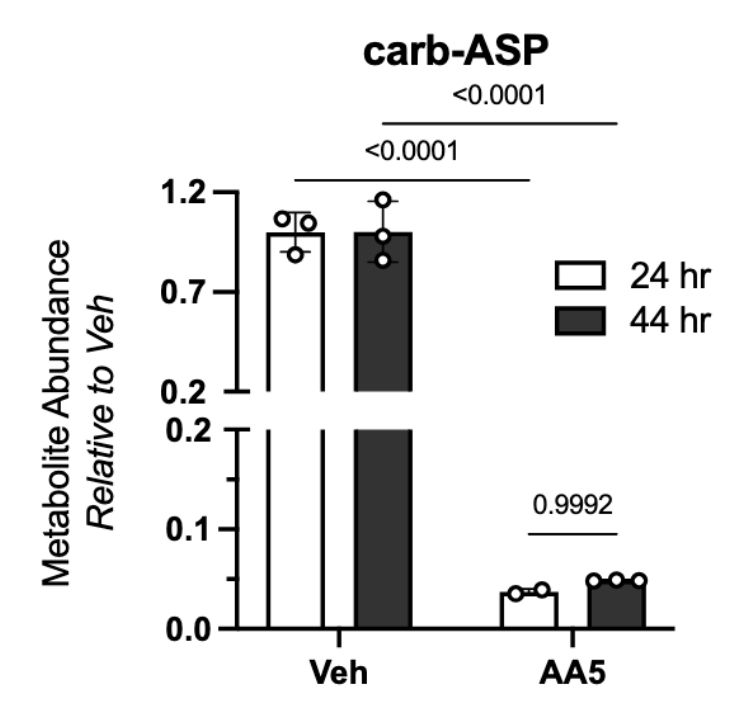
Carbamoyl-Aspartate (carb-ASP) levels are depleted by AA5 treatment at 24 hours and remain depleted at 44 hours, when ASP levels had partially recovered.
We next investigated the biosynthetic fates of aspartate and found:
Aspartyl tRNA charge = OK
Purine nucleotides = OK
ASN = OK - Rebounds with ASP
Pyrimidine nucleotides = Depleted at the first step (ATCase, which makes Carb-ASP) - and stays depleted even with rebounding ASP:
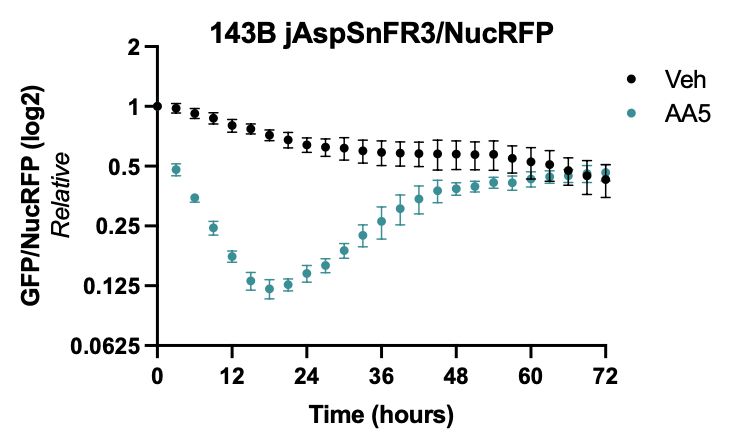
Aspartate levels, measured by the GFP/NucRFP ratio, fall for about 24 hours upon AA5 treatment, then rebound.
When we did the same experiment with the SDH inhibitor AA5, we get a strange result:
ASP declines for ~24 hours until proliferation slows, then..ASP rebounds???
Even stranger:
Proliferation doesn't recover with ASP even though we know ASP supplementation would solve the proliferation defect!
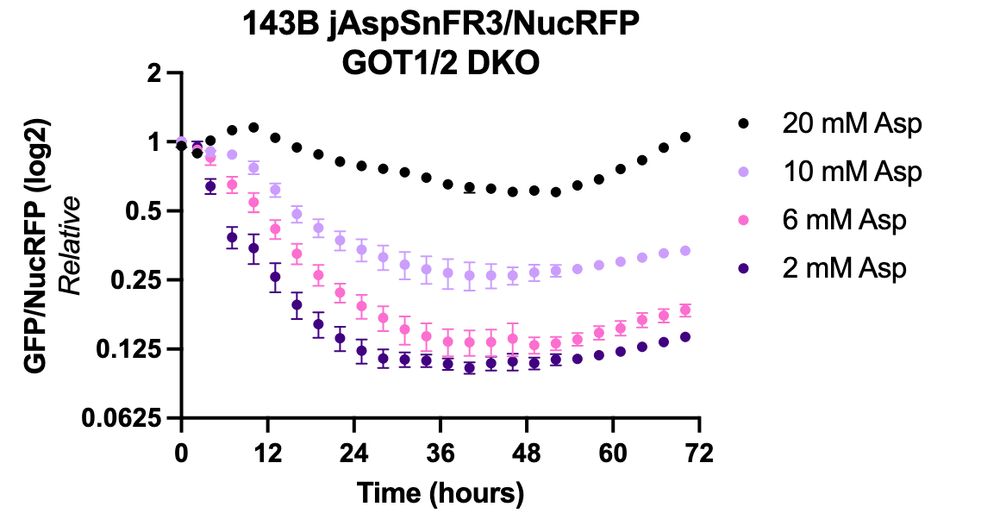
ASP (measured by GFP) declines proportionally to environmental ASP availability in ASP auxotrophs (GOT1/2 DKO cells)
Deploying our ASP biosensor, jAspSnFR3, Madeleine & co used live cell imaging to continuously measure ASP levels (GFP) and cell number. In two cases – CI inhibition and GOT1/2 DKO cells, ASP levels crash over 24 hours then cell proliferation decays, leading to a new ~steady state.
Very reasonable.