An Appraisal of Pharaonic Egyptian Boundary Studies
iksio
I wrote this overview of studies about boundaries and borderscapes in Pharaonic Egypt for a special issue of Etudes et Travaux! Check it out, and I hope you’ll also read the incredible work so many of my colleagues are doing on this subject!
www.etudesettravaux.iksiopan.pl/index.php/en...
09.02.2026 16:12 — 👍 2 🔁 1 💬 0 📌 0
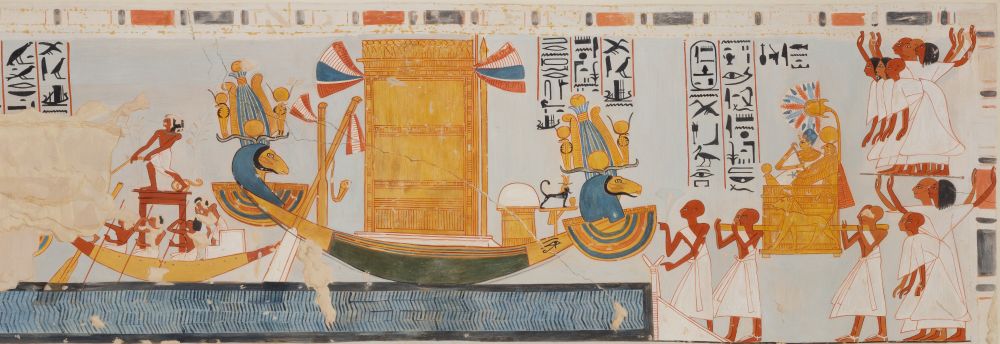
Charles K. Wilkinson, The Barque of Amun Arriving at the West Bank of Thebes, 20th century, 1930–31. Original from Egypt, Upper Egypt, Thebes, Dra Abu el-Naga, tomb of Amenmose (TT 19), original New Kingdom, Dynasty 19, reign of Ramesses I–Ramesses II; ca. 1295–1213 BCE. Tempera on paper. Facsimile, scale 1:1. The Metropolitan Museum of Art, New York, Rogers Fund, 1931 (31.6.5).
𝐂𝐞𝐥𝐞𝐛𝐫𝐚𝐭𝐢𝐧𝐠 𝐭𝐡𝐞 𝐃𝐢𝐯𝐢𝐧𝐞: 𝐅𝐞𝐬𝐭𝐢𝐯𝐚𝐥𝐬 𝐢𝐧 𝐀𝐧𝐜𝐢𝐞𝐧𝐭 𝐄𝐠𝐲𝐩𝐭
Join experts for a series of lectures exploring unique festivals that celebrate the gods of ancient Egypt.
The Met Fifth Avenue
Thursday, December 4, 2025
2–5 pm
engage.metmuseum.org/events/educa...
13.11.2025 21:15 — 👍 2 🔁 0 💬 0 📌 0
YouTube video by The Met
Exhibition Tour—Divine Egypt | Met Exhibitions
If you've ever wanted to hear me talk about art and ancient Egyptian deities, a video tour of Divine Egypt, the new exhibition on view at The Met, is now up on YouTube:
www.youtube.com/watch?v=4Wyh...
#DivineEgypt
24.10.2025 13:17 — 👍 4 🔁 2 💬 0 📌 1
I am giving a talk this Sunday (October 19th) at The Met, New York, in conjunction with the new exhibition 𝘋𝘪𝘷𝘪𝘯𝘦 𝘌𝘨𝘺𝘱𝘵 (which I worked on).
engage.metmuseum.org/events/educa...
#DivineEgypt
17.10.2025 13:55 — 👍 3 🔁 1 💬 0 📌 0
How would you account for the usual writing of 𓇓𓏏𓈖 with the ⟨n⟩ written last? With the reading 𝘯(𝘫)-𝘴𝘸𝘵 "he of the sedge plant," it is typically explained as a kind of honorific transposition.
(I am still surprised whenever I see a particularly old article transliterate the word as 𝘴𝘸𝘵𝘯.)
08.10.2025 18:32 — 👍 1 🔁 0 💬 1 📌 0
Is the 𝘣𝘫𝘵 in that sentence an infinitive then? Of which verb?
The verb 𝘣ȝ "have power" is a 2-rad. verb and wouldn't typically have a final -𝘵.
05.10.2025 14:59 — 👍 2 🔁 0 💬 1 📌 0
Are there other words in which 𓆤 (L2) is used as a phonogram/phonetic sign? Thot Sign List has it primarily as a logogram/classifier: thotsignlist.org/mysign?id=16
05.10.2025 03:12 — 👍 2 🔁 0 💬 1 📌 0
Are you suggesting a later reanalysis/folk etymology after phonological mergers? Or a new etymology?
04.10.2025 16:16 — 👍 3 🔁 0 💬 1 📌 0

A drawing of an Egyptian hieroglyph in the form of a sparrow, Gardiner sign G 37.

A photo of a sparrow. It is perched on a branch and is very small.
The sparrow 𓅪 was used as a semantic classifier on words relating to being little, such as 𝘯𝘥̱𝘴 “small,” and also by extension negative words such as 𝘣𝘫𝘯 “bad” or 𝘮𝘳 “ill.”
Egyptologists often call this sign the “bad bird.”
09.02.2025 17:15 — 👍 8 🔁 0 💬 0 📌 0

A drawing of an Egyptian hieroglyph in the form of a flamingo, Gardiner sign G 27.

A photo of an pink flamingo. It stands in the water and is holding its neck in a distinctive curl.
The Egyptian word for flamingo was 𝘥𝘴̌𝘳, literally “red (one),” due to its characteristic color.
Because of this, the flamingo 𓅟 is used as a triliteral phonological sign representing ⟨dšr⟩, usually found in 𝘥𝘴̌𝘳 “red” and related words.
09.02.2025 17:15 — 👍 7 🔁 1 💬 1 📌 0

A drawing of an Egyptian hieroglyph in the form of a falcon on a divine standard, Gardiner sign G 7.

A photo of a falcon. It has grey feathers and is perched on a rocky slope.
A falcon on a standard 𓅆 was commonly used as a semantic classifier (or “determinative”) after divine names.
This is because 𝘏̣𝘳(𝘸) /ˈħaru(w)/ ("Horus," Greek Ὧρος), who was depicted as a falcon or falcon-headed being, served as a prototype deity.
09.02.2025 17:15 — 👍 4 🔁 0 💬 1 📌 0

A drawing of an Egyptian hieroglyph in the form of a quail chick, Gardiner sign G 43.

A photo of a young quail chick. It has cute fluffy feathers.
The quail chick 𓅱, also a phonological sign, was used for ⟨w⟩ /w/.
This sign is often found at the end of words because the standard plural endings in Ancient Egyptian were -𝘸 and -𝘸𝘵 for masculine and feminine nouns, respectively.
09.02.2025 17:15 — 👍 7 🔁 1 💬 2 📌 0

A drawing of an Egyptian hieroglyph in the form of a vulture, Gardiner sign G 1.

A photo of an Egyptian vulture. It has white feathers and a yellow face.
The Egyptian vulture 𓄿 is used as the phonological sign for ⟨ȝ⟩ (Egyptian 'alef').
In the Old Kingdom, this sign probably represented a uvular trill /ʀ/, but by the Middle Kingdom, the underlying sound had shifted to a glottal stop /ʔ/.
09.02.2025 17:15 — 👍 6 🔁 0 💬 2 📌 0
Go Birds!
Several Egyptian hieroglyphic signs are birds. Here are some common bird signs and their meanings/uses:
[resurrecting an old but topical thread]
09.02.2025 17:15 — 👍 11 🔁 6 💬 2 📌 0
Bordering Power: Reinterpreting Three First Cataract Inscriptions of King Merenra
iksio
Really happy to see this article come out, as it was a joy collaborating with @brendanhainline.bsky.social, Serena Niccolini, and Maria Gatto on this work discussing political boundaries in the later Old Kingdom near the Nile’s First Cataract.
www.etudesettravaux.iksiopan.pl/index.php/en...
02.01.2025 17:11 — 👍 8 🔁 1 💬 0 📌 0
All this is to say—there does not seem to have been a native Egyptian phrase that meant “blue sky.”
But if we *really* want to force it, I would probably lean towards something like 𓊪𓏏𓇯𓍿𓎛𓋥𓈖𓏏 𝘱𝘵 𝘵̱𝘩̣𝘯𝘵 “gleaming sky” or “sky of faience.”
21.11.2024 15:53 — 👍 8 🔁 0 💬 1 📌 0
Coincidentally, the classifier for 𝘵̱𝘩̣𝘯 𓋥 (S17), which probably represents a pectoral made of faience, has a variant that appears in Dynasty 18, 𓋣 (S15).
What is that element at the top of the new sign? That’s right, it’s the 𓇯 𝘱𝘵 “sky” sign!
21.11.2024 15:53 — 👍 3 🔁 0 💬 1 📌 0

A blue faience inlay in the shape of the Egyptian hieroglyphic sign for "sky."
Faience is certainly close to the color of a blue sky.
As an illustration, here is a Late Period inlay of the 𓇯 𝘱𝘵 “sky” sign (N1) made of faience, now in the Metropolitan Museum of Art, New York (26.3.164i).
21.11.2024 15:53 — 👍 5 🔁 0 💬 1 📌 0
A much later Ptolemaic text at Karnak uses the phrase 𝘱𝘵 𝘴𝘵𝘫(𝘵) 𝘮 𝘵̱𝘩̣𝘯(𝘵) “the sky, radiating with faience” (Opet 147.2).
The word for “faience” 𓍿𓎛𓋥𓈖𓏏𓈒𓏥 𝘵̱𝘩̣𝘯𝘵 is derived from the verb 𓍿𓎛𓈖𓋥 𝘵̱𝘩̣𝘯 “to gleam, dazzle.”
21.11.2024 15:53 — 👍 5 🔁 0 💬 1 📌 0
Instead of using a traditional color words, Egyptians sometimes spoke of the sky using words that expressed [ʙʀɪɢʜᴛ], [ꜱʜɪɴʏ], or [ᴄʟᴇᴀʀ].
An early example in the Pyramid Texts is 𝘫ꜥ 𝘩̣𝘳 𝘱𝘵 𝘣ȝ𝘲 𝘱𝘥̱𝘵 “The face of the sky has been washed. The expanse is bright/clear” (PT 570 §1443a).
21.11.2024 15:53 — 👍 4 🔁 1 💬 1 📌 0
So what word(s) did Egyptians use for the color of the sky? As far as I have been able to find, they…didn’t.
For example, although 𝘸ȝ𝘥̲ “green” overlaps a bit with what we consider blue, it (as far as I can tell) is never used to describe the sky.
21.11.2024 15:53 — 👍 4 🔁 0 💬 1 📌 0
This isn't too surprising, as classification of colors is very culturally determined.
The most famous example of this is probably the Homeric Greek expression οἶνοψ πόντος “wine-faced sea.” As a comparison, Egyptians called the sea 𝘸ȝ𝘥̱-𝘸𝘳 “Great Green.”
21.11.2024 15:53 — 👍 5 🔁 0 💬 1 📌 0
The easy part—the Egyptian word for ”sky” was 𓊪𓏏𓇯 𝘱𝘵 (→ Coptic ⲡⲉ / ⲫⲉ) , also sometimes translated more poetically as “heaven(s).”
“Blue” is more difficult, as the Egyptian languages don’t really have a word for what we call “blue.”
21.11.2024 15:53 — 👍 5 🔁 0 💬 1 📌 0
I thought a good first post to Bluesky would be to talk about how ancient Egyptians would have said “blue sky.”
This ended up being a lot more challenging than I expected.
21.11.2024 15:53 — 👍 17 🔁 6 💬 1 📌 0
Writer, educator, sometime archaeologist | husband & dad | roots and beginnings | fiction website: ifchanceyoucallit.wordpress.com
Enabling 👥 on our 🌎 to use 💻📱 in any language.👉Learn more here: home.unicode.org Support our work by: ✅Becoming a member: https://home.unicode.org/membership/members/ ✅Adopting a Character / Emoji: https://aac.unicode.org/adopt
Nobody knows politics and policy like we do.
www.politico.com
Your story. Your platform. Follow our live coverage on aljazeera.com
University of Cambridge: Mapping Archaeological Heritage in South Asia Project
Documenting the endangered archaeology and heritage of South Asia and publishing this information in an Open Access Arches geospatial database.
https://linktr.ee/mahsaproject
Advancing the power of facts, globally 🌎
Egyptologist, Italian, astronomy enthusiast, in love with nature, geology and dinosaurs, mother of huskies
https://unifi.academia.edu/Mic%C3%B2lDiTeodoro
#AlJazeeraEnglish, we focus on people and events that affect people's lives. We bring topics to light that often go under-reported, listening to all sides of the story and giving a 'voice to the voiceless.'
#newstoday
👩🏻🏫 Senior Lecturer in Classics/AncHist & Egyptology, University of Liverpool
📚 PhD Egyptology, Johns Hopkins University
🏛️ Fellowships: Fulbright, FAvH, FRHistS, FHEA, HRF Rylands Library
📜🔍 Graeco-Roman Egypt, Papyrology, Ancient Science
💙 Books, Astrolabes
Public scholar of the Bible and religion
For speaking requests: live@thewatermarkagency.com
A goblin/artist
Illustrating fantasy characters from across the land. Commissions Open!
www.sketchgoblin.com
https://www.kickstarter.com/projects/badgersfrommars/regicide-inferno-and-regicide-crown-duels
I mostly make images about language and interesting maps.
Archaeologist, ancient historian, author of 1177 BC, After 1177 BC, Three Stones Make a Wall, and other books
https://cnelc.columbian.gwu.edu/eric-h-cline
Because all content deserves to go viral.