It's out! My review of "Abundance", my review of "Breakneck" and the slogan "rent extraction is always what the other guy does"
open.substack.com/pub/hypertex...

@jacobbruggeman.bsky.social
Intellectual & political historian writing on political economy, professions, technology, and hackers in the modern US | Examining the ideologies in/of Silicon Valley | Friend, Neighbor, Cat Dad & Baltimorean
It's out! My review of "Abundance", my review of "Breakneck" and the slogan "rent extraction is always what the other guy does"
open.substack.com/pub/hypertex...
Have we acclimated? 5 million people were in the streets, nationwide 3 days ago
17.06.2025 16:51 — 👍 230 🔁 40 💬 4 📌 0
Illustration showing a modem, a monitor, a disk drive, a central processing unit, a cassette deck and a printer.

An illustration of a livingroom with the family computer. There is a sofa chair, a dog and a fish in a fishbowl, with the computer on a desk beside a cactus,
These illustrations of the basic components of a home computer in Family Computing Magazine issue 4, from 1983.
14.06.2025 17:05 — 👍 1 🔁 1 💬 1 📌 0Digitizing a source and putting it on the Internet Archive assuages my guilt in these situations
07.06.2025 00:52 — 👍 1 🔁 0 💬 0 📌 0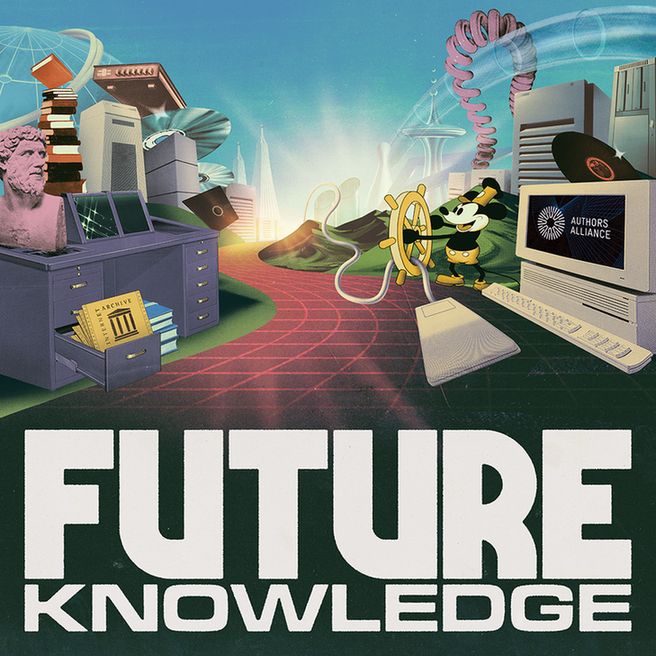
Illustration for the "Future Knowledge" podcast. A surreal, retro-futuristic landscape blends past and future elements: a bust of a Roman figure, stacks of books, file cabinets, satellites, DNA strands, skyscrapers, and futuristic buildings. A cartoon mouse steers a ship’s wheel connected to a giant computer mouse. An old desktop computer displays the Authors Alliance logo, and an open file drawer shows a yellow folder labeled Internet Archive. At the bottom, bold text reads: “FUTURE KNOWLEDGE.”
🚀 New podcast alert!
Introducing Future Knowledge—a podcast from the Internet Archive & Authors Alliance exploring how knowledge is created, shared & preserved in the digital age.
🎧 Listen and subscribe: futureknowledge.transistor.fm
#FutureKnowledge @archive.org @authorsalliance.bsky.social

“The group estimated that reducing the operating budget by $900 million, as the Trump administration wants to do, would require closing 350 of the 433 parks, monuments, historic sites and other locations overseen by the Park Service… we would be witnessing the dismantling of a century-old system”
02.06.2025 01:32 — 👍 944 🔁 606 💬 57 📌 127
Alison Gopnik stands before a slide explaining that multiple intelligences trade off in human development
@alisongopnik.bsky.social suggests that there is no such thing as general intelligence, natural or artificial. Instead, multiple intelligences trade off in salience throughout our life histories: As children, we explore. As adults, we exploit. As elders, we empower.
30.05.2025 02:47 — 👍 26 🔁 5 💬 0 📌 1
“The product will be capable of being fully aware of a user’s surroundings and life, will be unobtrusive, able to rest in one’s pocket or on one’s desk, and will be a third core device a person would put on a desk after a MacBook Pro and an iPhone.” 🫠
22.05.2025 09:41 — 👍 343 🔁 65 💬 211 📌 549
Giving political donors “dedicated VIP experiences” with the US military is not only corrupt, it will damagingly make Americans think of our military as partisan. Congress should prevent this.
16.05.2025 12:07 — 👍 1523 🔁 526 💬 93 📌 58
Digital criminals depicted in a 1978 issue of an Ann Arbor paper
13.05.2025 14:34 — 👍 2 🔁 0 💬 0 📌 0Science as Culture has a CFP for contributions to a forum on "Tech Oligarchy":
think.taylorandfrancis.com/special_issu...
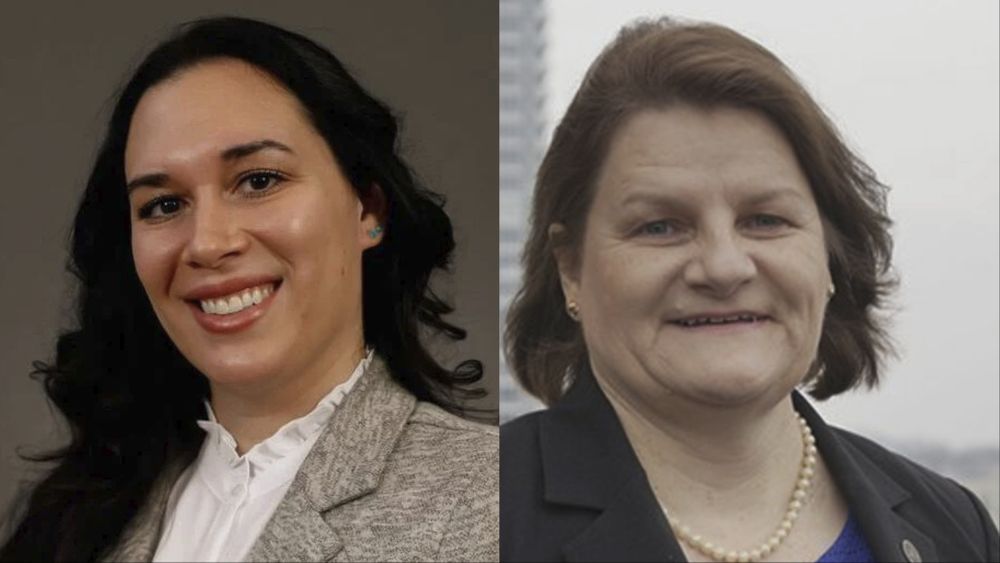
Monica Isham is the 1st woman & 1st minority to serve as a circuit court judge in Sawyer County.
In an email to all Wisconsin state judges she said: “If there is no support for us, l will refuse to hold court. If this costs me my job or gets me arrested, then at least I know I did the right thing.”
🚨
@safetyworkhstm.bsky.social

New at PB, Jacob Bruggeman (@jacobbruggeman.bsky.social) interviews historian Steven Conn about his new book “Lies of the Land” (@uchicagopress.bsky.social) which interrogates the myth of the rural in American politics and culture.
09.04.2025 16:12 — 👍 3 🔁 2 💬 0 📌 0This is high art
06.04.2025 21:37 — 👍 26501 🔁 7602 💬 533 📌 1018
More evidence that Trump 2.0/DOGE is setting the stage for unprecedented cyberattacks.
Or, as Bruce Schneier has quipped, this administration represents the most significant hack in the country’s history.
www.nytimes.com/2025/04/05/u...

A prominent computer scientist who has spent 20 years publishing academic papers on cryptography, privacy, and cybersecurity has gone incommunicado, had his professor profile removed by employer Indiana University, & had his homes raided by the FBI. No one knows why.
arstechnica.com/security/202...
My thoughts on the Signal business: "nobody wearing an American military uniform can doubt that if they took details of an ongoing operation off a classified system and transmitted them on an unclassified commercial platform, they would be court martialled and probably go to prison."
28.03.2025 21:18 — 👍 863 🔁 216 💬 22 📌 13
A 1980s computer surveillance cartoon to brighten up your morning...
27.03.2025 13:50 — 👍 0 🔁 0 💬 0 📌 0> Every day, about 100 terabytes of material are uploaded to the Internet Archive, or about a billion URLs, with the assistance of automated crawlers.
Woah.
Fascinating that government encryption expertise is at the center of the plot. Probably a hangover of the 1990s? Encryption has seemingly rarely made it into hacker representations in media since
21.03.2025 14:49 — 👍 0 🔁 0 💬 1 📌 0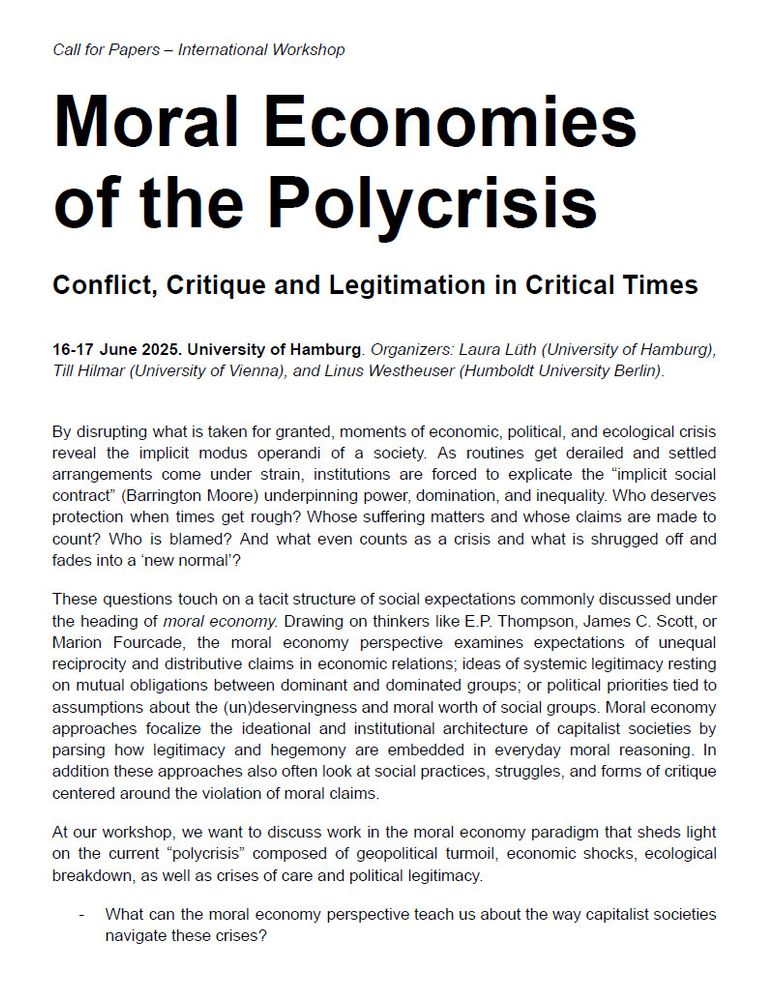
Moral Economies of the Polycrisis Conflict, Critique and Legitimation in Critical Times International Workshop. 16-17 June 2025. University of Hamburg. Organizers: Laura Lüth (University of Hamburg), Till Hilmar (University of Vienna), and Linus Westheuser (Humboldt University Berlin). By disrupting what is taken for granted, moments of economic, political, and ecological crisis reveal the implicit modus operandi of a society. As routines get derailed and settled arrangements come under strain, institutions are forced to explicate the “implicit social contract” (Barrington Moore) underpinning power, domination, and inequality. Who deserves protection when times get rough? Whose suffering matters and whose claims are made to count? Who is blamed? And what even counts as a crisis and what is shrugged off and fades into a ‘new normal’? These questions touch on a tacit structure of social expectations commonly discussed under the heading of moral economy. Drawing on thinkers like E.P. Thompson, James C. Scott, or Marion Fourcade, the moral economy perspective examines expectations of unequal reciprocity and distributive claims in economic relations; ideas of systemic legitimacy resting on mutual obligations between dominant and dominated groups; or political priorities tied to assumptions about the (un)deservingness and moral worth of social groups. Moral economy approaches focalize the ideational and institutional architecture of capitalist societies by parsing how legitimacy and hegemony are embedded in everyday moral reasoning. In addition these approaches also often look at social practices, struggles, and forms of critique centered around the violation of moral claims. At our workshop, we want to discuss work in the moral economy paradigm that sheds light on the current “polycrisis” composed of geopolitical turmoil, economic shocks, ecological breakdown, as well as crises of care and political legitimacy.

What can the moral economy perspective teach us about the way capitalist societies navigate these crises? To what extent do crises open up a space in which dominated groups can critique inequality and demand a renegotiation of the implicit social contract? How do demands and political responses informed by existing moral economies deepen inequality and domination? How do institutions like the welfare state or social and eco-social policies seek to mend rifts in the moral economy? What are moral background assumptions that make some developments (such as migration) but not others (such as poverty and extreme wealth) appear as crises? And what is the explanatory status of moral economy as a concept? For instance, are popular moral sentiments and subjective aspirations a driver of political and economic action, or are they merely a symptom of existing power relations? Is moral economy about agency or structure? And if both, how exactly? These are some of the questions we want to discuss with a group of international scholars. We invite papers taking a moral economy perspective to empirically research or theorize the current conjuncture. Papers can be at all stages of development, the event is meant to collaboratively discuss work in progress. We especially welcome submissions from doctoral and post-doctoral researchers. Limited funds are available to assist with travel and accommodation for those lacking institutional support. Please send an abstract of max. 500 words to: laura.lueth@uni-hamburg.de, till.hilmar@univie.ac.at and linus.westheuser@hu-berlin.de Deadline for abstract submissions: 7 April, 2025 The workshop is supported by the Economic Sociology Section of the German Sociological Association (DGS), the Research Unit Economic Sociology at the University of Hamburg, and the Research Unit Macrosociology at Humboldt University Berlin.
📢 CALL FOR PAPERS 📢
"Moral Economies of the Polycrisis. Conflict, Critique, and Legitimation in Critical Times"
Workshop, June 16-17
University of Hamburg
Deadline for abstracts: 07/04
Supported by the Economic Sociology section of @dgsoziologie.bsky.social
linuswestheuser.com/cfp-moral-ec...
Money quote:
17.03.2025 16:39 — 👍 17 🔁 4 💬 0 📌 0
Spotted in Midtown Atlanta
13.03.2025 21:52 — 👍 0 🔁 0 💬 0 📌 0
Absolutely perfect illustration of comparative advantage here: Japan builds the bullet train but Britain provides the bullshit design agency copy about it being inspired by cherry blossom www.designboom.com/technology/j...
10.03.2025 13:58 — 👍 59 🔁 8 💬 4 📌 0
Glad to be in TIME
explaining how DOGE draws on anti-bureaucracy and Clinton era New Economy thinking. It was a blast to write with my colleague and friend Casey Eilbert, & longer form work is coming soon. Thanks to @brianros1.bsky.social for edits!
time.com/7260722/atte...

white older man with grey hair, moustache, glasses, black shirt and black pants smiles at the camera while holding up a copy of Ted Nelson's Computer Lib/Dream Machines. he stands in front of a hallway, surrounded by an old iMac, stacks of software, early digital literature, and a handbuilt computer from eastern Europe in the mid-1980s
a tiny bit of reminiscing today: remembering when Alan Kay visited the @mediaarchaeology.bsky.social in 2019 and found our copy of Ted Nelson's Computer Lib/Dream Machines...big before-times energy
28.02.2025 19:53 — 👍 38 🔁 4 💬 1 📌 0Protestors lined up outside of a Tesla dealership on Route 35 in Eatontown NJ, a town sitting inside cherry red district 4, represented by congress’s longest serving Republican, Chris Smith
08.03.2025 21:59 — 👍 2784 🔁 482 💬 41 📌 26COLBERT, on Rep. Al Green’s removal:
“Some people questioned why so much muscle was needed to remove an old man with a cane. But it turns out it was for a serious reason. When security searched him, they found that he smuggled in a spine."
@latenightercom.bsky.social
Glad to be in TIME
explaining how DOGE draws on anti-bureaucracy and Clinton era New Economy thinking. It was a blast to write with my colleague and friend Casey Eilbert, & longer form work is coming soon. Thanks to @brianros1.bsky.social for edits!
time.com/7260722/atte...