Thank you, @markrubin.bsky.social, for sharing our paper!
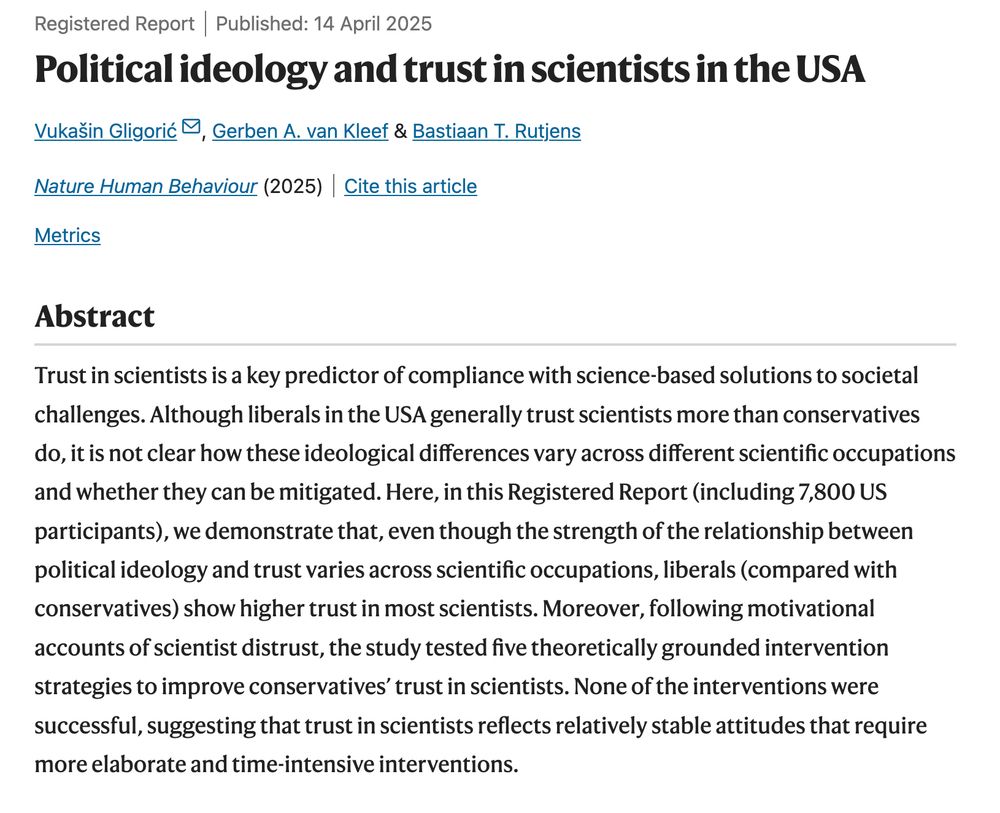
Others, please have a look at our paper where we discuss a bias in research of (dis)trust in science!
30.01.2026 18:40 — 👍 13 🔁 5 💬 1 📌 0

Screenshot of the OpenMoji project homepage. The text says OpenMoji 16.0.0 Open source emojis for designers, developers and everyone else! with a Search emoji box below and a lot of random emojis scattered on the page.
I don't think this science communication resource gets enough love.
OpenMoji offers 4,000+ free, #opensource emojis (CC BY-SA 4.0), with categories for healthcare, climate, UI...
Challenge: find Greta Thunberg and a Viennese coffee house. ☕
🔗 openmoji.org #SciComm #Design
18.11.2025 10:41 — 👍 44 🔁 20 💬 1 📌 2

Image of human face cutout looking toward cityscape silhouette, with "Psychology in Political and Economic Systems" written around the top.
Logo credit: Sondos Eatamadi
Thrilled & grateful to launch the Psychology In Political & Economic Systems (PIPES) Lab @NYUAbuDhabi:
tinyurl.com/4dw6h29r
We'll be looking at how phenomena at the societal level (from polarization to extreme inequality) reflect & shape psychological functioning. Stay tuned for research & events!
13.10.2025 14:36 — 👍 5 🔁 1 💬 0 📌 0
Over the next couple of years, I’ll be studying how political ideology, intergroup relations, and economic beliefs are shaped by broader societal structures like neoliberalism and neocolonialism.
Excited to see what’s ahead (and if Jennifer regrets her decision)!
09.10.2025 14:59 — 👍 1 🔁 0 💬 0 📌 0

✨Who says dreams can’t come true?✨
5 yrs ago, I emailed Jennifer Sheehy-Skeffington asking if she'd take me on as a PhD student. She rightly declined.
5yrs later, she is taking me on as a postdoc in Psychology in Political & Economic Systems (PIPES) lab at NYU Abu Dhabi (probably shouldn't have)!
09.10.2025 14:59 — 👍 6 🔁 0 💬 1 📌 0
Good question! Yes, that's basically what the graph shows though we got calculations estimated from the mixed model!
14.09.2025 12:47 — 👍 2 🔁 0 💬 0 📌 0
Yes Hakan, that's right!
14.09.2025 12:46 — 👍 1 🔁 0 💬 0 📌 0
✨On a personal note, this has been the most ambitious and rewarding project I’ve ever led (started in 2022 on the shores of Egypt). Even better, I carried it out with some of my closest and beloved people, and many new colleagues who became friends. Special thanks to Prof. John Jost for co-leading!
11.09.2025 13:49 — 👍 4 🔁 0 💬 0 📌 0

Sage Journals: Discover world-class research
Subscription and open access journals from Sage, the world's leading independent academic publisher.
💡Takeaway: global structural inequalities can override the usual ingroup favoritism. Sometimes nations admire powerful outsiders more than their own.
Full paper here 👉 journals.sagepub.com/doi/10.1177/...
11.09.2025 13:49 — 👍 3 🔁 0 💬 1 📌 0


🔎What did we find?
• Advantaged outgroups = seen as more competent, but less warm.
• Disadvantaged outgroups = less competent, no difference in warmth.
• In poorer & more exploited countries, outgroup favoritism on competence was strongest.
11.09.2025 13:49 — 👍 1 🔁 0 💬 2 📌 0
📊Our team of 76 researchers studied 12,339 participants across 45 non-Western countries.
We asked how people stereotype:
• their own nation
• a relatively advantaged outgroup (Western Europeans)
• a relatively disadvantaged outgroup (Western Africans)
11.09.2025 13:49 — 👍 3 🔁 0 💬 1 📌 0

🌍Do all nations believe they’re superior—or do some feel inferior?
Western social sciences claimed the first. But Fanon & Memmi argued colonization by the West left many in the Global South with colonial mentality—internalized oppression.
🧵Findings from our 45-country study:
11.09.2025 13:49 — 👍 22 🔁 11 💬 1 📌 1

This also marks the last empirical chapter of my PhD with great supervisors Gerben Van Kleef & Bastiaan Rutjens! 🎓
For those unable to access the paper behind the paywall, I uploaded the free preprint version (link should be working soon):
🔗 osf.io/v6pbg_v1
16.04.2025 12:08 — 👍 3 🔁 0 💬 0 📌 0
Speaking of systemic issues, with science cuts looming across the West (UK, US, NL), what can scientists do? Petitions/statements have their place, but can’t match the bargaining power of organized workers. Join a union, talk to colleagues, and organize to defend science 🚩
16.04.2025 12:08 — 👍 2 🔁 0 💬 1 📌 0
More broadly, we argue that low trust in scientists goes beyond political ideology. Neoliberal policies (privatization, commercialization) have damaged science. Corporations with vested interests (e.g., tobacco, climate change) and the "publish or perish" mentality don't help.🏢
16.04.2025 12:08 — 👍 1 🔁 0 💬 1 📌 0
Furthermore, we tested interventions to boost conservatives' trust in scientists (N = 7,800). Unfortunately, none worked. This raises concerns about the effectiveness of short, one-time interventions in increasing trust in science. 😕
16.04.2025 12:08 — 👍 2 🔁 0 💬 1 📌 0


In our registered report (two years in the making ⏳), we find that liberals trust scientists more, not just in fields like climate change, public health, & social sciences, but also in neuroscience, biology, & nuclear science.
16.04.2025 12:08 — 👍 1 🔁 0 💬 1 📌 0

Registration for symposium
Social Sciences and the System: Challenging or Upholding the Status Quo?
It is widely acknowledged that neoliberal capitalism has led to rampant socioeconomic inequalities, wars, and ecological crise...
To academics in Netherlands (and especially Amsterdam), we are organizing a symposium *Social sciences and the System: Challenging or Upholding the Status Quo* that includes John Jost, Enzo Rossi and Marija B. Petrović on 18th February in Amsterdam!
register here:
forms.gle/NSzoNxu2EKMf...
11.02.2025 11:34 — 👍 3 🔁 2 💬 0 📌 0
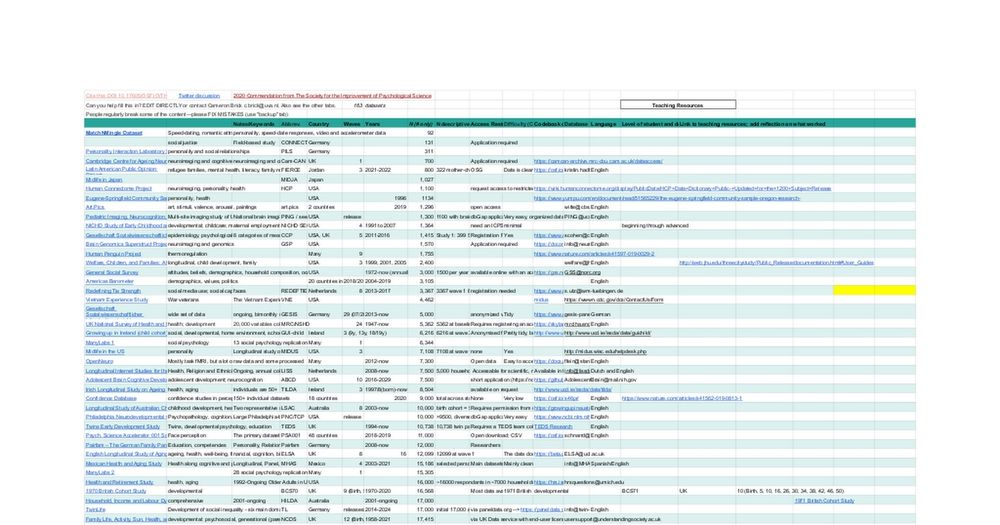
Psychological stimulus sets and datasets
Directory of free, open psychological datasets
docs.google.com/spreadsheets...
03.02.2025 09:53 — 👍 99 🔁 40 💬 3 📌 1
Thanks Samuel!
08.01.2025 18:15 — 👍 1 🔁 0 💬 0 📌 0
 08.01.2025 11:23 — 👍 0 🔁 1 💬 0 📌 0
We also measured behaviors - voodoo doll, petition signing and donation.
Started as a Master's student project and now we're here! Kudos to all the collaborators and supervisors on this one. Happy to say it's my fourth PhD project that is published 🎊
08.01.2025 11:23 — 👍 1 🔁 0 💬 0 📌 0
Across two studies (N=749), we investigated a number of predictors. We found that science cynicism (belief that scientists are incompetent and corrupt) drives harassment of scientists. Perceiving scientists as threatening and dark personality traits also play a role!👇🏼
www.nature.com/articles/s41...
08.01.2025 11:23 — 👍 0 🔁 0 💬 1 📌 0
In the past several years, and especially in the first few years of COVID-19, scientists have experienced harassment - from unwanted emails and doxxing to death threats and even lynching attempts. But who wants to harm scientists? Find out in our new paper just published in Scientific Reports! 🎉💥✨
08.01.2025 11:23 — 👍 6 🔁 8 💬 4 📌 0
So sing, thou psychological science! And celebrate your children's null results because your children are children no more
I have the right to shitpost because I have no followers (yet)
19.10.2023 17:46 — 👍 0 🔁 0 💬 0 📌 0
In that particular project, we found no experimental effects. Naive and puzzled, we didn't know what was going on. As we learned about the replication crisis, we always had a soft spot for replicating this project. Six years later, our dreams came true - we did a replication and found no effects.
19.10.2023 17:45 — 👍 0 🔁 0 💬 0 📌 0
Research fellow in social psychology at the University of Queensland. Climate Change | Aesthetics | Morality
Almost a psychologist, fully a RA & TA @ UTDT Neuroscience Lab 🇦🇷🧠
Exploring how moral cognition, group identity, and belief systems shape sociopolitical behavior, including intergroup dynamics and political polarization 👥
💜💚✊
assc prof of psychology at brooklyn college & psych & phil at cuny grad center; interested in moral psych—how people judge what is right and wrong, and what they do with those judgments; anagantman.com; https://anagantman.substack.com/p/introducing-psyop
Assistant Professor of psychology at Pace University’s Pleasantville campus.
Social psychologist with an interest in meta-science, methodology, political psychology, and whatever passing phenomenon happens to capture my interest.
🏳️🌈🏳️🌈🏳️🌈
Assistant Lecturer @ Massey University | System Justification | Polarization | Political Participation | Conspiratorial Beliefs
🇵🇦🇦🇲🇺🇸 in 🇳🇿
evanavaldes.carrd.co
🥑 Climate justice and food systems
📍 Amsterdam/Istanbul
BIAS Lab director studying prejudice, discrimination, dehumanization, speciesism, intergroup contact, generalized prejudice. Confirmed Boffin. #PrejudiceResearch #WhyWeLoveAndExploitAnimals (does not online-bicker).
Postdoctoral Researcher at Slovak Academy of Sciences studying intergroup relations, prejudice, and collective action
Author, teacher. Social, personality, political psychologist. Father, partner, mentor, & friend. Art, music, literature, movie, sports lover.
Social psychologist studying emotions: https://www.kamamutalab.org. Teaching at University of Oslo & European Master Global-MINDS. Dad to a rocket scientist. Born at 323 p.p.m.
Post-doctoral researcher at Karolinska Institute. I study social cognition and social learning using a mix of experiments, computational models and simulations.
Associate Professor, Psychology @cornelluniversity.bsky.social. Researching thinking & reasoning, misinformation, social media, AI, belief, metacognition, B.S., and various other keywords. 🇨🇦
https://gordonpennycook.com/
Assistant Professor of Psychology at Norfolk State University
Views expressed are my own & do not reflect those of my employer or the Commonwealth of Virginia.
trevorslies.com
phd student https://janpfander.github.io/
Psych PhD student in Vienna: self-control, effort, emotions, open science and meta-analysis
Private: boxing, walking and Stephen King
Postdoc
PhD Cognitive Neuroscience
PhD candidate @ UC Santa Barbara Comm | I study how people detect, perceive & respond to AI/algorithmic bias
https://www.hannahoverbye.com/
PhDid my PhD
Psychology - University of Belgrade
Psychologist | Metascience PhD @ Leibniz Institute for Psychology (ZPID) | Interested in Metascience, Political Ψ, Worldviews & Ideologies, Morality & Social Issues, Open Science, [...] Interspecies Communication, Canine Behavior. AllViewsMyOwn.