1/ Our new study, led by Jingwen Ding, examines the role of transcription factors during human neurogenesis to identify gene regulatory networks influencing cell fate, maturation, and subtype specification
www.nature.com/articles/s41...

@ryansohny.bsky.social
PostDoc @Stergachislab UW | Trying to become a scientist failing miserably for now
1/ Our new study, led by Jingwen Ding, examines the role of transcription factors during human neurogenesis to identify gene regulatory networks influencing cell fate, maturation, and subtype specification
www.nature.com/articles/s41...

Ribosomal RNA (rRNA) genes are found in hundreds of copies in the human genome.
Do sequence variations in these paralogs change the ribosome function? Yes!
I am excited to share our new preprint @mbarnalab @jkpritch in collaboration with Calico:
www.medrxiv.org/content/10.1...
1/8

A table showing profit margins of major publishers. A snippet of text related to this table is below. 1. The four-fold drain 1.1 Money Currently, academic publishing is dominated by profit-oriented, multinational companies for whom scientific knowledge is a commodity to be sold back to the academic community who created it. The dominant four are Elsevier, Springer Nature, Wiley and Taylor & Francis, which collectively generated over US$7.1 billion in revenue from journal publishing in 2024 alone, and over US$12 billion in profits between 2019 and 2024 (Table 1A). Their profit margins have always been over 30% in the last five years, and for the largest publisher (Elsevier) always over 37%. Against many comparators, across many sectors, scientific publishing is one of the most consistently profitable industries (Table S1). These financial arrangements make a substantial difference to science budgets. In 2024, 46% of Elsevier revenues and 53% of Taylor & Francis revenues were generated in North America, meaning that North American researchers were charged over US$2.27 billion by just two for-profit publishers. The Canadian research councils and the US National Science Foundation were allocated US$9.3 billion in that year.

A figure detailing the drain on researcher time. 1. The four-fold drain 1.2 Time The number of papers published each year is growing faster than the scientific workforce, with the number of papers per researcher almost doubling between 1996 and 2022 (Figure 1A). This reflects the fact that publishers’ commercial desire to publish (sell) more material has aligned well with the competitive prestige culture in which publications help secure jobs, grants, promotions, and awards. To the extent that this growth is driven by a pressure for profit, rather than scholarly imperatives, it distorts the way researchers spend their time. The publishing system depends on unpaid reviewer labour, estimated to be over 130 million unpaid hours annually in 2020 alone (9). Researchers have complained about the demands of peer-review for decades, but the scale of the problem is now worse, with editors reporting widespread difficulties recruiting reviewers. The growth in publications involves not only the authors’ time, but that of academic editors and reviewers who are dealing with so many review demands. Even more seriously, the imperative to produce ever more articles reshapes the nature of scientific inquiry. Evidence across multiple fields shows that more papers result in ‘ossification’, not new ideas (10). It may seem paradoxical that more papers can slow progress until one considers how it affects researchers’ time. While rewards remain tied to volume, prestige, and impact of publications, researchers will be nudged away from riskier, local, interdisciplinary, and long-term work. The result is a treadmill of constant activity with limited progress whereas core scholarly practices – such as reading, reflecting and engaging with others’ contributions – is de-prioritized. What looks like productivity often masks intellectual exhaustion built on a demoralizing, narrowing scientific vision.

A table of profit margins across industries. The section of text related to this table is below: 1. The four-fold drain 1.1 Money Currently, academic publishing is dominated by profit-oriented, multinational companies for whom scientific knowledge is a commodity to be sold back to the academic community who created it. The dominant four are Elsevier, Springer Nature, Wiley and Taylor & Francis, which collectively generated over US$7.1 billion in revenue from journal publishing in 2024 alone, and over US$12 billion in profits between 2019 and 2024 (Table 1A). Their profit margins have always been over 30% in the last five years, and for the largest publisher (Elsevier) always over 37%. Against many comparators, across many sectors, scientific publishing is one of the most consistently profitable industries (Table S1). These financial arrangements make a substantial difference to science budgets. In 2024, 46% of Elsevier revenues and 53% of Taylor & Francis revenues were generated in North America, meaning that North American researchers were charged over US$2.27 billion by just two for-profit publishers. The Canadian research councils and the US National Science Foundation were allocated US$9.3 billion in that year.

The costs of inaction are plain: wasted public funds, lost researcher time, compromised scientific integrity and eroded public trust. Today, the system rewards commercial publishers first, and science second. Without bold action from the funders we risk continuing to pour resources into a system that prioritizes profit over the advancement of scientific knowledge.
We wrote the Strain on scientific publishing to highlight the problems of time & trust. With a fantastic group of co-authors, we present The Drain of Scientific Publishing:
a 🧵 1/n
Drain: arxiv.org/abs/2511.04820
Strain: direct.mit.edu/qss/article/...
Oligopoly: direct.mit.edu/qss/article/...

A response to all the people who say "if your results depend on your random seed you have bigger problems."
blog.genesmindsmachines.com/p/random-see...
Delighted to announce that our consortium-wide paper demonstrating identification of cancer somatic genome alterations & epigenetic aberrations across traditionally intractable genomic regions (i.e., centromeres & telomeres) by leveraging personalized diploid genome assemblies is now up on bioRxiv.
14.10.2025 01:52 — 👍 0 🔁 0 💬 0 📌 0A telomere-to-telomere map of somatic mutation burden and functional impact in cancer https://www.biorxiv.org/content/10.1101/2025.10.10.681725v1
13.10.2025 23:33 — 👍 8 🔁 5 💬 0 📌 1
Delighted to finally announce a preprint describing the Q100 project! “A complete diploid human genome benchmark for personalized genomics” For which we finished HG002 to near-perfect accuracy: www.biorxiv.org/content/10.1... 🧵[1/14]
22.09.2025 17:01 — 👍 97 🔁 57 💬 4 📌 4My "Math, Revealed" series is freely available to anyone -- no paywall! -- in the thread below.
04.07.2025 00:07 — 👍 137 🔁 53 💬 6 📌 5
This upcoming #WorldEnvironmentDay, we’re highlighting how SMaHT is advancing science in ways that support both human health and sustainability.
By deepening our understanding of somatic mosaicism, SMaHT is helping to drive more precise diagnoses and support a more efficient healthcare system. 🌱🌍
Now published in PNAS: www.pnas.org/doi/10.1073/...
23.05.2025 18:39 — 👍 97 🔁 40 💬 1 📌 0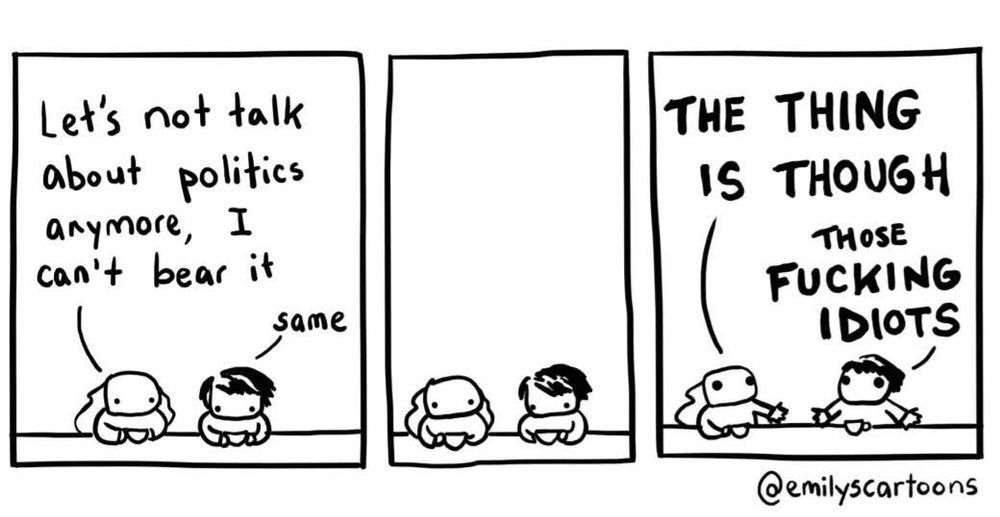
Apologies for getting a bit political on main tonight.
I think this cartoon sums it up.

I freakin love what Liz has been doing.
18.01.2025 01:58 — 👍 0 🔁 0 💬 0 📌 0
Not over yet and long way to go until we set this straight.
amp.cnn.com/cnn/2024/12/...
I am so sorry for what you are going through Nancy. My prayers are with you and your family.
23.12.2024 23:57 — 👍 0 🔁 0 💬 1 📌 0📌
21.12.2024 00:21 — 👍 1 🔁 0 💬 0 📌 0Awesome! I feel like there are so many amazing rust-based command-line tools that make life so much easier. I've started replacing tools I used to use with rust-based alternatives (e.g, grep -> rg).
20.12.2024 19:05 — 👍 0 🔁 0 💬 0 📌 0While I appreciate bat for its code viewing capabilities, I find it frustrating when I use it to view binary file which bat doesn’t support. Not to mention the syntax highlighting is lost when piping (gzip -cd foo.bed.gz | bat). But overall bat is so badass I don’t use less anymore
20.12.2024 18:11 — 👍 0 🔁 0 💬 1 📌 0📌
17.12.2024 05:36 — 👍 0 🔁 0 💬 0 📌 0
To Democracy
Here’s to democracy and to resilience.
14.12.2024 08:30 — 👍 0 🔁 0 💬 1 📌 0The president of South Korea has just been impeached.
14.12.2024 08:10 — 👍 0 🔁 0 💬 1 📌 0
Just a little reminder that the South Korean president who just declared martial law was elected two years ago on a wave of anti-feminist backlash. Misogyny is routinely part of the authoritarian package.
www.bbc.com/news/world-a...

Deaminase-assisted single-molecule and single-cell chromatin fiber sequencing https://www.biorxiv.org/content/10.1101/2024.11.06.622310v1
07.11.2024 08:36 — 👍 1 🔁 1 💬 0 📌 0