I still get chills
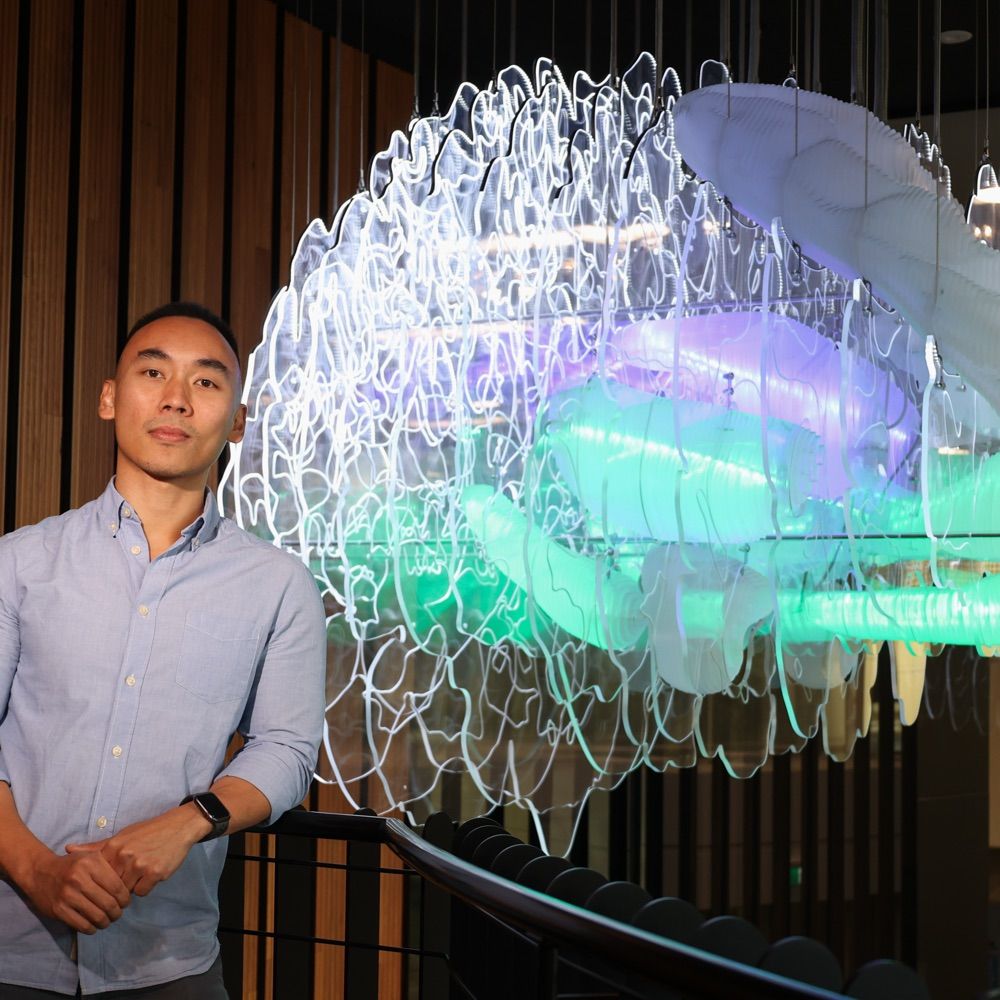
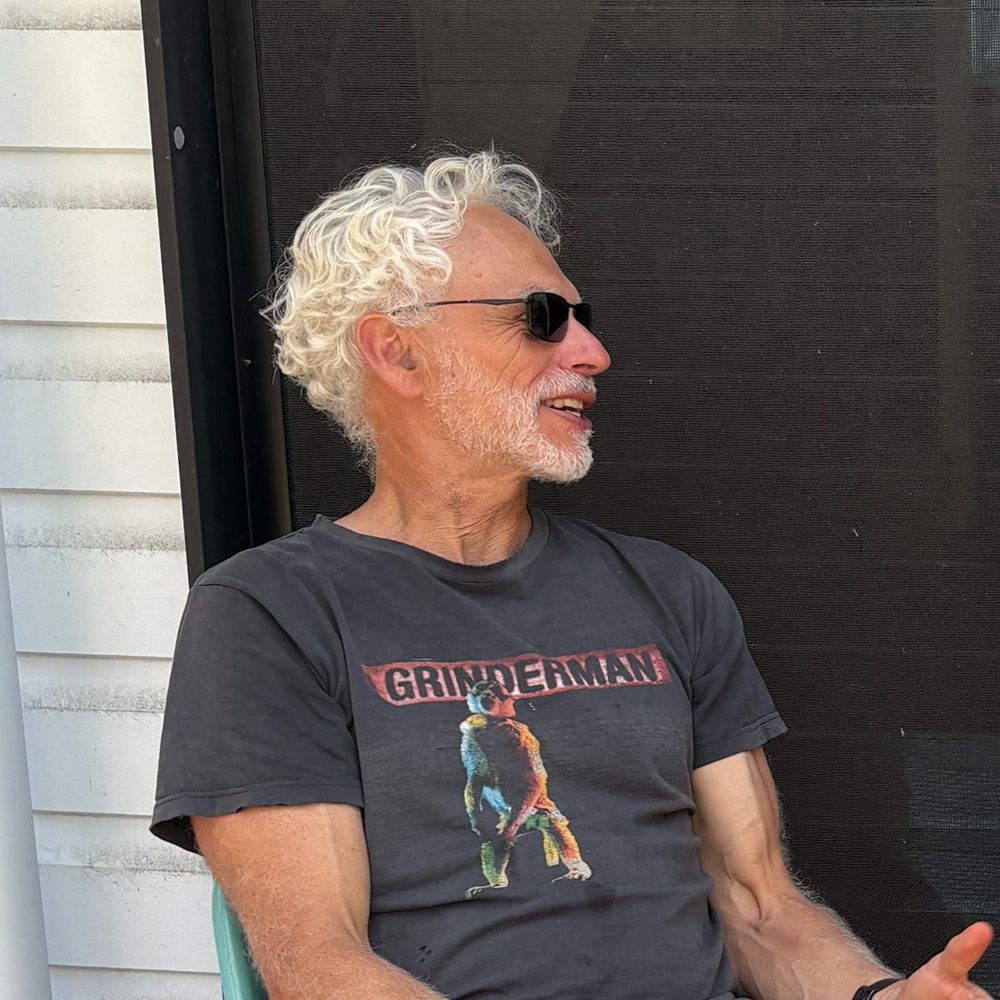
Meet Mike
*30+ years severe depression
*first hospitalized @ 13y
*20 meds
*3 rounds of ECT
*2 near-fatal suicide attempts
Mike felt joy for the first time in decades after we turned on his new brain pacemaker or PACE
see videos, read paper, follow thread
doi.org/10.31234/osf...
10.08.2025 18:22 — 👍 390 🔁 136 💬 17 📌 34
Big thanks to our team led by @zaixucui.bsky.social, with Guowei Wu, Yaoxin Li, @xiaoyuxuu.bsky.social, @jing-cong.bsky.social, Haoshu Xu, Yiyao Ma, Yang Li, @runsenchen.bsky.social, @pineurosci.bsky.social, @tingsterx.bsky.social, @valeriejsydnor.bsky.social, and @ted-satterthwaite.bsky.social.
20.03.2025 13:29 — 👍 2 🔁 0 💬 0 📌 0
In summary, we identified a stable and reproducible connectional axis of edge-level FC variability, which aligns with structural connectivity variability, evolves with development, and is associated with higher-order cognition /end.
20.03.2025 13:29 — 👍 0 🔁 0 💬 1 📌 0
Furthermore, our results remained robust across variations in data preprocessing methods, atlas selection, and analytical parameters 10/n.
20.03.2025 13:29 — 👍 2 🔁 0 💬 1 📌 0

Our findings were consistent across both the HCP-D and HCP-YA datasets. Additionally, we replicated these results in an independent youth cohort collected by our lab over the past two years, further demonstrating the robustness and generalizability of our findings 9/n.
20.03.2025 13:29 — 👍 0 🔁 0 💬 1 📌 0
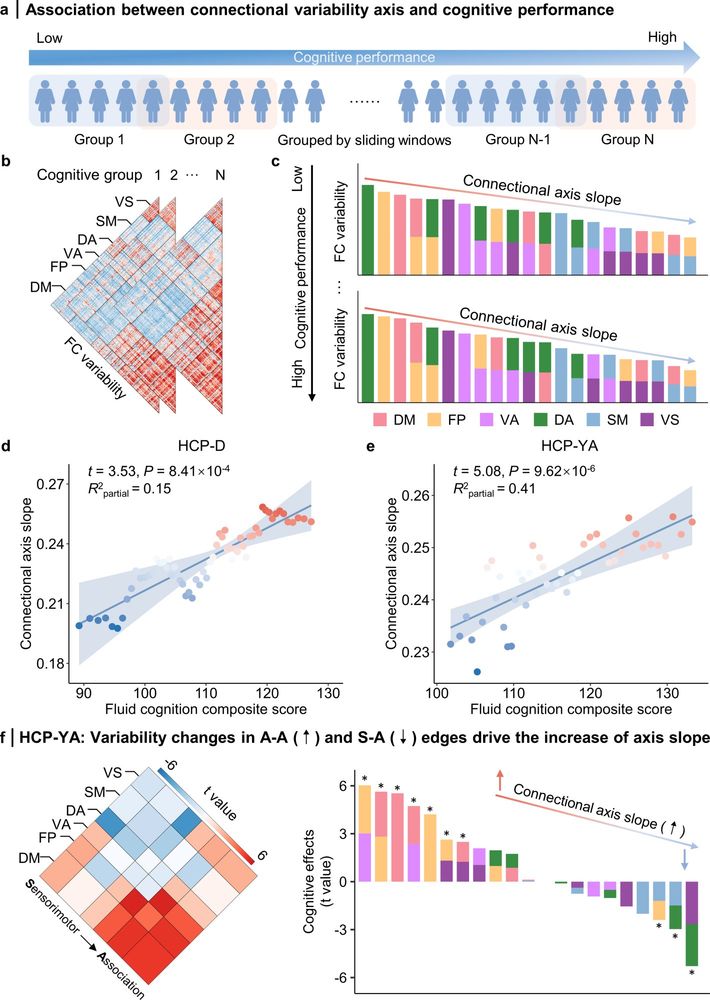
We found that the connectional variability axis slope positively correlated with higher-order cognitive performance, controlling for age. This effect was driven by greater individual variability in association connections among higher-cognitive individuals 8/n.
20.03.2025 13:29 — 👍 0 🔁 0 💬 1 📌 0

To assess the development of the FC variability axis, we calculated its slope. During youth, the variability axis slope declines with age, primarily driven by reduced FC variability in connections between association networks 7/n.
20.03.2025 13:29 — 👍 0 🔁 0 💬 1 📌 0
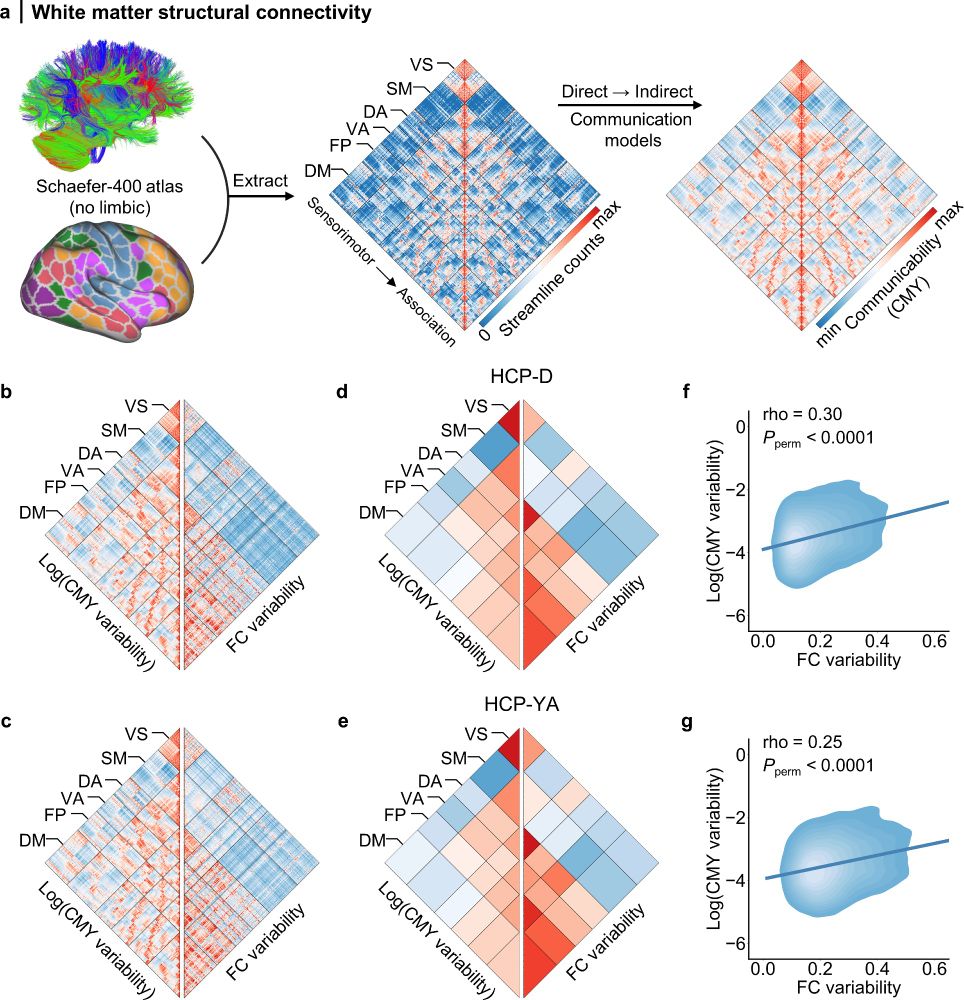
Using diffusion MRI to construct individual structural connectomes, we find that the connectional axis of FC variability aligns with the spatial pattern of individual variability in structural communicability across edges, suggesting a potential structural basis 6/n.
20.03.2025 13:29 — 👍 0 🔁 0 💬 1 📌 0
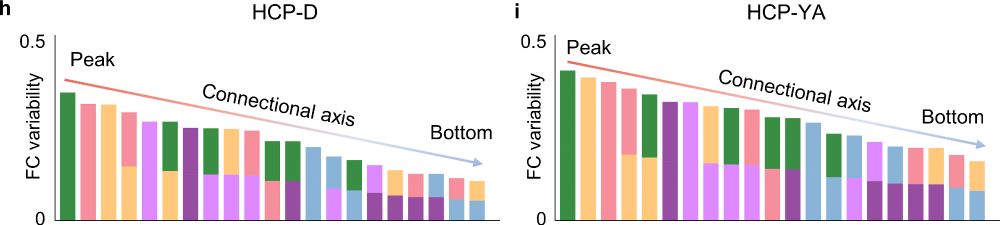
Next, we ranked FC variability across all 21 within- and between-network connections to define the “connectional variability axis.” Association-association (A-A) connections occupy the top of the axis, while sensorimotor-association (S-A) connections anchor the base 5/n.
20.03.2025 13:29 — 👍 0 🔁 0 💬 1 📌 0

Ranking FC variability within and between networks revealed an axis of decreasing variability from within-network to between-network edges. For example, in the DMN, variability declines from edges linking association areas to those connecting with sensorimotor regions 4/n.
20.03.2025 13:29 — 👍 0 🔁 0 💬 1 📌 0

We analyzed edge-level FC variability and summarized within- and between-network averages using the Yeo atlas. FC variability was heterogeneously distributed across connectome edges and consistent between datasets 3/n.
20.03.2025 13:29 — 👍 0 🔁 0 💬 1 📌 0
Understanding the spatial variation of individual FC variability across human connectome edges offers insights into connections most susceptible to plasticity, influenced by insults and interventions, aiding the development of connectivity-guided interventions 2/n.
20.03.2025 13:29 — 👍 0 🔁 0 💬 1 📌 0

Regional FC variability is heterogeneously distributed across the cortex, decreasing progressively from higher-order association to primary sensorimotor cortices (Mueller et al., 2013, Neuron). However, edge-level details remain unclear 1/n.
20.03.2025 13:29 — 👍 0 🔁 0 💬 1 📌 0
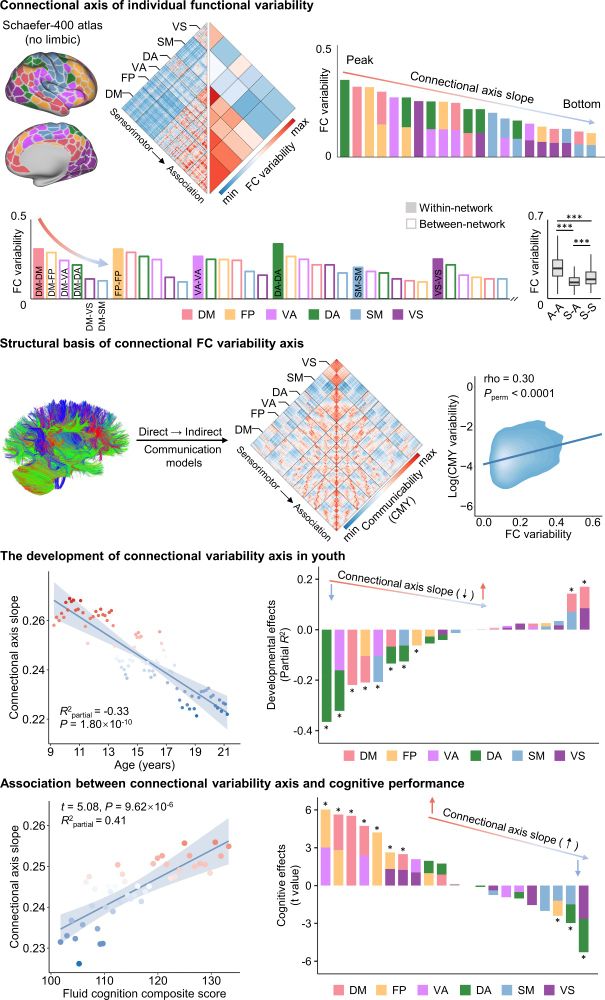
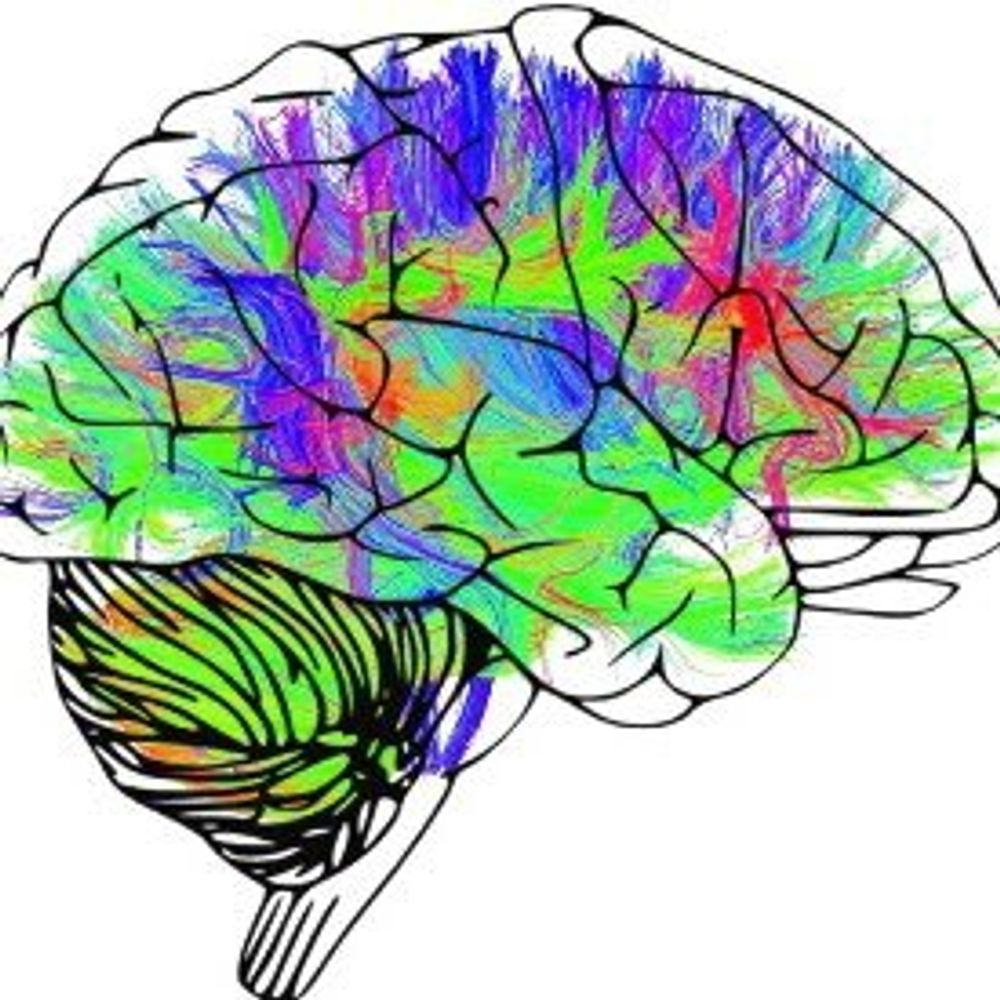
Excited to share our work “Connectional axis of individual functional variability: Patterns, structural correlates, and relevance for development and cognition,” now out at @pnas.org www.pnas.org/doi/10.1073/....
20.03.2025 13:29 — 👍 12 🔁 3 💬 1 📌 2
👍👍👍
15.01.2025 06:01 — 👍 1 🔁 0 💬 0 📌 0
Structural and genetic determinants of zebrafish functional brain networks https://www.biorxiv.org/content/10.1101/2024.12.20.629476v1
21.12.2024 01:20 — 👍 5 🔁 4 💬 0 📌 1
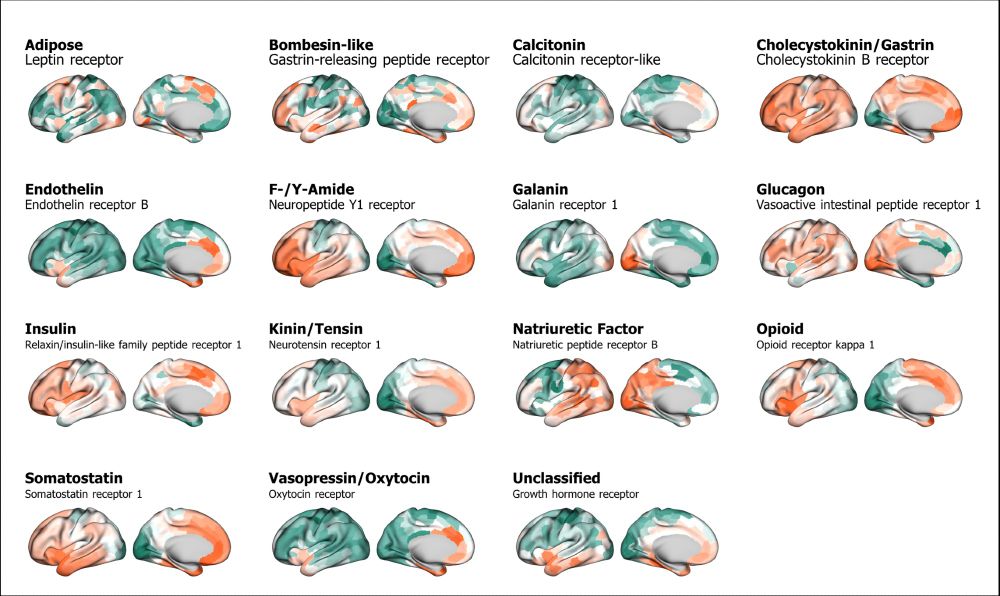
Mapping neuropeptide signaling in the human brain | doi.org/10.1101/2024...
Neuropeptides are among the functionally diverse signaling molecules in the brain and body.
@cebric.bsky.social curates an atlas of neuropeptide receptors and relates it brain function 🧩 🧠 ⤵️
19.12.2024 14:16 — 👍 90 🔁 39 💬 3 📌 2

OHBM has confirmed that Dec 17 is a hard deadline for abstracts.
12.12.2024 22:54 — 👍 26 🔁 16 💬 0 📌 4

New paper in Imaging Neuroscience by Peiyu Chen, Zaixu Cui, et al:
Group-common and individual-specific effects of structure–function coupling in human brain networks with graph neural networks
doi.org/10.1162/imag...
06.12.2024 05:47 — 👍 16 🔁 6 💬 0 📌 0
Excited to share our latest work, 'Group-common and Individual-specific Effects of Structure-Function Coupling in Human Brain Networks Using Graph Neural Networks,' now published in Imaging Neuroscience @imagingneurosci.bsky.social
26.11.2024 09:30 — 👍 8 🔁 2 💬 0 📌 1
Postdoc @ Harvard (Buckner Lab)
cognitive neuroscience, precision functional mapping
https://jingnandu93.github.io/
PhD candidate in MCIN Lab @Neuro_MNI @Douglas @McGill | My 🧩 in Neurodevelopment🧠/ Mental Health🧑⚕️/ Machine Learning🤖 | Exploring Postdoctoral Opportunities
Assistant Professor of Radiology at Washington University in St. Louis. Neuroscientist studying human brain organization with fMRI, functional connectivity, and DTI.
https://sites.wustl.edu/evangordon/
NHMRC Emerging Leadership Fellow at the School of Psychological Sciences, Monash University
Physicist/neuroscientist working on neuroimaging and computational models in human and non-human species
Brain imaging research, Oxford
EiC, Imaging Neuroscience https://bsky.app/profile/imagingneurosci.bsky.social
Michael Breakspear
Neuroscientist, Psychiatrist, Physicist.
https://www.systemsneurosciencegroup.com/
Multiscale Neuroscience
Prof @ Montreal Neurological Institute
work: http://mica-mni.mcgill.ca
pixels: @borismontreal
waves: https://soundcloud.com/heschls
The funder-researcher collaboration and open-access publisher for research in the life and biomedical sciences.
Follow @eLifeCommunity.bsky.social
Assistant Prof. at USC Prior Penn/CHOP, Max Planck Institute, Pitts; Neuroimaging Genetics; Developmental disorders; Posting papers and faculty jobs
https://shazhiqiang.wixsite.com/sha-lab
https://scholar.google.com/citations?user=02KznREAAAAJ&hl=en&oi=ao
🇦🇺
Assistant Professor of Psychiatry.
Network neuroscience, NeuroAI, multimodal MRI, precision psychiatry.
parkeslab.com
Redleaf Endowed Director, Masonic Institute for the Developing Brain (MIDB)
Professor, University of Minnesota
Co-Founder Turing Medical
MacArthur Fellow
Neuroscience, Brain Imaging, Mental Health, Data Science
The Organization for Human Brain Mapping (OHBM) is an international society dedicated to advancing the understanding of the anatomical and functional organization of the human brain using neuroimaging.
Laboratory of Neurocognitive Development under the mentorship of Dr. Beatriz Luna | University of Pittsburgh
Ph.D. candidate at State Key Laboratory of Cognitive Neuroscience and Learning, BNU.
NeuroImage, Connection,Parcellation
PhD candidate @MICA Lab (https://mica-mni.github.io/index.html) @McGill University @Montreal Neurological Institute
epilepsy | neuroimaging | connectomics
Montreal Neurological Institute - McGill University
https://netneurolab.github.io/