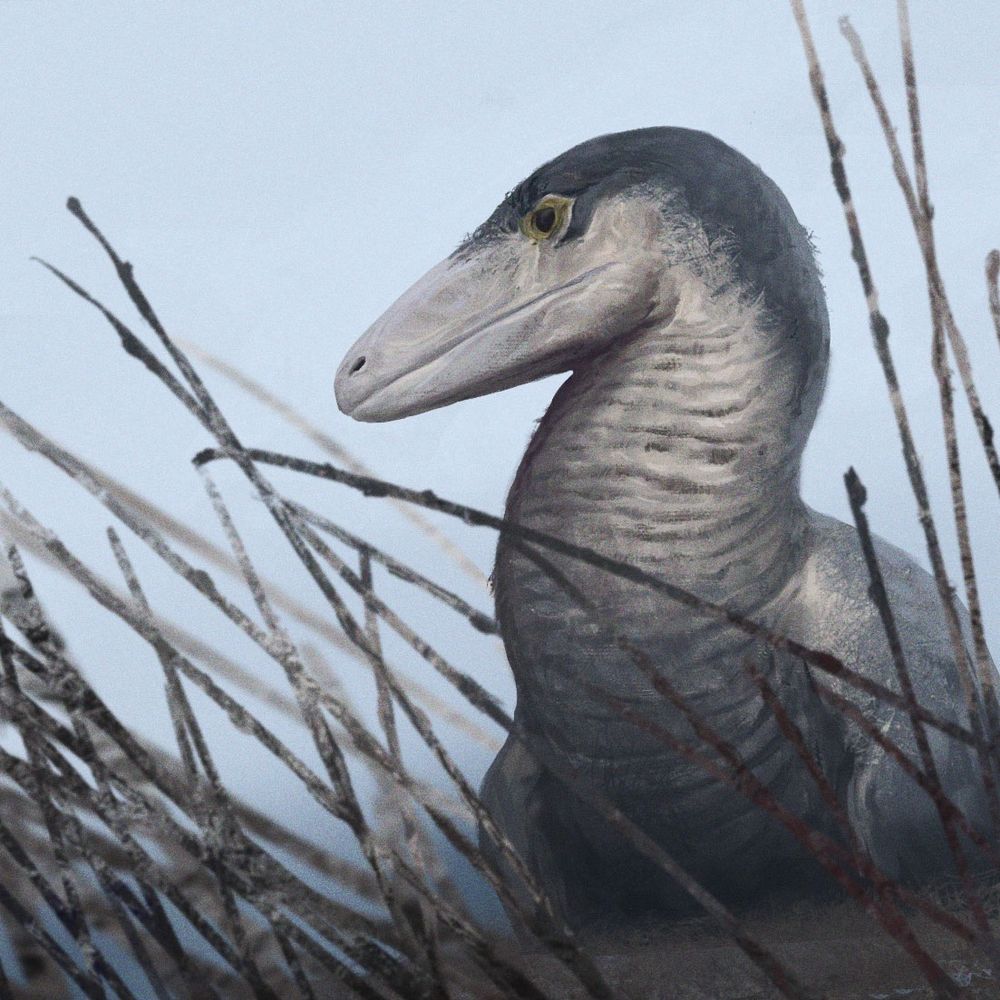
Amazing job, congratulations for bringing this specimen back to life ! I love the idea of the floating crinoids with the light that shines through them 😍
04.08.2025 19:18 — 👍 1 🔁 0 💬 0 📌 0
Honoured to receive the 2024 Robert May prize !! 😊 🎉 Many thanks to the @britishecologicalsociety.org
& @methodsinecoevol.bsky.social
18.04.2025 03:14 — 👍 26 🔁 11 💬 3 📌 2
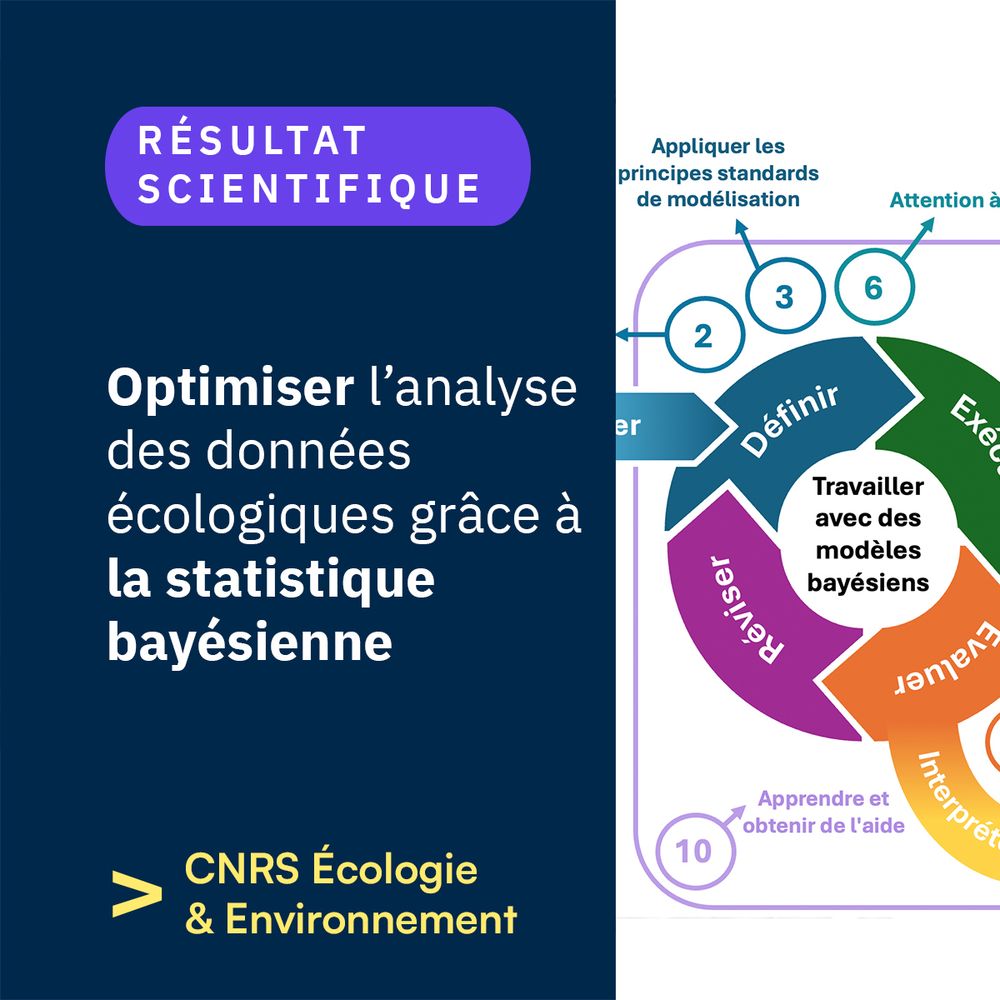
#RésultatScientifique🔎
Une équipe internationale publie 10 conseils pratiques pour aider les écologues à s’approprier la statistique bayésienne, outil clé en modélisation, conservation et évaluation des impacts humains sur les écosystèmes.
➡️ www.inee.cnrs.fr/fr/cnrsinfo/...
15.04.2025 15:07 — 👍 20 🔁 10 💬 0 📌 0

Variations da la probabilité de survie lors de 3 périodes (1995-2013 ; 2014-2018 ; 2019-2024). Les barres représentent les bornes hautes et basses de l’intervalle de confiance à 95%, et la barre horizontale noire, les estimations moyennes. Le seuil de tolérance moyen est de 34% de mortalité (soit 66% de survie) est donné (pointille rouge) avec son intervalle de confiance (en grisé ; Marescot et al. 2012). Des taux des survies en dessous de cet intervalle présentent donc un risque important de générer des taux de croissance négatifs de la population (selon Marescot et al. 2012). Les taux de survie sont présentés après avoir pris en compte l’effet transient sur la survie (Pradel et al. 1997).

Tendance démographique de la population de loups en France estimée par modèles de capture recapture et à partir du suivi génétique non-invasif. Les barres représentent les estimations basses et hautes des intervalles de confiance à 95% des effectifs chaque hiver depuis 1995/96. La valeur moyenne des estimations est représentée par une barre horizontale blanche. Les valeurs utilisées dans cette figure sont disponibles dans le Tableau S1.
🐺📈 Avec @milleretcyril.bsky.social et Christophe Duchamp, nous venons de mettre à jour les estimations de survie et effectifs de la population de loups en France pour l'hiver 2023/2024, tout est là hal.science/hal-05016361v1
@ofbiodiversite.bsky.social @cnrsecologie.bsky.social
16.04.2025 04:14 — 👍 9 🔁 3 💬 1 📌 0

“Our review provides a framework to better understand & predict animal movements & distributions in human-modified environments. Exciting opportunities now available to advance the movement ecology field into a more predictive science..” 🦁 buff.ly/uB9RyET
15.04.2025 14:00 — 👍 13 🔁 7 💬 0 📌 1

Le Faucon crécerellette est l'un des rapaces les plus rares de France. Il a fait l'objet d'un programme de réintroduction dans l'Aude et des individus en provenance d'Espagne ont permis de renforcer la population nicheuse.
1/7
07.04.2025 15:50 — 👍 90 🔁 20 💬 2 📌 0

Mechanisms underlying the loss of migratory behaviour in a long‐lived bird
White stork populations in Iberia are undergoing a profound change in their migratory patterns, becoming mostly resident. By combining census data, GPS-tracking and genomic analyses, Andrade et al. l....
In the 1990s, >80% of Portuguese white storks were winter migrants. Thirty years on, a drastic shift in behavior means most individuals are now residents.
Our new paper @animalecology.bsky.social combines census data, GPS tracking, and genomics to understand the loss of migratory behavior in birds:
03.04.2025 09:21 — 👍 19 🔁 6 💬 1 📌 1
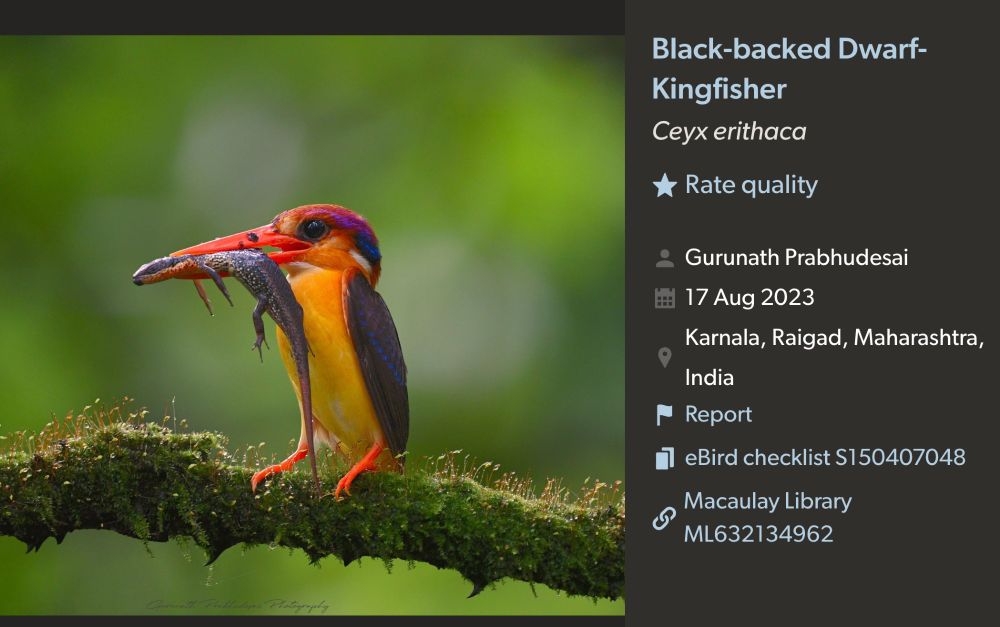
Picture of a dwarf kingfisher eating a lizard, showing how images uploaded to eBird can provide important dietary information.
A call to arms for eBirders and iNaturalists. 🚨
We want your bird photos! If you photograph feeding birds with flowers, fruit, seeds or prey, upload the image with locality details. We are data-harvesting species, size and type of food/prey to study foodwebs and species interactions. Thanks! 🧪🌐🪶
18.03.2025 12:51 — 👍 86 🔁 48 💬 3 📌 3
The Ecology & Behaviour annual conference is organised BY and FOR young researchers. In 2025 it comes back to Montpellier @ the Center for Functional & Evolutionary Ecology.
Highly recommended to PhD students & postdocs - come to share your science, make new friends & meet your future collaborators!
18.12.2024 15:51 — 👍 30 🔁 12 💬 2 📌 0
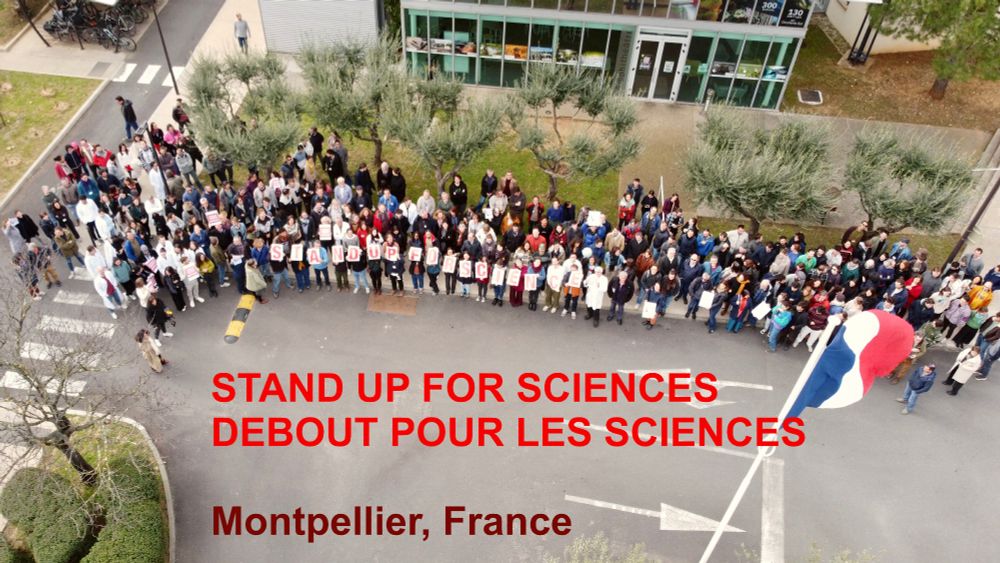
#StandUpForScience Montpellier, France @standupforscifr.bsky.social @standupforscience.bsky.social
07.03.2025 13:22 — 👍 131 🔁 34 💬 2 📌 4
Check out the way this Long-eared Owl changes the shape of its facial disk when it hears a rodent below it:
06.03.2025 03:39 — 👍 605 🔁 200 💬 11 📌 23
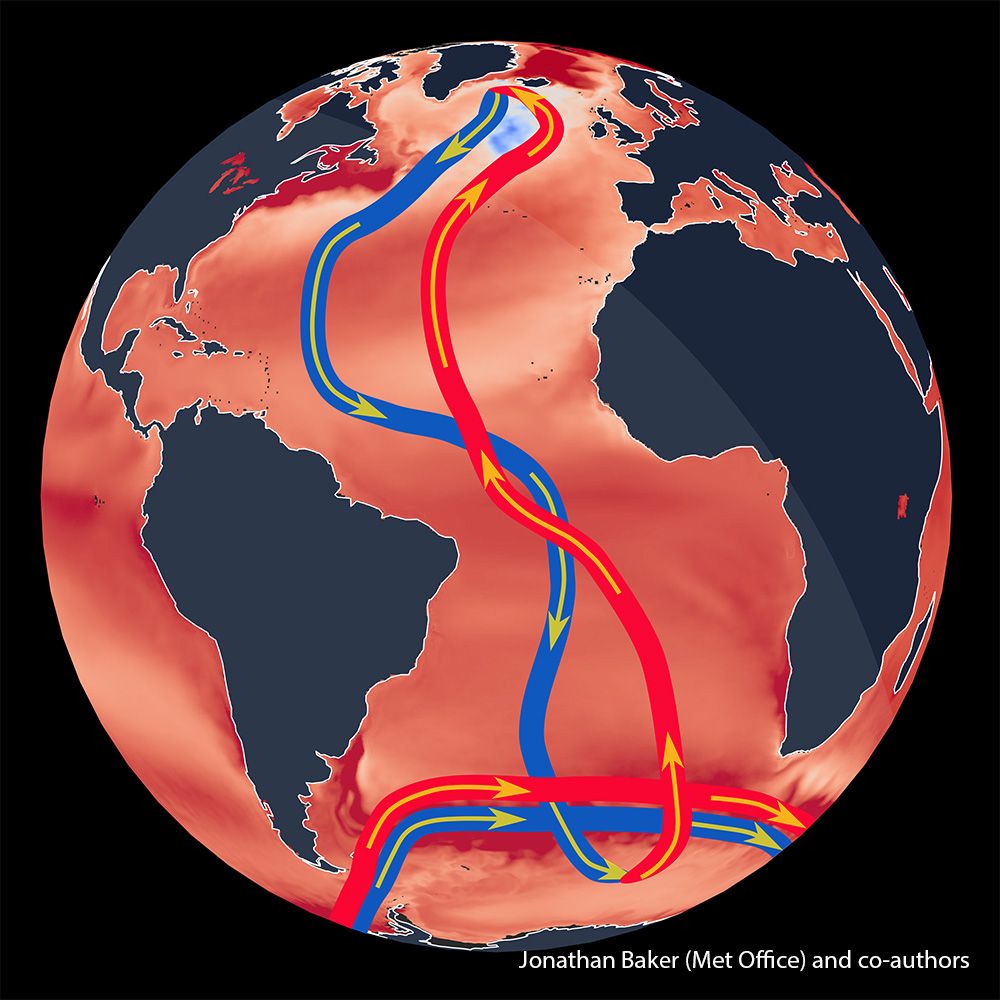
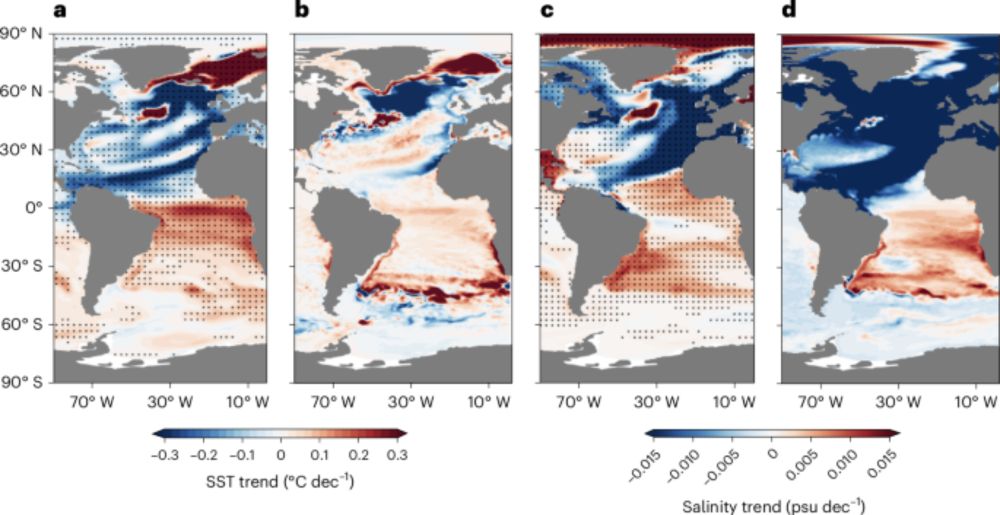
Caption: Even under extreme climate change, the Southern Ocean sustains a weakened but resilient Atlantic overturning circulation (AMOC), a vital component of Earth's climate system.
Credit: Jonathan Baker (Met Office) and co-authors
A study in Nature suggests that the Atlantic Meridional Overturning Circulation (AMOC) may be able to withstand future global warming and could avoid collapse. This important ocean current has a role in regulating temperatures around the planet. https://go.nature.com/4blFMKA 🧪
06.03.2025 02:42 — 👍 88 🔁 23 💬 3 📌 4
Very cool PhD project available in our group!
12.02.2025 16:52 — 👍 6 🔁 2 💬 0 📌 0
An integrative framework to combine migratory connectivity and demographic data
Migratory species experience various conditions and events throughout their annual cycle that influence their spatial and demographic dynamics. To understand these dynamics, it is essential to des...
2nd chapter of my PhD just published in @methodsinecoevol.bsky.social
doi.org/10.1111/2041...
Another step towards linking animal migration and population dynamics using integrated modelling! The secret lies in a neat equation relating survival and transition probabilities between migratory regions
04.02.2025 18:42 — 👍 34 🔁 10 💬 1 📌 1

⚠️A new study published by BirdLife Greece delivers a stark warning: climate change is rapidly making the treacherous journey of migratory birds even more deadly.
Read more: www.birdlife.org/news/2025/02...
07.02.2025 10:39 — 👍 32 🔁 10 💬 0 📌 0

This is figure 1, which presents photographs of concretion bearing the new V. iaai skull (AMNH FARB 30899).
A new, nearly complete fossil skull of Vegavis from Antarctic provides insight into its feeding ecology and exhibits morphologies that support placement among waterfowl within crown-group birds, according to a paper in Nature. https://go.nature.com/3Q7T0AO #Paleosky 🧪
06.02.2025 14:04 — 👍 19 🔁 2 💬 0 📌 1

Rising Temperatures Advance Start and End of the Breeding Season of an Alpine Bird | doi.org/10.1002/ece3... | Ecology and Evolution | #ornithology 🪶
04.02.2025 09:27 — 👍 30 🔁 8 💬 0 📌 1

Using informative priors to account for identifiability issues in occupancy models with identification errors
Monchy, Célian1 ; Etienne, Marie-Pierre2 ; Gimenez, Olivier1 1 CEFE, Univ Montpellier, CNRS, EPHE, IRD, Montpellier, France 2 IRMAR - Institut de Recherche Mathématique de Rennes, Rennes, France
Now published in Peer Community Journal, #Ecology section: Using informative priors to account for identifiability issues in occupancy models with identification errors
20.01.2025 12:12 — 👍 7 🔁 3 💬 0 📌 0

[📝Publication] Comprendre les déplacements des animaux dans des paysages fragmentés 🐾
Des lynx aux loutres, la modélisation peut guider les décisions de conservation. bit.ly/4akSsk1
#Cesab #Discar
@umontpellier.bsky.social @cnrs.bsky.social @maeliskervellec.bsky.social @oaggimenez.bsky.social
15.01.2025 09:03 — 👍 19 🔁 5 💬 0 📌 0

spAbundance package (Doser et al. doi.org/10.1111/2041-210X.14332) was published this year at
@methodsinecoevol.bsky.social! It fits a variety of single/multispecies abundance models using Bayesian Inference allowing also for hierarchical frameworks. Let me show you a funny example 🧵👇(1/6) #rstats
30.12.2024 17:31 — 👍 77 🔁 26 💬 5 📌 4
Animal movement & remote sensing course for conservation and ecology application - training and news. #openSource only, #rstats, #qgis - non-profit
Find more information about the course on: https://animove.org
CZ MSCA Postdoctoral Fellow | Ecology of Seasonal Bird Migration | #birdmigration #ecology #conservation | @uofguelph.bsky.social & @sciencecharles.bsky.social & @czechacademy.bsky.social
📩 www.ivb.cz/en/person/vojtech-brlik/ | vojtech.brlik[at]gmail.com
Quantitative wildlife biologist based at IZW Berlin 🇩🇪 / datazoogang.de / #wildlife #ecology #demography #conservation #evolution #rstats #linux
Behavioural ecologist interested in navigation, migration and collective behaviour, especially in birds | DPhil student in the OxNav group studying Manx shearwaters | BTO ringing trainer
Insomniac Sleepershark|He/Him/♂|25 y.o.|P.R.C.|中文/English|Freelance Scientific Illustrator|Zoo Enthusiast|Birdwatching|A Sea Crosser who draws all living things.
Professional paleoartist, concept artist and illustrator.
Brushes and 3d models: https://villes.gumroad.com
villesink@gmail.com
https://linktr.ee/VilleSink
Illustrator | Paleoartist 🎨
📧 : himarudolf19@gmail.com
Prints 🖼️: https://www.inprnt.com/gallery/rudolfhima/
Conservation of the European Roller in Portugal
#ornithology #conservation #steppebirds
Find out more: https://sites.google.com/view/roller-conservation-project/home
Investigates biogeography, animal movement and effects of global environmental change. Associate Professor of Ecology at University of East Anglia, UK
Professional Scientific Illustrator, Paleoartist & Herpetologist 🏳️🌈🦖🦎 Commissions gabuguetoillus@gmail.com He/Him/His https://linktr.ee/serpenillus
Client list includes The BBC Natural History Unit, Apple TV+, National Geographic Magazine, among others
Director of research #CNRS
#Prehistory / #HumanEvolution / #HomoSapiens / #Neandertal #Denisova / Lithic technology / #DNA / Middle and Later Stone Age #Africa / Middle and Upper Paleolithic #Eurasia
Auteur de “Nos premières fois” #Flammarion #Lavillebrule
Post Doc at CEBC, seabirds and birds of prey demography and behaviour, currently working on Albatross
Naturalist illustration #sciart
Birds, deep sea fish and eel lover 🦅🐦🐟🦈🐙 (they/them)
A group+platform for facilitating exchange and collaborations in this wide-ranging, cross-disciplinary field of research. Posts are not endorsements.
https://t.co/cslvXtGzNI
Artist • Photographer • Birdwatcher. 25 y/o he/him featured in the new book MESOZOIC ART
Scientist: #biodiversity, #macroecology, #climatechange, #restoration & #rewilding, #novelecosystems, #plants & #vegetation, #megafauna, #human-#nature relations & #remotesensing. Director, https://econovo.au.dk/
J'essaie de partager la beauté du monde vivant
(Compte créé pour actualiser sur l'avancement de mes projets et pour me plaindre de la vie que j'ai choisie)
Ecology, conservation, statistics, reproducibility https://camargue.unibas.ch Retire statistical significance https://nature.com/articles/d41586-019-00857-9
Research lab of Conservation Sciences: #Ecology, #Evolution & #SocialSciences for #biodiversity conservation
(@sorbonne-universite.fr, @MNHN.fr & @cnrs.bsky.social)