NEW #AJKDBlog Commentary: Sustainable Kidney Care: Aligning Patient and Planetary Health
bit.ly/4kEIjUz

@ajkd.bsky.social
AJKD, official journal of @kidney.org, is the leading source of information devoted to clinical nephrology research and practice. AJKD.org | AJKDblog.org | Organizer of #NephMadness @nephmadness.bsky.social
NEW #AJKDBlog Commentary: Sustainable Kidney Care: Aligning Patient and Planetary Health
bit.ly/4kEIjUz

Dilution Modes in Hemodiafiltration. Released under a CC BY 3.0 license from Imamovic et al
Hemodiafiltration: A Mini Review
bit.ly/4awrvuf

Correlations between PA parameters and step counts (a) A curvilinear correlation was found between MPA and step counts (Adjusted R-squared=0.77; P for non-linearity<0.001). (b) There was a negligible correlation between LPA and step counts (Adjusted R-squared=0.19; P for non-linearity<0.001), indicating that steps do not accurately reflect LPA. Nonlinearity was tested by comparing a model that included a quadratic term with one that included only a linear term using a likelihood ratio test. A quadratic curve (a) and Lowess curve (b) were fitted to visualize the relationships between the PA parameters and step counts. Abbreviations: PA, physical activity; MPA, moderate-intensity physical activity; LPA, light-intensity physical activity
Special Collection: World Kidney Day
Accelerometry-Derived Physical Activity Levels and Mortality in Hemodialysis Patients: A Prospective Cohort Study
bit.ly/4j9tE3e

NEW #AJKDBlog Commentary: Sustainable Kidney Care: Aligning Patient and Planetary Health
bit.ly/4kEIjUz

Associations of Skeletal Muscle Mass and Body Mass Index With Clinical Outcomes in Autosomal-Dominant Polycystic Kidney Disease: An Observational Study
bit.ly/3YHWnlZ

(A) Phase 2 trial design and modeled cumulative change in (B) UACR and (C) eGFR. Vicadrostat and empagliflozin doses were given once daily, and week 14 was the end of treatment. aWeek 18 indicates the follow-up period off treatment or after treatment discontinuation. Abbreviations: ACEi, angiotensin-converting enzyme inhibitor; ARB, angiotensin II receptor blocker; eGFR, estimated glomerular filtration rate; Empa, empagliflozin; EoT, end of treatment; FMV, first morning void; PBO, placebo; PBOEmpa, empagliflozin-matched placebo; PBOVica, vicadrostat-matched placebo; R1, first randomization; R2, rerandomization after run-in; T2D, type 2 diabetes; UACR, urinary albumin-creatinine ratio; Vica, vicadrostat.
Cumulative Effects of Vicadrostat and Empagliflozin on Albuminuria in CKD
bit.ly/4asDicZ (OPEN ACCESS)

EDITORIAL: Health-Related Quality of Life After Living Kidney Donation: Insights From a Contemporary Meta-Analysis
bit.ly/45Jd44p
Representation of Older Patients Receiving Maintenance Dialysis in Randomized Controlled Trials: A Meta-Epidemiologic Study
bit.ly/4pSYiQE (OPEN ACCESS)

In A Few Words essay by Yuki Teramoto, MD, PhD:
The Paper Balloon
bit.ly/49FoKrg

COM025’s disease course and eculizumab dosing. Treatment with eculizumab was started 1 day after presentation. Hemolysis resolved within 14 days, proteinuria decreased, and a partial kidney response was achieved 2 days after delivery (A). During treatment, persistent thrombocytopenia and classical pathway functional activity (CPFA) >10% suggested suboptimal complement blockade and thus, free eculizumab levels were measured, which confirmed subtherapeutic drug levels (B). The CPFA has been measured using a commercially available ELISA (Svar Life Sciences, Malmo, Sweden), according to the manufacturer’s instructions. Eculizumab trough levels should be between 50 and 100 μg/mL. CPFA, classical pathway functional activity. Ecu, eculizumab. iHD, intermittent hemodialysis. LDH, lactate dehydrogenase. UPCR, urinary protein-to-creatinine ratio.
Thrombotic Microangiopathy During Pregnancy: Role of Soluble Fms-like Tyrosine Kinase-1–Placental Growth Factor Ratios
bit.ly/3KMpv8m (OPEN ACCESS)

Corticosteroid, Parathyroid Hormone, and Body Composition Associations With Bone Density and Structure Following Kidney Transplantation
bit.ly/47wHN6h #OpenAccess

AJKD invites applications for its Editorial Internship Program, which will provide editorial experience to early career researchers interested in education, teaching, or medical editing/writing.
Apply by April 30. Details: bit.ly/3Z64pFG
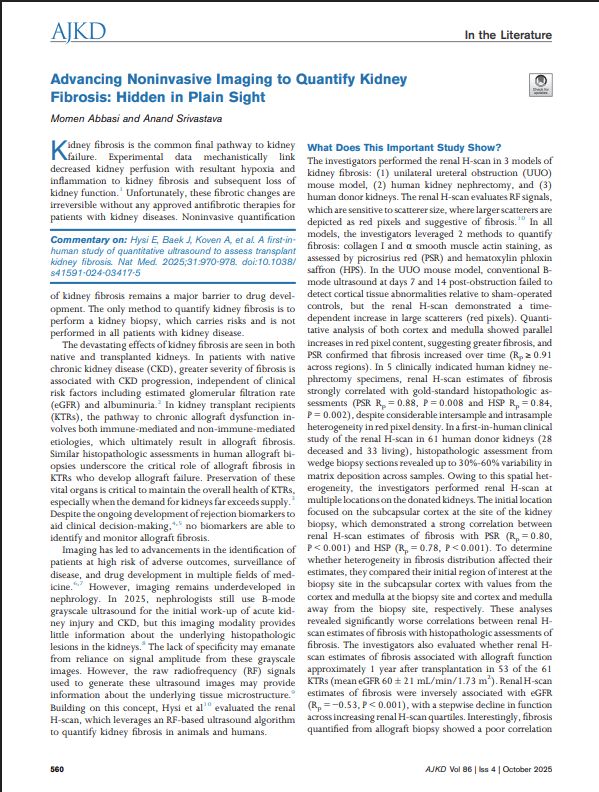
In the Literature by Momen Abbasi and Anand Srivastava:
Advancing Noninvasive Imaging to Quantify Kidney Fibrosis: Hidden in Plain Sight
bit.ly/46TMIwB (FREE)

Likelihood of graft failure or death at 5 years in transplant cohort using permutations of four characteristics and BMI groups BMI body mass index, DKD diabetic cause of kidney failure, HKD congenital/hereditary or polycystic cause of kidney failure Time to graft failure or death was regressed on age (18-29, 30-49, 50-64, 65-79, ≥80y), cause of kidney failure (diabetic nephropathy, renal vascular disease, glomerulonephritis/autoimmune disease, congenital/hereditary renal disease and polycystic kidney disease, drug induced nephropathy, unknown, and other), smoking at dialysis initiation, the number of comorbidities (0, 1, 2, 3 or more). Risks are presented for 16 selected permutations: age 30-49y vs 65-70y; non-smoker vs smoker at dialysis initiation, congenital/hereditary vs diabetic cause of kidney failure, and 0 vs 3 or more comorbidities) and all five BMI groups.
Access to Kidney Transplantation in Adults With Severe Obesity: A Population-Based Retrospective Cohort Study
bit.ly/4pxoRdx (OPEN ACCESS)

The February 2026 issue is available now! Check out the plain-language summaries on what inspired each study, the basic approach taken, what was learned, and why it matters:
bit.ly/46yYaOD

Axial noncontrast computed tomography (CT) of the thorax 3 months prior to presentation (A-B). Axial contrast-enhanced CT of the thorax at the time of hypercalcemia (C-D), which shows a new moderate left pleural effusion (white stars) and an enlarged 1.3 cm subaortic/aortopulmonary window lymph node (white arrow, C) and an enlarged 1.4 cm left perihilar lymph node (white arrow, D). Images © 2025 Cassiano Crespo Santiago, MD, and are recreated with the permission of the copyright holder.
A 55-year-old man with ESKD owing to diabetic nephropathy post kidney transplant 4 years ago presented to the clinic with 1 month of fatigue and poor appetite.
What is the differential diagnosis for hypercalcemia in a patient with a kidney transplant?
bit.ly/46o1qfG
Selecting Antihypertensive Medications for Kidney Transplant Recipients: Flying Blind by Deepthi Malepati and Paul E. Drawz
bit.ly/4r0HtE1 (FREE)

Unadjusted cumulative incidence of ≥40% decline in estimated glomerular filtration rate among adults with incident atrial fibrillation who received rhythm control therapy, stratified by recurrence of atrial fibrillation within 12 months from initial receipt of rhythm control therapy.
Association of Recurrent Atrial Fibrillation With Subsequent Kidney Function Decline in Adults Receiving Rhythm Control Therapy
bit.ly/4azSne3

Family Physicians’ Perspectives on Providing Living Kidney Donor Care
bit.ly/4pX8c3B

Exercise and Kidney Health: Core Curriculum 2026
bit.ly/3YK6uXv (OPEN ACCESS)

Unadjusted cumulative incidences of loss of employer-sponsored health insurance among patients on in-center hemodialysis and peritoneal dialysis. The incidence curves start at three months after dialysis initiation. Green, red, and blue lines respectively represent patients on peritoneal dialysis, in-center hemodialysis with a fistula, and in-center hemodialysis without a fistula. Abbreviations: HD, hemodialysis; PD, peritoneal dialysis; w/, with; w/o, without.
Changes in Employment Status After Initiation of Peritoneal and In-center Hemodialysis
bit.ly/4pKLXgA
The February 2026 issue is available now! Check out the plain-language summaries on what inspired each study, the basic approach taken, what was learned, and why it matters:
bit.ly/46yYaOD

Effects of Empagliflozin on Urine Biomarkers in EMPA-KIDNEY
bit.ly/3WA9uoy (OPEN ACCESS)

AJKD invites applications for its Editorial Internship Program, which will provide editorial experience to early career researchers interested in education, teaching, or medical editing/writing.
Apply by April 30. Details: bit.ly/3Z64pFG

Criteria for the diagnosis of a Major Depressive Disorder (MDD). According to the Diagnostic and Statistical Manual of Mental Disorders, 5th edition (DSM-5), the patient must experience at least 5 of the symptoms depicted over the same 2-week period, and at least one of the symptoms must be either sadness or loss of Interest. Created with BioRender.com.
MINI REVIEW: A Practical Primer on How to Detect and Treat Depression in CKD
bit.ly/4agFzJU (FREE)

Cost-Effectiveness Plane of One-Day Evaluation Versus Usual Evaluation Process
An Economic Evaluation of a One-Day Living Kidney Donor Evaluation Process Compared to the Usual Approach
bit.ly/4qeDkuQ

Home Dialysis Utilization in Puerto Rico
bit.ly/4p5ZYFH

Chronic Pain Locations, Characteristics, and Associations With Other Symptoms in Adults Receiving Maintenance Hemodialysis: Findings From the HOPE Consortium Trial
bit.ly/4qOf7wG (OPEN ACCESS)
#Visual Abstract

Cumulative Incidence of CKD progression by family history. Numbers less than 11 individuals are suppressed if data are from the USRDS.
Family History of Kidney Failure, APOL-1 Risk Variants, Social Determinants of Health, and Risk of CKD Progression: Findings From the CRIC Study
bit.ly/3NtxtEn
It was a pleasure reviewing the @kdigo.org 2025 clin practice guidelines for PD NS for US practice. Thanks @ajkd.bsky.social for asking me to do this with Chia-shi Wang. Highlight, Levamisole not approved for use in Humans in the US!!👍
03.02.2026 04:51 — 👍 3 🔁 1 💬 0 📌 0