The important pediatric perspective on CKDx. Moving nephrology towards precision medicine is an effort spanning all age groups.
Improving precision diagnosis in unexplained CKD url: academic.oup.com/ckj/article/...
@muellerrom.bsky.social
passionate for translational research...kidney disease and beyond...
The important pediatric perspective on CKDx. Moving nephrology towards precision medicine is an effort spanning all age groups.
Improving precision diagnosis in unexplained CKD url: academic.oup.com/ckj/article/...

SGLT-2 Inhibition in ADPKD? DAPA-PKD & STOP-PKD - Prof. Emilie Cornec Le Gall & Prof. Roman-Ulrich Müller
youtu.be/9e-UFBnIyDI?...
@ecorneclegall.bsky.social @muellerrom.bsky.social @kronbichlerlab.bsky.social @sarahelena.bsky.social @gunnarheine.bsky.social @marcussaemann.bsky.social

Transition of patients with hereditary nephropathies from pediatric to adult care url: academic.oup.com/ndt/article-...
Transition…such an important topic for improving patient care…but still underrepresented in care pathways.

Tonight it's all about ADPKD!
KDIGO Guidelines / ERA Genes & Kidney Working Group - Prof. Roser Torra, Prof. Roman-Ulrich Müller
youtu.be/qjnYDsYbx0Q?...
@rosertorra.bsky.social @muellerrom.bsky.social @dguerrot.bsky.social @gunnarheine.bsky.social @kronbichlerlab.bsky.social
📹 Interested in a PhD position in aging research starting in 2026? Then watch our new short video for some tips from our wonderful PhD students and faculty.
Don't miss the deadline: November 3, 2025.
Apply now and start your journey with us!


KDIGO 2025 ADPKD Guideline: A commentary on diagnosis and management of hepatopancreatic manifestations by the ERA Working Group Genes & Kidney by Drs. @muellerrom.bsky.social , @joostphdrenth.bsky.social, et al.
academic.oup.com/ndt/article/...

The KDIGO ADPKD Guideline is a milestone for the field.
Building upon this work, experts assembled by the ERA Working Group Genes&Kidney now provide additional practical guidance for polycystic liver disease in #ADPKD.
academic.oup.com/ndt/article/...
@ecorneclegall.bsky.social
CKDx: Simplicity matters, implementation is key url: academic.oup.com/ndt/article/...
At this stage, it is all about widespread adoption of a simple concept: we do not always know the diagnosis in kidney disease. And reporting diagnostic steps in a simple manner enables us to go the next step.
Apply now for a fully funded #PhD position at the Cologne Graduate School of Ageing Research and become part of our vibrant #AgingResearch commmuny.
🗓️ Deadline: November 3, 2025.
ℹ️ More info: www.ageing-grad-school.de
📣 Spread the news!

Obtaining a thorough family history is so important in kidney disease....but often more difficult than expected in clinical practice...
10 tips on how to take a proper family history in CKD patient care url: academic.oup.com/ckj/article/...

Happy to share the nice video @unicologne.bsky.social has produced on our recent publication identifying novel protein biomarkers for #ADPKD.
www.youtube.com/watch?v=FDGN...
rdcu.be/ezvN4
@cecad.bsky.social @uniklinikkoeln.bsky.social
Absolutely. But still no funding to implement these spectacular findings…😉 I guess this will be a long learning process for policymakers…
04.08.2025 17:28 — 👍 0 🔁 0 💬 0 📌 0
What happens when #mitochondria fail in high-energy tissues? Cells adjust their metabolism and alter the mechanics of the nucleus! Read more on the discovery by Dr. Harshita Kaul from the Trifunovic Lab in Nature Metabolism.
➡️ uni.koeln/QZURH
#CellStress #NatureMetabolism @unicologne.bsky.social

Mithilfe von #Massenspektrometrie ist es einem Team um @muellerrom.bsky.social vom @cecad.bsky.social an der @unicologne.bsky.social und der @uniklinikkoeln.bsky.social gelungen, den Verlauf von Erkrankungen der #Nieren anhand einer Blutprobe deutlich genauer vorherzusagen als bisher möglich.
31.07.2025 06:44 — 👍 2 🔁 1 💬 0 📌 0KDIGO ADPKD Guideline: A Milestone in Genetic Kidney Diseases Why is a global guideline for ADPKD so important?
Prof. Roman Müller explains how the new KDIGO guideline marks a crucial step forward in harmonizing care for patients with #ADPKD) worldwide 👇
Great thanks to Jörg Bernards-Stiftung and @dfg.de (Excellence Strategy @cecad.bsky.social) for supporting this work and to all patients participating.
23.07.2025 12:48 — 👍 7 🔁 2 💬 0 📌 0
Interested in a postdoctoral fellowship on polycystic kidney disease? Linking molecular data with outcome? Please get in touch.
euraxess.ec.europa.eu/jobs/hosting...
Untargeted. Targeted assays for absolute quantification in a prospective study will now have to be the next step towards implementation
22.07.2025 18:47 — 👍 1 🔁 0 💬 1 📌 0📎 Read the full study here: Nature Commun. 16, 6646 (2025) – DOI 10.1038/s41467-025-61887-8
21.07.2025 16:12 — 👍 1 🔁 0 💬 0 📌 010/ This work was enabled by all patients participating and central support by the Jörg Bernards-Stiftung and @DFG through the Excellence Initiative (@CECAD). Thank you!
@cecad.bsky.social @unicologne.bsky.social @uniklinikkoeln.bsky.social and Center for Molecular Medicine Cologne
9/ Next steps:
• Develop targeted assays for the 6 proteins
• Prospective multicenter validation
• Explore integration with other data layers (e.g. metabolomics) and treatment response
• Ultimate goal: precision-medicine profiling for ADPKD care rdcu.be/exbNq
8/ Why it matters:
✅ Blood-based protein markers are inexpensive and accessible
✅ They improve prediction where MRI and genetics may fall short
✅ Pave the way for targeted assays (e.g. ELISA, mass spec) and prospective clinical use rdcu.be/exbNq
7/ Notably, the proteome data adds predictive information independent of eGFR at baseline. In ROC analysis for identifying rapid progressors (>3 ml/min/yr) adding the protein to MIC enhanced the AUC rdcu.be/exbNq
21.07.2025 16:12 — 👍 1 🔁 0 💬 1 📌 06/ These models were cross-validated in two large cohorts: an internal cohort (Cologne) and an external cohort using EDTA plasma instead of serum (Groningen). rdcu.be/exbNq
21.07.2025 16:12 — 👍 1 🔁 0 💬 1 📌 05/ The model based on these 6 proteins was superior to a clinical standard model based on eGFR and Mayo Imaging Class (MIC). Adding the proteins to the clinical standard further improved the model. rdcu.be/exbNq
21.07.2025 16:12 — 👍 1 🔁 0 💬 1 📌 04/ Using weighted LASSO, we narrowed it to 6 key proteins:
• GPX3 (oxidative stress)
• SERPINF1 (angiogenesis regulator)
• AFM (vitamin E transport)
• FERMT3 (cell adhesion)
• CFHR1 (complement pathway)
• RARRES2 (inflammation/adipogenesis) rdcu.be/exbNq
3/ We analyzed serum from large cohorts via semi-automated mass spectrometry. Identified 29 proteins significantly linked to yearly eGFR decline rdcu.be/exbNq
21.07.2025 16:12 — 👍 1 🔁 0 💬 1 📌 02/ ADPKD is the most common genetic cause of kidney failure. Predicting how fast kidney function (eGFR) declines is crucial for tailored therapy (e.g. whether to prescribe tolvaptan) and for patient counseling rdcu.be/exbNq
21.07.2025 16:12 — 👍 1 🔁 0 💬 1 📌 0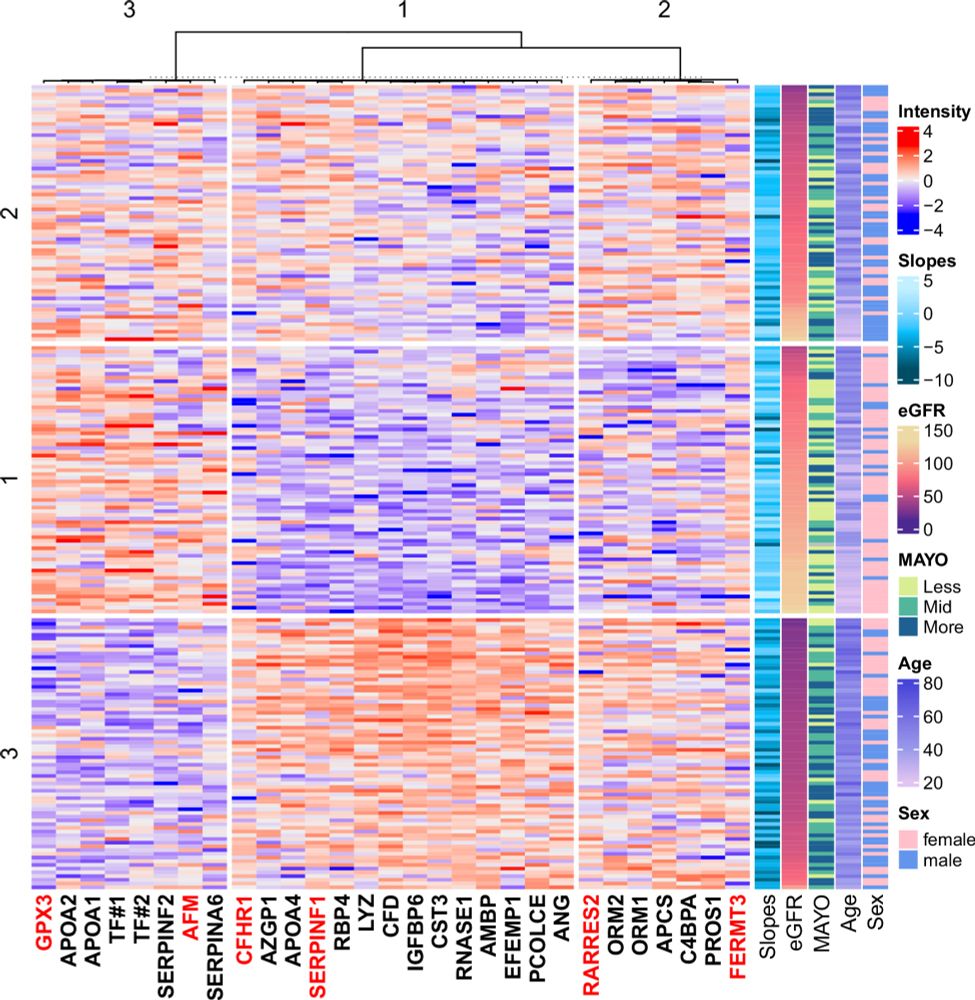
1/ 🧬 Exciting news! Our group just published a paper in Nature Communications on using serum proteomics to predict disease progression in #ADPKD (Autosomal Dominant Polycystic Kidney Disease) 🔬 — enhancing risk stratification beyond currently available models 🎯 rdcu.be/exbNq
21.07.2025 16:12 — 👍 8 🔁 3 💬 2 📌 0