Thanks Maria!
30.10.2025 15:51 — 👍 0 🔁 0 💬 0 📌 0
Somehow missed acknowledging Alon Shpigler, the first author 😱
30.10.2025 14:15 — 👍 0 🔁 0 💬 0 📌 0

Congratulations to Naor Kolet who led this project and thanks to co-authors Shahar Golan for his contribution and to @erinweisbart.bsky.social l for her critical insights regarding interpretability 🎉
3/3
30.10.2025 09:44 — 👍 0 🔁 0 💬 0 📌 0
Anomaly-based representations have several benefits:
1. Reducing batch effects
2. Improving reproducibility and mechanism of action classification
3. Complementing classical representations
4. Revealing alterations in biologically interpretable dependencies
2/3
30.10.2025 09:44 — 👍 0 🔁 0 💬 1 📌 0

Our paper is out ✨
doi.org/10.1016/j.ce...
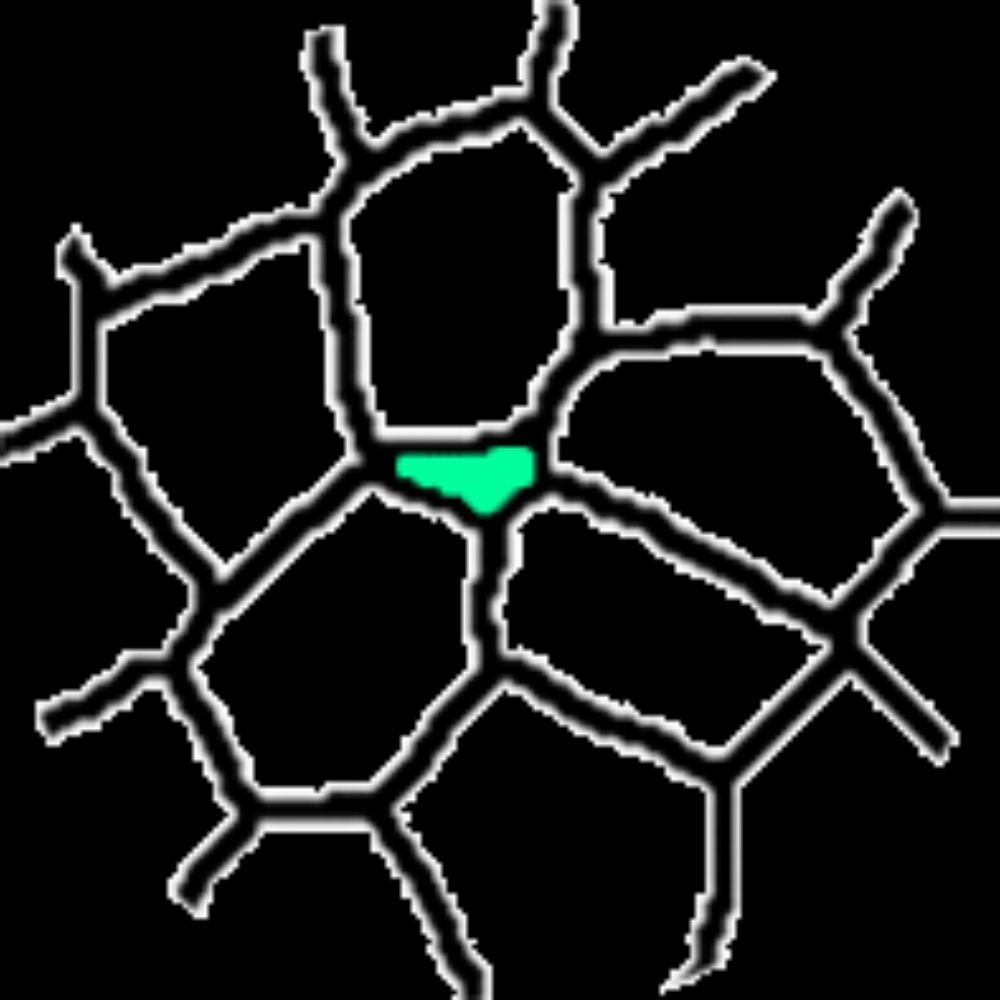
We propose a self-supervised anomaly representation that encodes morphological inter-feature dependencies for high-content image-based cell phenotyping!
1/3
30.10.2025 09:44 — 👍 2 🔁 0 💬 3 📌 1
Join us!
10.10.2025 14:37 — 👍 0 🔁 0 💬 0 📌 0
Jennifer Lippincott-Schwartz, Emma Lundberg, Alex Mogilner, Maddy Parsons, @loicaroyer.bsky.social, Guillaume Salbreux, Anđela Šarić, Timm Schroeder, Hervé Turlier, @virginieuhlmann.bsky.social, Vincenzo Vitelli
Please save the date and spread the word!
3/3
10.10.2025 09:23 — 👍 2 🔁 0 💬 0 📌 0
Co-organized with Meghan Driscoll, @quantumjot.bsky.social and Susanne Rafelski
Speakers include: @kevin-dean.bsky.social, @ellenberglab.bsky.social, Margaret Gardel, @florianjug.bsky.social, @krishnaswamylab.bsky.social, @levayerr.bsky.social, @priscaliberali.bsky.social, ...
10.10.2025 09:23 — 👍 8 🔁 1 💬 1 📌 0

Excited to announce the first @cshlnews.bsky.social meeting on Cell Modeling in Space and Time, June 2026 💫
meetings.cshl.edu/meetings.asp...
Bringing together experiments, computation and theory to explore dynamic, multi-scale cellular organization and function!
1/3
10.10.2025 09:23 — 👍 24 🔁 7 💬 2 📌 0

Nature Biomedical Engineering is hiring again! This time we're hoping to add an editor with machine learning expertise to the team (although we are open to those with other relevant expertise!) Deadline is Oct 20. Please RT! springernature.wd3.myworkdayjobs.com/SpringerNatu...
24.09.2025 18:36 — 👍 17 🔁 18 💬 1 📌 2

📢We're #hiring Group Leaders!
Apply to lead a lab at Janelia & advance biology using theory, computational modeling & machine learning.
🔹5-year renewable appointment
🔹Pioneer new tools & approaches
🔹Collaborate across disciplines
Apply by Nov. 4👉 https://janelia.link/groupleader
26.08.2025 19:00 — 👍 63 🔁 66 💬 0 📌 2
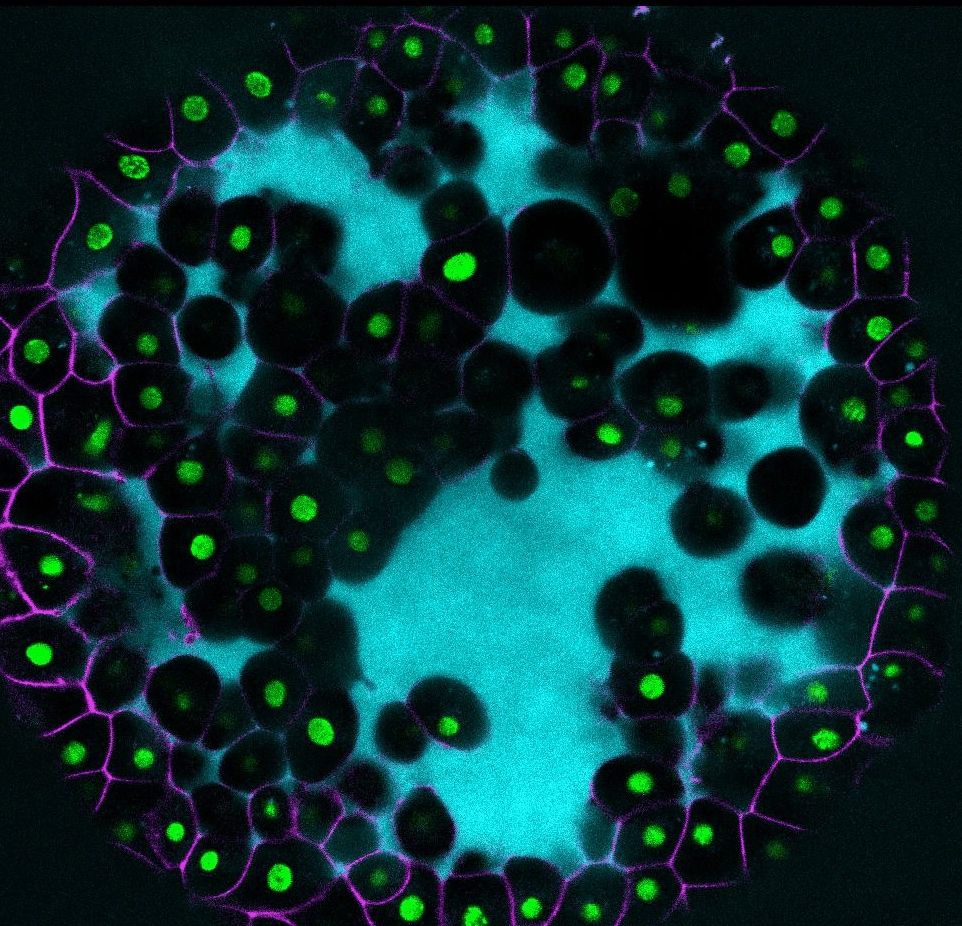
We are searching for an enthusiastic scientist to join our team and establish annual killifish as a model system for early developmental biology and biophysics! @embl.org @embldbunit.bsky.social
Apply here:
embl.wd103.myworkdayjobs.com/EMBL/job/Hei...
Please re-post 🙏
08.08.2025 09:01 — 👍 39 🔁 25 💬 2 📌 2

BIG start to #mmc2025 with Assaf Zaritsky giving an awesome opening plenary.
@royalmicrosoc.bsky.social @eurobioimaging.bsky.social @globias.bsky.social @bioimaginguk.bsky.social @globalbioimaging.bsky.social
01.07.2025 08:22 — 👍 19 🔁 4 💬 1 📌 2
Sorry, I meant @leeat-keren.bsky.social and Yael Amitay....
09.05.2025 09:15 — 👍 0 🔁 0 💬 0 📌 0

A creative and technically challenging idea led by @zamir_amos, with key contributions from Yuval Tamir and @yaelam75. This would not have been possible without the great collaboration with @leeat_keren! And thanks to @WellcomeLeap ΔTissue for funding!
16/n
09.05.2025 09:02 — 👍 0 🔁 0 💬 1 📌 0

Our results suggest that the local organization of a few cells in discriminative motifs are emergent properties that may define an intermediate spatial scale driving tissue function
14/n
09.05.2025 09:02 — 👍 0 🔁 0 💬 1 📌 0

CISM’s unsupervised motif enumeration followed by supervised context-dependent selection distils the discriminative motifs from the huge and noisy landscape of all putative sub-networks of intercellular interactions and provides discrimination along with interpretability
13/n
09.05.2025 09:02 — 👍 0 🔁 0 💬 1 📌 0
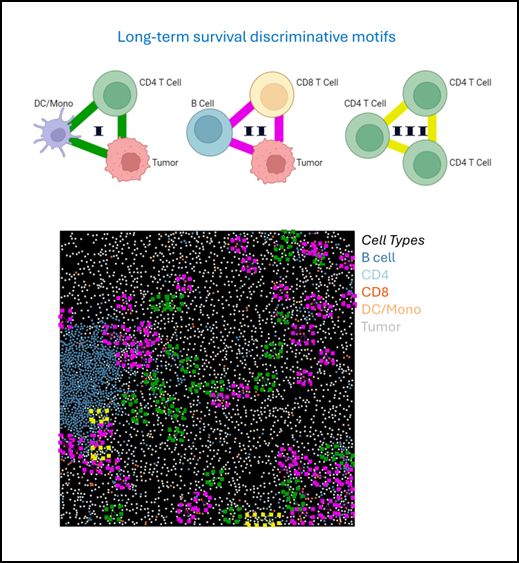
To demonstrate the general applicability of CISM for identifying local cellular structures linked to disease states, we applied it to investigate the tumor microenvironment in a human cohort of Breast Cancer (TNBC) patients, comparing short-term and long-term survivors.
12/n
09.05.2025 09:02 — 👍 0 🔁 0 💬 1 📌 0

The same motifs can be differentially analyzed according to different context-dependent selection of the discriminative motifs. We demonstrate this by investigating the immune microenvironment of NP versus PN (metastatic lymph nodes that did not develop distant metastases)
11/n
09.05.2025 09:02 — 👍 0 🔁 0 💬 1 📌 0

Spatial interpretation of motifs localization patterns reveals an association between (local) motifs to (global) tissue compartments highlighting the potential contribution of CISM to multi-scale analysis and interpretation
10/n
09.05.2025 09:02 — 👍 0 🔁 0 💬 1 📌 0

The spatial arrangement of cell types within the discriminative motifs contributed to disease state classification, indicating that the specific intra-motif cell-cell interactions are sensitive markers for disease state beyond their cell type composition
9/n
09.05.2025 09:02 — 👍 0 🔁 0 💬 1 📌 0

Exploring the landscape of the discriminative motifs-induced cell distribution and motifs-induced pairwise cell-cell interactions revealed differential composition of cell type and cell-cell interactions
8/n
09.05.2025 09:02 — 👍 0 🔁 0 💬 1 📌 0

Classifying NN vs. NP disease states using discriminative four-cell motifs outperformed other methods, suggesting that these motifs can act as multicellular signatures of disease
7/n
09.05.2025 09:02 — 👍 0 🔁 0 💬 1 📌 0

We applied CISM to investigate future metastases by analyzing the immune microenvironment in tumor-free lymph nodes of melanoma patients using multiplexed imaging.
Cohort and data by our collaborators @yaelam75 and @leeat_keren are described here doi.org/10.1101/2024...
6/n
09.05.2025 09:02 — 👍 0 🔁 0 💬 1 📌 0

These discriminative motifs’ representations can be interpreted based on their prevalence, contribution to classification, identity of the cells that comprise them and their pairwise interactions and their spatial location in respect to more global tissue compartments
5/n
09.05.2025 09:02 — 👍 0 🔁 0 💬 1 📌 0

CISM context-dependent discriminative motifs can be used to formulate a machine learning-based prediction of the tissue’s disease state where each patient is represented by the (sparse) vector of its discriminative motifs' frequencies
4/n
09.05.2025 09:02 — 👍 0 🔁 0 💬 1 📌 0

CISM reduces the number of potential high-order interactions with unsupervised selection of ‘motifs’, enriched local multicellular structures, and then associates these motifs with the tissue disease state according to their presence in patients at different clinical states
3/n
09.05.2025 09:02 — 👍 0 🔁 0 💬 1 📌 0

Source: https://doi.org/10.15252/msb.202110726
The clinical manifestation of diseased tissue arises from intricate intercellular interactions that extend beyond pairwise cell-cell interactions. Deciphering these processes is challenging due to the combinatorial complexity of multicellular organization.
2/n
09.05.2025 09:02 — 👍 0 🔁 0 💬 1 📌 0
Bioimage Analyst. I help people turn pictures into numbers. Overly passionate about documentation and FAIR data. Senior Staff Scientist in the Cimini Lab at the Broad. I also read, knit, sew, bake, and herd cats.
A scientific journal publishing cutting-edge advances at the intersection of the life and physical sciences. Posts by the editors.
...we are passionate about spatial proteomics, mass spectrometry and single-cell technologies to study disease mechanisms @MDC_Berlin 🇩🇪🇨🇴🇨🇳🇰🇿🇵🇷🇵🇱🇲🇽
LMCB Group Leader at UCL. Cis-regulatory control of cell fate choice in development.
https://delaslab.com/
Migrating on my own path. Cytoskeletal enthusiast with a love for mechanics, development, and biophysical approaches. | BWF CASI Fellow with Orion Weiner at UCSF | PhD Gardel lab at UChicago | HHMI Gilliam, Ford Predoctoral Fellow Alum |
Physicist having a go at biology, EMBO postdoctoral fellow @UCL in the Mao group, @EMBL alumna
🔬 Animating the french community of #scientists and companies involved in #microscopy and #imaging for #biology
👉 http://imabio-cnrs.fr
#nanoscopy #cell_dynamics #biosensors #superresolution #confocal #fluorescence #endoscopy #photoacoustics
Non-profit research and educational institution at the forefront of molecular biology, cancer, neuroscience, plant biology, and genetics.
https://www.cshl.edu/
Assistant Professor in Bioimaging and Data Analysis and Director of the BioVisionCenter at UZH; Research Group Leader at EMBL-EBI. Loves image analysis, mountains, and birds.
We systematically elucidate the mechanisms underlying cell division and nuclear organisation and develop advanced imaging technologies
@EMBL.org
Life scientist.
Head of EMBO Membership & Elections and Courses & Workshops @embo.org #EMBOevents
previously: Editor at Molecular Systems Biology, EMBO Press
Views my own
AI/ML for cell image analysis @biohub.org | prev Broad Institute, CUHK-SZ & UMich
Asymmetric cell division | Microscopy tech development | Synthetic biology | Fly models |
All views are our own
Postdoctoral Researcher at the MRC lab for Molecular Biology - Derivery Group 🧑🔬
Multispectral microscopist and endosome enthusiast 🔬 🌈
Expect science, books and animals 🥼📖🐈⬛
Biophysicist, researcher & team leader @cnrs.fr. Msg are my own. Lab account: @turlierlab.bsky.social
Combining physical modeling, AI and computer vision to understand how cells self-organize into embryos and tissues. ERC DeepEmbryo. Team headed by @herveturlier.bsky.social
Image Data Analysis at @crick.ac.uk
Science → Reproducible as Data Analysis → Automated
Dubliner 🇮🇪 in London 🇬🇧 | Brunch sceptic | Trophy husband | Dissipator of masculine energy
Epithelial cell death, cell extrusion, self-organisation, mechanotransduction and many other things
Faculty member at Tel Aviv University. Leading theoretical and computational research in nonequilibrium statistical mechanics of soft matter. Mainly mechanical metamaterials, geometry, active matter, stochastic processes https://shokef.tau.ac.il
Prof. of Physics, Cell Biology and Molecular Engineering @ UChicago. Passionate about all the squishy matter driving dynamics and function from sub-cellular to tissue scales.