Submit your research to JCM's Special Series, "Diagnostic Testing for Mycobacteria."
Tuberculosis (TB) remains one of the world’s leading infectious killers, and NTM infections are rising. #JClinMicro invites submissions to our "Diagnostic Testing for Mycobacteria" series. 📄 Share your research now → asm.social/2B6
16.09.2025 14:18 — 👍 9 🔁 5 💬 0 📌 0
Oooh. Interesting.
09.09.2025 17:38 — 👍 19 🔁 5 💬 2 📌 0

“Click Chemistry Methodology: The Novel Paintbrush of Drug Design”, a Review published in ACS Chemical Biology
Check out this Review, published in ACS Chemical Biology: “Click Chemistry Methodology: The Novel Paintbrush of Drug Design”.
Find out more: buff.ly/reGfX7R
03.09.2025 19:01 — 👍 1 🔁 1 💬 0 📌 0
What an unprecedented and strong bipartisan voice to sound this alarm. Will the Republican Congress wake up and stop playing politics with the health of the American people?
02.09.2025 05:21 — 👍 31 🔁 7 💬 3 📌 0
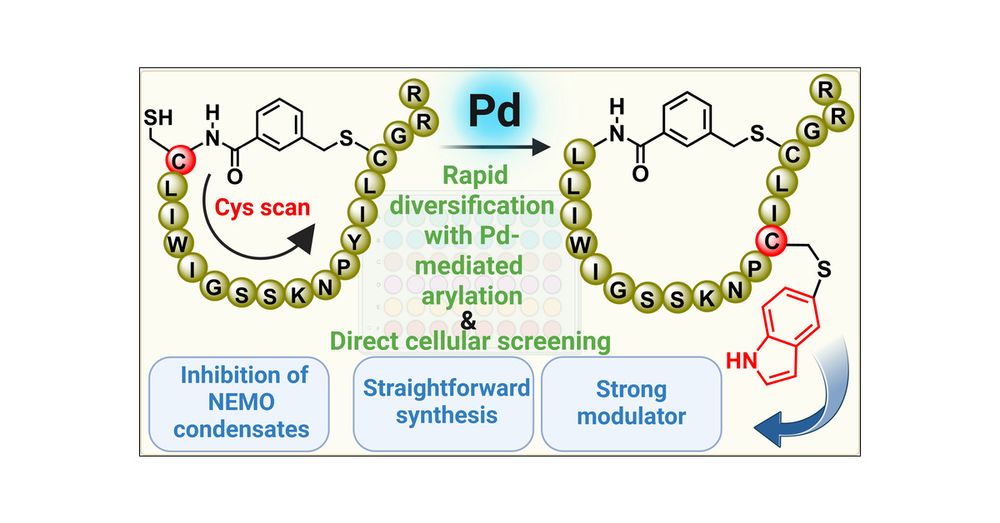
Direct Cellular Screening of Pd-Mediated Arylation of Cyclic Peptide Binders Targeting Ubiquitin Chains: Toward Modulating NEMO Liquid–Liquid Phase Separation
Ubiquitination is a critical post-translational modification that regulates key cellular processes such as protein degradation and DNA damage repair. Targeting a specific type of ubiquitin chain (e.g., Lys48 or Lys63-linked ubiquitin chain) via cyclic peptides presents a new strategy to modulate biological processes with therapeutic potential for various diseases. However, such a strategy remains challenging due to the obstacles of cell permeability and bioactivity. Here, we present a new method that directly assesses these parameters by integrating palladium-mediated Cys arylation with direct cellular screening. Using CP4, a previously identified cyclic peptide modulator of Lys63-linked ubiquitin chains, we generated a focused library of arylated analogues and optimized the Pd-mediated arylation for direct cellular screening. We discovered a new analog, CP-P12-ArH, that demonstrated enhanced binding affinity and robust bioactivity, as evidenced by increased γ-H2AX phosphorylation and apoptosis induction in cancer cells. Furthermore, CP-P12-ArH effectively inhibited the in vitro formation of NF-κB essential modulator (NEMO) biomolecular condensates by disrupting the elongation of Lys63-linked ubiquitin chains, offering a novel way to modulate NF-κB signaling. This work establishes a generalizable platform for the rapid optimization of cyclic peptide therapeutics targeting protein–protein interactions.
Interesting paper by the group of Ashraf Brik in @jacs.acspublications.org. Pd-mediated modification of cyclic peptides allows to combinatorially generate S-arylated derivatives and directly screen them for activity in cells.
pubs.acs.org/doi/10....
#ChemSky #ChemBio #DirectToBiology #D2B
31.07.2025 09:43 — 👍 13 🔁 2 💬 1 📌 0
If you are interested in peptide-based protein binders, check out this new @biorxivpreprint.bsky.social by the group of @sebastianpomplun.bsky.social of our @led3hub.bsky.social on their computer-based design.
26.07.2025 10:17 — 👍 27 🔁 5 💬 1 📌 0
Novel approaches to glycomimetic design: development of small molecular weight lectin antagonists: Expert Opinion on Drug Discovery: Vol 16, No 5 www.tandfonline.com/doi/abs/10.1...
20.07.2025 11:44 — 👍 3 🔁 0 💬 2 📌 0

www.mdpi.com/2076-0817/11...
Aspartyl Protease Inhibitors as Anti-Filarial Drugs
20.07.2025 11:41 — 👍 2 🔁 0 💬 1 📌 0
@scotthultgren.bsky.social
20.07.2025 11:33 — 👍 0 🔁 0 💬 0 📌 0

Macrocyclic Phage Display for Identification of Selective Protease Substrates
Traditional methods for identifying selective protease substrates have primarily relied on synthetic libraries of linear peptides, which offer limited sequence and structural diversity. Here, we present an approach that leverages phage display technology to screen large libraries of chemically modified cyclic peptides, enabling the identification of highly selective substrates for a protease of interest. Our method uses a reactive chemical linker to cyclize peptides on the phage surface, while simultaneously incorporating an affinity tag and a fluorescent reporter. The affinity tag enables capture of the phage library and subsequent release of phages expressing optimal substrates upon incubation with a protease of interest. The addition of a turn-on fluorescent reporter allows direct quantification of cleavage efficiency throughout each selection round. The resulting identified substrates can then be chemically synthesized, optimized and validated using recombinant enzymes and cells. We demonstrate the utility of this approach using Fibroblast Activation Protein α (FAPα) and the related proline-specific protease, dipeptidyl peptidase-4 (DPP4), as targets. Phage selection and subsequent optimization identified substrates with selectivity for each target that have the potential to serve as valuable tools for applications in basic biology and fluorescence image-guided surgery (FIGS). Overall, our strategy provides a rapid and unbiased platform for effectively discovering highly selective, non-natural protease substrates, overcoming key limitations of existing methods.
Macrocyclic Phage Display for Identification of Selective Protease Substrates | Journal of the American Chemical Society pubs.acs.org/doi/full/10....
19.07.2025 21:42 — 👍 16 🔁 2 💬 0 📌 0
Dietrich Volmer · Research in analytical chemistry, mass spec and metabolomics · Editor-in-Chief of Anal. Sci. Adv. + Editor of Rapid Commun. Mass Spectrom · Views my own
Humboldt University · Berlin · 🇨🇦🇩🇪 · volmerlab.de
Organic synthesis | Methodology | Catalysis | C–H functionalization | Arynes ⬢ Mechanochemistry ⛬ Dept. of Chemistry – BMC, Uppsala University, Sweden.
Cancer biologist at the Francis Crick Institute. Europhile
From the experience of @stitches.today, we bring you the best papers in medicine, daily in your inbox - for free!
Subscribe 👉 www.stitches.today/medicine
Lab loves mechanisms-regulation: ribosomes, translation, DNA repair, cell cycle, cancer signaling & dogs! Uplift! opinions-own
RNA, Ribosome, miRNA, mRNA, translation, translational control, sometimes splicing
Bioinorganic #Chemsky Group of Lena Daumann @HHU.de PI tweeting. We love iron, rare earth elements, enzymes and bacteria!🧫 🧪 #fblockrocks www.bioac.hhu.de/
The Innovation, a Cell Press partner journal, aims to publish cutting-edge research and high-quality reviews. #Scisky #Journal
https://www.cell.com/the-innovation/home
Our research group is interested in Chemical Ecology, Natural Product Chemistry, Organic Chemistry, arthropods, e. g. spiders, butterflies, or Collembola, frogs, bacterial volatiles and communication, as well as plants. We are located in Braunschweig, D.
Mosquitoes, Wolbachia, gut microbes, microbiomes, arboviruses, Plasmodium. Liverpool way. 🦟🦠
LSTM takes a whole-picture view on global health issues and works, in partnership, to develop genuine, sustainable, long-term solutions to save and improve lives in the world's most vulnerable communities. Est. 1898.
Researcher at Bernhard-Nocht Institute for Tropical Medicine | Exploring virus interactions in mosquitoes to block mosquito-borne virus transmission | https://drminealtinli.com | www.linkedin.com/in/mine-altinli
Research scientist at a national lab. OIF / OEF veteran. Stutterer. Microbiome engineering, evolution, bees, bread, and data. He/him
Chair in Virology and Emerging Infectious Diseases, Liverpool School of Tropical Medicine.
Arboviruses, emerging viruses, viruses of parasites!
Mosquitoes, Wolbachia, microbiomes, symbiosis, arboviruses, Plasmodium, host-microbe interactions.
Mosquito Symbiosis and Infection lab account - @mossi-lab.bsky.social
Professor, Fels Cancer Institute at Temple University School of Medicine. My lab works on #kinase and #phosphatase signaling during the #cellcycle in normal and #cancer cells.
Co-Director of Graduate and HUR Undergraduate Programs.
A leading life science journal that champions high-impact research across all disciplines—from molecules to ecosystems. We offer innovative formats and collaborative editorial support to ensure your work achieves its full scientific impact.
Investigating virus dynamics, the innate antiviral response and its involvement in carcinogenesis. Part of the DKFZ research program "Immunology, Infection and Cancer". Posts by Marco Binder.
❗️Old 𝕏-Tweets copied to BSKY, please note "original date" tag❗
Associate Professor of Microbiology & Immunology
UNC Chapel Hill
Viral pathogenesis, arboviruses, virus-host interactions, antiviral immunity
www.lazearlab.org