CCN Lab
🚨 We’re hiring! The Computational Cognitive Neuroscience Lab at Virginia Tech is looking for a postdoc to join our team studying the neural + computational mechanisms of structure learning and flexible cognition: ccnvt.github.io#positions
10.07.2025 12:17 — 👍 29 🔁 19 💬 1 📌 1
New Paper: Continuous Thought Machines
pub.sakana.ai/ctm/
Neurons in brains use timing and synchronization in the way that they compute, but this is largely ignored in modern neural nets. We believe neural timing is key for the flexibility and adaptability of biological intelligence.
Thread ↓
12.05.2025 02:38 — 👍 129 🔁 29 💬 5 📌 1
Check out our new special issue on cognitive flexibility @coolscontrol.bsky.social: authors.elsevier.com/a/1l4vl8MqMi...
12.05.2025 22:23 — 👍 36 🔁 9 💬 0 📌 2

A spatial code governs olfactory receptor choice and aligns sensory maps in the nose and brain
Although topographical maps organize many peripheral sensory systems, it remains unclear whether olfactory sensory neurons (OSNs) choose which of the ~1100 odor receptors (ORs) to express based upon t...
Maps are everywhere in the brain...and finally we've discovered one in the nose! Led by @davidhbrann.bsky.social, we uncovered the logic that specifies the positions of each of the 1,000 sensory neuron subtypes in the nose and aligns their projections to the brain.👇👃see more details below👃👇
09.05.2025 20:44 — 👍 148 🔁 52 💬 5 📌 2
What a terrific idea.
28.03.2025 14:31 — 👍 0 🔁 0 💬 0 📌 0

ARIA Opportunity Space: Scalable Neural Interfaces
Looking for an exciting fellowship in AI & Neuro, with competitive salary (~£100k)? We got a new position in the lab at Oxford, working with @somnirons.bsky.social and me! 🧪
Our project: encode.pillar.vc/projects/beh...
General info: encode.pillar.vc
#compneuro #neuroai #neuroscience #sciencejobs
23.03.2025 19:45 — 👍 41 🔁 26 💬 1 📌 1
Hippocampal encoding of memories in human infants
Humans lack memories for specific events from the first few years of life. We investigated the mechanistic basis of this infantile amnesia by scanning the brains of awake infants with functional magne...
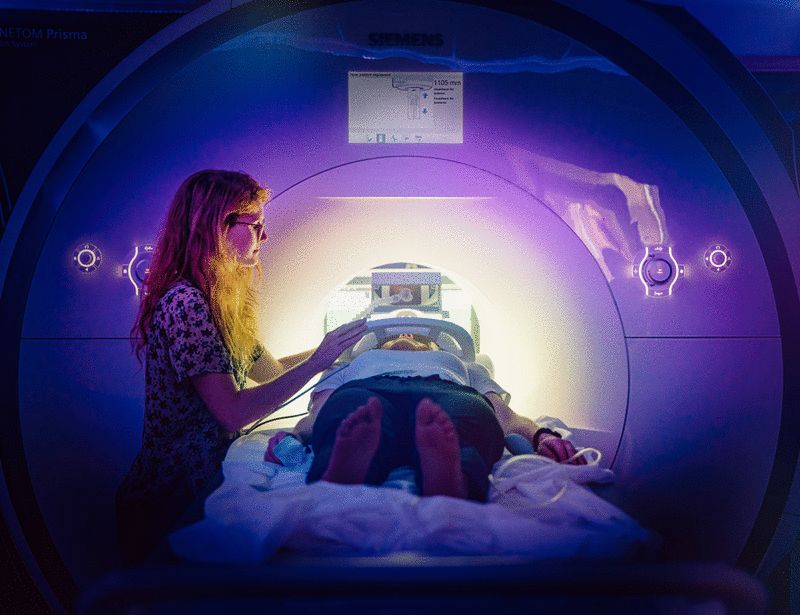
Why do we not remember being a baby? One idea is that the hippocampus, which is essential for episodic memory in adults, is too immature to form individual memories in infancy. We tested this using awake infant fMRI, new in @science.org #ScienceResearch www.science.org/doi/10.1126/...
20.03.2025 18:36 — 👍 482 🔁 165 💬 19 📌 22
Excited to share our latest story! We found disentangled memory representations in the hippocampus that generalized across time and environments, despite the seemingly random drift and remapping of single cells. This code enabled the transfer of prior knowledge to solve new tasks
17.03.2025 01:35 — 👍 145 🔁 57 💬 6 📌 5
If you are curious about the brain🧠 on causal inference, insight💡, memory retrieval, and narrative comprehension🎬, this will be the one.
work by dream team @jinke.bsky.social Rhea Madhogarhia @ycleong.bsky.social @monicarosenb.bsky.social ⭐
13.03.2025 14:58 — 👍 32 🔁 16 💬 1 📌 3


How did early human symbolic behavior evolve? osf.io/preprints/ps... Can we use cultural transmission chains to explore how humans were using and producing the 40k-year of engravings from Blombos & Diepkloof? W Pagnotta Tylén @felixthehauskat.bsky.social & others. A thread:
12.03.2025 16:14 — 👍 49 🔁 13 💬 2 📌 2
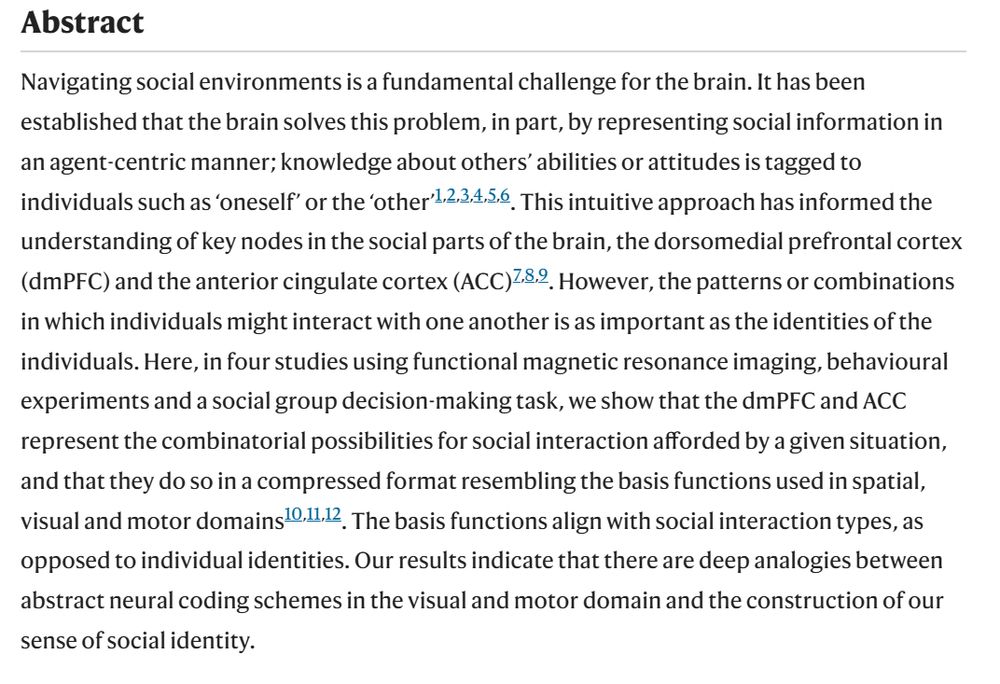
Our paper in Nature (@mkwittmann.bsky.social et al.): the brain does not only process the *identity* of a person but primarily our *relationship* to them. Even on a neural level, who someone is *in relation to others* is key. www.nature.com/articles/s41...
#PsychSciSky #socialpsyc #neuroskyence
12.03.2025 17:37 — 👍 137 🔁 42 💬 2 📌 1
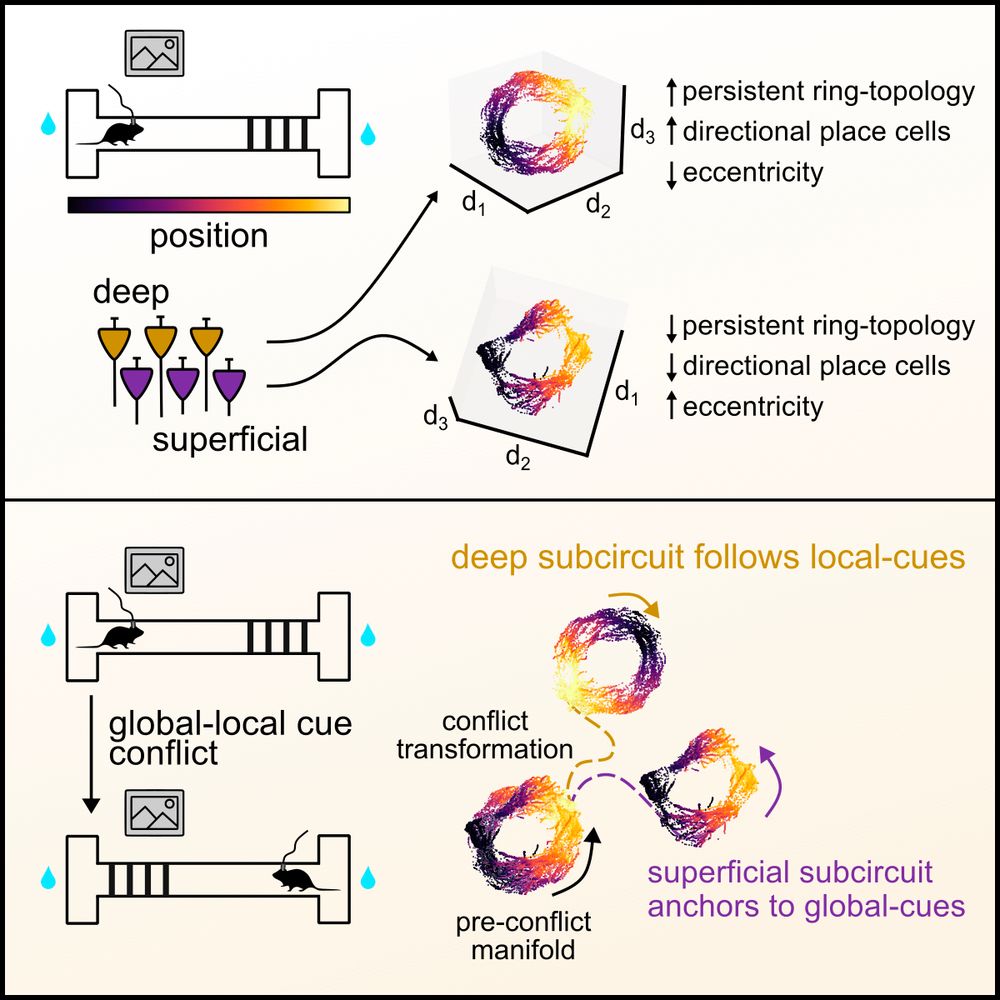
New from the lab!! 👉🏼 authors.elsevier.com/a/1kgT43BtfH... 📝 @cellpress.bsky.social We discovered that genetically-defined neuron types in the hippocampus form unique manifolds! Dual color imaging, chemogenetics and topological analysis all at once! With Juan Gallego @juangallego.bsky.social
26.02.2025 16:16 — 👍 90 🔁 32 💬 4 📌 3
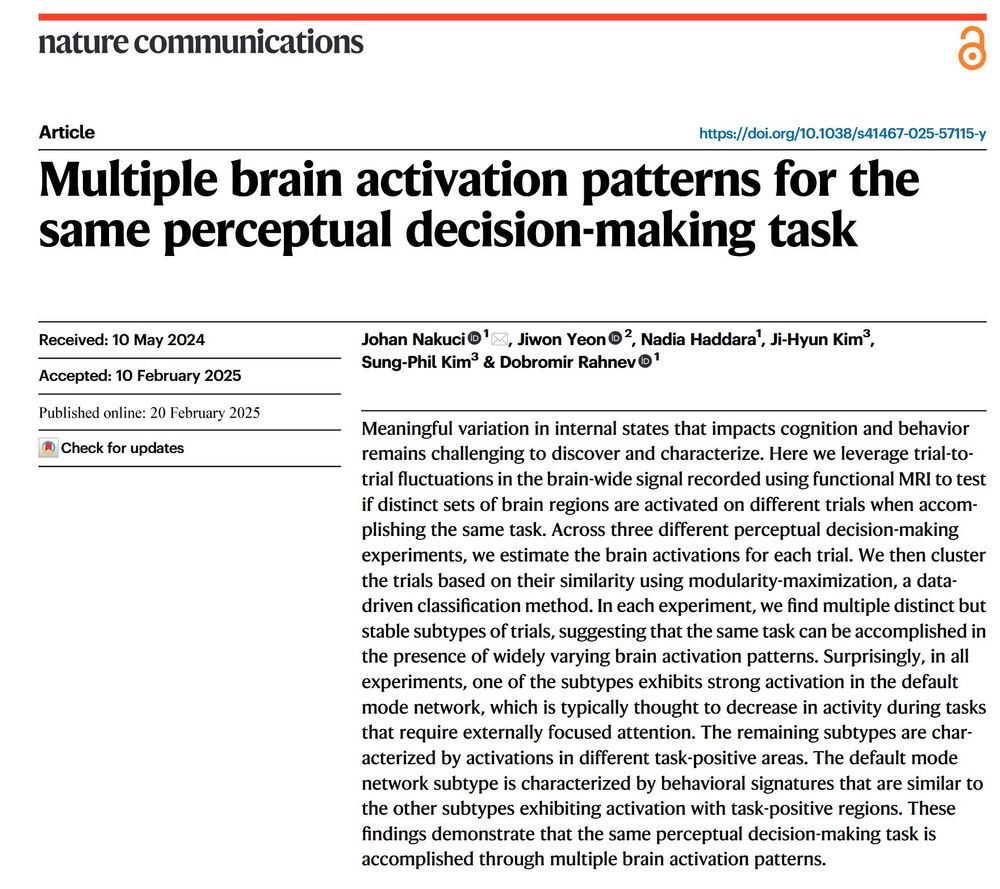
Averaging brain responses is not a great idea...
#neuroscience #neuroskyence
www.nature.com/articles/s41...
23.02.2025 16:27 — 👍 145 🔁 30 💬 7 📌 8
Computation-through-Dynamics Benchmark: Simulated datasets and quality metrics for dynamical models of neural activity https://www.biorxiv.org/content/10.1101/2025.02.07.637062v1
09.02.2025 05:18 — 👍 11 🔁 5 💬 0 📌 0
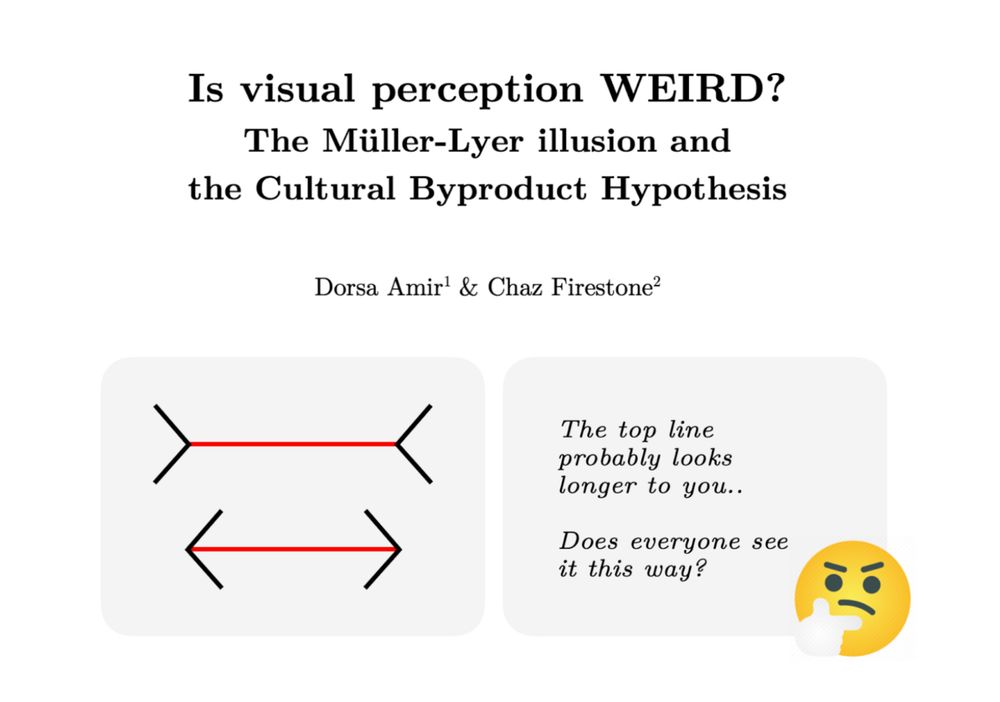
Does the culture you grow up in shape the way you see the world? In a new Psych Review paper, @chazfirestone.bsky.social & I tackle this centuries-old question using the Müller-Lyer illusion as a case study. Come think through one of history's mysteries with us🧵(1/13):
25.01.2025 22:05 — 👍 1095 🔁 423 💬 33 📌 78
Cool new work from my labmate Alice!
02.08.2024 19:39 — 👍 4 🔁 3 💬 0 📌 0
New paper with Alice Xia, Yang Teoh and Oriel FeldmanHall.
03.08.2024 14:20 — 👍 0 🔁 0 💬 0 📌 0
Please do share your feedback and thoughts, and repost!
09.03.2024 19:18 — 👍 0 🔁 0 💬 0 📌 0

This is the hardest project I've worked on: extensive methods development, painstaking piloting, writing two grants, intensive data collection, and a LOT of thinking. It needed a huge dose of patience as we carried its burden over many years. A bit like Frodo carrying the ring.
09.03.2024 19:18 — 👍 0 🔁 0 💬 0 📌 0
Collectively, studying representations of two different task structures in the same subjects revealed generalizable principles by which lPFC tailors representations to different tasks.
09.03.2024 19:16 — 👍 0 🔁 0 💬 0 📌 0

Learning shapes neural geometry in the prefrontal cortex
bioRxiv - the preprint server for biology, operated by Cold Spring Harbor Laboratory, a research and educational institution
The flat task showed local high-dim structure and orthogonality across clusters that were unrelated to the structure of the task. These may have been vestiges of an expressive, task-agnostic representation. Such a process has been observed in monkey lPFC www.biorxiv.org/content/10.1...
09.03.2024 19:16 — 👍 0 🔁 1 💬 0 📌 0
However, there were clues in the data suggesting lPFC may have started with a task-agnostic, high-dim representation with learning-driven dimensionality reduction helping reshape it to fit the task structure.
09.03.2024 19:16 — 👍 0 🔁 0 💬 0 📌 0

Therefore, at least in highly trained subjects, lPFC learned task-tailored representations that recapitulated the structure of the task, showing that lPFC representations are shaped by representation learning.
09.03.2024 19:15 — 👍 0 🔁 0 💬 0 📌 0

On the other hand, in the flat task, a global axis encoded the response-relevant, XOR categories abstractly. Category-specific local geometries were high-dimensional, retaining stimulus information that was not strictly required for readout.
09.03.2024 19:15 — 👍 0 🔁 0 💬 0 📌 0

In the hierarchy task, the global axis abstractly encoded higher-level context, while low-dimensional, context-specific local geometries compressed context-irrelevant information & abstractly encoded context-relevant response-relevant category.
09.03.2024 19:14 — 👍 0 🔁 0 💬 0 📌 0

Using a series of decoding analyses, we comprehensively worked out the detailed local structure within each cluster in both tasks.
09.03.2024 19:14 — 👍 0 🔁 0 💬 0 📌 0

Nevertheless, lPFC representational geometry for each task was highly tailored to its structure. In each task, clustering created subspaces along a global axis - context subspaces in the hierarchy task, and response category subspaces in the flat task.
09.03.2024 19:13 — 👍 0 🔁 0 💬 0 📌 0

Across both tasks, inputs were encoded on manifolds of intermediate dimensionality, with at least some non-linear mixing of inputs. These representations did not differ in their overall separability, or degree of non-linear mixing.
09.03.2024 19:13 — 👍 0 🔁 0 💬 0 📌 0

With decoding analyses, across both task structures, we found lPFC coding diverse task-relevant information. On the other hand, primary auditory cortex showed obligatory coding of only auditory information, whether or not it was task-relevant.
09.03.2024 19:12 — 👍 0 🔁 0 💬 0 📌 0
Cognitive neuroscientist exploring how the brain learns, decides, and generalizes. 🧠 http://ccnvt.github.io
A Black economist for the people. Harvard PhD candidate and author.
Studying labor economics, inequality, and behavioral science. ☀️ #GodsPlan
Learn more 👉🏿 annagifty.com
neuro phd student @Brown // Desrochers Lab
studying how cells code primitives of sequences and generalize & relationships between the BOLD signal and LFPs
non-science things:📚💃🏽🏋🏻♀️🎾
uchicago’22 🇹🇷
PhD student doing LLM interpretability with @davidbau.bsky.social and @byron.bsky.social. (they/them) https://sfeucht.github.io
Neuroscientist post-doc working with Nico Dosenbach at Washington University in St. Louis
Cognitive neuroscientist studying how we pay attention, associate professor of Psychology at UChicago, cablab.uchicago.edu director
DPhil(PhD) student @ox.ac.uk, @oxexppsy.bsky.social studying #CognitiveNeuroscience | B.S. from @pku1898.bsky.social.
Website: https://www.psy.ox.ac.uk/people/deng-pan
Twitter: https://x.com/DengPan18
Post-Doc at Abdel Rahman Lab, Humboldt-Universität zu Berlin
Neurocognitive psychologist interested in emotions, social-emotional (mis)information, face perception, artificial intelligence & deepfakes, EEG
PhD student at the Human Neuroscience Lab at @cimcyc.bsky.social | @universidadgranada.bsky.social
Cognitive neuroscientist interested in how humans achieve complex tasks 🧠. Postdoc at @cimcyc.bsky.social - UGR (Granada, Spain)
I work with neuroimaging and pattern analyses.
PhD student in CogSci at FeldmanHall Lab, Brown University
forever a student
currently a post-doc @ sites.brown.edu/badrelab
curious about control of decision making, neural dynamics, multivariate stats
mcfreund.github.io
Neuroscientist interested in building blocks of adaptive behaviour
Assistant Professor-www.birmingham.ac.uk
Incoming Postdoc at UChicago in Bakkour lab. PhD from WUSTL. Interested in how we build models of the world, naturalistic neuroimaging, and reinforcement learning.
Postdoc in cognitive neuroscience on sequential learning and decision making (Aix Marseille University & ENS Paris). Previously, PhD with G. Dehaene-Lambertz on sequence learning in infants and adults. M/EEG, behaviour and modelling.
Autism researcher interested in individual differences in human behaviour and brain function.
University professor by day.
UK, India
[@bhismadev on (e)X]
www.bhismalab.org
Behavioral Neuroscientist
Postdoc, Kellendonk Lab | Visiting Postdoc, Radulescu Lab
Columbia University | NYSPI | Mount Sinai
https://meghangallo.com
#aging #stress #dopamine #acetylcholine #learning #decisionmaking
Prof in Cognitive Neuroscience at Univ of Granada in Spain. Director of the Mind, Brain & Behavior Research Center https://cimcyc.ugr.es/en