Screenshot of a paper abstract in Geo: Geography and Environment by E. Cotterill, I. Jon & H. Pitt (2026) entitled: 'Copenhagen not Copacabana? Practices and Perspectives for Fieldwork Without Flying' with an orange banner at the top.
✈️New in Geo!✈️
'Copenhagen not Copacabana? Practices and perspectives for fieldwork without flying' by E. Cotterill, @ihnji.bsky.social & @routesandroots.bsky.social
This paper addresses the challenges of designing fieldtrips around long-distance train travel.
doi.org/10.1002/geo2... #geosky
09.02.2026 12:49 — 👍 2 🔁 2 💬 0 📌 0
Have a read of this blogpost by one of our recent authors @ckweatherill.bsky.social ⬇️
06.02.2026 12:07 — 👍 1 🔁 2 💬 0 📌 0

Screenshot of a paper abstract in Geo: Geography and Environment by Annika Kühn, Teresa Erbach, Hilke Marit Berger & Haratua Zosran (2026) entitled: 'Playful Mapping for Climate Adaptation: Two Case Studies From Jakarta's Coast' with an orange banner at the top.
While playful methods are increasingly used in participatory mapping processes, their strategic value, particularly in relation to climate adaptation, remains underexamined. This paper explores the potential and limitations of playful mapping approaches in climate adaptation, focusing on two qualitative case studies in Jakarta's flood-prone Kampung Akuarium: memory mapping with children and speculative gameplay with residents and government officials. Both approaches are examined in terms of their methodological strengths and weaknesses as well as their impact and scalability. The findings show that playful and participatory mapping tools open spaces for storytelling, imagination and collective reflection. They make visible immaterial cultural heritage and emotional aspects often excluded from technocratic planning, allowing participants to articulate the cultural dimensions of urban transformation. Yet, these insights often remain symbolic without pathways for institutional uptake. The paper argues that the context-specific potentials and the downsides of playful methods need to be evaluated carefully. Where their contribution to adaptation processes outweighs their resource-intensiveness, they should be treated not only as experiential formats but as strategic instruments embedded in long-term, co-creative research infrastructures.
🌊New in Geo🌊
'Playful mapping for climate adaptation: Two case studies from Jakarta's coast' by Annika Kühn et al.
This paper is part of an ongoing Special Section: 'Mapping Climate Change Perceptions'.
doi.org/10.1002/geo2...
04.02.2026 14:54 — 👍 3 🔁 1 💬 0 📌 0

Screenshot of a paper abstract in Geo: Geography and Environment by Khiddir Iddris, Andreas Buerkert, Ellen Hoffmann, Katharina Hemmler & Martin Oteng-Ababio (2026) entitled: 'Navigating the Path to Sustainable Rurbanity: The Assemblage of Livelihood Pursuits in E-Waste Hubs of Urban Accra' with an orange banner at the top.
💻New in Geo💻
'Navigating the path to sustainable rurbanity: The assemblage of livelihood pursuits in e-waste hubs of urban Accra' by Khiddir Iddris et al.
This paper uses assemblage theory to analyse the governance of e-waste recycling in Accra, Ghana.
doi.org/10.1002/geo2... #geosky
30.01.2026 14:26 — 👍 1 🔁 0 💬 0 📌 0

A graphical abstract for a paper in Geo: Geography and Environment. It shows a wheel graphic with 'Adaptive mobile cultures' in the centre, and different sections around it: Environmental mobilities, Beyond human, Adaptive livelihoods, and Indigenous knowledge. From each of these stems 'adaptive frictions' such as development-induced immobility, epistemic dominance of Western scientific paradigms, and sedentary adaptation approaches. These are explored in the paper.
🌍New in Geo!🌍
'Cultural heritage in motion: Adaptive mobile cultures of (semi)nomadic Indigenous people in changing climates' by Nuhu Adeiza Ismail et al.
This paper draws on empirical research carried out in Thailand, Ethiopia and Senegal.
doi.org/10.1002/geo2...
22.01.2026 14:30 — 👍 1 🔁 1 💬 0 📌 0

Screenshot of a paper abstract in Geo: Geography and Environment by Md. Naimur Rahman, Md. Mushfiqus Saleheen, Md. Rakib Hasan Rony, Biddut Kumar Ghosh, Md. Abdur Rouf Sarkar & Kevin Lo (2026) entitled: 'Modelling the Effects of Urban Growth on Land Surface Temperature and Carbon Emissions Through Geospatial and Machine Learning Techniques in Gazipur, Bangladesh' with an orange banner at the top.
The rapid expansion of urban areas and their significant effects on carbon emissions and the urban heat landscape have become major research subjects in Bangladesh. The primary aim of this study was to analyse the changes in land use and land cover (LULC) and land surface temperature (LST) from 2003 to 2023 and project them to 2043 for Gazipur, Bangladesh. Additionally, spatiotemporal variations in carbon emissions during summer and winter and their relationships with the LST were explored. A support vector machine (SVM) was used to evaluate changes in LULC. Furthermore, Cellular Automata-Artificial Neural Network (CA-ANN) models were utilised to investigate the future dynamics of LST and LULC. The findings of the study include urban expansion from 3% in 2003 to 18% in 2023, and its projected value indicates an expansion of 315 km2 in 2043 from 52 km2 in 2003. Therefore, the projected LST results indicate a notable increase of 10°C for the winter season in 2043. The correlation between LST and carbon emissions showed strong R2 values for both summer and winter. Specifically, the R2 values were 0.93 and 0.97 for summer and 0.91 and 0.94 for winter in 2013 and 2019, respectively. This investigation has the potential to offer novel insights into prospective urban development, effective management of thermal environments and strategies for mitigating carbon emissions.
🌆New in Geo🌆
'Modelling the effects of urban growth on land surface temperature and carbon emissions through geospatial and machine learning techniques in Gazipur, Bangladesh' by Md. Naimur Rahman et al.
doi.org/10.1002/geo2... #geosky
16.01.2026 09:59 — 👍 4 🔁 0 💬 0 📌 0

Screenshot of a paper abstract in Geo: Geography and Environment by Kapil Yadav & Henry Thompson (2025) entitled: 'Adding Lines Along Pixels: Remote Sensing, Traditional Knowledge and Human–Fire Interactions in Ethiopia and India' with an orange banner at the top.
This study critically examines the limitations of satellite remote sensing (SRS) in capturing the complexities of human–fire interactions. It proposes a relational approach grounded in the embodied, place-based knowledge of communities living with fire. Conventional SRS reduces fire to pixels, providing a synoptic yet partial view of fire regimes. Fire governance shaped by these representations often marginalises local practices, knowledge, and priorities. Drawing on relational theory and critical remote sensing scholarship, we introduce ‘adding lines along pixels’, an approach that reworks the use of SRS through a situated, community-centred perspective. Here, lines denote the dynamic relations among fire, people, landscapes, and institutions, which pixel-based methods overlook. Our case studies in Ethiopia and India used satellite data alongside ethnographic and participatory approaches to explore not only where and when fires occur, but also why they emerge and how they are embedded in seasonal rhythms, livelihood practices and local governance. This approach challenges the prevailing narratives that marginalise local fire use and underscores the need to engage with diverse knowledge systems for more inclusive and effective fire management. As fire governance is reshaped by climate change and digital technologies, such critical engagements are essential for co-producing sustainable fire futures.
🔥New in Geo🔥
'Adding lines along pixels: Remote sensing, traditional knowledge and human-fire interactions in Ethiopia and India' by Kapil Yadav & Henry Thompson
This paper is part of an ongoing Special Section: 'Mapping Human-Fire Interactions'.
doi.org/10.1002/geo2... #geosky
14.01.2026 15:28 — 👍 1 🔁 0 💬 0 📌 0

Title: ‘Operation Hurricane’: Narrating Climate Change as Imperial Mess.
Abstract: How climate change is narrated matters. Every story that is told of climate change contains its own causes of the problem, its own solutions and its own vision of the future. This article juxtaposes two stories: the dominant story of climate change as represented by the IPCC and a counter-story of climate change as ‘imperial mess’. This language comes from Alice Te Punga Somerville and her book Two Hundred and Fifty Ways to Start an Essay About Captain Cook (2020). In this book, Te Punga Somerville writes about colonialism in Aotearoa and the Pacific as a story that can be told in endless different ways, with each story drawing out different elements. Number 223 of her project, ‘In Montebello Islands’, discusses the British nuclear weapons testing programme. The tests were called ‘Operation Hurricane’, and Te Punga Somerville writes that the whole imperial mess of the past five centuries could be called “Operation Hurricane”. This article takes this claim as a prompt, both methodologically and theoretically, in order to argue that climate change needs to be understood in a historically and geographically informed way, where the colonial history becomes the present, coloniality and resistance entwine and the ‘way out of the mess’ has to be found in a fight against the entirety of Operation Hurricane. The contribution of the article is twofold: First, this article contributes to literatures that understand climate change as a historical process of imperial violence, by directly addressing what this changes about an analysis of climate politics. Second, it contributes to critiques of the IPCC by showing how its approach depoliticises climate change through the way it narrates and communicates climate science as separate from historical and structural processes.
ICYMI My new article on the material politics of climate storytelling.
I use an experimental approach to juxtapose two stories of climate change in the Pacific. That of the IPCC, representing the dominant narrative, & then an anti-imperial version.
@geoopenaccess.bsky.social
doi.org/10.1002/geo2...
07.01.2026 07:09 — 👍 43 🔁 13 💬 1 📌 2

Screenshot of a paper abstract in Geo: Geography and Environment by Xiaoxuan Lu (2025) entitled: 'Entangled frontiers: Uncovering the hydrosocial territories of Shenzhen' with an orange banner at the top.
🌊New in Geo🌊
'Entangled frontiers: Uncovering the hydrosocial territories of Shenzhen' by Xiaoxuan Lu
This paper is part of an ongoing Special Section: 'Blue Infrastructures: Mapping the visual while unpacking the unseen'.
doi.org/10.1002/geo2...
06.01.2026 09:28 — 👍 3 🔁 0 💬 0 📌 0

Screenshot of a paper abstract in Geo: Geography and Environment by Mariusz Lamentowicz, Grzegorz Micek, Mateusz C. Strzelecki & Tomasz Wites (2025) entitled: 'Shaping Interconnected Geography in Central and Eastern European Academia—Key Research Challenges for the Future' with an orange banner at the top.
🌍New in Geo🌍
'Shaping interconnected geography in Central and Eastern European academia—Key research challenges for the future' by @utriculator.bsky.social et al.
This paper explores the entanglement of the natural & social sciences in Central & Eastern European geography
doi.org/10.1002/geo2...
18.12.2025 10:14 — 👍 1 🔁 0 💬 0 📌 0

Screenshot of a paper abstract in Geo: Geography and Environment by Emily Stone, Rebecca Holloway, Brendan Moore, Michael Steckler & Robert Stojanov (2025) entitled: 'Desires for In Situ Adaptation Versus Out-Migration? The Impact of Flooding and Cyclones on Polder Communities in the Bangladesh Delta' with an orange banner at the top.
In Bangladesh's delta, rural communities have long held lives inseparable from seasonal flooding, adapting their homes and livelihoods to the annual monsoon. However, land subsidence, changing seasons, severe storms, increased salinity, and rising sea levels are threatening local livelihoods. The objective of this paper is to understand rural residents' perceptions of climate impacts and adaptation measures, focusing on their mobility choices. Through 15 qualitative, semi-structured interviews with 22 representatives from two embanked polder localities in southwest Bangladesh, we explored the following questions: (i) How do local residents perceive recent climate and environmental changes? (ii) How are local residents coping with these changes and what external assistance do they require to maintain their livelihoods; and (iii) How do local residents perceive migration or partial migration as a potential adaptation strategy? While these communities report an increased frequency of extreme climate events and severe flooding, our findings also reveal a lack of external assistance for adaptation solutions. Moreover, most families are either unwilling or unable to completely migrate out of affected areas. Therefore, increased support—the provision of fresh drinking water, money to recoup lost income and assistance rebuilding or reinforcing homes—is essential for building adaptive capacity and increasing local resilience in the face of climate shocks.
🌀New in Geo🌀
'Desires for in situ adaptation versus out-migration? The impact of flooding and cyclones on polder communities in the Bangladesh delta' by Emily Stone et al.
This paper draws on in-depth interviews with residents of rural polder communities in Bangladesh.
doi.org/10.1002/geo2...
15.12.2025 12:53 — 👍 0 🔁 0 💬 0 📌 0

Screenshot of a paper abstract in Geo: Geography and Environment by Luca Scheunpflug & Kira Gee (2025) entitled: 'Repoliticising the Coast: A Post-Foundational Commentary on Integrative Governance and Blue Infrastructure' with an orange banner at the top.
🌊New in Geo🌊
'Repoliticising the coast: A post-foundational commentary on integrative governance and blue infrastructure' by Luca Scheunpflug & Kira Gee
This paper is part of an ongoing Special Section: 'Blue Infrastructures: Mapping the visual while unpacking the unseen'.
doi.org/10.1002/geo2...
11.12.2025 10:38 — 👍 1 🔁 0 💬 0 📌 0

Screenshot of a paper abstract in Geo: Geography and Environment by Katie Keddie, Sam Beaver, Elizabeth A. Law, Christopher D. Ives & Rachel S. Friedman (2025) entitled: 'Place-Based Sustainability Transformations for Just Futures: A Systematic Review' with an orange banner at the top.
The planet is facing enduring and intersecting challenges from climate change, land degradation, habitat and biodiversity loss, as well as social inequalities. To achieve sustainability in the face of these crises, transformative changes are essential. While the path towards a more sustainable future has the capacity to bring net social benefits, it also holds the potential to exacerbate vulnerabilities. As such, there is growing recognition that social equity and justice must be central to action for sustainability transformations. However, it remains unclear what characterises a ‘just transformation’ and how to achieve it. To develop a baseline understanding of how social justice is integrated into sustainability transformations and to help guide research and practice in this emerging field, we present a systematic literature review of 125 papers that explicitly account for social equity and justice in research on place-based transformations. Results reveal considerable variation and ambiguity in how the concepts of transformation and equity are employed, and highlight a focus on a narrow set of systems, with a large number of papers focusing on energy and urban transformations, located primarily in the Global North. While distributional and procedural dimensions of justice are frequently addressed, contextual and restorative justice remain underexplored. We identify key areas that require future attention in research and practice, including promoting interdisciplinary research that champions global inclusivity as well as a more explicit consideration of contextual justice and place.
🌍New in Geo🌍
'Place-based sustainability transformations for just futures: A systematic review' by Katie Keddie et al.
This paper presents a review of research on sustainability transformations, revealing significant variation in how justice & equity are addressed.
doi.org/10.1002/geo2... #geosky
10.12.2025 10:22 — 👍 2 🔁 2 💬 0 📌 0

Editorial Assistant for RGS-IBG Journals | Job vacancy
An exciting opportunity to develop a greater understanding of the academic peer review and publishing process. Part time, six-month fixed term contract.
📣Work with us! The Society is seeking an Editorial Assistant to support the publication of its academic journals (part time, fixed term contract).
Application deadline: 11 December.
Find out more: https://ow.ly/8tZU50XCI4w
05.12.2025 15:01 — 👍 7 🔁 10 💬 0 📌 0
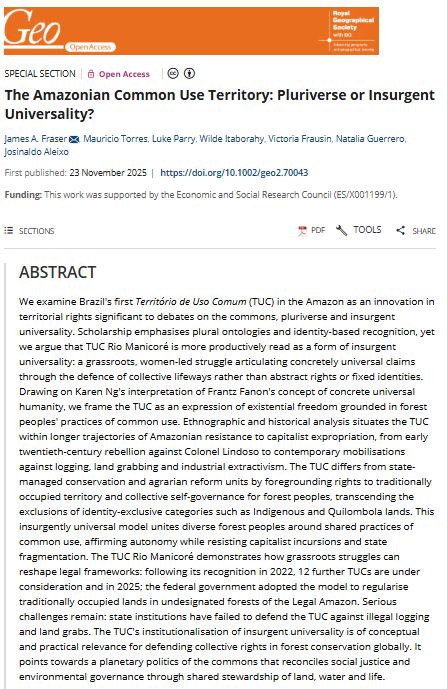
Screenshot of a paper abstract in Geo: Geography and Environment by James A. Fraser, Mauricio Torres, Luke Parry, Wilde Itaborahy, Victoria Frausin, Natalia Guerrero & Josinaldo Aleixo (2025) entitled: 'The Amazonian Common Use Territory: Pluriverse or Insurgent Universality?' with an orange banner at the top.
New in Geo:
'The Amazonian common use territory: Pluriverse or insurgent universality?' by @jfraser.bsky.social et al.
This paper analyses Brazil's first Território de Uso Comum, drawing on Karen Ng's interpretation of Fanon's concept of concrete universal humanity.
doi.org/10.1002/geo2...
03.12.2025 12:33 — 👍 5 🔁 3 💬 0 📌 0

Editorial Assistant for RGS-IBG Journals | Job vacancy
An exciting opportunity to develop a greater understanding of the academic peer review and publishing process. Part time, six-month fixed term contract.
🚨 Job opportunity🚨
We are looking for an editorial assistant to work with me on the RGS journals (TIBG, The GJ, Area & Geo) as we move online systems.
🗓6 months fixed term
🕑0.4 FTE
📍Remote working option
❗️Closing date 11th Dec
Please share & apply! Happy to answer Qs.
www.rgs.org/about-us/wor...
01.12.2025 15:58 — 👍 7 🔁 16 💬 1 📌 2

ABSTRACT
How climate change is narrated matters. Every story that is told of climate change contains its own causes of the problem, its own solutions and its own vision of the future. This article juxtaposes two stories: the dominant story of climate change as represented by the IPCC and a counter-story of climate change as ‘imperial mess’. This language comes from Alice Te Punga Somerville and her book Two Hundred and Fifty Ways to Start an Essay About Captain Cook (2020). In this book, Te Punga Somerville writes about colonialism in Aotearoa and the Pacific as a story that can be told in endless different ways, with each story drawing out different elements. Number 223 of her project, ‘In Montebello Islands’, discusses the British nuclear weapons testing programme. The tests were called ‘Operation Hurricane’, and Te Punga Somerville writes that the whole imperial mess of the past five centuries could be called “Operation Hurricane”. This article takes this claim as a prompt, both methodologically and theoretically, in order to argue that climate change needs to be understood in a historically and geographically informed way, where the colonial history becomes the present, coloniality and resistance entwine and the ‘way out of the mess’ has to be found in a fight against the entirety of Operation Hurricane. The contribution of the article is twofold: First, this article contributes to literatures that understand climate change as a historical process of imperial violence, by directly addressing what this changes about an analysis of climate politics. Second, it contributes to critiques of the IPCC by showing how its approach depoliticises climate change through the way it narrates and communicates climate science as separate from historical and structural processes.
Today is my first day in my new job at the Uni of Manchester, and I have a new article to share!
‘Operation Hurricane’: Narrating Climate Change as Imperial Mess.
This article is something a bit different, playing with format to explore why climate storytelling matters.
doi.org/10.1002/geo2...
01.12.2025 08:25 — 👍 56 🔁 15 💬 4 📌 1

Screenshot of a paper abstract in Geo: Geography and Environment by Dennis Schüpf & Jonas Hein (2025) entitled: 'Adapting to Uncertainty: Knowing Shifting Sands and Blue Infrastructure in Unpredictable Seas' with an orange banner at the top.
🌊New in Geo🌊
'Adapting to uncertainty: Knowing shifting sands and blue infrastructure in unpredictable seas' by @dennis228.bsky.social & Jonas Hein
This paper is part of an ongoing Special Section: Blue Infrastructures: Mapping the visual while unpacking the unseen'.
doi.org/10.1002/geo2...
28.11.2025 12:09 — 👍 3 🔁 0 💬 0 📌 0

Screenshot of a paper abstract in Geo: Geography and Environment by Mingcan Rong (2025) entitled: 'Cultivating Scientific Authority: A Vegetal Geography of Chinese Rhododendrons at the Royal Botanic Garden Edinburgh' with an orange banner at the top.
This paper presents a vegetal geography of Chinese rhododendrons at the Royal Botanic Garden Edinburgh (RBGE), examining the mechanisms through which RBGE's scientific authority is established in the field of Rhododendron research and conservation. Building on the geographical conceptualisation of relational plant agency, this paper extends it by illustrating that attending to the rhododendron–people–environment relationship sheds light on the ecological–political nature of the Rhododendron species at RBGE, the broader historical contexts that stimulate the accumulation, and the environmental conditions that encourage the maintenance. Drawing on interviews, observation and document analysis, I illustrate the contribution and labour of the underappreciated Chinese collectors in the historical botanical exploration, discuss rhododendron's ‘plantiness’ and examine RBGE's contemporary activities that aim to accumulate and sustain the ex situ rhododendrons both materially and epistemically. I argue that the scientific authority of RBGE has been shaped by the semi-colonial history of China after the First Opium War ending in 1842, the encounters between British botanists and local collectors, as well as RBGE's intentional accumulation and maintenance of rhododendrons and related knowledge, all of which are mediated by rhododendrons' agency and continue to influence today's conservation dynamics.
🌺New in Geo🌺
'Cultivating scientific authority: A vegetal geography of Chinese rhododendrons at the Royal Botanic Garden Edinburgh' by @mingcan-rong.bsky.social
doi.org/10.1002/geo2... #geosky
27.11.2025 15:56 — 👍 8 🔁 4 💬 3 📌 0
the moment when you can fangirl your friends 😎🥰 way to go @johannatunn.bsky.social 🔥
26.11.2025 17:51 — 👍 3 🔁 3 💬 0 📌 0
Excited to share my first PhD paper which was based on my fieldwork at @thebotanics.bsky.social and just published on @geoopenaccess.bsky.social yesterday! 🌺
21.11.2025 14:09 — 👍 20 🔁 9 💬 3 📌 0

Screenshot of a paper abstract in Geo: Geography and Environment by Johanna Tunn (2025) entitled: 'Epistemic Violence in Global Climate Governance: The Case of Climate Finance in Vanuatu' with an orange banner at the top.
This paper explores mechanisms of epistemic violence enacted through the climate finance (access) industry in Vanuatu, shedding light on the colonial inflictions of multilateral green funds in global climate governance. While the climate crisis is a reality in Vanuatu, its access to direct climate finance remains constrained, as it is not an accredited entity to any of the major climate funds. This serves as a gateway for a growing climate finance (access) industry that has established itself across the Pacific and in Vanuatu. Using an action-theoretical perspective that centres acts of doing epistemic violence, this paper identifies four mechanisms of epistemic violence enacted through Vanuatu's climate finance (access) industry: distortion via the mistranslation of realities; imposition via rendering people and regions investable; devaluation via rendering people incapable and exploitation through the extraction of knowledges and exhaustion of resources. Rather than improving access and equity for frontline communities, this paper elaborates that epistemic violence remains the modus operandi of Vanuatu's climate finance (access) industry—and is thus complicit in the perpetration of physical violence in the form of losses and damages, ecocide and epistemicide. Dismantling this system would at least require the islanding of climate finance, emphasising local agency and self-determination over externally imposed, extractive models.
🏝️New in Geo!🏝️
'Epistemic violence in global climate governance: The case of climate finance in Vanuatu' by @johannatunn.bsky.social
This paper is part of an ongoing Special Section: 'Political Ecologies of Islands: Environmental & Climate (In)Justices'.
doi.org/10.1002/geo2... #geosky
19.11.2025 14:27 — 👍 10 🔁 4 💬 0 📌 1
Always good to read something by @ckweatherill.bsky.social
18.11.2025 13:33 — 👍 2 🔁 2 💬 0 📌 0