Wow, what a great image! Absolutely love it! I don't know the region that well, but there even seems to be galactic cirrus 😍
04.02.2026 21:36 — 👍 1 🔁 0 💬 1 📌 0

PuWe 1 is one of the largest and faintest planetary nebula known. Its apparent size almost reaches that of a full moon! It lies in the constellation of Lynx at a distance of about 1200 light years.
PuWe 1 captured from my dark site in southern France 🇫🇷 😊🔭
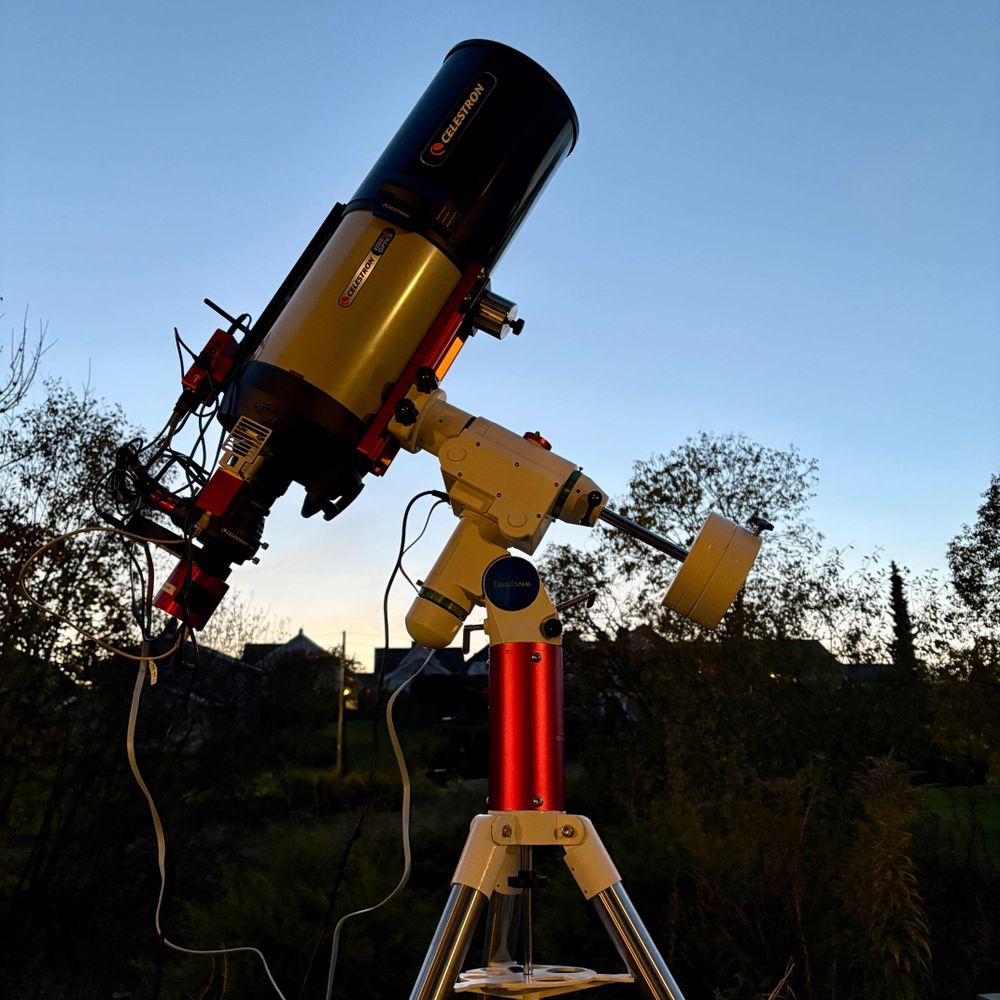
This was shot on the EdgeHD 8 with Hyperstar at f/2 for a total integration time of about 6.5 hours using an OSC cam with the Baader UHCL filter.
PuWe 1 is one of the largest and faintest planetary nebula known!
#Astrophotography
04.02.2026 19:49 — 👍 66 🔁 10 💬 6 📌 0
Thank you, Phillip! 😊
Was also surprised about all the details, but I think I still need to sharpen a bit more...
04.02.2026 06:42 — 👍 2 🔁 0 💬 0 📌 0
Thank you, Bernd! 😊
03.02.2026 22:05 — 👍 1 🔁 0 💬 0 📌 0

Foto des Supernova-Überrestes Messier 1 (Krebsnebel) im Sternbild Stier. Der Nebel zeigt viele grünliche und rötliche Filamente. Die Aufnahme entstand im Januar 2026 mit einer gekühlten Astrokamera (ASI294mc Pro) an einem Teleskop Celestron C8 mit insgesamt 6h 26min Belichtungszeit
The Crab Nebula (M 1) in the constellation Taurus was the second prominent supernova remnant that I captured this January. It is already visible with larger binoculars, but all the nice filaments only show up in the photo. Total integration: 6h 26min #astrophotography 🔭
@kat-astro-bot.bsky.social
03.02.2026 20:26 — 👍 71 🔁 10 💬 2 📌 1
Thank you, Phillip!
31.01.2026 10:02 — 👍 0 🔁 0 💬 0 📌 0
Thank you, Bernd! Has been quite challenging since the "normal" C8 produces a lot of deformed stars and background noise, but at least there is an image 🤣
30.01.2026 20:02 — 👍 1 🔁 0 💬 0 📌 0

Two-panel mosaic of the Jellyfish Nebula (IC 443) taken with an astro camera ASI294mc Pro through a telescope C8 with a total exposure time of 16,5 h.
The Jellyfish Nebula (IC 443), a prominent supernova remnant in the constellation Gemini, was my first attempt at a mosaic. The idea only came to me during data collection, but after some challenging editing, I am kind of happy with the result. 🔭 #astrophotography
@kat-astro-bot.bsky.social
30.01.2026 19:13 — 👍 64 🔁 20 💬 3 📌 1
Short timelapse of #comet C/2025 K1 (ATLAS) shows its movement within 1 hour. The comet is quite faint... #astrophotography 🔭
25.01.2026 20:45 — 👍 20 🔁 0 💬 0 📌 0

Foto des Kometen 24P/Schaumasse vom 17. Januar 2026, aufgenommen mit einer Astrokamera durch ein Teleskop. Der Komet zeigt eine große grüne Koma, ein Schweif ist nicht zu erkennen.

Foto des Kometen C/2025 K1 (ATLAS) vom 26. Dezember 2025, aufgenommen mit einer Astrokamera durch ein Teleskop. Der grünliche Komet zeigt einen langen Schweif und zwei Kernfragmente
Currently, several weaker comets are at least bright enough to be photographed. I captured 24P/Schaumasse on 17 January and the fragmented #comet C/2025 K1 (ATLAS) back on 26 December 2025. Their very different appearances are definitely worth further observation #astrophotography 🔭
25.01.2026 19:59 — 👍 52 🔁 8 💬 1 📌 0
A short time-lapse of yesterday's bright northern lights in the Harz foothills. I'm still thrilled by yesterday's spectacular views – today's #aurora is significantly weaker... #AuroraBorealis #Polarlicht #astrophotography 🔭
20.01.2026 22:33 — 👍 102 🔁 14 💬 0 📌 0
Crazy #AuroraBorealis last night at latitude <52° N, even hitting Orion in the southern sky above the Harz mountains. What a night! #astrophotography 🔭
20.01.2026 07:55 — 👍 56 🔁 7 💬 0 📌 0
🤣 Da hat sich Deine Ausdauer echt ausgezahlt!
17.01.2026 22:53 — 👍 1 🔁 0 💬 0 📌 0

The Spider Nebula is an emission nebula with an embedded open star cluster.
Sh2-234 is located in the constellation of Auriga (Charioteer) at an estimated distance of about 7,500 light years away from Earth.
Sh2-234 (IC 417) The Spider Nebula captured from my patio on six nights in December 😊🔭
It was shot on the EdgeHD 8 for a total integration time of about 50 hours in mono using Ha, SII and OIII narrowband filters and combined with RGB stars.
#Astrophotography
17.01.2026 19:43 — 👍 86 🔁 17 💬 10 📌 2
Klasse, Bernd! Ein tolles Objekt, da hat sich die viele investierte Zeit wirklich gelohnt 👏🏻
17.01.2026 22:44 — 👍 1 🔁 0 💬 1 📌 0
Thank you!
13.01.2026 13:31 — 👍 0 🔁 0 💬 0 📌 0
Vielen Dank, Stefan!😊
13.01.2026 09:00 — 👍 1 🔁 0 💬 0 📌 0
Danke Dir! 😊
13.01.2026 06:44 — 👍 1 🔁 0 💬 0 📌 0
Thank you!😊
I only worked with Photoshop Elements, took one shot as background image, added all other shots as layers, aligned them with the stars and drew layer masks that only kept the meteor of that shot.
12.01.2026 23:07 — 👍 1 🔁 0 💬 0 📌 0
😍
12.01.2026 22:47 — 👍 0 🔁 0 💬 0 📌 0
Thank you! I love your image from 2021, must have been a great night
12.01.2026 22:17 — 👍 2 🔁 0 💬 0 📌 0
Thank you, Bernd!
12.01.2026 21:56 — 👍 1 🔁 0 💬 0 📌 0
Wow 😊
12.01.2026 21:56 — 👍 0 🔁 0 💬 1 📌 0
Glaube, ich hatte ein paar doppelte dabei 😉
12.01.2026 20:45 — 👍 1 🔁 0 💬 0 📌 0
🤞🏻🤞🏻🤞🏻
12.01.2026 20:44 — 👍 1 🔁 0 💬 0 📌 0
Thank you!🙏
12.01.2026 20:39 — 👍 0 🔁 0 💬 1 📌 0

Komposit aus 61 Aufnahmen des Sternenhimmels mit 65 Meteoren, aufgenommen in der Nacht vom 13. zum 14. Dezember 2025 während des Maximums der Geminiden. Im Vordergrund sind Bäume und eine Wiese zu sehen.
Finally, here is my composite image of the #Geminids peak on 13/14 December 2025. It was by far my most successful observation of a #MeteorShower, with over 260 meteors within 5 hours - what a night! The image is a composite of 61 individual shots of 15s and contains 65 Geminids. #Astrophotography 🔭
12.01.2026 20:28 — 👍 141 🔁 27 💬 9 📌 1
Thank you 😊
10.01.2026 18:47 — 👍 2 🔁 0 💬 0 📌 0
Thank you, Kat!☺️
30.12.2025 15:56 — 👍 1 🔁 0 💬 0 📌 0
Danke!😊
30.12.2025 14:25 — 👍 1 🔁 0 💬 0 📌 0
European with a German accent.
Beruflich was mit Kommunikation und KI-Forschung.
Posts auf Deutsch, in English et parfois même en français.
Essen, Brüssel, Saarbrücken, Paris, Frankfurt, Berlin.
Covid warrior, for the duration. Scientist. 💙
🇦🇹🇵🇱Geologist, field work enthusiast with a weakness for thrust belts; tectonics & structural geology group leader at Uni Jena, Germany, www.structures.uni-jena.de. Layman interested in many natural phenomena.
Nyctophilic. Night,Astroscapes & Meteo
https://www.marinaprol.com
Home of Astrophotography since 2011.
Retired. Astronomer, Naturalist, Geologist. STEM Ambassador, Aeromodeller.
www.mad-science.org.uk for fun
🇧🇪 in 🇲🇨 Happy birder and nature enthusiast, innovation & data-viz, biodiversity & sustainability.
Specialist Director
Norwegian Institute of Public Health.
Personal posts, not employer’s views.
https://orcid.org/0000-0001-5909-7917
Teacher, Philosopher, Local Patch Birder (private acc)
Founded #LocalPatchClub: Students habitually visit nature on their doorstep. Stay where you are and marvel at the small wonders of nature and the soul.(Peter)
#lowcarbonbirding #jazz #poetry #astronomy
Huntress of moments in the sky & on 🌍
Outdoor.Dogs.Aurora.AlpenAdria.Gardening.Food.
>CleanIndoorAir!<
Amateur Chef de vegetarian & vegan cuisine.
CustomerCentricity | Leadership |
CleanAir, Outdoor & Veggie Food Business-Projects welcome
Monticola saxatilis, el Roxu. Fotos de pájaros y otros bichos. #pajareo #birds
Plager alle med amatørmessige astrofacts i tide og utide.
HansP, Nordre Follo 🇳🇴
Entwickelt Elektromotoren. Gerne in der Natur unterwegs, am liebsten im Wald und in den Bergen. Wieder häufiger mit Kamera. Papa von K1 und K2 (Nestmodell).
Ecke Oberschwaben/Bodensee/Allgäu
Kein Platz für Nazis!
Header von @ju1es.bsky.social - danke!
Ben vaak met de hobby sterrenkunde druk,
https://sterrenwachtkreeft.nl .
BEKIJK : www.astronomie.nl .
My Portfolio: https://portfolio.pixelfed.social/JoeGarrity
Por el día hago ciencia de materiales en el ICMSE del CSIC y por la noche astronomía en el TFP Observatory. Aficionado, siempre...
Photon collector - Science will win!
Astrophysicist & photographer in Brighton.
🌿 Doğa aşığı | 📷 Objektifimden kareler
🇹🇷 Atatürkçü | 🐾 Hayvansever | 🤝 Dost canlısı
❤️ Vatan sevgisiyle
📸 Tüm fotoğraflar bana aittir
👨👩👧 Evli | Bir kız babası