Why did consciousness evolve at all? A superb special issue of @royalsocietypublishing.org brings together experts across disciplines to explore the functions of consciousness and why it emerged in some species but not others. @tecumsehfitch.bsky.social royalsocietypublishing.org/rstb/issue/3...
08.02.2026 12:47 — 👍 131 🔁 50 💬 5 📌 3

Could the logic of life be shaped by the architecture of biological circuitry? In this paper, @manlius.bsky.social shows how genetic, metabolic, and social networks can govern slow evolutionary dynamics in a unified nonequilibrium framework. iopscience.iop.org/article/10.1...
07.02.2026 12:34 — 👍 40 🔁 8 💬 1 📌 2
Non-invasive brain surface stimulation targeting personalized SCAN alleviated symptoms in patients with Parkinson’s disease. See the videos below.(www.nature.com/articles/s41...)
05.02.2026 02:08 — 👍 13 🔁 14 💬 2 📌 0
#ProtistsOnSky
no 'swimming' by 𝘝𝘢𝘮𝘱𝘺𝘳𝘦𝘭𝘭𝘢, definitively no 'staying still'. just a relaxed walk towards the lunch...
02.02.2026 00:00 — 👍 177 🔁 68 💬 5 📌 4
This is happening today.
05.02.2026 09:01 — 👍 2 🔁 0 💬 0 📌 0

The evolutionary potential of symbiosis
Abstract. Symbiosis is considered a source of evolutionary innovation. Example innovations that have evolved in symbioses include new organs, morphological
New perspective on the evolutionary potential of symbiotic interactions!
Is there something special about symbiosis that leads to new traits and adaptations? If so, how would we know and how would this work?
academic.oup.com/jeb/advance-...
03.02.2026 16:08 — 👍 24 🔁 9 💬 0 📌 0
Why don’t neural networks learn all at once, but instead progress from simple to complex solutions? And what does “simple” even mean across different neural network architectures?
Sharing our new paper @iclr_conf led by Yedi Zhang with Peter Latham
arxiv.org/abs/2512.20607
03.02.2026 16:19 — 👍 151 🔁 41 💬 7 📌 3

Iranians are experiencing a collective trauma. Thousands have been killed/injured in recent events, the economy is crippled & the threat of a wider conflict is real. This is especially difficult for those living in Iran, as many have lost (or fear losing) loved ones. www.nature.com/articles/d41...
03.02.2026 14:11 — 👍 67 🔁 32 💬 1 📌 6
Infants organise their visual world into categories at two-months-old! So happy to see these results published - congratulations Cliona and the rest of the FOUNDCOG team.
02.02.2026 16:39 — 👍 30 🔁 3 💬 1 📌 0

This Thursday (Feb 5th) we're hosting Dr. Salvador Durá-Bernal with a talk on “Large-scale biophysical models of neuronal circuits to study brain function and disease”.
Here's the registration link and the abstract:
cam-ac-uk.zoom.us/meeting/regi...
02.02.2026 16:49 — 👍 5 🔁 1 💬 0 📌 1

The Good Research Code Handbook
This handbook is for grad students, postdocs and PIs who do a lot of programming as part of their research. It will teach you, in a practical manner, how to organize your code so that it is easy to...
Discovered @patrickmineault.bsky.social's excellent Good Research Code Handbook today, which was always awesome, but is even more necessary as more scientists consider integrating coding agents into their workflows.
goodresearch.dev
31.01.2026 20:29 — 👍 16 🔁 5 💬 1 📌 0
YouTube video by MIT Consciousness Club
George Mashour - Consciousness and the Dying Brain
The recording of George Mashour's talk "Consciousness and the dying brain" is now available: www.youtube.com/watch?v=dz7o....
28.01.2026 01:29 — 👍 26 🔁 7 💬 0 📌 0

Are episodic and semantic memory really that different? Using closely matched tasks, we found no substantial neural differences between recalling personal experiences and general knowledge: https://www.nature.com/articles/s41562-025-02390-4
29.01.2026 11:01 — 👍 42 🔁 22 💬 0 📌 3

This is what an engineer would typically do: to build a robot, one would design perception modules, typically one per sensory modality, planning modules, and motor control modules (but see Brooks (1986) for an alternative way of building robots). The reasons for this modularity are cognitive and social. Cognitively, this allows one to focus on one simple problem at a time, following Descartes’ rule of analysis (Descartes, 1637): to divide the problem into smaller, more intelligible, pieces ("Diviser chacune des difficultés que j'examinerais, en autant de parcelles qu'il se pourrait et qu'il serait requis pour les mieux résoudre"). Socially, it also allows work to be divided between different people, or even different companies: one in charge of each module. These modules can then be reused in different contexts, different machines that combine modules in new ways. For this to work, the input-output properties of modules are well-specified, for example by stating that a module’s output represents sound direction. What the output represents should not depend on the context in which the module is embedded.
Thus, there are excellent reasons for engineers to use modular design. But brains are not made by people, let alone by human societies. However appealing the functional argument for computational modularity might be, it is hard to reconcile with the known physiology and anatomy of nervous systems.
Brain modularity is a concept inspired by how we make machines. But brains are not made by people.
press.princeton.edu/books/paperb...
28.01.2026 08:30 — 👍 23 🔁 5 💬 2 📌 1
PNAS
Proceedings of the National Academy of Sciences (PNAS), a peer reviewed journal of the National Academy of Sciences (NAS) - an authoritative source of high-impact, original research that broadly spans...
New paper out at PNAS: www.pnas.org/doi/10.1073/...
Revisiting the high-dimensional geometry of population responses in the visual cortex with @jpillowtime.bsky.social. The review took forever because a reviewer was doubtful our new estimator can infer eigenvalues beyond the rank of the data! (1/6)
27.01.2026 16:34 — 👍 69 🔁 19 💬 2 📌 2


Postdoc position in Paris: come help develop new generation human brain computer interfaces ⚡🧠💻
Interested? Contact me if you have experience with machine learning (e.g. simulation-based inference, RL, generative/diffusion models) or dynamical systems.
See below for + details and retweet 🙏
27.01.2026 22:12 — 👍 75 🔁 56 💬 3 📌 5


We could all use some extra stress #resilience rn. But how does it work in the brain? On the surface, resilience looks like ignoring stress. Does the brain fail to respond? Or are active adaptations required? Or are resilience and susceptibility divergent paths? doi.org/10.1016/j.celrep.2025.116867
24.01.2026 13:14 — 👍 60 🔁 19 💬 6 📌 0

Happy to share our preprint with @neworderofjamie.bsky.social , @danakarca.bsky.social and @drtnowotny.bsky.social !
We’ve been working on a neuron position learning algorithm by coupling space and time! See manuscript below 👇
27.01.2026 12:02 — 👍 16 🔁 8 💬 1 📌 0

Nine subcortical/cerebellar atlases included in the subcortex_visualization Python package (and subcortexVisualizationR package in R). The atlases are depicted in two-dimensional vector graphic format.
The extended version of my thesis procrastination project/subcortex visualization package is out now in both Python and R, now that I’ve graduated 🤠 This figure shows the 9 atlases included (and counting)!
Preprint: www.biorxiv.org/content/10.6...
Website: anniegbryant.github.io/subcortex_vi...
27.01.2026 03:04 — 👍 111 🔁 46 💬 3 📌 5

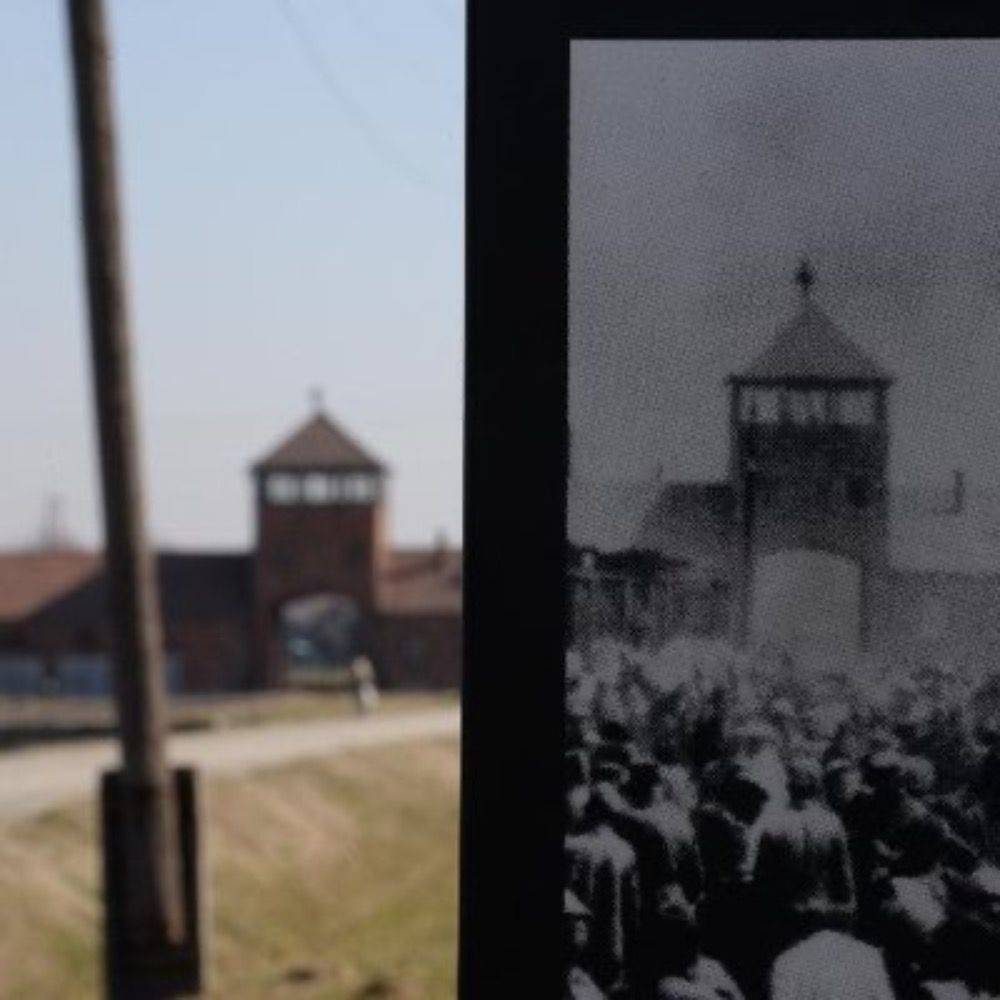
A bird's-eye view of a former Auschwitz II-Birkenau camp showing a wide dirt pathway flanked by parallel rows of barbed-wire fences. Groups of visitors walk along the path, surrounded by the remnants of brick structures and barracks, now reduced to foundations. Green grass contrasts with the somber history of the site, as the path leads toward a guard tower in the distance.
Auschwitz was at the end of a process. We must remember that it did not start from gas chambers.
This hatred gradually developed: from ideas, words, stereotypes & prejudice through legal exclusion, dehumanization & escalating violence... to systematic and industrial murder.
Auschwitz took time.
27.01.2026 11:00 — 👍 11981 🔁 5905 💬 236 📌 344

Decoding behavior with minimal and interpretable agent models www.biorxiv.org/content/10.6... Some days I wake up feeling like a minimal agent model
24.01.2026 11:34 — 👍 17 🔁 3 💬 1 📌 0
"The accounts from the massacre in Mashhad, Iran’s second-most populous city, are a small window into one of the most lethal government actions the Iranian regime has taken in recent history."
22.01.2026 23:58 — 👍 8 🔁 1 💬 2 📌 0

Anatomical White Matter Tracts Span the Cortical Hierarchy to Support Cognitive Diversity | bioRxiv www.biorxiv.org/content/10.6...
23.01.2026 04:22 — 👍 5 🔁 1 💬 0 📌 0

🚨 New paper from @comunelab.bsky.social ! 🧪🧠
If you do connectome analysis from correlations, you’re probably averaging at some point (and you probably don't give it much thought).
But when is it OK?
👉 www.nature.com/articles/s42...
🧵 1/
22.01.2026 07:51 — 👍 17 🔁 7 💬 1 📌 0
Reminder that this is happening today.
22.01.2026 09:12 — 👍 4 🔁 1 💬 0 📌 0

Data-Driven Analysis Reveals Three Archetypes Of Armed Conflicts
New CSH study identifies systematic patterns in armed conflicts across Africa – and the limits of forecasting conflict intensity, duration, or fatalities.
New study examines 20+ years of armed conflict data across Africa. Researchers @kushwaha.bsky.social and @spintheory.bsky.social identify three conflict archetypes, but also show that classification does not necessarily help to predict the severity of conflicts.
Learn more: shorturl.at/81pkf
21.01.2026 10:14 — 👍 2 🔁 2 💬 0 📌 0

What kinds of cognitions are possible? Are there discrete classes of cognition? Here's our new paper with @brigan.bsky.social @jordiplam.bsky.social @mitibennett.bsky.social @mkhochb.bsky.social and @drmichaellevin.bsky.social arxiv.org/abs/2601.12837 We explore basal, neural and human-AI spaces.
21.01.2026 10:06 — 👍 64 🔁 25 💬 1 📌 0
Complexity scientist studying ecology and synthetic ecosystems.
Astrophysicist at the University of Cambridge. Research interests include massive star evolution, core-collapse supernovae and other related phenomena. 🌌
Research scientist at Google in Zurich
http://research.google/teams/connectomics
PhD from @mackelab.bsky.social
Former German Nazi concentration & extermination camp Auschwitz. Official account. We commemorate victims, educate about history & preserve the authentic site.
www.auschwitz.org | lesson.auschwitz.org | podcast.auschwitz.org
PhD student in cognitive neuroscience @University Medical Center Hamburg-Eppendorf (UKE)
Cognitive, Systems and Computational Neuroscientist, Professor at UC Berkeley, and lab head. Check out our lab web site http://gallantlab.org For the latest news, publications, brain viewers, code and tutorials, and data.
Neuroscientist and cell biologist. Investigator of the Zuckerman Mind Brain Behavior Institute (ZMBBI) in New York
🧠👨🔬 Postdoc UKE Hamburg - attention, decision-making & large-scale dynamics
Twitter: @itSiemsThatWay
Official account of the Portugues Lab @Cornell (previously @TUM), studying all things sensorimotor in larval zebrafish.
Professor, Northwestern University
Computational neuroscience | Neural manifolds
phd @ cambridge
social media | psychiatry | anthropology
co-parenting the @cognitations.bsky.social podcast
website: https://tinyurl.com/t-katiyar
How are biological forms encoded? Group leader at IBDM Marseille, director of Turing Center for living systems (CENTURI). Professor at Collège de France, Paris: Dynamics of living systems
Assistant professor at the Haifa University, interested in how Humans smell, breathe, remember and recall their world.
Neuroscience, Sleep, Imaging - Teacher @ LPI - Researcher @ CNRS and Atip-Avenir Emerging Group Leader @ Paris Brain Insitute
Cracking the code for cognition.
Doctoral researcher at the University of Tuebingen, studying neural interactions in the Medial Temporal Lobe for high-level visual processing using human intracranial recordings
MD/PhD neuroscientist/psychiatrist, father of 3, Nak Muay, engineer at heart. mPFC-HPC interactions in addiction/schizophrenia, multi-region ephys and imaging in vivo, gene therapy, novel optical methods for spatial transcriptomics https://sjulsonlab.org
PhD in Schuck lab @ Uni Hamburg | cognitive computational neuroscience | learning about learning | would choose cheese over chocolate