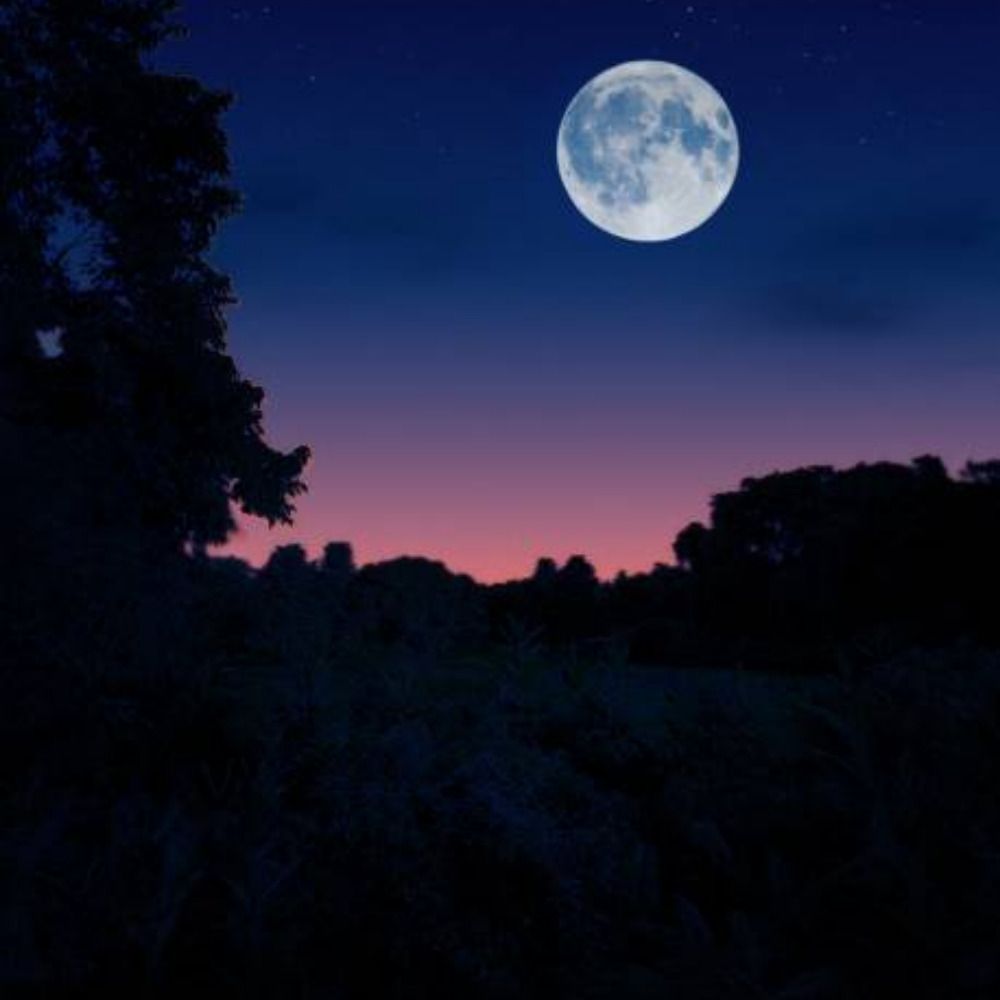
Additional frame for the light echo originating from the #Cassiopeia A (a #supernova remnant) was released.
#JWST NIRCam 🔭 filter F444W
program: www.stsci.edu/jwst-program...
30.09.2025 20:09 — 👍 84 🔁 15 💬 1 📌 4

James #Webb Space Telescope #JWST
NIRCam observations of a star forming nebula and young cluster
TARG: #MACSJ1931-2635
DATE: 2024-09-06
PI: Garcia Marin, Macarena
NIRCAM f444w f335m f200w f187n f090w
mast.stsci.edu/portal/Mashu...
NASA/ESA/CSA/STScI/j. Roger
05.09.2025 15:02 — 👍 49 🔁 15 💬 3 📌 2

Patricia Lockwood · Diary: Back to the Rectory
It was our first visit to Kansas City since before the election and the rectory seemed to have grown smaller, darker,...
This really is exceptional writing by Patricia Lockwood in the current LRB, concerning her father and her country, or what little apparently remains of either:
www.lrb.co.uk/the-paper/v4...
10.08.2025 21:35 — 👍 6 🔁 2 💬 0 📌 0

(PDF) How Not to Lie with Visualization
PDF | How data are presented visually has a powerful effect on the perception and interpretation of the structure in those data. This article addresses... | Find, read and cite all the research you ne...
So rainbow palettes that have been designed to have smooth transitions and reduced dark/light/dark transitions may be the best of both worlds.
*If* you have normal color vision.
Here’s the classic #endrainbow paper: www.researchgate.net/publication/...
A rebuttal: www.computer.org/csdl/magazin...
05.08.2025 22:27 — 👍 3 🔁 1 💬 1 📌 0

www.rolfolsenastrophotography.com
NGC 6188 is a large emission nebula located some 4000 light years distant in the southern constellation Ara. This giant molecular cloud is being illuminated by the young star cluster NGC 6193 which in this image appears in the upper centre, almost as if suspended above a cloud of dense nebulosity which forms a great wall across the field of view.
The cluster belongs to the Ara OB1 association and is very young, not older than 3 million years, and contains some 30 stars. At the centre of the cluster lies an intensely bright pair of stars; the O-type giants HD 150135 and HD 150136. The latter is in fact itself an extremely close binary with a confirmed third component in an outer eccentric orbit of between 2950 and 5500 days. This triple star system is one of the most massive in our galaxy with the three components containing 64, 40 and 35 solar masses respectively.
The intense radiation from the massive stars is slowly eroding the surrounding gas and dust away, sculpting it into the striking forms seen in this image. Within these clouds new stars are currently being born and in some places have already begun to light up the nebulous clouds from within. The intricately shaped dust and gas provide for a stunning interplay of light and shadow throughout the area and the entire scene is littered with thousands of dimmer stars in a multitude of colours. Especially in the lower part of the image several long shadows can be seen cast by the glo...
The Great Wall of Ara - NGC 6188 (Narrowband Colour) - From Rolf Wahl Olsen - https://flic.kr/p/Vv4rYE
13.05.2025 22:00 — 👍 141 🔁 28 💬 0 📌 0

Scientific discovery in a model-centric framework: Reproducibility, innovation, and epistemic diversity
Consistent confirmations obtained independently of each other lend credibility to a scientific result. We refer to results satisfying this consistency as reproducible and assume that reproducibility i...
Six years ago, we published a (thus far underappreciated) study where we showed how scientific communities may generate a literature populated by irreproducible results or may converge on many perfectly reproducible yet false findings *in the absence of QRPs*, challenging popular narratives.
16.03.2025 17:31 — 👍 186 🔁 49 💬 10 📌 12
Another look at Westerlund 2, such a wonder
16.03.2025 07:27 — 👍 11 🔁 2 💬 0 📌 0
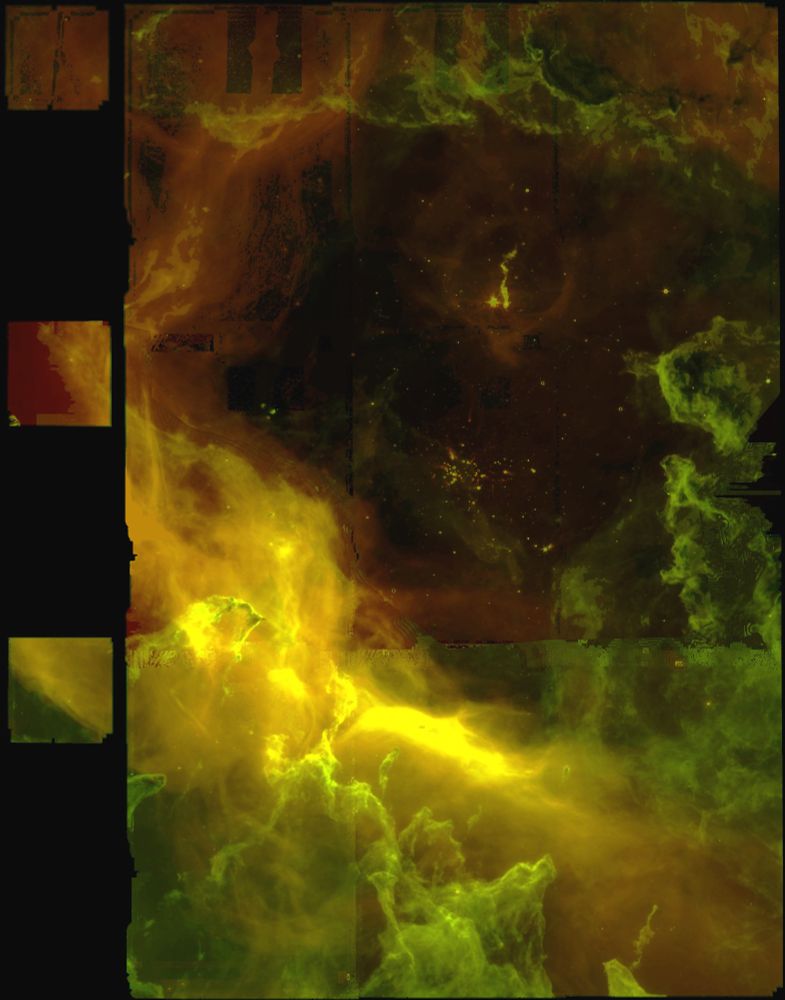
A MIRI (Mid-Infrared Instrument) image of the Westerlund 2 star-forming region featuring a complex nebula with bright yellow and green emission, revealing intricate structures and dark areas. The image is presented in a mosaic format with separate panels.
New MIRI data of Westerlund 2 was released earlier.
Data processed by @yuvharpaz.bsky.social
nerdculture.de/@yuvharpaz/1...
05.03.2025 20:44 — 👍 221 🔁 27 💬 2 📌 0

The images in this gallery are the first amateur images of light echoes from the 19th-century Great Eruption of Eta Carinae. These light echoes have been detected by the Hubble Space Telescope and from large observatories such as the CTIO 4m telescope, but this is the first time that amateur images reveal these transient features. My other first amateur detection of light echoes from supernova SN1987a inspired me to try looking for the fainter echoes near Eta Carinae.
What are Light Echoes?
Light echoes occur when the initial flash from a bright source, like a supernova, is reflected back to us from a slightly different direction. Dust clouds in interstellar space reflect a portion of the outward-traveling light from the supernova, redirecting it towards Earth. These faint light echoes can be observed decades or centuries after the original flash. Swiss astronomer Fritz Zwicky, known for his contributions to supernovae, neutron stars, dark matter, and gravitational lenses, predicted the existence of light echoes as early as 1940. Together with Walter Baade, he coined the term 'supernova' in 1934 and proposed that faint echoes of historical supernovae could be visible long after the initial explosion.
The Great Eruption was a significant brightening of the star Eta Carinae that occurred in phases during the mid-19th century.
The light echoes are produced when the initial flash from the eruption is subsequently reflected off interstellar dust as light travels outward from ...
Widefield Animation: First Amateur Detection of Light Echoes from 19th-Century Great Eruption of Eta Carinae - From Rolf Wahl Olsen - https://flic.kr/p/2pqijB2
10.03.2025 15:00 — 👍 19 🔁 3 💬 0 📌 0
Theory-freedom is an incoherent ideal for scientific objectivity and one which harms the integrity of science.
08.03.2025 21:29 — 👍 48 🔁 12 💬 4 📌 3
Machine Learning in Science
“I have argued that the notion that widespread adoption of the methods of ML in science will obviate the need for theorising is 1. widespread, 2. symptomatic of a theory-free ideal in science, and 3. untenable.”
10.03.2025 13:42 — 👍 30 🔁 6 💬 4 📌 1
The restaurant at the beginning of the universe: Natural scientists on ultimate reality, science, and religion | Religious Studies | Cambridge Core
The restaurant at the beginning of the universe: Natural scientists on ultimate reality, science, and religion
Our qualitative study with natural scientists on ultimate reality has been published. We look at the influence of religious background and disciplinary field, as well as inspiration from humanities. Care for the planet an enduring concern. Read it open access here! Thank you to participants
07.03.2025 15:27 — 👍 286 🔁 84 💬 15 📌 15
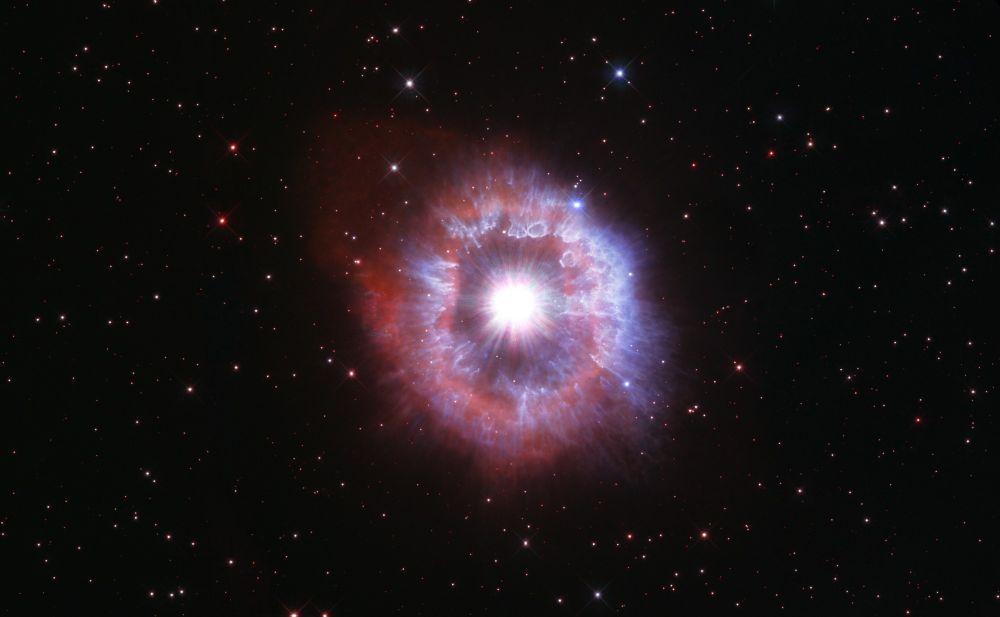
In celebration of the 31st anniversary of the launch of the NASA/ESA Hubble Space Telescope, astronomers aimed the celebrated observatory at one of the brightest stars seen in our galaxy to capture its beauty.
The giant star featured in this latest Hubble Space Telescope anniversary image is waging a tug-of-war between gravity and radiation to avoid self-destruction. The star, called AG Carinae, is surrounded by an expanding shell of gas and dust. The nebula is about five light-years wide, which equals the distance from here to our nearest star, Alpha Centauri.
Hubble's 31st anniversary image of AG Carinae.
Credit:
NASA, ESA and STScI
esahubble.org/images/heic2...
06.03.2025 21:28 — 👍 773 🔁 90 💬 8 📌 1

A star forming region with a huge gas structure. The gas appears red and orange, with some beige veil all occupying the whole picture. On the bottom left, a bubble like structure can be seen: it has been carved by stellar winds of young massive stars. Hundreds of dots can be seen everywhere: they are stars!

A focus on the bubble structure: dozens of stars can be seen, with two of them being bigger than the rest. Some pillars can be spotted in the gas structure, this is where new stars are being born.
In these dark times, I will continue to brighten your TL with some astronomy pics! 🔭
This is N159, a star forming region in the LMC, as seen by Hubble in 2014 (and processed by me obviously).
There are many beautiful details, such as these pillars in the bubble ✨
HD: flic.kr/p/2qK9yd7
05.02.2025 19:49 — 👍 1092 🔁 101 💬 14 📌 4

Gender Dysphoria, Children, And Moral Panics
What new data from the UK shows about trans children
My new piece looks at newly-published data from the Cass review and how it contradicts the document in many ways.
The review continues to be remarkably problematic and scientifically flawed.
gidmk.substack.com/p/gender-dys...
30.01.2025 23:19 — 👍 112 🔁 52 💬 3 📌 7

Today's view of Popocatepetl volcano in Mexico.
Image taken by Sentinel-2.
Visible light and enhanced SWIR.
30.01.2025 23:33 — 👍 14 🔁 3 💬 0 📌 0

A monochrome image of a complex space nebula, containing the "Keyhole Nebula" in the center and two Herbig-Haro objects
Center of this in a bit more detail (Hydrogen alpha wavelengths)
29.01.2025 01:05 — 👍 6 🔁 2 💬 0 📌 0

A region of space with several prominent HII structures, dark nebulas, reflection nebulas, star clusters and Herbig-Haro objects
This region near Orion Nebula is absolutely bonkers
29.01.2025 00:51 — 👍 160 🔁 12 💬 4 📌 0

www.rolfolsenastrophotography.com
NGC 6188 is a large emission nebula located some 4000 light years distant in the southern constellation Ara. This giant molecular cloud is being illuminated by the young star cluster NGC 6193 which in this image appears in the upper centre, almost as if suspended above a cloud of dense nebulosity which forms a great wall across the field of view.
The cluster belongs to the Ara OB1 association and is very young, not older than 3 million years, and contains some 30 stars. At the centre of the cluster lies an intensely bright pair of stars; the O-type giants HD 150135 and HD 150136. The latter is in fact itself an extremely close binary with a confirmed third component in an outer eccentric orbit of between 2950 and 5500 days. This triple star system is one of the most massive in our galaxy with the three components containing 64, 40 and 35 solar masses respectively.
The intense radiation from the massive stars is slowly eroding the surrounding gas and dust away, sculpting it into the striking forms seen in this image. Within these clouds new stars are currently being born and in some places have already begun to light up the nebulous clouds from within. The intricately shaped dust and gas provide for a stunning interplay of light and shadow throughout the area and the entire scene is littered with thousands of dimmer stars in a multitude of colours. Especially in the lower part of the image several long shadows can be seen cast by the glo...
The Great Wall of Ara - NGC 6188 (RGB Colour) - From Rolf Wahl Olsen - https://flic.kr/p/UNTpmj
21.01.2025 22:00 — 👍 58 🔁 19 💬 1 📌 0

Why Is Animal Consciousness Controversial? A Trialogue
Jonathan Birch
Abstract
A conversation between three characters: Credulus, who thinks conscious mental states can and should be attributed to other animals without any need for scientific inquiry; Skepticus, a critic with behaviorist leanings; and Moderus, who sees a middle path in the emerging science of animal consciousness.
I enjoyed my colleagues @birchlse.bsky.social's dialogue on animal consciousness. I think animals are conscious (it strikes me as just a bit barmy to deny as much being real) but I found SkepticBloke's arguments compelling. Fortunately arguments never change my mind tho.
philpapers.org/rec/BIRWIA-3
07.01.2025 12:13 — 👍 62 🔁 7 💬 3 📌 0


This image will be in the NASA calendar for 2025. One of the most detailed red sprites I have captured. Plasma physics is both beautiful and wild. Available as a print on my website for those who'd like to support my work
22.11.2024 23:48 — 👍 478 🔁 64 💬 12 📌 5
YouTube video by STAT
Why scientists are worried about three unusual cases of #H5N1 #birdflu in North America
The first hint I had that something was amiss in late December, 2019, was a post from @helenbranswell.bsky.social about a pneumonia of unknown etiology in Wuhan, China.
Here's Helen speaking about three recent, abnormal H5N1 cases. It's not panic time yet, but it's worth paying attention.
23.11.2024 05:51 — 👍 831 🔁 318 💬 39 📌 21
I’m sorry to report that Helmut Abt died today. He was the editor of The Astrophysical journal for 28 years, succeeding Chandrasekhar and preceding Rob Kennicutt.
23.11.2024 00:10 — 👍 28 🔁 6 💬 2 📌 1

A colorful space nebula in rich red, orange, teal and blue tones. There's some complex structures visible all around, notably something that looks a bit like a dead tree near the right center of the image, with star cluster Melotte 15.
I looked at my photon storage today and thought I'd revisit some photons I trapped on my driveway in 2022. You won't believe what happened next.
The core of the Heart Nebula (IC 1805) in Cassiopeia.
🧪🔭 #astrophotography
17.11.2024 23:11 — 👍 277 🔁 33 💬 2 📌 2
nyc-based programmer and designer. alum @recursecenter.bsky.social. public transit enjoyer. thoughts on local-first software, javascript frameworks, web components, css and other web minutiae.
🌐 https://jakelazaroff.com
Official account for Monthly Notices of the Royal Astronomical Society (MNRAS), Geophysical Journal International (GJI) and RAS Techniques and Instruments (RASTI). See also https://academic.oup.com/rasjournals
A 🤖 by @yuvharpaz.bsky.social for updates on #JWST data. NASA / STScI DB is queried every 2h. Preview images for the last 7 days are collected here:
https://yuval-harpaz.github.io/astro/jwst_latest_release.html
Black Sky Thinking since 2008.
Help support independent cultural journalism & get perks by becoming a tQ subscriber here: https://steadyhq.com/thequietus
SFF author (Planetfall sequence, Split Worlds series, The Vengeance), audiobook narrator, podcaster, tea drinker. Loves LARP, dressmaking and nerdery. Co-host of the Starship Alexandria podcast. www.linktr.ee/emma_newman
A curious artist • science ☆ art ☆ history
cherylblanchardart.com
Data Visualization. Ex-Planet & NASA Earth Observatory. Blue Marble, Earth at Night, color, cartography, occasionally skewed views of Earth. Looking for a job.
Writing books, thinking about Python and data science.
Author of "Software Engineering for Data Scientists"
Cartoonist and Illustrator. My book of science cartoons, PHYSICS FOR CATS, is available now! www.tomgauld.com
Queen of Lasers, Mother of Storms, & NYT/USAToday bestselling author of Fairyland, Space Opera, Deathless, & many more. Any/All
Art: http://patreon.com/catvalente
Politics: http://catvalente.substack.com
TipJar: https://venmo.com/u/cat-valente
Pure Mathematician+pianist. Grieving involuntary childlessness. Author: "Is Math(s) Real?" 2023 etc. "Unequal" out 2025!
The Journal of Open Source Software is a developer friendly, diamond open access journal for research software packages.
Committed to publishing quality research software with zero article processing charges or subscription fees.
https://joss.theoj.org/
Python and data corporate trainer, author, ...
I program the programming program that other programmers use to program programs. Python Steering Council and core developer. Python 3.10/3.11 release manager. Deals with black holes and parsers. Attracts linker problems.
The official Bluesky feed of McSweeney's Quarterly Concern, McSweeney's Internet Tendency, & McSweeney's Books.
.
Writer, scientist, bug. she/her. #yeg. 🇨🇦 🇬🇾 Winner of a Nebula, Locus, World Fantasy, Ignyte, and Aurora award! Rep: Michael Curry 📚🪲 Tips for cat treats! https://ko-fi.com/premee
Amateur astrophotographer
Michigan State alumn in astrophysics and business analytics
he/him
https://linktr.ee/op_astro
Research, news, and commentary from Nature, the international science journal. For daily science news, get Nature Briefing: https://go.nature.com/get-Nature-Briefing