🥁Thrilled to announce that Prof. Anil Seth will chair the MESEC Winter School 2026 in Turkey🥁 @anilseth.bsky.social
One unforgettable week exploring consciousness with one of the most pioneering thinkers in the field 🌟🧠 🎓
Applications open soon — stay tuned! 👀
🔗 mesec.co/event/winter...
05.12.2025 14:22 — 👍 22 🔁 8 💬 1 📌 1

🌟 Mark your Calendars!
📣 MESEC Winter School 2026 will take place in Ephesus, Turkey 🇹🇷, from March 22nd–28th!
🧠 Dive into consciousness science right next to one of the seven wonders of the ancient world 🏛️
Applications open soon — stay tuned! 👀
🔗 mesec.co/event/winter...
03.12.2025 17:50 — 👍 6 🔁 3 💬 0 📌 0
What determines where specialisation for sensory information occurs in the cortex? We observe a spatial competition between primary sensory areas and the Default Mode Network, using our new Spatial Component Decomposition method. Work by @ulysse-klatzmann.bsky.social , with Bazin & Daniel Margulies
09.09.2025 08:51 — 👍 7 🔁 4 💬 0 📌 0
I’m sure Bluesky will have brilliant suggestions for people or labs doing exciting work on modeling subjective experience in the broadest sense. If anything (or anyone!) comes to mind, I’d love to hear from you—always up for a chat and curious to explore new directions!
Thanks in advance!
01.04.2025 14:45 — 👍 5 🔁 1 💬 0 📌 0
I enjoy building big-brain models and simulations to uncover the underlying mechanisms of cognitive functions and large-scale neural dynamics. Along the way, I’ve developed strong skills in hardcore maths, machine learning, whole-cortex simulations, neuroimaging, and neuroanatomy.
01.04.2025 14:45 — 👍 3 🔁 0 💬 1 📌 0
Hi there!
I’m nearing the end of my PhD (what a journey!), and I’ve come to the terrible conclusion that we haven’t solved consciousness yet. That’s why I’m on the hunt for a postdoc! I already have a couple of very exciting options, but I’d love to broaden my horizons.
01.04.2025 14:45 — 👍 8 🔁 1 💬 1 📌 0

🎉 We kicked off our Winter School with an incredible session by our chair @davidchalmers.bsky.social
We explored the big questions: What is consciousness? What challenges does the field face? What are the prevalent theories in the field? 🧠✨ #Consciousness
@ibroorg.bsky.social
27.03.2025 20:54 — 👍 7 🔁 1 💬 0 📌 0

Many people are already talking about this book, and for good reason!
A must-read in theoretical neuroscience from Xiao-Jing Wang.
26.03.2025 08:45 — 👍 1 🔁 0 💬 0 📌 0
and special thanks to xiao-jing wang for his guidance, and to @seanfw.bsky.social for his kind mentoring, support and hard work 🙌!
18.03.2025 17:04 — 👍 4 🔁 0 💬 1 📌 0
many thanks to @jorgefmejias.bsky.social, daniel bliss, @theodoni.bsky.social for the help on the modeling work, to meiqi niu, lucija rapan & nicola palomero-gallagher for the experimental data, and to @clairesergent.bsky.social & @standehaene.bsky.social for bringing consciousness to the model!
18.03.2025 17:04 — 👍 4 🔁 1 💬 2 📌 1
But I can already hear people writing letters, so here’s a quick disclaimer!
We’re talking about the neural correlates of conscious access, not the correlates of specific experiences—that’s a whole other (super cool) story.
Feel free to reach out if you want to discuss it!
18.03.2025 17:04 — 👍 5 🔁 0 💬 1 📌 0
So to sum up:
✔ We built a biophysical model of the cortex, grounded in real data
✔ Explored the unknown parameter space
✔ Uncovered a cool underlying mathematical mechanism
✔ Experimentally validated model predictions
18.03.2025 17:04 — 👍 6 🔁 0 💬 1 📌 0

Time to test it!👨🔬
We teamed up with Nicola Palomero's lab to measure the NMDA/AMPA ratio across the cortex (after all the work we put in building the model, it would be rude of the data not to match our predictions).
And Voilà!🧠✨Monkeys' brains agree with us.
Very polite
18.03.2025 17:04 — 👍 8 🔁 0 💬 1 📌 0

Wait a second... this makes a testable prediction!🤯
Since sensory regions get more feedback projections, they should have more NMDA receptors than associative areas.
Which is counterintuitive—past studies emphasized NMDA in association areas, not sensory regions!
18.03.2025 17:04 — 👍 4 🔁 0 💬 1 📌 0

So, what makes this parameter space special?
✅ AMPA receptors strongly mediate feedforward pathways—so sensory info propagates fast
✅ Feedback pathways are relatively more NMDA-driven
Outside this sweet spot, we either lose bifurcation entirely or ignite the whole cortex
18.03.2025 17:04 — 👍 7 🔁 0 💬 1 📌 0

And here’s the cool part:
The model reproduces several experimental findings, including by @pieterroelfsema.bsky.social , @clairesergent.bsky.social & @standehaene.bsky.social, but only if we stick within this region of parameter space.
18.03.2025 17:04 — 👍 6 🔁 0 💬 2 📌 0

No scary math (it’s in the paper 👀), here’s the idea:
Stimuli shift the nullclines, pushing the system toward the excited state—or back to rest.
Then, a network of associative regions together switches between two states:
😴Resting(low activity)
🤩 Excited(high activity)
18.03.2025 17:04 — 👍 5 🔁 0 💬 1 📌 0

But of course, not everything in the cortex has been measured yet 🤷♀️. So, we explored the unknown parameter space.
And in a very specific region of this space, something cool happens...
🔥 A dynamic bifurcation! 🔥
18.03.2025 17:04 — 👍 5 🔁 0 💬 1 📌 0

To reproduce these dynamics, we built biophysical simulations of the macaque cortex—a species we have tons of detailed neural data for. 🧠🐵
This way, we can simulate neuronal activity across the whole cortex at the millisecond scale.
18.03.2025 17:04 — 👍 6 🔁 0 💬 1 📌 0
Let’s start broad,
Visual information enters the cortex through V1, crawls through the visual streams like a wave🌊, reaching associative regions.
Sometimes, the sensory wave🌊dies off. Other times, it triggers a cortex-wide ignition🔥.
What's behind this magic?
18.03.2025 17:04 — 👍 11 🔁 0 💬 1 📌 0
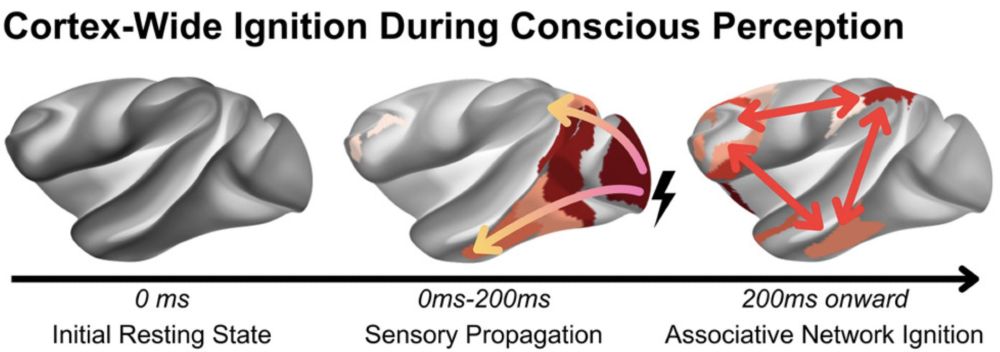
What happens in the brain when a stimulus enters consciousness?
We built a biophysical model of the cortex to zoom in to synaptic interactions and zoom out to whole-cortex neural dynamics during perception.
It revealed a key mechanism for ignition🧵...
www.cell.com/cell-reports...
18.03.2025 17:04 — 👍 74 🔁 28 💬 1 📌 5
Haha, just like MESEC, acronyms which don't work are the best <3
10.12.2024 08:19 — 👍 1 🔁 0 💬 0 📌 0
Neuroscience, subjective experience and all things consciousness
Neuroscience PhD student
@uclbbk_mrcdtp dabbling in computational psychiatry, consciousness and psychedelic action
@UniofOxford @ENS_ULM graduate
MD. PhD. Psychiatrist and researcher at GHU Paris psychiatrie & neurosciences - Psychedelics, consciousness and psychiatry
Psychologist and neuroscientist at UCL https://metacoglab.org
Author, Know Thyself (2021) https://metacoglab.org/book
Dad and assistant to the Diplomat
Cognitive neuroscience/ Consciousness researcher at Clinical Neurosciences/Medicine, University of Cambridge. bit.ly/ccigcambridge
PhD student in philosophy of consciousness at Monash University, Melbourne
PhD student working on hallucinations in Parkinson's disease in Grenoble by day ,
Proud loser by night
she/her
Director, Perception and Brain Dynamics Laboratory @ NYU School of Medicine; Cognitive neuroscientist interested in understanding how the brain generates the mind
Mathematician and Theoretical Computer Scientist (#mathematics, #TCS) interested in #Consciousness and #NeuroAI (#Neuroscience, #AI). Distinguished Career Prof of CS at CMU, Emerita. President, Assoc for MathConscSci (AMCS) (https://amcs-community.org)
🍄 Ralph Metzner Distinguished Professor,
Neurology & Psychiatry, UCSF.
Psychedelic neuroscientist & psychologist.
Author & pioneer in consciousness research.
https://linktr.ee/Robincarhartharris
Research Project on qualia. https://en.qualia-structure.jp/
Science, brains, feelings, thoughts.. and its combination.
Philosophy and the Mind Sciences (PhiMiSci) is a peer-reviewed, not-for-profit open-access journal that is free for authors and readers. https://philosophymindscience.org
Post-doctoral research fellow in cognitive neuroscience (Oxford), interested in complex systems and in simple systems who believe they are complex systems