Led by Marzieh Ajirak, with Nili Solomonov, Ph.D. (@nilisolomonov.bsky.social) and me co-senior and amazing @weillcornell.bsky.social collaborators @odedbein.bsky.social, Ellie Rose Bowen, Dora Kanellopoulos, Avital Falk, and Faith Gunning.
07.10.2025 15:55 — 👍 0 🔁 1 💬 0 📌 0
A key result: significant error reduction for depression & anxiety prediction using unstructured and structured data, with explainable routing policies that match clinical intuition.
07.10.2025 15:54 — 👍 0 🔁 0 💬 1 📌 0

New preprint from the lab, accepted at @neuripsconf.bsky.social NeurIPS 2025!
lnkd.in/eKVNGVNU
Most AI models treat all inputs the same.
We show how to adaptively route each sample across modalities and tasks, boosting performance, interpretability, and clinical impact for heterogenous data.
07.10.2025 15:54 — 👍 4 🔁 0 💬 1 📌 0

JAMA article cover: "Women's Health Is Everywhere—Introducing JAMA+ Women's Health" by Linda Brubaker, MD, MS and Kirsten Bibbins-Domingo, PhD, MD, MAS. A headshot of Linda Brubaker is on the right.
"JAMA enthusiastically launches JAMA+ Women’s Health as a curated source of trusted clinical information to help clinicians advance health care for women worldwide."
🔗 Read this Editorial to learn more: ja.ma/46kacf7
📌 Explore JAMA+ Women’s Health: ja.ma/42ifhSF
05.09.2025 18:15 — 👍 20 🔁 10 💬 0 📌 0
Launched in 2023, Imaging Neuroscience is now firmly established, with full indexing (PubMed, etc.) and 700 papers to date.
We're very happy to announce that we are able to reduce the APC to $1400.
Huge thanks to all authors, reviewers, editorial team+board, and MIT Press.
05.09.2025 02:59 — 👍 231 🔁 79 💬 2 📌 6
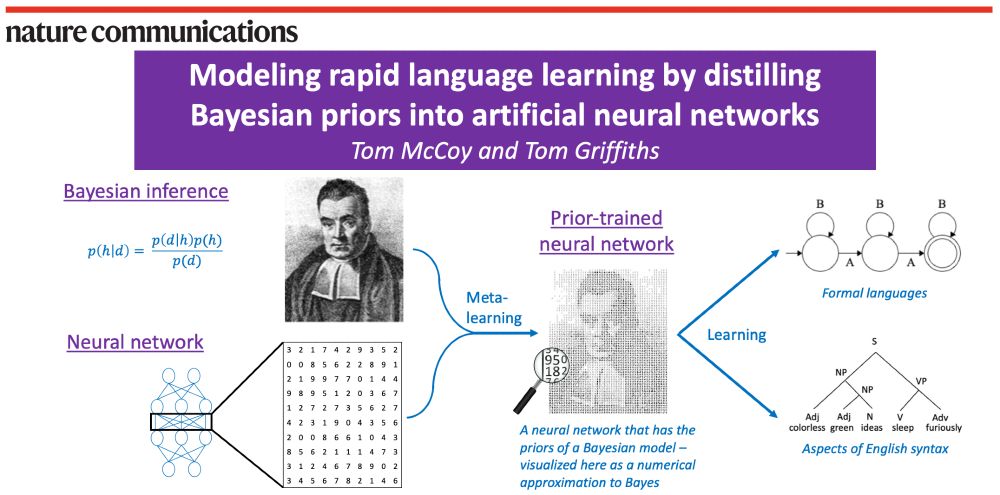
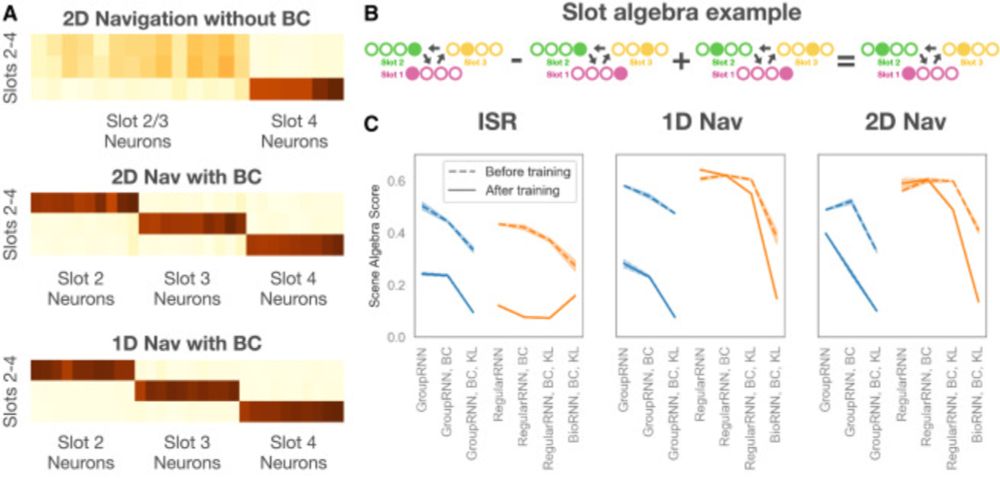
A schematic of our method. On the left are shown Bayesian inference (visualized using Bayes’ rule and a portrait of the Reverend Bayes) and neural networks (visualized as a weight matrix). Then, an arrow labeled “meta-learning” combines Bayesian inference and neural networks into a “prior-trained neural network”, described as a neural network that has the priors of a Bayesian model – visualized as the same portrait of Reverend Bayes but made out of numbers. Finally, an arrow labeled “learning” goes from the prior-trained neural network to two examples of what it can learn: formal languages (visualized with a finite-state automaton) and aspects of English syntax (visualized with a parse tree for the sentence “colorless green ideas sleep furiously”).
🤖🧠 Paper out in Nature Communications! 🧠🤖
Bayesian models can learn rapidly. Neural networks can handle messy, naturalistic data. How can we combine these strengths?
Our answer: Use meta-learning to distill Bayesian priors into a neural network!
www.nature.com/articles/s41...
1/n
20.05.2025 19:04 — 👍 154 🔁 43 💬 4 📌 1
YouTube video by Weinan Sun
Learning produces an orthogonalized state machine in the hippocampus
1/12 How do animals build an internal map? In our new paper, we tracked thousands of mouse CA1 neurons over days/weeks as they learned a VR navigation task. @nspruston.bsky.social & co-1st author @johanwinn.bsky.social
Video: www.youtube.com/watch?v=yw_4...
Paper: www.nature.com/articles/s41...
12.02.2025 19:36 — 👍 188 🔁 65 💬 4 📌 7
a woman sitting on a couch with the words " wanna know a fun fact " on her face
ALT: a woman sitting on a couch with the words " wanna know a fun fact " on her face
Now that the first Advisory Council meeting will be announced in the Federal Register tomorrow (National Institute for Complementary and Integrative Health) tomorrow, I want to clarify something that has been happening for at least the past 30 days.
1/n
19.03.2025 15:05 — 👍 63 🔁 37 💬 5 📌 5
Re the Tononi paper: Both Tononi’s IIT (phi) and Friston’s FEP start from fundamental, axiomatic, and debatable assumptions. These assumptions are generally made without any humility. This logic allows them to make exceptionally broad claims. Which contributes to my unease about them.
12.03.2025 16:01 — 👍 92 🔁 17 💬 9 📌 3
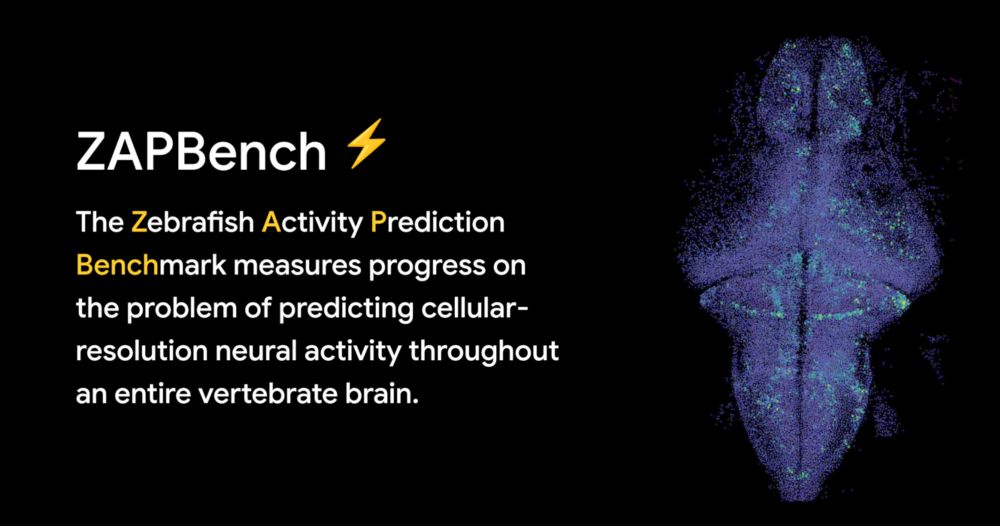
ZAPBench
ZAPBench evaluates how well different models can predict the activity of over 70,000 neurons in a novel larval zebrafish dataset.
⚡️ Excited to introduce ZAPBench, our #ICLR2025 spotlight: The Zebrafish Activity Prediction Benchmark measures progress in predicting neural activity within an entire vertebrate brain (70k+ neurons!)
Explore interactive visualizations, datasets, code + paper: google-research.github.io/zapbench
🧠🧪
04.03.2025 15:21 — 👍 39 🔁 20 💬 2 📌 2
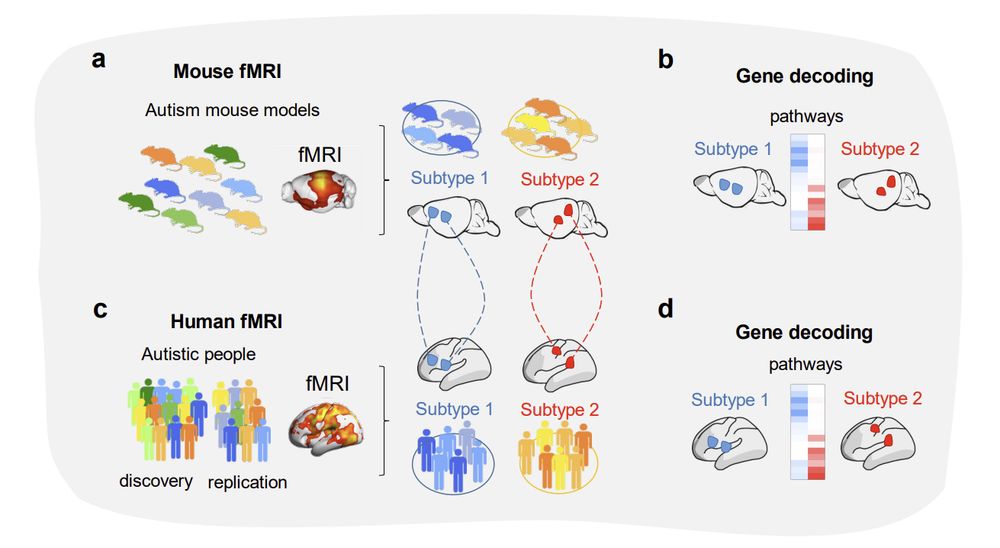
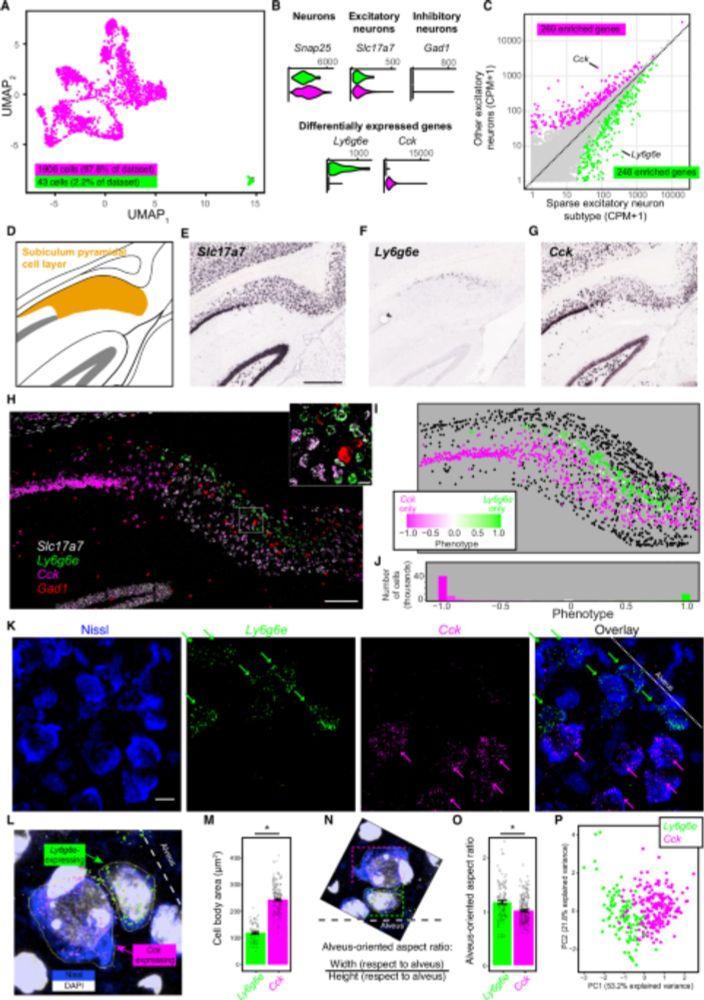
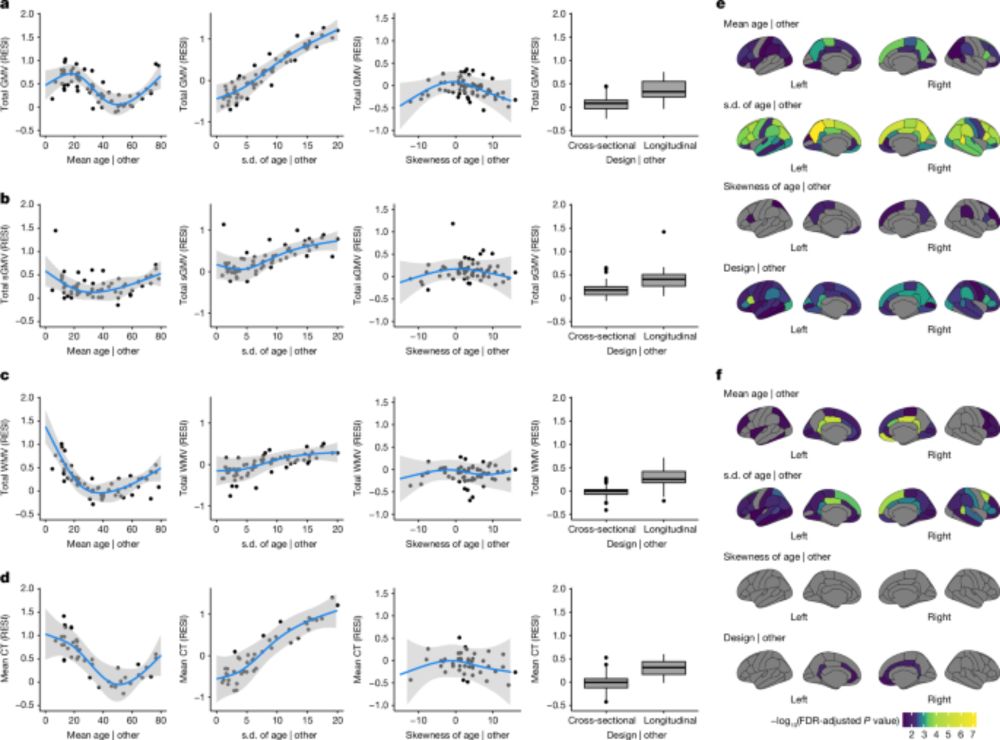
Can we use brain scans to identify biologically distinct "autisms"? And If so, how?
In our latest cross-species study 🐭👨 with @iitalk.bsky.social we dive into these questions!
Find out more here 👇👇
www.biorxiv.org/content/10.1...
Thread below 🧵 1/n
06.03.2025 11:18 — 👍 75 🔁 27 💬 5 📌 3
One of the NIMH PIs whose name is the termination list: Sooyhun Lee, whose lab just published this beautiful @nature.com paper (that has received too little press because comms at NIH are down). Read! Cite!
www.nature.com/articles/s41...
06.03.2025 19:04 — 👍 97 🔁 48 💬 2 📌 2
Nice story on fabulous new work from @dingliu.bsky.social in my lab, just out today!...
26.02.2025 17:08 — 👍 42 🔁 14 💬 1 📌 1
New work accepted to #AISTATS2025 ✨
We developed a new explainable AI method to better understand time-series data.
We can map back inputs (neurons) to their latent space. Basically merging #CEBRA with measuring the individual neurons contribution over time
arxiv.org/abs/2502.12977
20.02.2025 05:35 — 👍 51 🔁 13 💬 1 📌 1
Cells in the hippocampus encode not only information about a fellow bat’s position, but also its identity and distinct social features.
By @claudia-lopez.bsky.social
#neuroskyence
www.thetransmitter.org/social-behav...
30.01.2025 19:05 — 👍 58 🔁 11 💬 0 📌 1
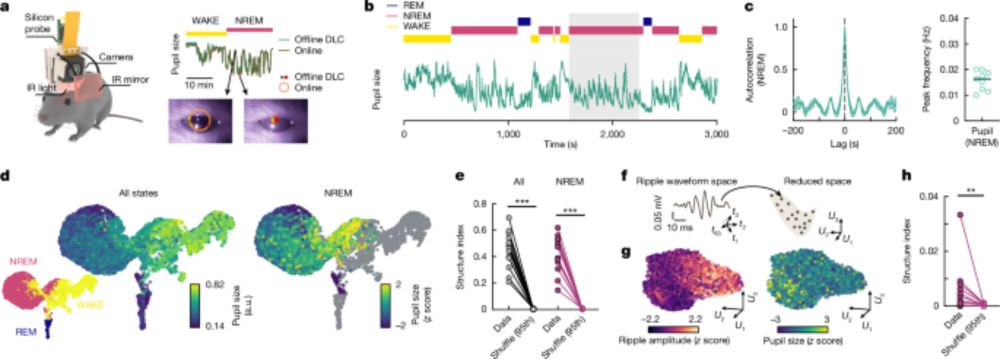
Sleep microstructure organizes memory replay - Nature
The temporal microstructure of the brain can multiplex distinct cognitive processes during sleep to support continuous learning.
Two cool papers on the HPC out today in @nature.com:
1. Replay during non-REM sleep switches between prioritizing recent versus remote memories:
www.nature.com/articles/s41...
2. All optical obs. of synaptic plasticity rules during place field formation:
www.nature.com/articles/s41...
🧠📈 🧪
30.01.2025 16:32 — 👍 72 🔁 13 💬 0 📌 0
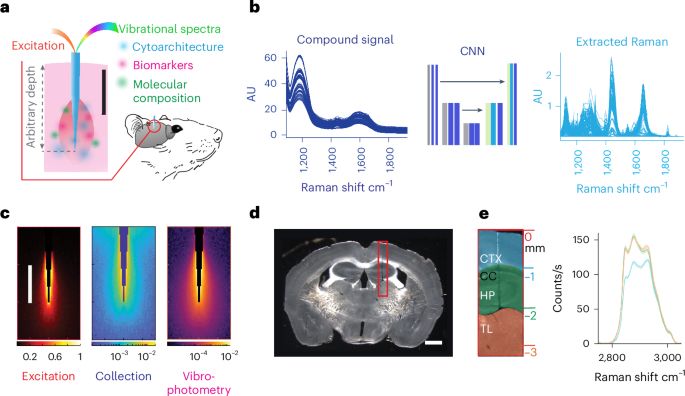
Together with some friends we built an optical Brain Machine Interface to see if cortical activity (PPC) can control behaviour in real time, without animals having to learn to use it. Here's what happened:
www.biorxiv.org/content/10.1...
03.12.2024 11:03 — 👍 34 🔁 11 💬 2 📌 1
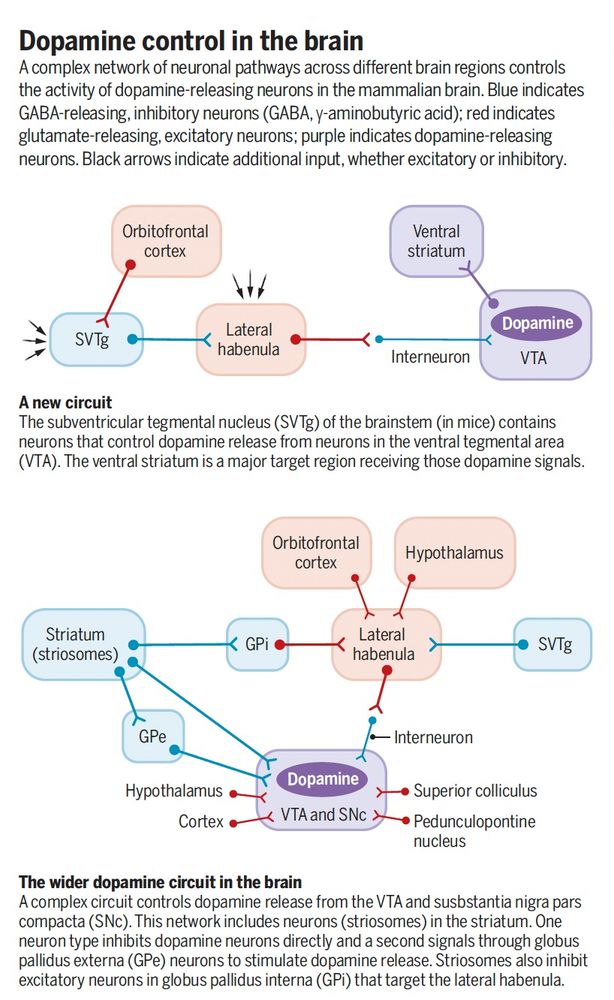
Where do the dopamine hits does from? A new reward center in the brain is discovered (yes, single cell, spatial omics at work again)
@science.org
www.science.org/doi/10.1126/...
www.science.org/doi/10.1126/...
23.01.2025 20:41 — 👍 244 🔁 58 💬 3 📌 5
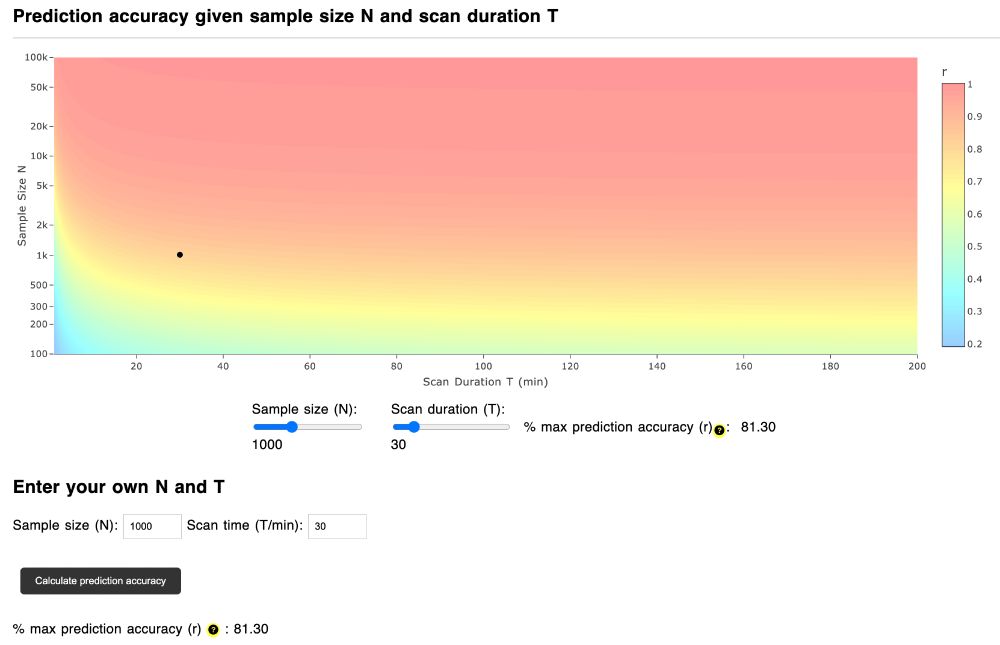
Thanks to everyone's feedback, we have updated our calculator to optimize sample size N & scan time T for fMRI studies: leonoqr.github.io/ORSP_Calcula...
The first new feature is that users can explore how different N & T leads to different accuracy, e.g., N=1000 & T=30min => 81% max accuracy. 🧵
24.01.2025 00:02 — 👍 138 🔁 58 💬 6 📌 3
It’s better.
24.01.2025 04:07 — 👍 2 🔁 0 💬 0 📌 0
neuro and AI (they/she)
Allen Institute for Neural Dynamics, theory lead | UW affiliate asst prof
Neuroscientist and painter | group leader at SIDB, University of Edinburgh | SCGB BTI Fellow | Prediction and Plasticity lab
Neuroscientist at the Allen Institute for Neural Dynamics | UW NBio | prev: Champaliamud & UCSD
Computational neuroscientist interested in cognition, computation, memory, decision making. Studying the human brain.
Neuroscientist studying neural circuits underlying perception and behaviour. Professor at the Sainsbury's Wellcome Centre, London
Computational neuroscientist @princetonneuro.bsky.social deciphering natural and advancing artificial intelligence.
Assistant Professor of Physics & Neuroscience at Princeton University. Studying how C. elegans nervous system processes information to generate actions.
Advancing the frontiers of basic science through grantmaking, research and public engagement. Sign up for our newsletter: simonsfoundation.org/newsletter
Assistant Professor at PittPsychiatry|Clinical psychologist|Studying suicide, protective factors, reinforcement learning, EEG/ERP🧠. She/her. alionatsypes.com
Psychiatrist @VAProvidence & Professor @BrownPsychiatry
| mission to design, develop & deploy neuromodulation tx for #PTSD, depression & suicide. Opinions own.
https://vivo.brown.edu/display/nphilip
bioengineer & neuroscientist | assistant professor @Princeton | molecular tools for accessing neural ensembles | inclusive & open science 🧗🏻♀️🏄🏻♀️🐕🪴
Neuroscience, Artificial Intelligence, and Beyond.
Assistant professor at Cornell Dept. of Neurobiology & Behavior
Senior Director, Translational Genetics and Data Science, Translational Medicine | Data Science | Computational Biology | Drug Discovery | Passionate about advancing genomics and biobank research through collaboration. Opinions are my own!
Husband, Father and grandfather, Datahound, Dog lover, Fan of Celtic music, Former NIGMS director, Former EiC of Science magazine, Stand Up for Science advisor, Pittsburgh, PA
NIH Dashboard: https://jeremymberg.github.io/jeremyberg.github.io/index.html
Berkeley professor, former Secretary of Labor. Co-founder of @inequalitymedia.bsky.social and @imcivicaction.bsky.social.
Substack: http://robertreich.substack.com
Buy my new book: https://sites.prh.com/reich
Visit my website: https://rbreich.com/
The Penn Artificial Intelligence and Technologies Collaboratory for Healthy Aging (PennAITech) is an initiative at the University of Pennsylvania, funded by the National Institute on Aging, aiming to advance innovation to support aging.