Second, the situation may change in the future. We do find evidence of a subset (19%) of socially radicalized respondents, who do avoid out-partisans. A small group of radicals can have destabilizing effects, even if society at large remains moderate.
16/16
02.02.2026 14:24 — 👍 0 🔁 0 💬 0 📌 0
I close with two caveats. First, our results do not downplay polarization at the level of elites and the media, nor do they speak to political radicalization or political violence. But fears of excessive partisan division at the level of interpersonal relationship formation are misplaced.
15/16
02.02.2026 14:24 — 👍 0 🔁 0 💬 1 📌 0
Moreover, results offer scope conditions to the external validity of using group labels to assess relationship formation, discrimination, or cooperation. Intended behavior towards abstract categories should not necessarily be taken as indicative of real-world behavior towards actual people.
14/16
02.02.2026 14:24 — 👍 0 🔁 0 💬 1 📌 0
Our results suggest that the interpersonal consequences of partisanship have been exaggerated. While
partisan labels consistently evoke real feelings of hostility, ordinary people who happen to be out-partisans
do not do so at scale (caveats below)
13/16
02.02.2026 14:24 — 👍 0 🔁 0 💬 1 📌 0
We conclude that partisanship plays a limited role in relationship formation. This may explain why despite decades of elite and media polarization, individuals still entertain relationships with numerous out-partisan close
ties and acquaintances (see: sociologicalscience.com/articles-v12...)
12/16
02.02.2026 14:24 — 👍 0 🔁 0 💬 1 📌 0

We close with conjoints, where explicit information of partisanship is provided. A setting which, we maintain, remains rare in everyday life.
Here, people express a wish to avoid profiles with out-partisan labels. Though note that strong out-partisans are avoided much more than moderates.
11/16
02.02.2026 14:24 — 👍 0 🔁 0 💬 1 📌 0

In each setting, partisanship is deemed relatively unimportant. Almost any other characteristic, from personality, to setting-specific traits, to most demographics, is considered more important
than knowing whether a potential partner is a Republican or a Democrat.
10/16
02.02.2026 14:24 — 👍 0 🔁 0 💬 1 📌 0

Next, we move to experimental evidence. First, we test whether people look for partisanship when it is invisible.
We ask them about the relative importance of various characteristics of potential coworkers, neighbors or sports club partners, and run pairwise comparisons.
9/16
02.02.2026 14:24 — 👍 0 🔁 0 💬 1 📌 0

If they find out that their new acquaintance is an out-partisan, most people indicate not to care, or to avoid talking politics.
In other survey questions, they indicate to be surrounded by out-partisans in various social environments, but to mostly not avoid them.
8/16
02.02.2026 14:24 — 👍 0 🔁 0 💬 1 📌 0

As the relationship unfolds, some people find out - at the same rate as religion. But 42% still don't know today, several months, or even a year after meeting for the first time.
If partisanship drove relationship formation, you'd expect people to know and learn about it instantly.
7/16
02.02.2026 14:24 — 👍 2 🔁 0 💬 1 📌 0

Invited to think about the last friend or acquaintance they made in real life, only 15% of respondents knew the partisanship of their new acquaintance during their first encounter. This is statistically indistinguishable from religion, another often invisible trait.
6/16
02.02.2026 14:24 — 👍 1 🔁 0 💬 1 📌 0

To test the role of partisanship in the process of relationship formation in the US, we ran two surveys (N = 5900), in November 2022 and July 2025.
First, we introduce a novel survey module to trace knowledge and relevance of partisanship in the unfolding of new social relationships.
5/16
02.02.2026 14:24 — 👍 0 🔁 0 💬 1 📌 0

In contrast, when meeting a real person, partisanship may be invisible, or ambiguous. People can hide their politics, be moderately political, politically moderate, or cross-pressured. They may not care about politics, nor look for it. Therefore, partisanship may remain in the background.
4/16
02.02.2026 14:24 — 👍 1 🔁 0 💬 1 📌 0

When confronted with an out-partisan label in a survey, people often imagine stereotypical others – ideologically extreme and very politically involved. No wonder they express a strong desire to avoid them.
3/16
02.02.2026 14:24 — 👍 0 🔁 0 💬 1 📌 0
In surveys and experiments, US citizens express a wish to avoid fictitious out-partisans. This is often taken as evidence of actual avoidance of fellow citizens. However, we believe that expressed behavior towards partisan labels differs markedly from actual behavior towards out-partisans.
2/16
02.02.2026 14:24 — 👍 0 🔁 0 💬 1 📌 0

Do ordinary Republicans and Democrats really avoid each other in everyday life? In a new working paper with Delia Baldassarri, we present descriptive and experimental evidence to challenge the view that partisanship drives the formation of social relationships.
osf.io/preprints/so...
1/15
02.02.2026 14:24 — 👍 22 🔁 4 💬 2 📌 1
Sage Journals: Discover world-class research
Subscription and open access journals from Sage, the world's leading independent academic publisher.
We stress the importance of social structure for polarization along a new cleavage --> policies shaping network segregation matter!
Also see this paper by @jonadejong.bsky.social @jonnekamphorst.bsky.social who come to similar conclusions based on different data/countries. tinyurl.com/47edtwtc
06.11.2025 08:28 — 👍 5 🔁 3 💬 0 📌 0
Educational Networks, Social Closure, and Cleavage Stabilization | British Journal of Political Science | Cambridge Core
Educational Networks, Social Closure, and Cleavage Stabilization - Volume 55
How are contemporary cleavage structures stabilized in times of declining mass social and political organizations?
In this new paper with @davidattewell6.bsky.social @bjpols.bsky.social, we suggest that homogeneous social (educational) networks provide part of the answer.
tinyurl.com/49cs8jwp
06.11.2025 08:28 — 👍 66 🔁 32 💬 1 📌 2
@dpzollinger.bsky.social and I are thrilled "Cleavage Politics in Western Democracies" is out as an SI at @wepsocial.bsky.social!
Its papers explore the foundations of the cleavage pitting new left against radical right parties, and how it compares to the classic cleavages of Lipset & Rokkan:
🧵⬇️
07.10.2025 11:27 — 👍 118 🔁 57 💬 4 📌 8
Amazing, congratulations!
22.09.2025 15:28 — 👍 1 🔁 0 💬 0 📌 0
Congratulations!
17.09.2025 13:21 — 👍 1 🔁 0 💬 0 📌 0
Thanks a lot Mohamed!
16.07.2025 15:29 — 👍 0 🔁 0 💬 0 📌 0
Thank you Rense!
16.07.2025 15:02 — 👍 0 🔁 0 💬 0 📌 0
Thanks a lot!
16.07.2025 14:58 — 👍 1 🔁 0 💬 1 📌 0

Jona de Jong awarded 2025 Linz Rokkan Prize
This years Linz Rokkan Prize for the Best EUI Doctoral Thesis in Political Sociology was awarded to Jona de Jong during the EUI Degree Conferring Ceremony on
🎉 Congrats to @jonadejong.bsky.social for winning the 2025 Linz‑Rokkan Prize for the best EUI thesis in Political Sociology! His work sheds new light on how social networks shape divides and reduce partisan hostility. 👏
Read more 👉 www.eui.eu/news-hub?id=...
16.07.2025 14:30 — 👍 20 🔁 4 💬 2 📌 0
Taken together, politically heterogeneous social relationships remain common and reduce partisan animosity. Our findings nuance worries about partisan echo chambers and suggest that partisan division, at the interpersonal level, might not be as widespread and
constitutive as previously thought.
09.07.2025 11:28 — 👍 2 🔁 0 💬 0 📌 0
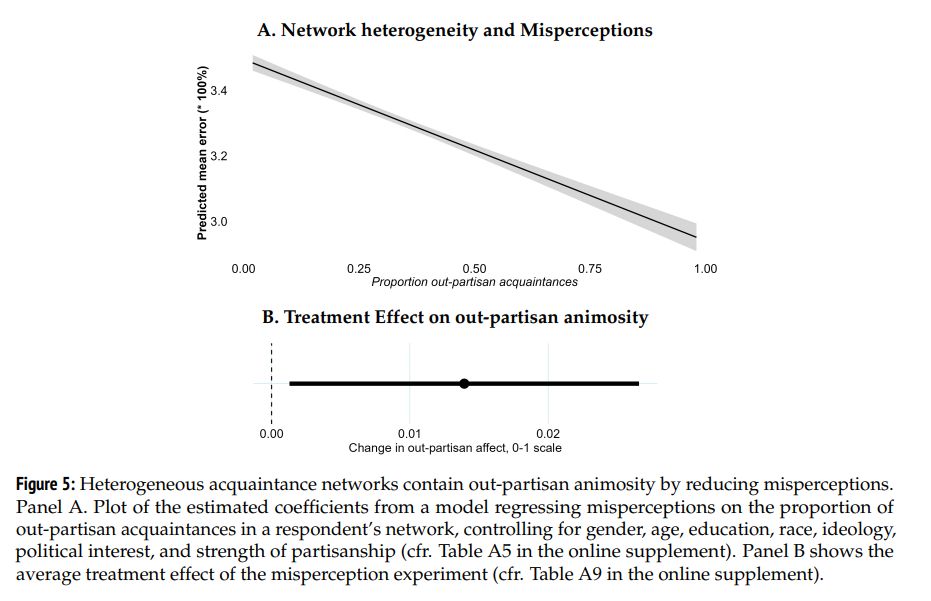
Moreover, we show that 'seeing the other side', casual exposure to a politically diverse set of acquaintances, contributes to correcting the misperceptions that partly fuel animosity. We find both cross-sectional and experimental evidence in favor of this complementary mechanism
09.07.2025 11:28 — 👍 2 🔁 0 💬 1 📌 0
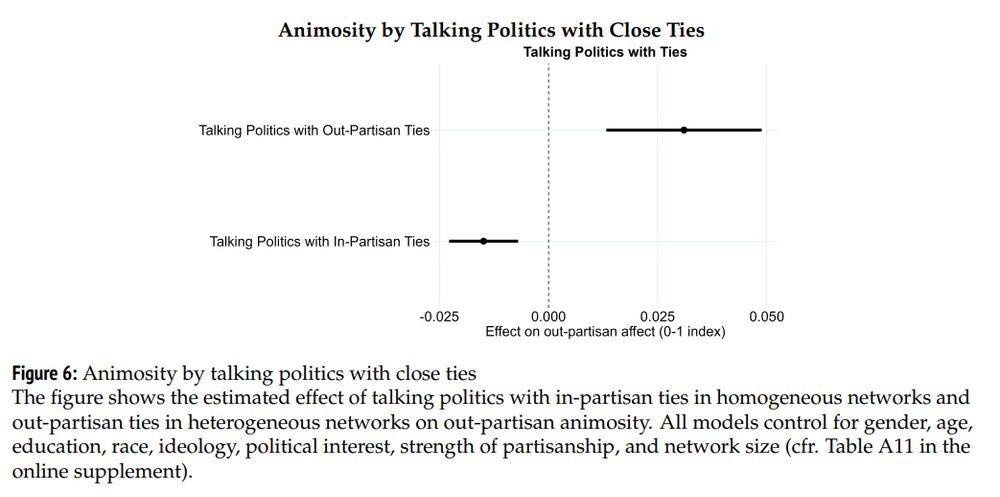
Traditionally, close relationships are thought to buffer partisan animosity by exposing citizens to cross-cutting political discussion. We find that heterogeneous discussions still take place frequently, even during a contentious election, and still reduce partisan animosity
09.07.2025 11:28 — 👍 0 🔁 0 💬 1 📌 0
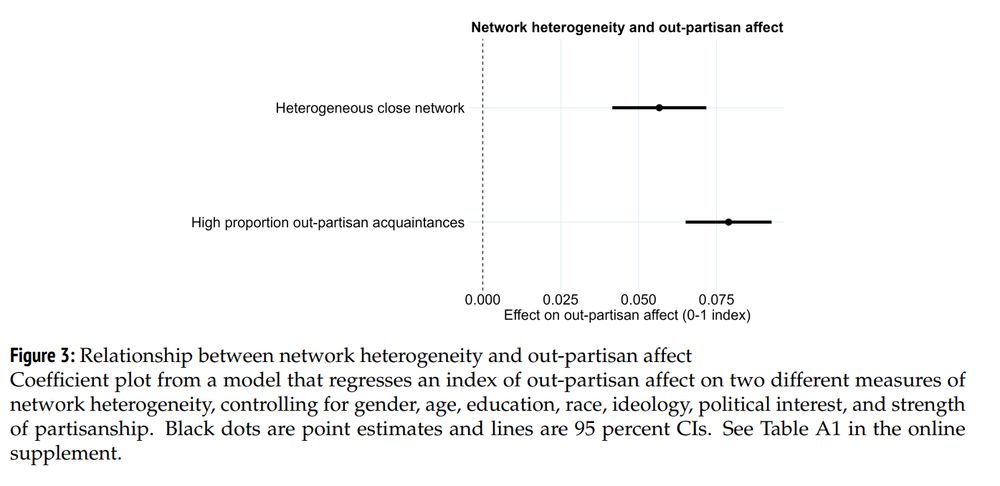
Both out-partisan close relationships and out-partisan acquaintances are associated with lower partisan animosity. In the paper, we complement traditional measures of affective polarization with a behavioral-incentived experiment where expressing animosity costs respondents actual money.
09.07.2025 11:28 — 👍 1 🔁 0 💬 1 📌 0
Associate Professor in Quantitative Social Science at UCL, interested in civic engagement, religion, ethnic integration, residential mobility, quant methods.
https://profiles.ucl.ac.uk/67454-dingeman-wiertz
Assistant Professor of Political Science, University of Hamburg, also Fellow at WZB Berlin
Violence | Migration | Health
schrijft (https://www.debezigebij.nl/auteur/sheila-sitalsing/ en https://www.volkskrant.nl/) en praat (https://www.volkskrant.nl/podcasts/beluister-de-volkskrant-elke-dag~bc018e52/ en https://www.nporadio1.nl/programmas/nos-met-het-oog-op-morgen)
PhD student at the Department of Political Science at Stockholm University.
website: https://joenoonan.se/
danbischof.com
Political Scientist: studying democracy with experiments & data
Professor | University of Münster
Associate Professor | Aarhus University
(he/him | "Sie" als Anrede brauche ich nicht)
Postdoc at @coalescelab.bsky.social
Inequality, Social Justice, Social Stratification, Social Mobility, Social Networks.
PhD Candidate at UC Berkeley
wouterleenders.eu
Follow the Money is een platform voor onderzoeksjournalistiek met een glashelder doel: waarheidsvinding in dienst van de samenleving. https://ftm.nl
Associate professor at Leiden University. Political economy, migration, welfare states 🇨🇭🇵🇹 🇳🇱 http://alexandreafonso.me
Associate Professor in Political Behaviour at the LSE. I like campaigns and do experiments. http://www.florianfoos.net
Lecturer in Political Science https://www.sciencespo.fr/centre-etudes-europeennes/en/.
Political Science | Comparative Politics | Political Behaviour & Public Opinion
https://www.dianebolet.com/
Political scientist @ FUS, studying politics in multilingual places
https://giacomolemoli.com/
Rechtsfilosoof // UvA // Burgerschap
Column De Groene Amsterdammer
Associate professor of legal and political theory with focus on citizenship
PostDoc WZB-Berlin and Berlin School of Economics, researching gender norms and inequality
PhD student at University of Amsterdam | European identities 🇪🇺
Political scientist at University of Oxford. Voting, elections, discrimination, conjoint/field experiments, in-group voting, immigration attitudes, politics, representation. https://www.compas.ox.ac.uk/people/sanne-van-oosten/
Assistant Professor in Sociology @Radboud_Uni | Studying in- & exclusion processes of migrants with a mix of methods 📊🎙️ | In de redactie van Mens & Maatschappij
Associate Professor of Political Science at Luiss, Rome. Author for Routledge and Palgrave. Cleavages, elections, new parties, party system change, technocracy, party competition, and voting behavior. Personal views only.
PhD Candidate in Political Science at CUNY
PhD Candidate @Harvard Gov. Political Economist researching on the politics of opportunity. Credit Access, Education, and Labor Market policy in US, Germany, and Japan + affects on global financial stability. On the market.
https://www.danieltroberts.com/