Thanks a lot!
Only reduced cysteine, and there is no disulfide exchange mechanism needed for its detection (it is based on non-covalent binding-dependent conformational modifications).
09.02.2026 13:14 — 👍 1 🔁 0 💬 0 📌 0
If you work on:
#redoxbiology #metabolism #ferroptosis #mitochondria #biosensors
…and want to monitor cysteine dynamics in your system, Cystector might help (🧬 Plasmids soon available on Addgene!).
Happy to discuss applications or adaptations-DMs welcome!
09.02.2026 12:03 — 👍 4 🔁 0 💬 0 📌 0
Across systems, Cystector enables:
• live-cell measurements
• subcellular resolution
• cross-domain comparisons
• minimal perturbation of metabolism
09.02.2026 12:01 — 👍 1 🔁 0 💬 1 📌 0
We also targeted Cystector to the mitochondrial matrix.
🔍 Result:
• mammalian mitochondria maintain higher cysteine levels than the cytosol
• under cysteine-limiting conditions, mitochondrial cysteine recovery is prioritized
Mitochondrial and cytosolic cysteine pools are not equivalent.
09.02.2026 12:01 — 👍 1 🔁 0 💬 1 📌 0
In mammalian cells, Cystector reports:
• cysteine depletion upon H₂O₂ treatment
• rapid cysteine loss following erastin2 or glutamate (therefore dynamics relevant to ferroptosis)
09.02.2026 12:00 — 👍 1 🔁 0 💬 1 📌 0
In yeast, Cystector shows that cysteine homeostasis:
• depends strongly on energy (fermentation vs. respiration) state
• is reshaped under oxidative stress
09.02.2026 12:00 — 👍 2 🔁 0 💬 1 📌 0
In E. coli, Cystector reveals that:
• imported cystine is rapidly reduced to cysteine
• excess cysteine is exported into the extracellular medium
• glutathione and glutaredoxins are key for cystine reduction
Cystector enabled the direct visualization of a long-standing hypothesis.
09.02.2026 11:59 — 👍 1 🔁 0 💬 1 📌 0
We then asked: what can we learn if we use the same cysteine sensor across organisms?
We applied Cystector in:
Escherichia coli
Saccharomyces cerevisiae
Mammalian cells
09.02.2026 11:58 — 👍 1 🔁 0 💬 1 📌 0
💡 Cystector is a genetically encoded, ratiometric fluorescent biosensor that directly reports cysteine binding.
Key properties:
• very large dynamic range (~4500%)
• minimal sensitivity to physiological pH
• high selectivity for cysteine over thiol-containing molecules, including glutathione
09.02.2026 11:57 — 👍 1 🔁 0 💬 1 📌 0
Existing approaches struggle because cysteine:
• oxidizes during cell lysis
• is modified by chemical probes that measure it
• is confounded by high glutathione levels
➡️ We needed a non-invasive, selective, live-cell tool.
09.02.2026 11:57 — 👍 0 🔁 0 💬 1 📌 0
Why cysteine?
Cysteine is central to:
• thiol redox regulation
• glutathione & CoA synthesis
• iron-sulfur cluster assembly
• ferroptosis
Yet, tracking dynamic cysteine levels in living cells has been extremely challenging.
09.02.2026 11:56 — 👍 1 🔁 0 💬 1 📌 0

🧪🧬 New preprint!
What if the same biosensor could reveal how cysteine is regulated across life domains?
We introduce Cystector, a genetically encoded fluorescent biosensor for real-time cysteine monitoring in living cells.
www.biorxiv.org/content/10.6...
🧵A thread ⬇️
09.02.2026 11:55 — 👍 15 🔁 7 💬 2 📌 0

Just wrapped up a fantastic week at the EMBO Workshop on Thiol-Based Redox Switches. Great science, great discussions, and a truly inspiring community. Huge thanks to the organizers @danareichmann.bsky.social and Tobias Dansen for their hard work in putting together such a memorable meeting!
22.09.2025 19:10 — 👍 2 🔁 0 💬 0 📌 0
🧵 1/6
Just dropped in @naturecomms.bsky.social
We’ve engineered the most photostable yellow fluorescent proteins (YFPs) to date—mGold2s and mGold2t—with up to 25× greater photostability than mVenus and mCitrine, without compromising brightness.
👇
🔗 www.nature.com/articles/s41...
09.04.2025 20:59 — 👍 47 🔁 17 💬 1 📌 1
A long but fruitful journey: from a roGFP2-based drug screen to reaching protein targets of the proton pump inhibitor rabeprazole. Congratulations to all the authors! @aubrykmiller.bsky.social
25.02.2025 09:50 — 👍 1 🔁 0 💬 0 📌 0
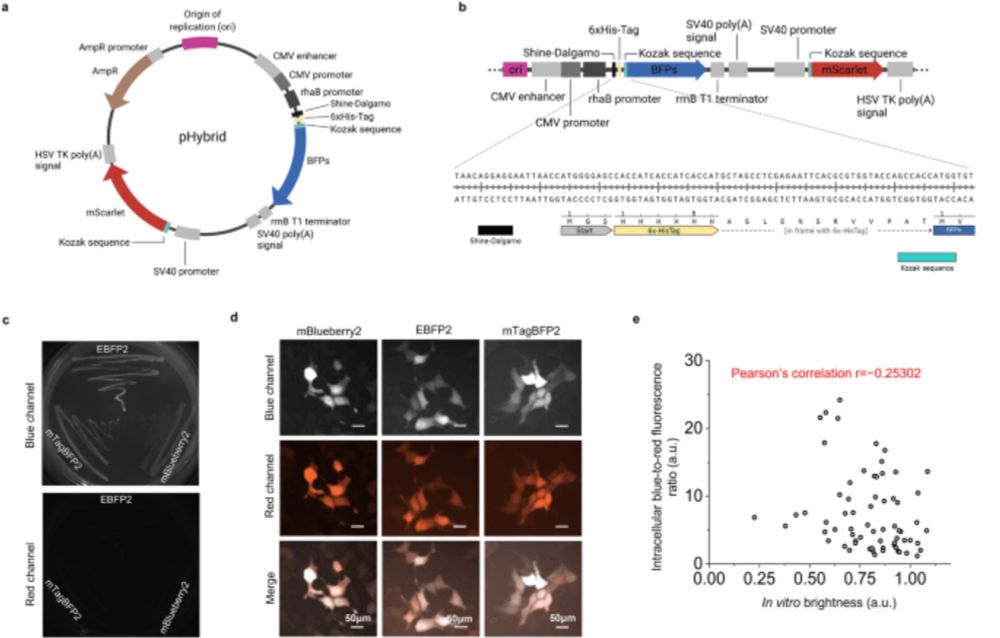
Dual-expression system for blue fluorescent protein optimization - Scientific Reports
Scientific Reports - Dual-expression system for blue fluorescent protein optimization
We are very excited to see the first orange flame lit up for our plasmid pHybrid-Electra2 on Addgene, which is designed for gene expression in E. coli and mammalian cells www.nature.com/articles/s41...
18.02.2025 05:11 — 👍 4 🔁 1 💬 0 📌 0

First Bluesky post! 👋 I work designing fluorescent indicators for redox biology. Last year, I published a review on genetically-encoded redox biosensors—DM me if you’d like a copy! Happy to connect with fluorescence enthusiasts and redox biologists. #FluorescenceFriday
doi.org/10.1016/j.ab...
31.01.2025 08:51 — 👍 7 🔁 0 💬 0 📌 1
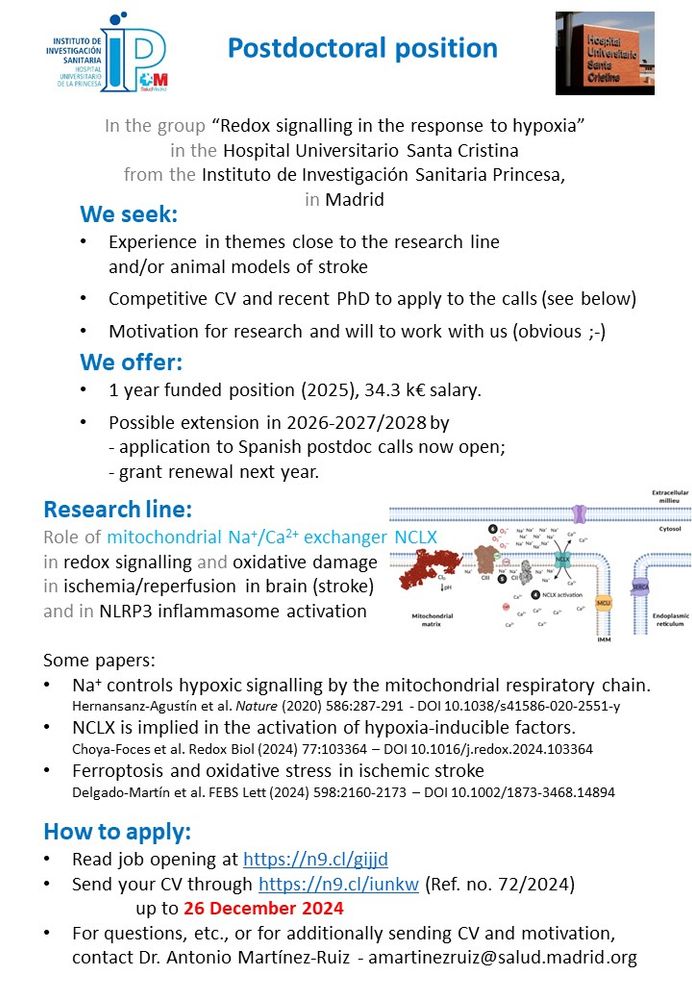
Postdoctoral position in the group of Dr. Antonio Martínez Ruiz in Madrid
Do you want to work as a #postdoc in our group in a Hospital Research Institute in Madrid?🏥🔬
Interested in how #mitochondria and #redox signalling/stress can influence #stroke outcome and #inflammation?🧠💊
Apply up to 26 December at n9.cl/iunkw (ref 72/2024)
Full call n9.cl/gijjd
Please repost 😉
16.12.2024 10:23 — 👍 11 🔁 17 💬 0 📌 1
Thank you very much for your initiative @tonnomartinez.bsky.social !
25.11.2024 09:14 — 👍 1 🔁 0 💬 0 📌 0
Developing microscopy tools for Drosophila brain imaging┃Postdoc at Hiesinger Lab (lab.flygen.org) at FU Berlin┃Formerly PhD at Ewers Lab
PhD Student - Universität Bremen
and Universität zu Köln @massecklab.bsky.social
Check out our new calcium sensor PinkyCaMP: doi.org/10.1101/2024.12.16.628673
Now on Addgene!
Sharing speeds science! Addgene helps scientists around the world find and share research materials - plasmids, viral preps, antibodies, data, and more.
Biochemistry/Structural Bio at Uni Jena and Cluster of Excellence 'Balance of the Microverse'
(Membrane) protein dynamics admirer, parasite aficionado and coffee addict.
Action against #NTDs!
www.hellmich-group.de
Assistant professor of computational chemistry at Wayne State University (Detroit). Computational simulations of fluorescent biomolecules. PhD@Cisneros, PD@Martinez #bifurious
faculty at NYU School of Medicine. We use advanced microscopy techniques to understand gene expression. Opinions my own. timotheelionnet.net
Predoctoral Research Assistant at the Llorca lab @cniostopcancer.bsky.social working on mTORC1 signaling and cryo-EM ❄️🔬. Intrigued by the structural mechanisms of protein assemblies involved in endomembrane signaling and trafficking 🧪.
Harnessing physics to understand life.
Pulling one RNA molecule at a time.
RNA, Biophysics, and Proteins sometimes.
Lame puns intended.
Currently sciencing at @tudresden.bsky.social
Principal Investigator | Northwestern University Microbiology-Immunology | #RNA #ribosome #antibiotic resistance #AMR #MRSA | hails from 🇲🇾 by way of 🇹🇼 |Views are my own. 🧪 🧬🔬💉
Cell biologist and a cat person. I mainly study CDK8/19, cell cycle regulation, and new anti-cancer drug candidates.
https://orcid.org/0000-0002-9080-5683
postdoc at caltech
he/they
opinions are my own
computers and biosensors
💻 https://samholtzen.github.io/
🏺 sellish.ghost.io
Mathematics Sorceror (sensory alchemist) at the Arctangent Transpetroglyphics Algra Laboratory (ATAL), I transflarnx mathematics into living rainbows. http://owen.maresh.info https://github.com/graveolensa
Psoeppe-Tlaxtlal, (an undreamt splendour?)
Organic Chemist & Biochemist | Chemical Biology | Triathlete
PhD Student at the Praetorius Lab
PhD student at Karolinska Institutet and Scilifelab | Cell physics
https://www.csi-nano.org/
Group Leader @MRC LMS @Imperial College
Lab studying #redox #metabolism #ageing #Drosophila
A platform for life sciences. Publications, research protocols, news, events, jobs and more. Sign up at https://www.lifescience.net.