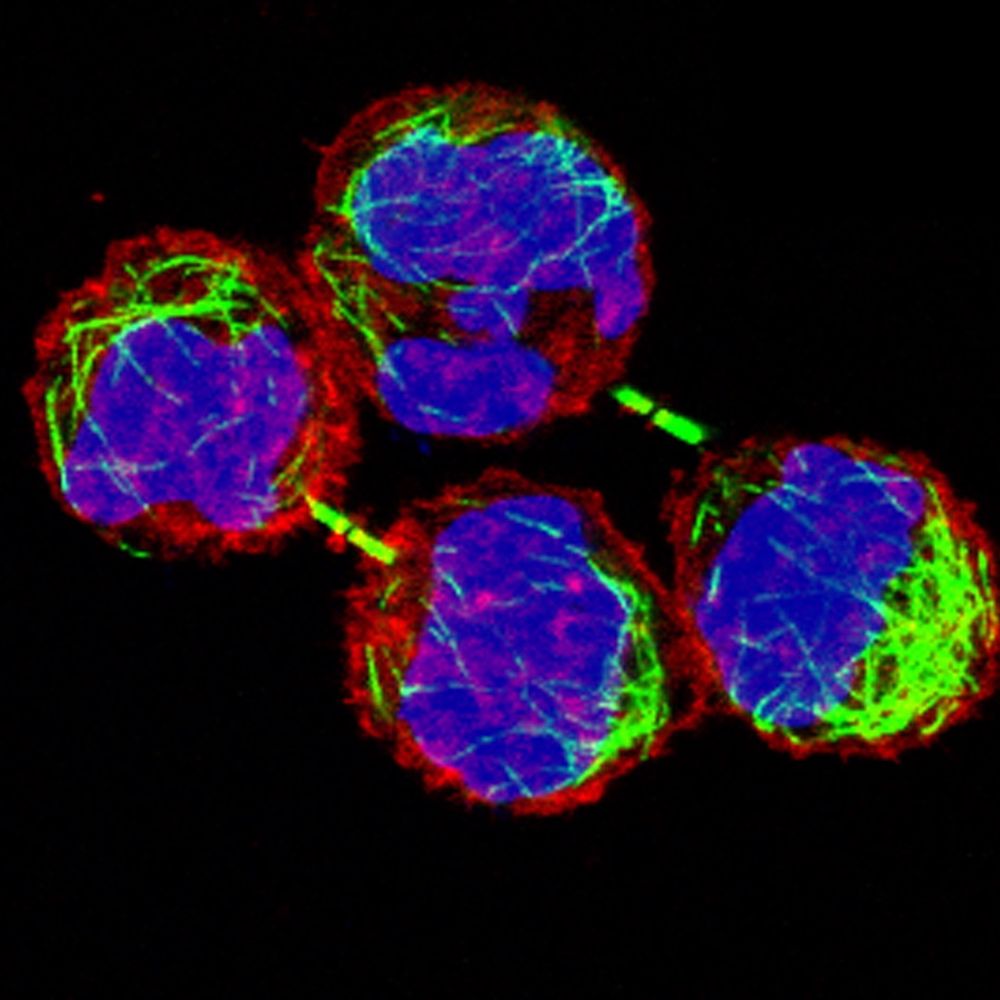
Does the noncoding genome actually carry more genetic information than coding seqs? Motivated by this question we mutated every bp in the 10kb MYC locus. Results are even more exciting: Decoding the MYC locus reveals a druggable ultraconserved RNA element www.biorxiv.org/content/10.6...
31.01.2026 01:13 — 👍 123 🔁 45 💬 4 📌 6

Pre-assembly of biomolecular condensate seeds drives RSV replication
Nature - Viral ribonucleoprotein–viral protein networks form pre-replication centres that nucleate viral factories and drive respiratory syncytial virus replication.
Now out in Nature! We visualize infection of the RNA virus RSV in real-time with single-vRNP resolution to understand how RSV establishes viral factories, biomolecular condensates that act as sites of viral replication. A huge collaborative effort led by Dhanushika Ratnayake!
rdcu.be/e1bBW
28.01.2026 20:38 — 👍 83 🔁 33 💬 1 📌 1
Frequently Asked Questions (FAQs) | Grants & Funding
"NIH will provide a warning when the Common Forms are not used but will not withdraw applications that don’t comply with the use of the Common Forms. We expect the leniency to be in place through May 2026"
grants.nih.gov/faqs#/common...
29.01.2026 22:02 — 👍 6 🔁 10 💬 1 📌 2
Dynamic regulation of endogenous transcription factor hubs at single-molecule resolution https://www.biorxiv.org/content/10.64898/2026.01.25.701606v1
28.01.2026 01:46 — 👍 2 🔁 2 💬 0 📌 0
Question for the crowd :
Do you have any examples of subunits which have a function independent of the multiprotein complex to which they belong?
I am currently thinking about writing a review (focusing on the Mediator complex and examples of specific subunit functions, such as PMID: 41414671).
27.01.2026 13:31 — 👍 6 🔁 3 💬 7 📌 0

The image shows an illustration of the comic book character Doctor Manhattan from the graphic novel Watchmen, depicted sitting on Mars. The text reads:
It is 1996, we have a president born in 1946
It is 2006, we have a president born in 1946
It is 2016, we have a president born in 1946
It is 2026, we have a president born in 1946
As someone who spent the last 15 years working with aging brains & dementia, I can't stop thinking about this. It is gerontocracy: leaders who are substantially older than most of the adult population. When did we accept this? The new generations can't show up because the old generations never left.
21.01.2026 15:42 — 👍 2226 🔁 669 💬 88 📌 72

New preprint on technologies to scale up CRISPR screens.
We use them to map 665,856 pairwise genetic perturbations and outline a path to comprehensive interaction mapping in human cells.
We also introduce an approach for cloning lentiviral libraries with billions of elements.
20.01.2026 13:42 — 👍 87 🔁 41 💬 2 📌 2


House Appropriations minibus bill funding NIH is out now.
- $400M increase
- Multiyear funding of new awards capped at 2025 levels.
- No line item for BRAIN Initiative
text here: docs.house.gov/billsthiswee...
Screenshots from Dem summary and Sec 240 (multiyear funding text).
20.01.2026 14:29 — 👍 31 🔁 23 💬 4 📌 0
congrats Tim!
19.01.2026 17:46 — 👍 1 🔁 0 💬 1 📌 0
a close up of a brown surface with a few spots
ALT: a close up of a brown surface with a few spots
The appropriations bill that includes NIH is being finalized.
The Senate bill includes a bipartisan amendment from Senators Capito (WV) and Baldwin (WI) limiting multi-year funding of grants.
The House version does not and OMB has issued a veto threat if the House includes such language.
1/3
14.01.2026 13:33 — 👍 101 🔁 65 💬 8 📌 14
entering the academic/medical centers are real estate companies in a trench coat era
14.01.2026 13:04 — 👍 1 🔁 0 💬 0 📌 0
amazing sunrise here as well!
14.01.2026 12:57 — 👍 1 🔁 0 💬 0 📌 0
Delivering interfering RNA – Soft Machines, by Richard Jones
Really encouraging to see siRNA therapies enter the mainstream. A sobering reminder of how long this stuff takes to get to the clinic, though - here's me writing about their promise (and what you'd need to deliver them) in 2005
softmachines.org?p=143
28.12.2025 21:31 — 👍 11 🔁 4 💬 1 📌 0

1/ 🎄 We got our Christmas present today: "Two distinct chromatin modules regulate proinflammatory gene expression" is now published @natcellbio.nature.com doi.org/10.1038/s415.... Our study introduces a scATAC-seq-based framework for genome-wide analysis of gene regulation features.
24.12.2025 22:44 — 👍 76 🔁 24 💬 3 📌 2
As the year ends, let me thank public school teachers who, under difficult circumstances, are doing their best to educate our kids.
If this country is to flourish, we need the best education system in the world. Let’s fight for a nation where teachers are well-paid & respected.
24.12.2025 18:23 — 👍 3182 🔁 662 💬 86 📌 35
Not that long ago, in vivo mouse enhancer design was a dream. Today, it's a reality! Using transfer deep learning to design de novo synthetic embryonic enhancers active in the heart, limb, and CNS. Great collab with @alex-stark.bsky.social lab! @ucibiosci.bsky.social @impvienna.bsky.social
24.12.2025 15:51 — 👍 76 🔁 23 💬 3 📌 0

Six (or seven) predictions for AI 2026 from a Generative AI realist
2025 turned out pretty much as I anticipated. What comes next?
“2025 will be known as the year of the peak bubble, and also the moment at which Wall Street began to lose confidence in generative AI... the Oracle craze early in September and what has happened since will in hindsight be seen as the beginning of the end.” garymarcus.substack.com/p/six-or-sev...
20.12.2025 17:38 — 👍 18 🔁 5 💬 0 📌 0
I'm working on a new water-dipping objective targeting expansion imaging. Targeting the following specs:
5mm WD
NA 1.0
1.2mm FOV, plan-corrected
8mm EFL ("25x") but this is flexible
well-corrected in visible
minimum mechanical profile
Optics question: is there any reason to make it telecentric?
18.12.2025 19:54 — 👍 11 🔁 1 💬 3 📌 0
“A process which led from the amoeba to man appeared to the philosophers to be obviously a progress - though whether the amoeba would agree with this opinion is not known"
- Bertrand Russell, 1976.
Time-lapse video of Vampyrella lateritia eating Spirogyra algae from Science Source/Oliver Skibbe. 🦠
17.12.2025 16:53 — 👍 507 🔁 155 💬 19 📌 32
Founder @democracydocket.com. Chair of Elias Law Group. My dog's name is Blue.
New Yorker staff writer and Houston Rockets fan.
Postdoc in the Ingolia Lab @ UC Berkeley. Interested in the crosstalk between neuronal activity and gene expression. 김정우.
I work on @securedrop.org
Former fed at 18F "deleted" by DOGE
🔗 https://skiles.blue/
SDOH #EpiSky | Unequal Treatment #MedSky | #CardioSky 🫀 Health Equity
NIA F99/K00 Fellow
PhD, Population Health Sciences, Duke Med | 🌲Dartmouth ‘21 |
It doesn’t take an expert to demand evidence
michaeldgreen.phd
Views my own
Head of the Advanced Bioimaging Unit, joint center Udelar & Inst. Pasteur Montevideo. Imaging Scientist CZI and LABI executive committee.
Columnist, The Nation: https://www.thenation.com/authors/jeet-heer/ Podcast: The Time of Monsters: https://www.thenation.com/content/time-of-monsters/
I'm a physicist; I invent techniques to measure and control biological systems.
Homepage: andrewgyork.github.io
playing the hits, the misses, the B-sides & deep trx. Go Birds.
philly. tweeter deactivator. resister
Professor & JC Bose Fellow at IISER Mohali, India
Studying IDPs/prions/amyloids/biomolecular condensates
Formerly, editor @BiophysJ.bsky.social
Attended Jadavpur Univ. IISc Bangalore @tifr.res.in @Scripps.edu
Lab Website: https://www.MukhopadhyayLab.org
Membraneless Organelles in Bacteria: Structure, Dynamics, Function, and Engineering. Assistant Professor @scripps.edu.
https://laskerlab.org/
Computational Biophysics | Understanding molecular behaviour using microprocessors & integrative biology. #IDPs, #NMR and #smFRET enthusiast.
Cell biologist, artist, science artist, educator, scientific cake baker, foodie, and traveler. I study the RNA granule in the Midbody and MBR.
The midbody remnant (MBR) is a large translating Extracelluar vesicle that is generated in mitosis.
Associate Professor, Computational biophysicist @UofT
http://rauscher-group.physics.utoronto.ca
Molecular and Systems Medicine Group Leader,
NHMRC Emerging Leadership Level 2 Fellow,
University of Queensland
Group page: https://biomedical-sciences.uq.edu.au/research/groups/molecular-and-systems-medicine
Alzheimer's disease | Infectious diseases
Mom. PhD student in biomedical technology (Synthetic phosphorylation-based sensory circuits) @ Mart Loog's lab @unitartu
Professor at Buck Institute & UCSF. Interests- Aging, glycation, TOR, CR, circadian clocks, menopause & antagonistic pleiotropy.
Protein evolution, IDRs, bimolecular condensates, phenotypic mutations. Science and fun from the ATPlab.
Assistant Professor of Biology at Syracuse University. Scientific interests: intrinsically disordered proteins, biomolecular condensates, and plant cell and developmental biology. Other interests: running, dancing, and getting lost in fiction.