We're so proud of our very own Richard for being awarded this fellowship! Onwards and upwards!
20.11.2025 21:22 — 👍 1 🔁 0 💬 0 📌 0
Can’t be happier seeing Richard starting this. His original angle to an old problem ( 😉) has great potential for success.
Fascinating to see how findings in dev. neuro. leads to insights in age-related degenerative disorders!
@houartlab.bsky.social @devneuro.bsky.social @kingsioppn.bsky.social
20.11.2025 17:00 — 👍 5 🔁 2 💬 0 📌 0
Axonal pathfinding of zebrafish retinal ganglion cells forms the optic nerve. Credit to Dr. Matthew Bostock @houartlab.bsky.social. #ZebrafishZunday 🧪
16.11.2025 20:30 — 👍 178 🔁 58 💬 4 📌 2
What a day! Congrats to @danafd.bsky.social for great achievement. Big thanks to Sylvie Retaux & @jamesasharpe.bsky.social for very useful examination of thesis.
Absolutely loved joint supervision w. Zena! Perfect @crick.ac.uk & @kingsioppn.bsky.social combo
Dana’s day had a stiff competition 😉😉😉
24.10.2025 17:45 — 👍 6 🔁 1 💬 1 📌 1


Couldn’t be prouder of the first PhD graduate of the lab, super congrats @danafd.bsky.social 🙌🎓🌟. Such a pleasure to supervise you together with @cohouart.bsky.social @houartlab.bsky.social, the learning journey never ends 😌. Huge thanks to @jamesasharpe.bsky.social and Sylvie Retaux for examining 💥
24.10.2025 08:15 — 👍 23 🔁 2 💬 1 📌 2
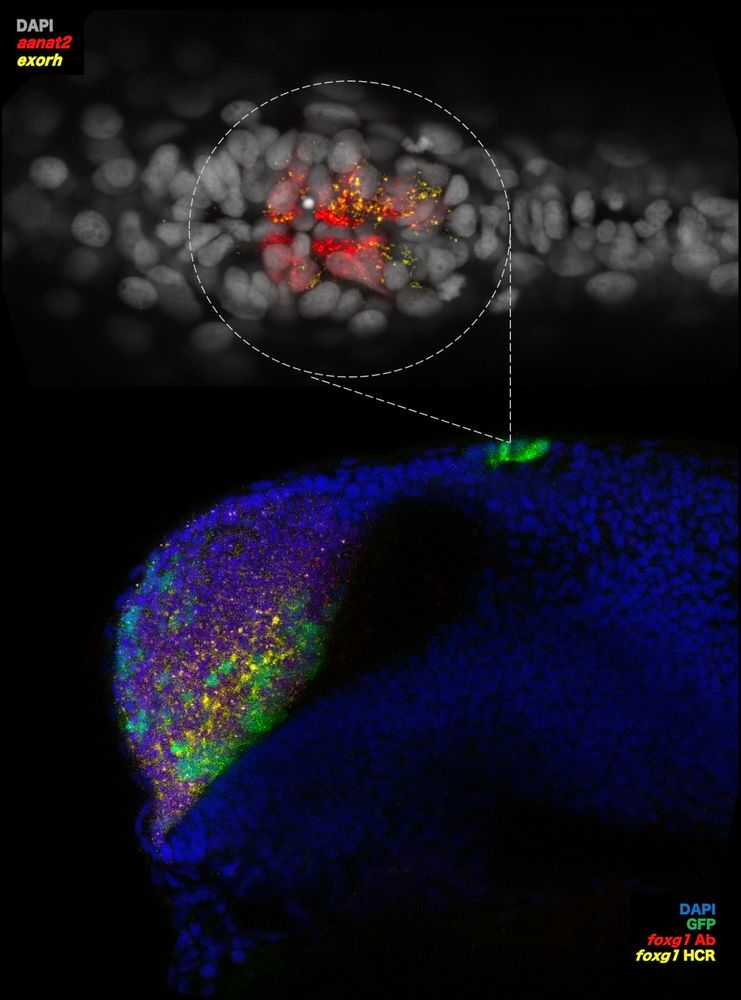
How does foxg1 impact pineal gland development? What are the implications for FOXG1 syndrome?
Lewis Hill, masters student, investigates this in #zebrafish. His image shows in-situ HCR + immuno in foxg1,Gal4;UAS,GFP zebrafish at 24hpf revealing foxg1 mRNA/protein with pineal markers aanat2 & exorh.
29.07.2025 16:23 — 👍 10 🔁 4 💬 0 📌 0
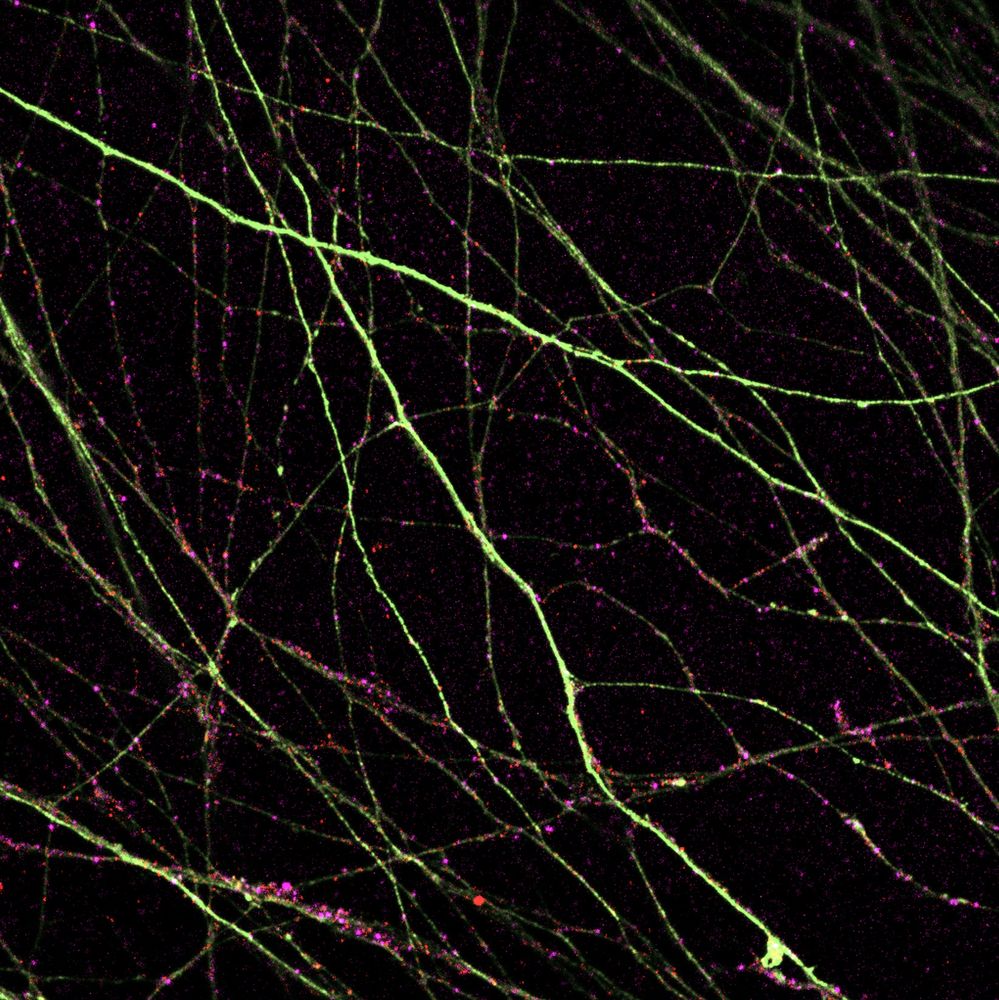
Human cortical neurons growing in a dish, with their signal-receiving structures - dendrites - coloured in green by Richard Taylor.
Richard explores how translation of mRNAs into proteins is regulated in dendrites and whether disruptions in this process in dementia contribute to their degeneration.
18.07.2025 14:59 — 👍 9 🔁 2 💬 1 📌 0
The red dots are the RNA-binding protein SFPQ, while the translation initiation complex eIF2 is marked in magenta.
18.07.2025 15:00 — 👍 0 🔁 0 💬 0 📌 0
Human cortical neurons growing in a dish, with their signal-receiving structures - dendrites - coloured in green by Richard Taylor.
Richard explores how translation of mRNAs into proteins is regulated in dendrites and whether disruptions in this process in dementia contribute to their degeneration.
18.07.2025 14:59 — 👍 9 🔁 2 💬 1 📌 0
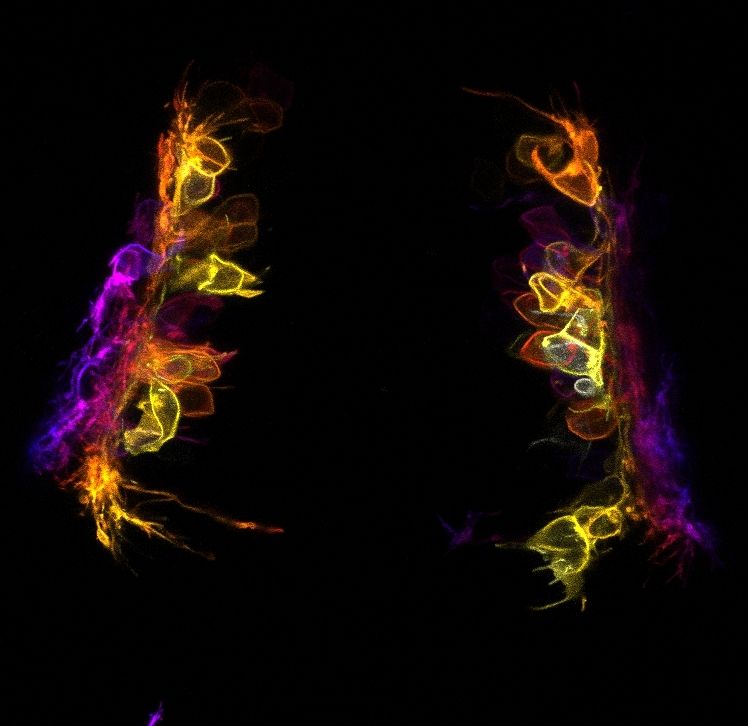
This week, post-doc Katie Adamson shares an incredible image of a #zebrafish embryo forebrain at 24hpf with membrane labelled tbr2+ excitatory neurons.
Just 24 hours post fertilisation, neuronal cell types are already being born and will come to form the forebrain of this magnificent beast.
24.06.2025 16:54 — 👍 6 🔁 2 💬 0 📌 0
This week, post-doc Katie Adamson shares an incredible image of a #zebrafish embryo forebrain at 24hpf with membrane labelled tbr2+ excitatory neurons.
Just 24 hours post fertilisation, neuronal cell types are already being born and will come to form the forebrain of this magnificent beast.
24.06.2025 16:54 — 👍 6 🔁 2 💬 0 📌 0
Movie of the week - joined collab of @houartlab.bsky.social & Long lab @kingsioppn.bsky.social @devneuro.bsky.social
@crick.ac.uk
Joining cell identity to cell behaviour in human embryonic brain.
Fascinating >10 days timelapse imaging by @gessicagoncalves.bsky.social
A technical tour de force!
20.06.2025 16:40 — 👍 2 🔁 2 💬 0 📌 0
A 3D view of apical radial glia finding their way in the developing human cortex.
A stunning video shared by @gessicagoncalves.bsky.social who cultures organotypic cortical slices to study cell dynamics during human cortex development.
20.06.2025 13:59 — 👍 8 🔁 2 💬 0 📌 1
Do tissue material properties impact morphogen transport? Yes! And morphogens know it. Thanks to @nicolettapetridou.bsky.social who got us involved and to Bernat Corominas-Murtra, and kudos to @cami-autorino.bsky.social @dianakhorom.bsky.social and all the authors! 🧵 below if you are curious 👇
12.06.2025 16:23 — 👍 11 🔁 2 💬 0 📌 0
Amazing work by Afnan @stochastalive.bsky.social and our lab satellite colleagues @crick.ac.uk, comparing human vs mouse forebrain signalling centres & progenitor diversity in nascent embryonic telencephalon. Outcome of exploration soon on bioRxiv.
@kingsioppn.bsky.social @devneuro.bsky.social
11.06.2025 19:28 — 👍 16 🔁 3 💬 0 📌 0
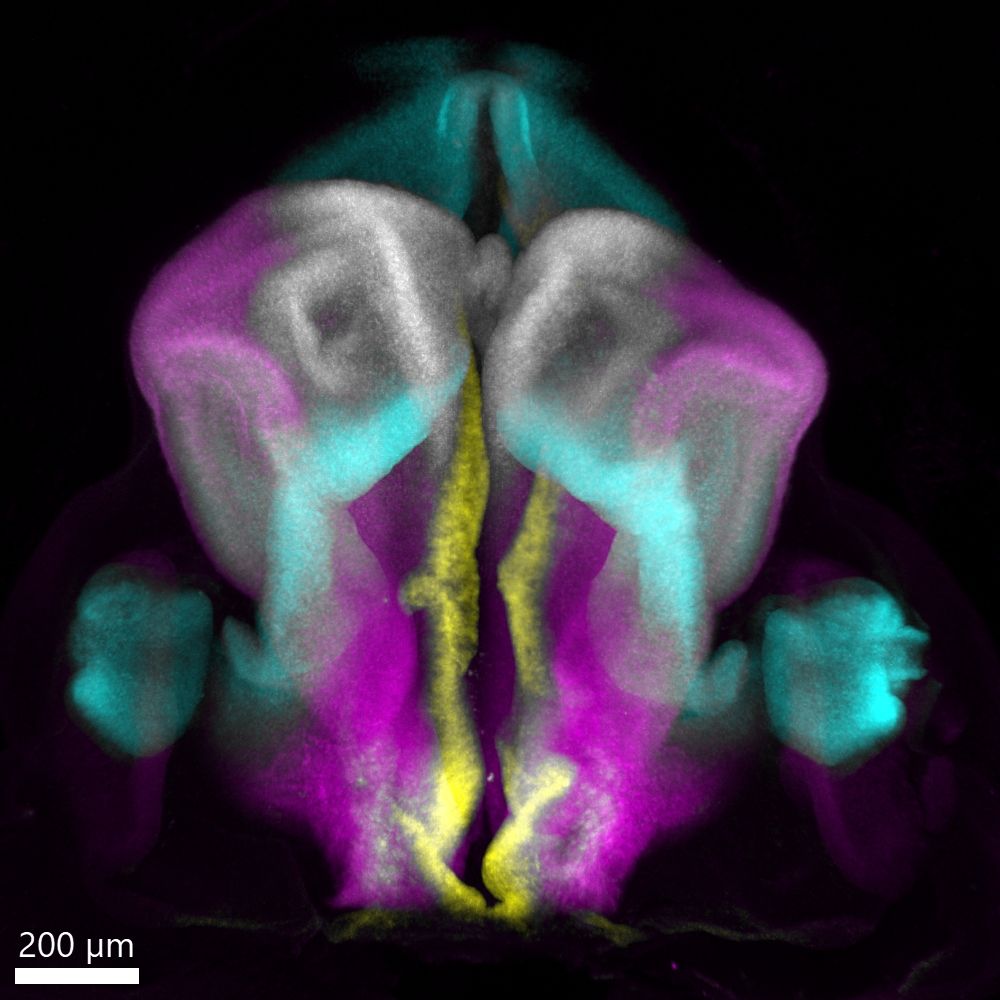
A look at the developing human embryonic forebrain in 3D!
Post-doc @stochastalive.bsky.social shares this week's image showing a dorsal view of the human embryonic forebrain at Carnegie Stage 16 (~6 weeks post conception). Major regions marked by FOXG1, WNT8B, PAX6, and SHH are displayed.
11.06.2025 16:54 — 👍 34 🔁 9 💬 1 📌 1
The chick is at HH20 (~E3). Can you guess what gene each colour represents?
03.06.2025 13:30 — 👍 0 🔁 0 💬 0 📌 0
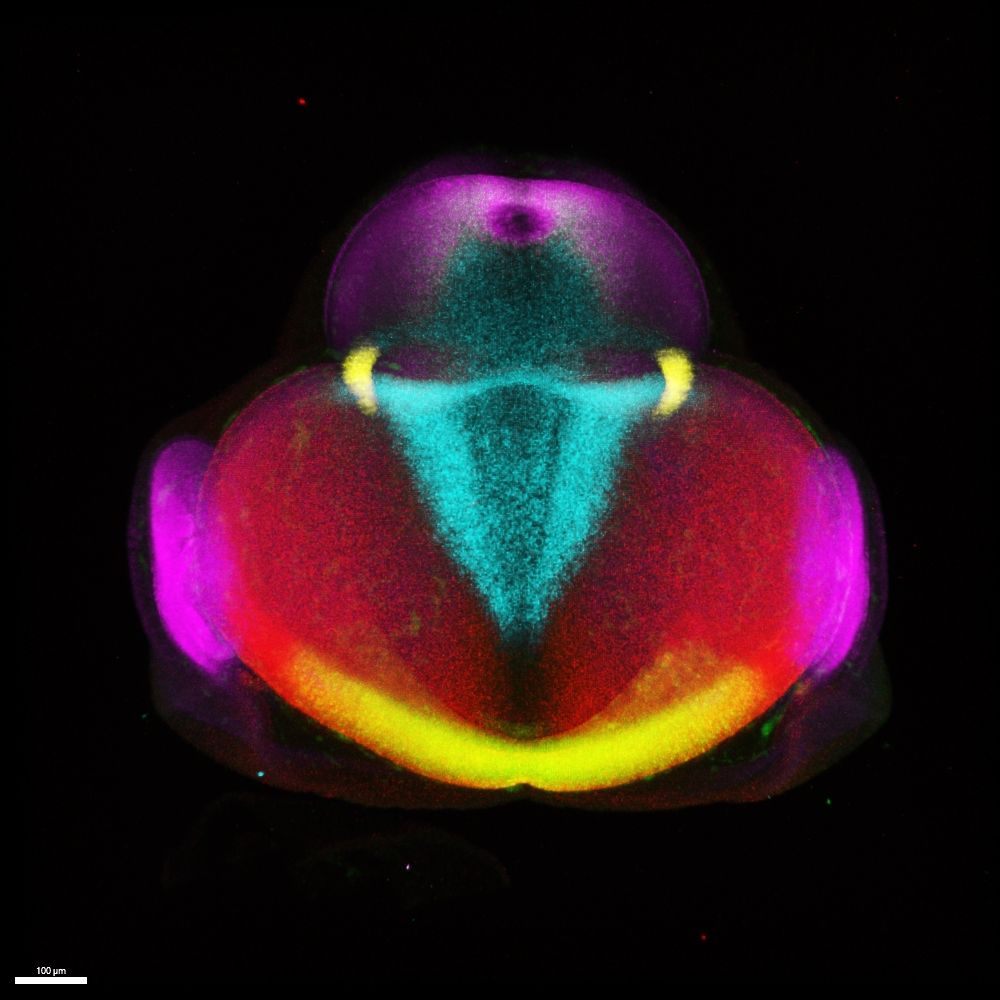
Another week, another Houart lab image🔬
This week, it's a 3D image of a multiplex, in-situ of a chick forebrain by @danafd.bsky.social who studies early forebrain development in vertebrates & uses HCR to show the expression patterns of gene products instrumental in pallial/subpallial specification.
03.06.2025 13:28 — 👍 10 🔁 3 💬 1 📌 0
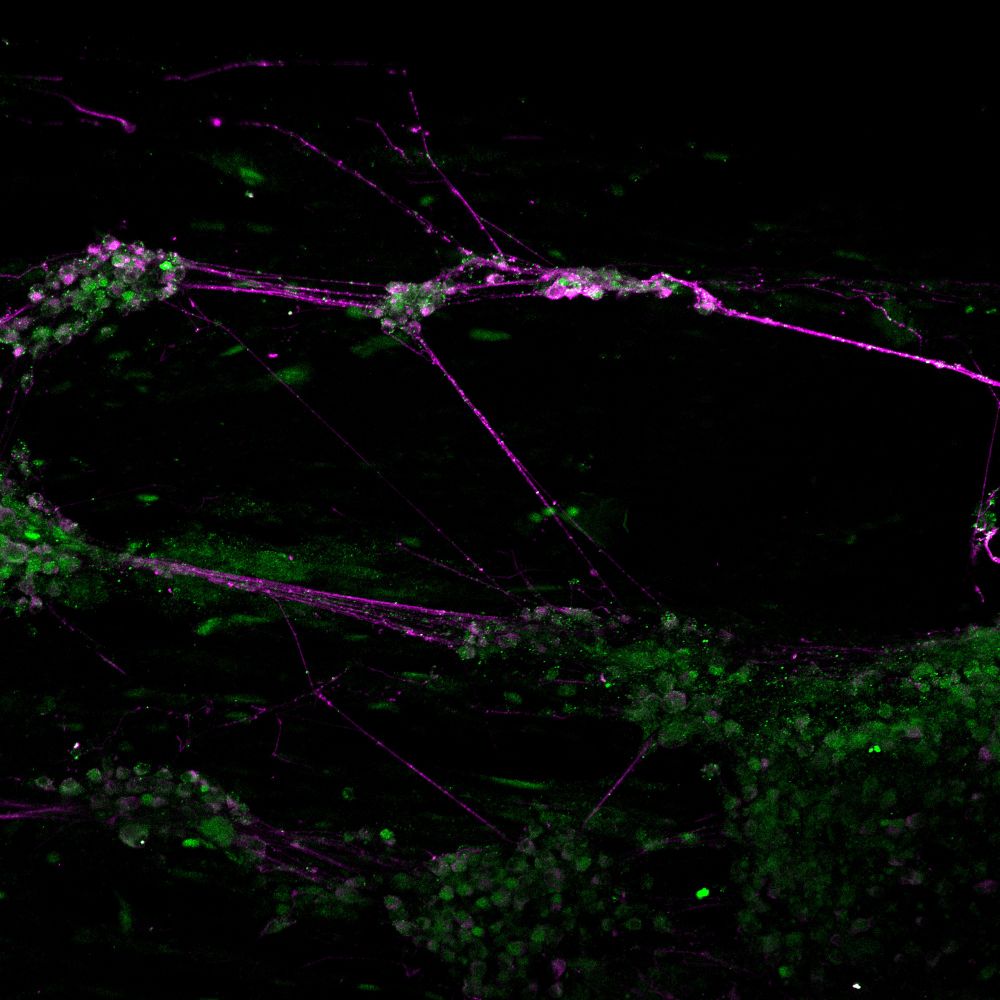
This week, Rachel Moore shares a gorgeous image from her #zebrafish neuron culture. In a dish, these neurons can grow long axons (magenta). If you look closely, you might be able to see some RNA splicing proteins (green) localised as small puncta along the axons.
28.05.2025 08:41 — 👍 8 🔁 3 💬 0 📌 0
This week, Rachel Moore shares a gorgeous image from her #zebrafish neuron culture. In a dish, these neurons can grow long axons (magenta). If you look closely, you might be able to see some RNA splicing proteins (green) localised as small puncta along the axons.
28.05.2025 08:41 — 👍 8 🔁 3 💬 0 📌 0
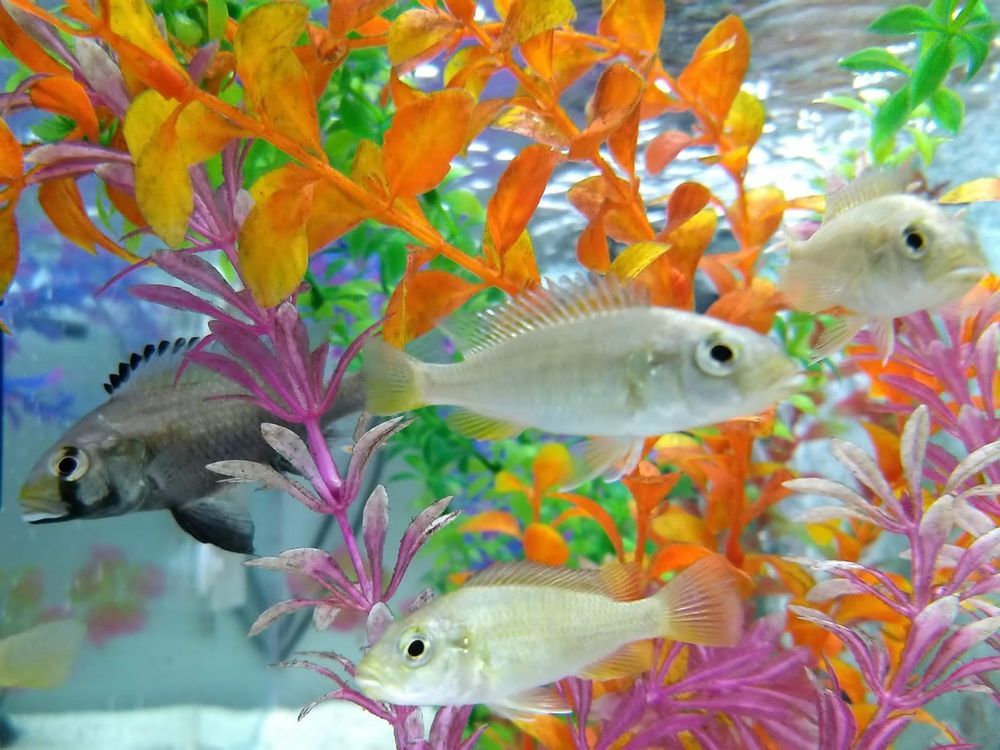
Experimental embryology postdoc available in my lab at the @biology.ox.ac.uk @ox.ac.uk working on the evolution of vertebral counts. Reach out if you’re passionate about EvoDevo, enjoy lab work and microscopy and are into or could get into cichlid fishes. Deadline on the 16th June. Please share!
19.05.2025 16:10 — 👍 64 🔁 66 💬 4 📌 5
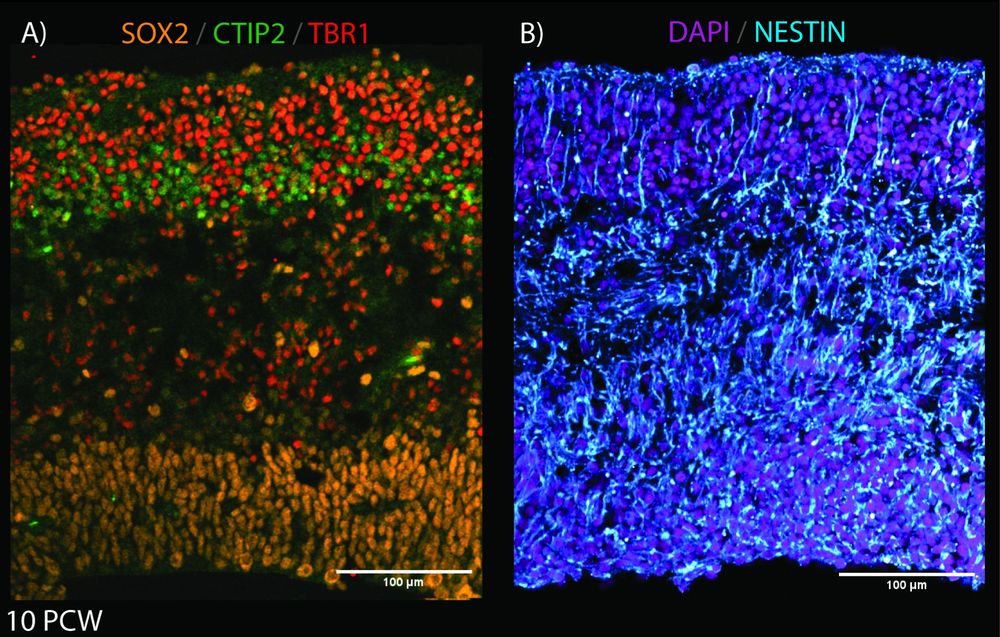
This week's image is by @joseriveraz.bsky.social who's tracing the lineage of progenitors in the human developing cortex.
Here, José shows the building blocks of the developing cortex at 10pcw with SOX2 (apical progenitors), CTIP2 & TBR1(neuronal markers), NESTIN (radial glial fibers), and DAPI.
17.05.2025 13:15 — 👍 5 🔁 3 💬 0 📌 0
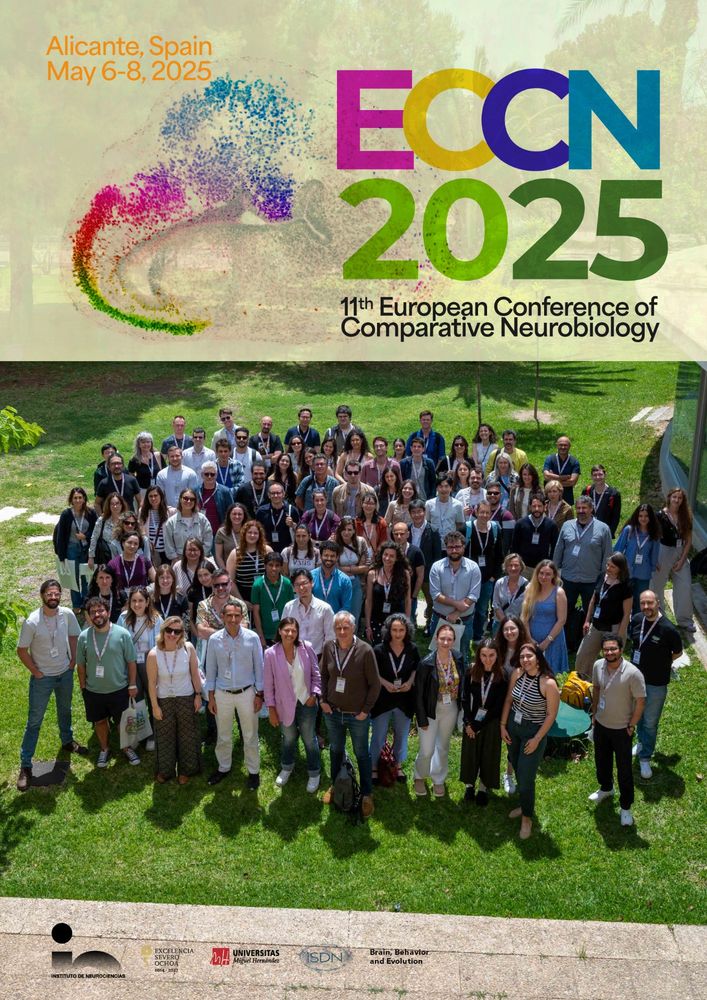
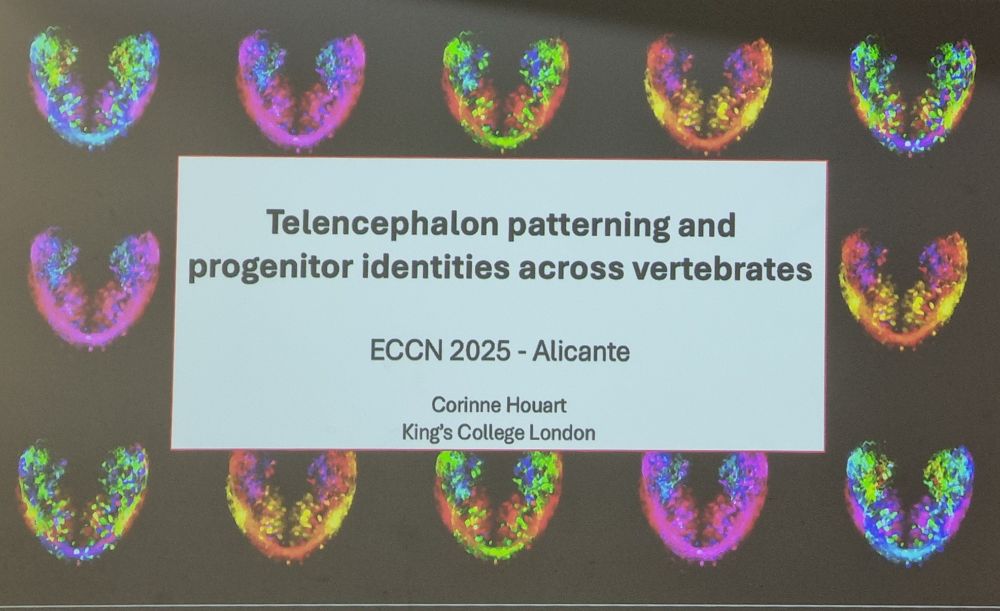
It has been an absolute pleasure for our lab to attend #ECCN2025 for the first time this year.
We had meaningful discussions and learned a lot from a vibrant community tackling tough questions on brain evolution and development! Super excited for what lies ahead!
09.05.2025 11:44 — 👍 12 🔁 5 💬 0 📌 2
Dkk genes dynamically expressed in the zebrafish nervous system, some in very discreet brain populations (watch this space for brain images).
Malik Missaoui is using genetics to follow behaviour of endogenous proteins and crack their local functions.
@mrc-cndd.bsky.social @kingsioppn.bsky.social
08.05.2025 13:08 — 👍 2 🔁 3 💬 0 📌 0
@houartlab.bsky.social first time at the comparative neuro conference. Fantastic #ECCN2025 meeting! The mix of ‘old’ and new technologies brings the field a new edge and the potential for new understanding of brain evolutionary mechanisms. Exciting!
08.05.2025 13:43 — 👍 14 🔁 4 💬 0 📌 0
In this video, dkk1a (green), dkk1b (yellow), and dkk3a (magenta) are shown along the trunk of 48hpf zebrafish embryo.
06.05.2025 18:12 — 👍 1 🔁 0 💬 0 📌 0
Our laboratory in the MCB department at UC Berkeley studies how tissues, cells, and subcellular dynamics coordinate to generate organs and initiate physiologies. www.swinburnelab.org
The official Bluesky account of the European Zebrafish Society - supporting and connecting the zebrafish research community across Europe. Updates on events, training, resources, and community initiatives.
FWO fellow @ KU Leuven studying the origin and evolution of human language
@vandenberglab.bsky.social
winner of the 2025 LAVA Scholarship for autistic researchers
pedagoog, bioloog en ervaringstaalkundige
Devine lab at @crick.ac.uk
We study how mitochondria regulate neuronal synapses and how that regulation goes wrong in diseases that affect the brain
Posts by lab members | Views are own
Asst. Prof @ UW-Madison. I study the cell biology of the neuroimmune system using zebrafish. I make pretty pictures. #FirstGen
Postdoc in the Perry Lab at UCSD. Trying to figure out how changes in development lead to new kinds of eyes in Insects. Now working on the male Housefly "Lovespot"
PhD student in (developmental/comp)neuroscience. Cossart lab (INMED, Marseille). track2p.github.io
How cells stick to things and move around, microscopy, cats, garden bugs, forays into machine learning, occasional political snark. Asst Prof University of Bath, UK 🏳️🌈
PhD MICROBIOLOGIST /
Phage Therapy, AMR, Biofilms, Drug Design and some other topics
@remissionbiome.bsky.social &
@renegaderesearch.bsky.social team
DEFEND SCIENCE, RESIST IGNORANCE
Ankara/Boston
PhD student in the Urbán lab, IMBA • Neural stem cells in the adult brain
Developmental neurobiologist studying the adult brain. Group leader @IMBA, Vienna. Quiescence, adult neurogenesis, fate transitions.
Neuroscience/Stem Cell PhD student 🧠 👩🏽🔬 @grocottlab.bsky.social
@uniofeastanglia.bsky.social
Virtual Events Officer @womeninneurouk.bsky.social
Alumni @blizardinstitute.bsky.social @uniofnottingham.bsky.social
Group Leader @MPI-CBG and @POL, TU-Dresden. Dev Biologist mixing it up w/ Physics. Want to know how organs grow! also obsessed with structural colors | ritamateus.com
Assistant Professor at Aarhus University, Denmark. Working with Zebrafish to understand the gut-brain axis
Interested in cell fate decisions in central nervous system development and developmental eye anomalies.
Chancellor's Fellow (ERC StG & NIRG) @ Institute for Neuroscience and Cardiovascular Research, University of Edinburgh 🐟🧠 🏳️🌈
Interested in synaptic and non-synaptic neurotransmission, and myelin
#zebrafish #neurobiology #neuroscience
http://almeida-lab.com
Neuroscience, meninges, blood-brain barrier, cake (or cookies)
http://siegenthalerlabcu.weebly.com/
Postdoctoral Research Fellow in the Developmental Signalling Lab @The Francis Crick Institute 🐟🔬🧫🎓