Simone Marini's Avatar

Simone Marini

@simonemarini.bsky.social

AI, BioML, compbio, data science | pathogens, AMR antimicrobial and antibiotic res, inflammation, CBD, single-cell RNA seq, metagenomics | Asst Prof @ University of Florida, AI advisor @ enGenome | Prev: UMich, UniPV, KyotoU | Immigrant πŸ‡ͺπŸ‡ΊπŸ‡­πŸ‡°πŸ‡―πŸ‡΅πŸ‡ΊπŸ‡Έ

2,388 Followers  |  744 Following  |  35 Posts  |  Joined: 11.11.2024  |  2.0132

Latest posts by simonemarini.bsky.social on Bluesky


Preview
Probing Scientific General Intelligence of LLMs with Scientist-Aligned Workflows Despite advances in scientific AI, a coherent framework for Scientific General Intelligence (SGI)-the ability to autonomously conceive, investigate, and reason across scientific domains-remains lackin...

A new 156 page paper defines Scientific General Intelligence as end to end research capability and introduces SGI Bench with 1,000 plus expert tasks. Results show LLMs fail badly at full scientific workflows. arxiv.org/abs/2512.16969

25.12.2025 13:05 β€” πŸ‘ 3    πŸ” 2    πŸ’¬ 0    πŸ“Œ 0

suspect a big reason why many academics and others who work in areas where getting facts RIGHT is key are disinterested in using LLMs for research:

they’ve tried it, they keep noticing major errors in output, and they conclude that having to verify all that doesn’t actually save them time.

21.12.2025 16:16 β€” πŸ‘ 3221    πŸ” 621    πŸ’¬ 112    πŸ“Œ 182
Post image

Ampicillin/Sulbactam in Combination with Ceftazidime/Avibactam against Metallo-ß-Lactamase-Producing Carbapenem-Resistant Acinetobacter baumannii: A Genomics-Informed Mechanism-Based Model

βœ… Just Accepted
πŸ”— https://bit.ly/3WUrcmU

19.12.2025 21:15 β€” πŸ‘ 4    πŸ” 3    πŸ’¬ 1    πŸ“Œ 1
Post image

An activate-to-eliminate approach in HIV

Joel N. Blankson & team report on a strategy to selectively eliminate antigen-specific HIV infected CD4+ T cells by stimulation with cognate peptides and incubation with antiproliferative drugs: doi.org/10.1172/JCI1...

17.12.2025 14:03 β€” πŸ‘ 1    πŸ” 3    πŸ’¬ 0    πŸ“Œ 0

National Academy of Medicine launches AI patient safety initiative to develop harm prevention frameworks across healthcare systems www.beckershospitalreview.com/healthcare-i...

12.12.2025 12:17 β€” πŸ‘ 0    πŸ” 2    πŸ’¬ 0    πŸ“Œ 0

Thanks for sharing! These 1st hand experiences are really important, especially for students.

15.11.2025 15:52 β€” πŸ‘ 0    πŸ” 0    πŸ’¬ 0    πŸ“Œ 0

Clifti-GPT: Privacy-preserving federated fine-tuning and transferable inference of foundation models on clinical single-cell data #SingleCell πŸ§ͺ🧬πŸ–₯️
https://www.researchsquare.com/article/rs-7917089/latest

12.11.2025 08:00 β€” πŸ‘ 0    πŸ” 1    πŸ’¬ 0    πŸ“Œ 0
A table showing profit margins of major publishers. A snippet of text related to this table is below.

1. The four-fold drain
1.1 Money
Currently, academic publishing is dominated by profit-oriented, multinational companies for
whom scientific knowledge is a commodity to be sold back to the academic community who
created it. The dominant four are Elsevier, Springer Nature, Wiley and Taylor & Francis,
which collectively generated over US$7.1 billion in revenue from journal publishing in 2024
alone, and over US$12 billion in profits between 2019 and 2024 (Table 1A). Their profit
margins have always been over 30% in the last five years, and for the largest publisher
(Elsevier) always over 37%.
Against many comparators, across many sectors, scientific publishing is one of the most
consistently profitable industries (Table S1). These financial arrangements make a substantial
difference to science budgets. In 2024, 46% of Elsevier revenues and 53% of Taylor &
Francis revenues were generated in North America, meaning that North American
researchers were charged over US$2.27 billion by just two for-profit publishers. The
Canadian research councils and the US National Science Foundation were allocated US$9.3
billion in that year.

A table showing profit margins of major publishers. A snippet of text related to this table is below. 1. The four-fold drain 1.1 Money Currently, academic publishing is dominated by profit-oriented, multinational companies for whom scientific knowledge is a commodity to be sold back to the academic community who created it. The dominant four are Elsevier, Springer Nature, Wiley and Taylor & Francis, which collectively generated over US$7.1 billion in revenue from journal publishing in 2024 alone, and over US$12 billion in profits between 2019 and 2024 (Table 1A). Their profit margins have always been over 30% in the last five years, and for the largest publisher (Elsevier) always over 37%. Against many comparators, across many sectors, scientific publishing is one of the most consistently profitable industries (Table S1). These financial arrangements make a substantial difference to science budgets. In 2024, 46% of Elsevier revenues and 53% of Taylor & Francis revenues were generated in North America, meaning that North American researchers were charged over US$2.27 billion by just two for-profit publishers. The Canadian research councils and the US National Science Foundation were allocated US$9.3 billion in that year.

A figure detailing the drain on researcher time.

1. The four-fold drain

1.2 Time
The number of papers published each year is growing faster than the scientific workforce,
with the number of papers per researcher almost doubling between 1996 and 2022 (Figure
1A). This reflects the fact that publishers’ commercial desire to publish (sell) more material
has aligned well with the competitive prestige culture in which publications help secure jobs,
grants, promotions, and awards. To the extent that this growth is driven by a pressure for
profit, rather than scholarly imperatives, it distorts the way researchers spend their time.
The publishing system depends on unpaid reviewer labour, estimated to be over 130 million
unpaid hours annually in 2020 alone (9). Researchers have complained about the demands of
peer-review for decades, but the scale of the problem is now worse, with editors reporting
widespread difficulties recruiting reviewers. The growth in publications involves not only the
authors’ time, but that of academic editors and reviewers who are dealing with so many
review demands.
Even more seriously, the imperative to produce ever more articles reshapes the nature of
scientific inquiry. Evidence across multiple fields shows that more papers result in
β€˜ossification’, not new ideas (10). It may seem paradoxical that more papers can slow
progress until one considers how it affects researchers’ time. While rewards remain tied to
volume, prestige, and impact of publications, researchers will be nudged away from riskier,
local, interdisciplinary, and long-term work. The result is a treadmill of constant activity with
limited progress whereas core scholarly practices – such as reading, reflecting and engaging
with others’ contributions – is de-prioritized. What looks like productivity often masks
intellectual exhaustion built on a demoralizing, narrowing scientific vision.

A figure detailing the drain on researcher time. 1. The four-fold drain 1.2 Time The number of papers published each year is growing faster than the scientific workforce, with the number of papers per researcher almost doubling between 1996 and 2022 (Figure 1A). This reflects the fact that publishers’ commercial desire to publish (sell) more material has aligned well with the competitive prestige culture in which publications help secure jobs, grants, promotions, and awards. To the extent that this growth is driven by a pressure for profit, rather than scholarly imperatives, it distorts the way researchers spend their time. The publishing system depends on unpaid reviewer labour, estimated to be over 130 million unpaid hours annually in 2020 alone (9). Researchers have complained about the demands of peer-review for decades, but the scale of the problem is now worse, with editors reporting widespread difficulties recruiting reviewers. The growth in publications involves not only the authors’ time, but that of academic editors and reviewers who are dealing with so many review demands. Even more seriously, the imperative to produce ever more articles reshapes the nature of scientific inquiry. Evidence across multiple fields shows that more papers result in β€˜ossification’, not new ideas (10). It may seem paradoxical that more papers can slow progress until one considers how it affects researchers’ time. While rewards remain tied to volume, prestige, and impact of publications, researchers will be nudged away from riskier, local, interdisciplinary, and long-term work. The result is a treadmill of constant activity with limited progress whereas core scholarly practices – such as reading, reflecting and engaging with others’ contributions – is de-prioritized. What looks like productivity often masks intellectual exhaustion built on a demoralizing, narrowing scientific vision.

A table of profit margins across industries. The section of text related to this table is below:

1. The four-fold drain
1.1 Money
Currently, academic publishing is dominated by profit-oriented, multinational companies for
whom scientific knowledge is a commodity to be sold back to the academic community who
created it. The dominant four are Elsevier, Springer Nature, Wiley and Taylor & Francis,
which collectively generated over US$7.1 billion in revenue from journal publishing in 2024
alone, and over US$12 billion in profits between 2019 and 2024 (Table 1A). Their profit
margins have always been over 30% in the last five years, and for the largest publisher
(Elsevier) always over 37%.
Against many comparators, across many sectors, scientific publishing is one of the most
consistently profitable industries (Table S1). These financial arrangements make a substantial
difference to science budgets. In 2024, 46% of Elsevier revenues and 53% of Taylor &
Francis revenues were generated in North America, meaning that North American
researchers were charged over US$2.27 billion by just two for-profit publishers. The
Canadian research councils and the US National Science Foundation were allocated US$9.3
billion in that year.

A table of profit margins across industries. The section of text related to this table is below: 1. The four-fold drain 1.1 Money Currently, academic publishing is dominated by profit-oriented, multinational companies for whom scientific knowledge is a commodity to be sold back to the academic community who created it. The dominant four are Elsevier, Springer Nature, Wiley and Taylor & Francis, which collectively generated over US$7.1 billion in revenue from journal publishing in 2024 alone, and over US$12 billion in profits between 2019 and 2024 (Table 1A). Their profit margins have always been over 30% in the last five years, and for the largest publisher (Elsevier) always over 37%. Against many comparators, across many sectors, scientific publishing is one of the most consistently profitable industries (Table S1). These financial arrangements make a substantial difference to science budgets. In 2024, 46% of Elsevier revenues and 53% of Taylor & Francis revenues were generated in North America, meaning that North American researchers were charged over US$2.27 billion by just two for-profit publishers. The Canadian research councils and the US National Science Foundation were allocated US$9.3 billion in that year.

The costs of inaction are plain: wasted public funds, lost researcher time, compromised
scientific integrity and eroded public trust. Today, the system rewards commercial publishers
first, and science second. Without bold action from the funders we risk continuing to pour
resources into a system that prioritizes profit over the advancement of scientific knowledge.

The costs of inaction are plain: wasted public funds, lost researcher time, compromised scientific integrity and eroded public trust. Today, the system rewards commercial publishers first, and science second. Without bold action from the funders we risk continuing to pour resources into a system that prioritizes profit over the advancement of scientific knowledge.

We wrote the Strain on scientific publishing to highlight the problems of time & trust. With a fantastic group of co-authors, we present The Drain of Scientific Publishing:

a 🧡 1/n

Drain: arxiv.org/abs/2511.04820
Strain: direct.mit.edu/qss/article/...
Oligopoly: direct.mit.edu/qss/article/...

11.11.2025 11:52 β€” πŸ‘ 641    πŸ” 453    πŸ’¬ 8    πŸ“Œ 66
Preview
Toward security-aware portable sequencing - Nature Communications Portable genome sequencers are revolutionizing genomic research. However, their reliance on external systems introduces new vulnerabilities that threaten the security of these sequencers. By employing...

Three critical vulnerabilities (now patched) have been discovered in a portable ONT DNA sequencing device.

While our attention is focused on the security of genomic data storage, this is a strong reminder we have to factor in hardware security as well.

www.nature.com/articles/s41...

11.11.2025 00:06 β€” πŸ‘ 0    πŸ” 0    πŸ’¬ 0    πŸ“Œ 0
Preview
Reporting guidelines for studies involving generative artificial intelligence applications: what do I use, and when? - npj Digital Medicine With a growing number of studies applying generative artificial intelligence (GAI) models for health purposes, reporting standards are being developed to guide authors in this space. We describe the…

The use of GenAI in health research necessitates transparent reporting standards.

New guidelines help: CHART for chatbot health advice, TRIPOD-LLM for model development or prediction, and GAMER for GenAI-assisted manuscript writing.
#MedSky #MedAI #MLSky

07.11.2025 16:09 β€” πŸ‘ 5    πŸ” 2    πŸ’¬ 0    πŸ“Œ 0
Preview
Language models cannot reliably distinguish belief from knowledge and fact - Nature Machine Intelligence Suzgun et al. find that current large language models cannot reliably distinguish between belief, knowledge and fact, raising concerns for their use in healthcare, law and journalism, where such disti...

This is why we build knowledgebases & build our own agentic AI tools for querying them www.nature.com/articles/s42... #llms

04.11.2025 13:05 β€” πŸ‘ 5    πŸ” 1    πŸ’¬ 0    πŸ“Œ 0
Preview
WHO warns of widespread resistance to common antibiotics worldwide One in six laboratory-confirmed bacterial infections causing common infections in people worldwide in 2023 were resistant to antibiotic treatments, according to a new World Health Organization (WHO) r...

WHO reports 1 in 6 bacterial infections worldwide are antibiotic-resistant, with resistance rising sharply since 2018. Gram-negative bacteria like E. coli and K. pneumoniae pose the biggest threat. Action on #AMR surveillance and responsible antibiotic use is needed.

www.who.int/news/item/13...

13.10.2025 11:09 β€” πŸ‘ 49    πŸ” 28    πŸ’¬ 0    πŸ“Œ 8
Preview
Efficient and accurate search in petabase-scale sequence repositories - Nature MetaGraph enables scalable indexing of large sets of DNA, RNA or protein sequences using annotated de Bruijn graphs.

MetaGraph by Karasikov and coauthors makes the world’s DNA searchable. By turning 67 petabases of raw sequences into a compressed graph structure, it enables fast, low-cost search across global genomic dataβ€”bringing biology closer to having its own β€œsearch engine”. www.nature.com/articles/s41...

13.10.2025 12:20 β€” πŸ‘ 1    πŸ” 1    πŸ’¬ 0    πŸ“Œ 0
Preview
Genomic constraints shape the evolution of alternative routes to drug resistance in prokaryotes Background Variation within the prokaryotic pangenome is not random, and natural selection that favours particular combinations of genes appears to dominate over random drift. What is less clear is wh...

New preprint reveals bacteria can't just collect all resistance genes like Pokemon cards.
We found mutually exclusive evolutionary pathways to multidrug resistance in E. coli & P. aeruginosa - some resistance mechanisms actively prevent others from coexisting www.biorxiv.org/content/10.1...

29.08.2025 14:05 β€” πŸ‘ 165    πŸ” 77    πŸ’¬ 4    πŸ“Œ 5
Post image

The Impact of Tokenizer Selection in Genomic Language Models. #GenomicLanguageModels #Genomics #LLMs #Bioinformatics
academic.oup.com/bioinformati...

31.08.2025 07:32 β€” πŸ‘ 3    πŸ” 3    πŸ’¬ 0    πŸ“Œ 0
Preview
White mold fungi split their genome across several nuclei, with implications for future gene editing Challenging the long-standing assumption that a cell’s nucleus contains a complete set of chromosomes, recent research reveals that some fungi nuclei only contain half.

White mold fungi split their genome across several nuclei, with implications for future gene editing - Could enable dramatic revolutions in gene editing: theconversation.com/white-mold-f... #CdnSci #genomics #science #SciChat

29.08.2025 15:48 β€” πŸ‘ 1    πŸ” 2    πŸ’¬ 0    πŸ“Œ 0

PBMCpedia: A Harmonized PBMC scRNA-seq Database With Unified Mapping and Enhanced Celltype Annotation #SingleCell πŸ§ͺ🧬πŸ–₯️
https://www.biorxiv.org/content/10.1101/2025.08.06.668843v1

09.08.2025 07:00 β€” πŸ‘ 1    πŸ” 2    πŸ’¬ 0    πŸ“Œ 0
Preview
SARITA: a large language model for generating the S1 subunit of the SARS-CoV-2 spike protein Abstract. Background: The COVID-19 pandemic has caused over 776 million infections and 7 million deaths globally between December 2019 and November 2024. S

Paper out! SARITA, a Genomic language model to predict SARS-CoV-2 mutations and support the design of antigenic variants for downstream use in therapy development and immunological studies.

academic.oup.com/bib/article/...

06.08.2025 23:02 β€” πŸ‘ 2    πŸ” 1    πŸ’¬ 0    πŸ“Œ 0
Preview
Respiratory viral infections awaken metastatic breast cancer cells in lungs - Nature Mouse models show that respiratory infections from viruses such as influenza and SARS-CoV-2 can trigger metastasis of dormant breast cancer cells in the lungs, a finding supported by epidemiological d...

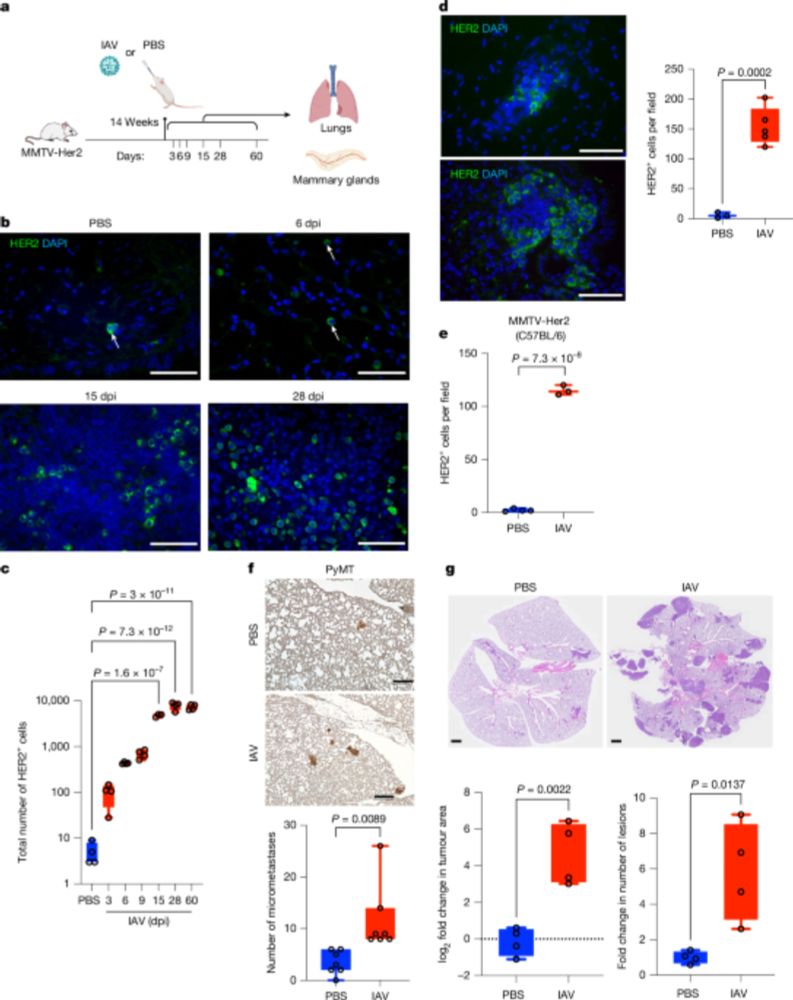
Respiratory infections reactivate dormant metastatic breast cancer cells in mouse lungs, correlating with evidence in humans that #SARS-CoV-2 infection increases the risk of cancer-related mortality & lung metastasis

😎 biology but double whammy for cancer patients

www.nature.com/articles/s41...
πŸ§ͺ

30.07.2025 16:54 β€” πŸ‘ 73    πŸ” 45    πŸ’¬ 9    πŸ“Œ 4
Preview
Behavioral and Demographic Profiles of HIV Transmission and Exposure Networks in Florida: Network Analysis of HIV Contact Tracing Data Background: To complete the Ending the HIV Epidemic initiative in areas with high HIV incidence, there needs to be a greater understanding of the demographic, behavioral, and geographic factors that i...

Paper out on HIV epidemiology + network science!

We identify risk groups and clusters of transmission and exposure throughout Florida, via a rich database of multi-year contact tracing interviews.

publichealth.jmir.org/2025/1/e65573/

15.07.2025 19:42 β€” πŸ‘ 1    πŸ” 0    πŸ’¬ 0    πŸ“Œ 0

Every time I read about experiments showing AI cheating, deceiving, tricking--the last one finding how o3 is a master schemer when playing Diplomacy against other AIs--I keep thinking how we are slowly approaching the proof that philosophical zombies are real.

09.06.2025 19:06 β€” πŸ‘ 1    πŸ” 0    πŸ’¬ 0    πŸ“Œ 0
Preview
Reproducibility: How replicable is biomedical science in Brazil? The results of a project to estimate the reproducibility of research in Brazil have just been published.

πŸ‡§πŸ‡· The Brazilian Reproducibility Initiative published the results of 143 replication attempts in biomedical science.

Success rates ranged from just 15–45%.

Now, the project team reflects on what made replication so hard and what needs to change.
buff.ly/55j9Sax

09.05.2025 08:21 β€” πŸ‘ 12    πŸ” 3    πŸ’¬ 1    πŸ“Œ 1
Preview
Assemblies of long-read metagenomes suffer from diverse errors Genomes from metagenomes have revolutionised our understanding of microbial diversity, ecology, and evolution, propelling advances in basic science, biomedicine, and biotechnology. Assembly algorithms...

I am very happy (and anxious) to share with you our most recent work in which we evaluated four of the most popular long-read assemblers,

www.biorxiv.org/content/10.1...

and tell you just a little bit about it in the following 🧡

28.04.2025 08:07 β€” πŸ‘ 137    πŸ” 73    πŸ’¬ 5    πŸ“Œ 8
Preview
Antibiotic Drug Market Rewriting Incredible Growth Stay tuned with latest market insights and key-players market position in Antibiotic Drug Market with more detailed insights by type, application and major geographies. HTF MI released latest edition...

The global antibiotic market is projected to grow from $51B in 2025 to $65B by 2032, driven by rising infections and R&D. Key challenges include #AMR and high costs, with new opportunities in phage therapy and diagnostics.
#InfectiousDisease
www.htfmarketinsights.com/report/41017...

05.04.2025 11:15 β€” πŸ‘ 22    πŸ” 9    πŸ’¬ 0    πŸ“Œ 0
Post image

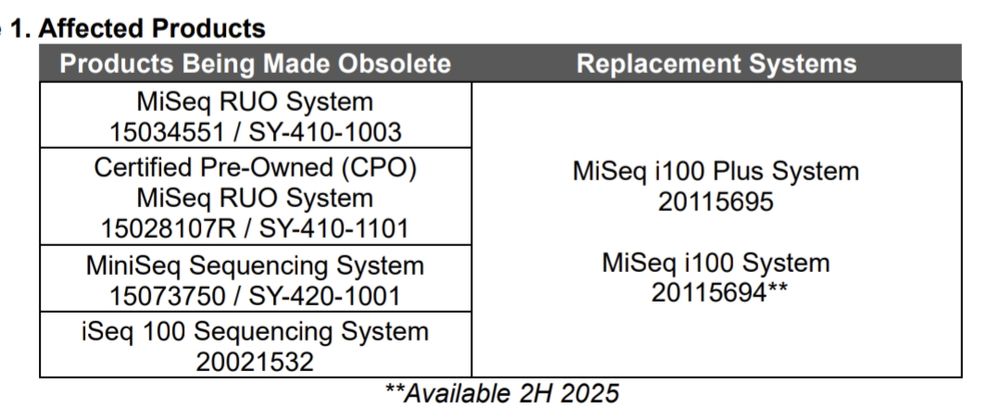
Illumina announced the discontinuation of the old MiSeq, MiniSeq and old i100 instruments.

28.03.2025 13:02 β€” πŸ‘ 1    πŸ” 4    πŸ’¬ 1    πŸ“Œ 0
Preview
NIH Grants Fueled $95 Billion In FY 2024 Economic Activity, Finds New Report National Institutes of Health grants generated almost $95 billion in economic activity nationwide in FY 2024 according to a new report by United for Medical Research.

NIH is the best investment there is.

www.forbes.com/sites/michae...

13.03.2025 00:49 β€” πŸ‘ 268    πŸ” 132    πŸ’¬ 5    πŸ“Œ 4

This example, along with others, seems to tell us that, after all, philosophical zombies could be a thing.
I mean, you get all these AI behaviors that we naively ascribed to conscious (or partially conscious) beings only. Because
they not getting conscious, one step at the time, right? Right...?

24.02.2025 19:59 β€” πŸ‘ 1    πŸ” 0    πŸ’¬ 0    πŸ“Œ 0
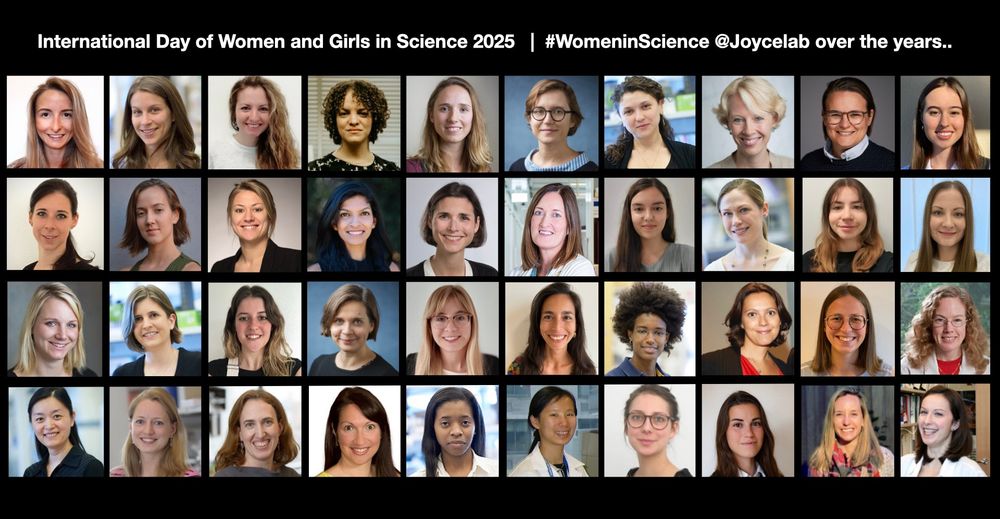
Composite image of women scientists from the Joyce lab over the past 20 years

Composite image of women scientists from the Joyce lab over the past 20 years

Happy International Day of Women and Girls in Science!

Its been a privilege to work with these extraordinary scientists in my lab over the years - all making an incredible impact throughout the world πŸ™Œ

We must never give up on #equality #diversity & #inclusion πŸ’ͺ

#WomeninScience #GirlsInSTEM πŸ§ͺπŸ”¬πŸ”­πŸš€

11.02.2025 12:00 β€” πŸ‘ 224    πŸ” 53    πŸ’¬ 0    πŸ“Œ 3

@simonemarini is following 20 prominent accounts