I’d be more sure if we could see the top of the staff, as the thrysus would be a strong iconographic clue, but the pose and the garland are very much in keeping with Dionysos, so those clues stand in favour. I agree with you that there’s elements of the feminine. Dionysos is my current best guess.
13.02.2026 18:09 — 👍 1 🔁 0 💬 0 📌 0
The house was revealled during archaeological excavations in 2022 and can be seen today as part of the tour of the baths.
#FrescoFriday #AncientRome #Dionysus #Bacchus #History
13.02.2026 08:32 — 👍 5 🔁 0 💬 0 📌 0
The fresco comes from a house that was built on the same site, but prior to, the Baths of Caracalla in Rome. It is thought to date to the early second century CE.
13.02.2026 08:32 — 👍 5 🔁 0 💬 1 📌 0
Bacchus appears to be wearing a garland - a very typical thing in his iconography. Just off on stage right appears to be another figure holding a dish. The background of this scene is a brilliant warm red.
13.02.2026 08:32 — 👍 3 🔁 0 💬 1 📌 0

Bacchus, the god of wine (also known as Dionysus to the Greeks) lounges semi-nude in a golden and burgundy gown while holding a spectre of some kind. This is likely a thyrsus, but the telltale details are missing. Bacchus appears to be wearing a garland - a very typical thing in his iconography. Just off on stage right appears to be another figure holding a dish. The background of this scene is a brilliant warm red.
Bacchus, the god of wine (also known as Dionysus to the Greeks) lounges semi-nude in a golden and burgundy gown while holding a spectre of some kind. This is likely a thyrsus, but the telltale details are missing.
13.02.2026 08:32 — 👍 11 🔁 2 💬 2 📌 0

Description from the Getty: "Black body with tendril of ivy leaves and grape clusters in added white. On the front, a figure of an old man with a swollen belly and an oversize phallus wearing a cloak stands in a rocky landscape. His wrists are bound. Below him to left is a crow. The scene is a parody of Prometheus bound to a rock having his liver eaten by an eagle."

Description from the Getty: "Black body with tendril of ivy leaves and grape clusters in added white. On the front, a figure of an old man with a swollen belly and an oversize phallus wearing a cloak stands in a rocky landscape. His wrists are bound. Below him to left is a crow. The scene is a parody of Prometheus bound to a rock having his liver eaten by an eagle."
✨It’s #PhallusThursday ✨
A celebration of the imagery of the ancients, today we turn to this red figure ware vessel depicting an old man with quite the phallus. He is bound and a crow looks up at him in an allusion to the myth of Prometheus.
#AncientGreece #Prometheus
12.02.2026 08:40 — 👍 34 🔁 5 💬 1 📌 0
🤣🤣🤣
12.02.2026 08:54 — 👍 1 🔁 0 💬 0 📌 0
Description from the Getty: "Black body with tendril of ivy leaves and grape clusters in added white. On the front, a figure of an old man with a swollen belly and an oversize phallus wearing a cloak stands in a rocky landscape. His wrists are bound. Below him to left is a crow. The scene is a parody of Prometheus bound to a rock having his liver eaten by an eagle."
Description from the Getty: "Black body with tendril of ivy leaves and grape clusters in added white. On the front, a figure of an old man with a swollen belly and an oversize phallus wearing a cloak stands in a rocky landscape. His wrists are bound. Below him to left is a crow. The scene is a parody of Prometheus bound to a rock having his liver eaten by an eagle."
✨It’s #PhallusThursday ✨
A celebration of the imagery of the ancients, today we turn to this red figure ware vessel depicting an old man with quite the phallus. He is bound and a crow looks up at him in an allusion to the myth of Prometheus.
#AncientGreece #Prometheus
12.02.2026 08:40 — 👍 34 🔁 5 💬 1 📌 0

1. #SarcophagusSaturday brings me to this wonderfully carved fragment of a banquet scene from the lid of a now-lost sarcophagus from Palmyra (Tadmor),originally at the West Necropolis, Valley of the Tombs, Temple Tomb no. 36, Palmyra Museum, inv. no. 401/525, VI.5.
📸Troels Myrup
07.02.2026 15:40 — 👍 12 🔁 4 💬 1 📌 1
Palmyra was an important trading city within ancient Syria. It's history as a site of human activity dates back to the Neolithic period and the city had been in existence thousands of years before the Roman influence was felt in the region.
#ReliefWednesday #AncientRome #AncientSyria #Palmyra
11.02.2026 08:05 — 👍 7 🔁 0 💬 1 📌 0

Description from the Getty: "The subject of the funerary stele is a frontally-facing, bearded man dressed in a tunic and himation (mantle). His left hand grasps a fold of the garment; his right arm is wrapped in the folds of his himation in a sling-like arrangement with only the hand visible. His hair is arranged in rows of tight snail curls and his beard is short and neat. Thin, incised eyebrows appear over large eyes with incised irises and pupils and exaggerated eyelids." Object number: 88.AA.50
✨Palmyra funerary stele✨
Today we travel across the Roman empire to the city of Palmyra and the funerary stele of Maqi, son of Ma'ani. The stele dates to c. 200 CE. The identity of Maqi is evident in the inscription on the stele. The script is in Aramaic.
11.02.2026 08:05 — 👍 25 🔁 2 💬 1 📌 0

This red figure wear charming Attic owl in a circular frame serves a mascot for the American School of Classical Studies in Athens.
Surely we didn’t miss #SuperbOwl 😅
As far as we’re concerned, owls are always in season and worthy of celebration! This charming Attic owl serves as a mascot for the American School of Classical Studies in Athens.
With its inquistive expression, what's not to love!
10.02.2026 06:24 — 👍 28 🔁 4 💬 0 📌 0

Description from the Getty: "Although quite fragmentary, enough remains of the scene depicted in this floor mosaic to identify it as one of the earliest episodes from Homer's Iliad (Book 1, lines 409-415): the moment when Briseis, the captive war-prize of the hero Achilles, is taken from him to be given instead to Agamemnon, king of Mycenae. This contest between two great Greek warriors set in motion the rest of Homer's epic poem. The mosaic shows Briseis being led away by two heralds on the right, Talthybios and Eurybates, who wear traveler's hats and carry staffs. Only her face remains intact. Achilles, holding a lyre and seated next to Patroclus, watches morosely from the far left. The older, bearded man may be Achilles's tutor, Phoenix. The scene takes place in a tent; in the background are two shields holding up a curtain. The same subject is depicted in additional mosaics, as well as wall paintings and other media, attesting to its popularity in Roman art."
✨Achilles and Briseis✨
This stunning mosaic floor is thought to represent the moment when Briseis is taken from Achilles and given to Agamemnon. The conflict that this moment generates sets in motion the horrors covered in Homer's Iliad.
#MosaicMonday #AncientGreece #AncientRome🏺
09.02.2026 06:47 — 👍 36 🔁 4 💬 0 📌 0
Description from the Getty: "Although quite fragmentary, enough remains of the scene depicted in this floor mosaic to identify it as one of the earliest episodes from Homer's Iliad (Book 1, lines 409-415): the moment when Briseis, the captive war-prize of the hero Achilles, is taken from him to be given instead to Agamemnon, king of Mycenae. This contest between two great Greek warriors set in motion the rest of Homer's epic poem. The mosaic shows Briseis being led away by two heralds on the right, Talthybios and Eurybates, who wear traveler's hats and carry staffs. Only her face remains intact. Achilles, holding a lyre and seated next to Patroclus, watches morosely from the far left. The older, bearded man may be Achilles's tutor, Phoenix. The scene takes place in a tent; in the background are two shields holding up a curtain. The same subject is depicted in additional mosaics, as well as wall paintings and other media, attesting to its popularity in Roman art."
✨Achilles and Briseis✨
This stunning mosaic floor is thought to represent the moment when Briseis is taken from Achilles and given to Agamemnon. The conflict that this moment generates sets in motion the horrors covered in Homer's Iliad.
#MosaicMonday #AncientGreece #AncientRome🏺
09.02.2026 06:47 — 👍 36 🔁 4 💬 0 📌 0
I get into Roman ideas about gender and how they influenced everything from the cursus honorem to imperial rule.
#AncientRome #Gender #History
06.02.2026 09:41 — 👍 4 🔁 0 💬 0 📌 0

Book cover for ‘A CULTURAL HISTORY OF GENDER IN ANTIQUITY’ Edited by
Alastair J. L. Blanshard. Published by Bloomsbury.

Inside title page from ‘CHAPTER 4: Politics and War’ by PETA GREENFIELD AND ALASTAIR J. L. BLANSHARD
✨Dr G in print✨
It’s always an exciting day to see your work make it to print! I’m thrilled to have contributed to an exploration of gender concepts in ancient Rome to help researchers dipping into the subject for the first time.
06.02.2026 09:41 — 👍 16 🔁 3 💬 1 📌 0
We sit down with Marc Hyden to consider details of Titus’ rule of Rome and its impact across the Mediterranean, particularly involving Judaea.
05.02.2026 10:02 — 👍 3 🔁 0 💬 1 📌 0

Image of the Arch of Titus. Text reads ‘Special Episode - The Emperor Titus with Marc Hyden’
Titus was the second Flavian emperor and had a huge influence on imperial Rome. The Flavians were the second dynasty of the imperial period - Titus’ reign was short, but significant.
05.02.2026 10:02 — 👍 7 🔁 3 💬 1 📌 0
It will - this is an early release rather than an exclusive ☺️
05.02.2026 08:46 — 👍 0 🔁 0 💬 1 📌 0

Image is a fresco depicting two Lares flanking a genius. A snake depicted beneath the figures approaches an altar. This artefact comes from the House of the Vettii, Pompeii.
Ever wondered what Roman religion was like *before* they meet the Greeks? This is a fascinating side to early Roman history and we chat about what we do know and what we can know when it comes to truly Roman practices in relation to the gods.
05.02.2026 07:28 — 👍 26 🔁 3 💬 1 📌 0
An exciting collection if you’re based in NSW!
04.02.2026 08:05 — 👍 4 🔁 0 💬 0 📌 0

This relief fragment shows part of a face and hair of a woman thought to be a theatre mask. The hair is wavy and pulled back but loose curls fall over the shoulder. The figure also appears to wear a garland of some kind. From the Getty, object number 71.AA.291.
This beautiful but fragmentary relief depicts a theatre mask. Dating to the first century CE, the provenance of this relief is unknown, but the artistry cannot be denied. The intricate curls and waves of the hair add a sense of drama to the subject.
#ReliefWednesday #AncientRome #History
04.02.2026 08:03 — 👍 51 🔁 10 💬 0 📌 0

Image is a promotional poster for the documentary showing a gladiator helmet laying on the sands of the arena.
✨Gladiators!✨
If you’re in the UK and have been keen to catch us in the National Geographic documentary ‘Gladiators: Warriors of the Ancient World’ you’re in luck as it’s out now!
03.02.2026 10:13 — 👍 13 🔁 3 💬 0 📌 0
Such expressiveness!
02.02.2026 19:52 — 👍 1 🔁 0 💬 0 📌 0
These delightful faces reveal the artistry of glass-workers in the ancient world. The necklace is held by the Getty (object number 2003.259)
#MosaicMonday #AncientRome🏺
02.02.2026 08:40 — 👍 6 🔁 0 💬 0 📌 0

A grid of nine glass beads with faces on them. Question reads: “On a scale of squished glass mosaic bead face, how are you feeling today?”

Image of a necklace made of glass beads with faces on them.
Mosaic glass beads were used for jewellery in the eastern provinces of the Roman empire. These beads are thought to date to the first century CE and most were part of a necklace.
02.02.2026 08:40 — 👍 24 🔁 6 💬 2 📌 0
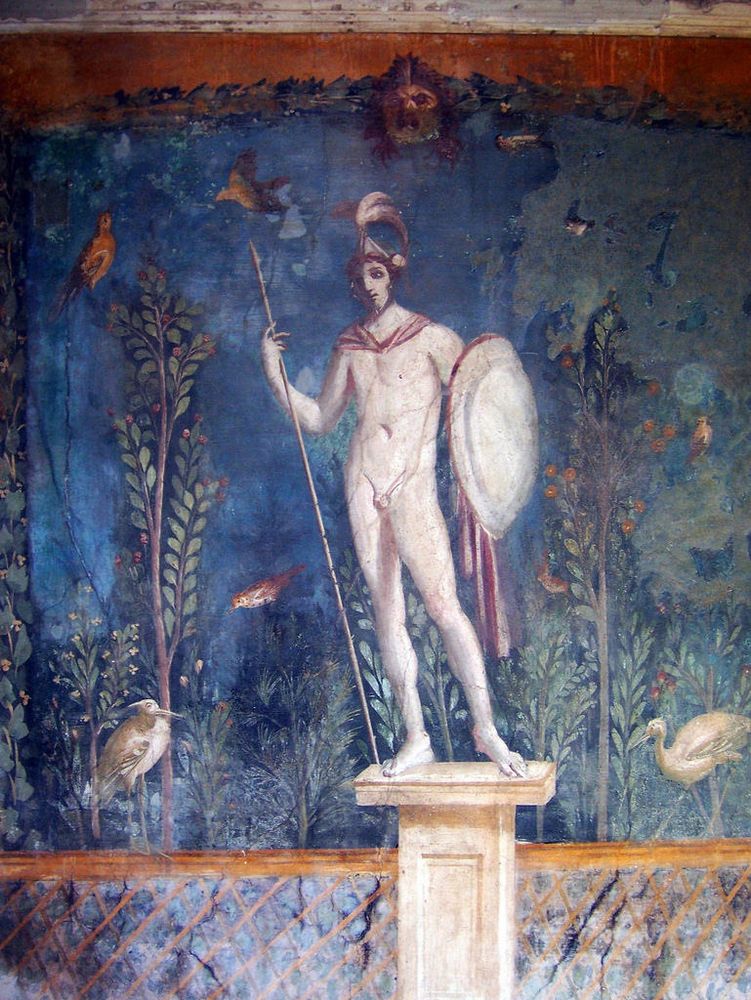
Description from World History Encyclopaedia: ‘Mars, the Roman god of war, is painted standing on a plinth in this fresco from Pompeii. In a typical pose, he has a spear, shield and crested helmet. (House of Venus, Pompeii).”
✨Mars, the god of war ✨
Ancient frescoes hint at the sometimes delicate colouration of statuary. There are polychromatic elements to the cloak and helmet of Mars, but he does look very pale…
30.01.2026 09:31 — 👍 37 🔁 4 💬 1 📌 0
An upcoming podcast about the ancient world presented by @artemis20five.bsky.social. More details coming soon!
Teaches and writes about ancient Greek literature, rhetoric and politics at the University of St Andrews. https://www.st-andrews.ac.uk/classics/people/jph4/
non-profit promoting #Zooarchaeology & fostering communication among the international community!
Tweets by @shyamavermeersch.bsky.social
Zooarchaeology lab based at the University of Sheffield, home to an extensive animal bone reference collection and one of the most active zooarch research teams in the world
🪨 Digital Archaeologist + Heritage Communicator
🌿 Exploring the prehistory of British + beyond!
📜 louise@louisebedford.com
Also on YouTube, TikTok and Instagram @louisearchaeology
All opinions my own | she/her 🏳️🌈
Professor of History and author, most recently, of CLODIA OF ROME: Champion of the Republic (Norton). Learn more at douglasboin.com / religiousdirt.com.
Roman history enthusiast, firefighter, veteran and all round good guy. Lift heavy run far…
Founder: New Classical Scholarship (NCS), Developed: New Forensic Methodology for Ancient Studies. Author of 'Piso Christ' (The Other Side Of The Jesus Story), 'Pliny The Younger: His Words & Phrases' & of hundreds of research papers. Animals & Democracy.
Heritage & Archaeology Manager at Chilterns National Landscape; prehistorian, flyfisher, ferroequinologist. Jack of some trades, master of none. FSA
Opinions are all my own...
Military, history, nerdery. PhDing at UNC, instructor USMA. History of U.S. Sec Coop., currently in Lat America.
Personal acct, opinions do not reflect USG/DOD
#Archaeological excavation project in the #Etruscan city of #Vulci. Exploring the urban development and the new temple.
For more news: https://vulcityscape.hypotheses.org/
Author, anthropologist, archaeologist, angry beer mom. If you've got a time machine, DM me. https://shannonleedawdy.substack.com/
Hollywood or History? Unpack fact vs. fiction in film. Great for teachers, trivia buffs, and history fans. New episodes every other week.
Available on Spotify, Apple, and YouTube
https://youtube.com/@hollywoodorhistorypodcast?si=gNOPQUnVXde2_NZz
The podcast documenting the good/bad/ugly/absurd of this distinctive genre of film, the biopic. New episodes on Tuesdays. A movie/history/comedy podcast. https://open.spotify.com/show/1qaBKP7ho2WPqRXRQjqLJZ?si=UjaT86PfQBSIXhqSR8QJ6A
Eisner-nominated comic artist with an MSc in science communication. Posting about comics, illustration, science, nature, history. www.jordancollver.com
My books:
PETS TELL TALES - https://shorturl.at/gjT9P
HOCUS POCUS - https://shorturl.at/nYyXd
Andrew, Host of Epic Facts Review on YouTube.
Currently focused on WWII Wehrmacht & Red Army.
Follow! 👉Subscribe YT https://www.youtube.com/@epicfactsbooks/videos
Best Books list: https://www.goodreads.com/user/show/158569335-andrew
Postdoc neuroscience researcher.
Brain networks, cognition, emotion, stress & mitochondria. Mental health.
Proud mom. I love music, poetry, & take photos sometimes. ND. 🏳️🌈
Wants ppl safe and happy.
phd candidate +writer•♥️ history+art history, literary childhoods, books, fairy tales, wonder, old sites, nature, music, dance, the cozy+kind• home is Ottawa, Canada 🇨🇦• #GoSensGo🏒#GoBlueJays⚾️•
Compte officiel du Musée Archéologique de la Bataille de Gergovie
🏺 Un nouveau regard sur l'histoire et l'archéologie, en Auvergne
⚔️ Une immersion dans la célèbre bataille gauloise entre Vercingétorix et Jules César