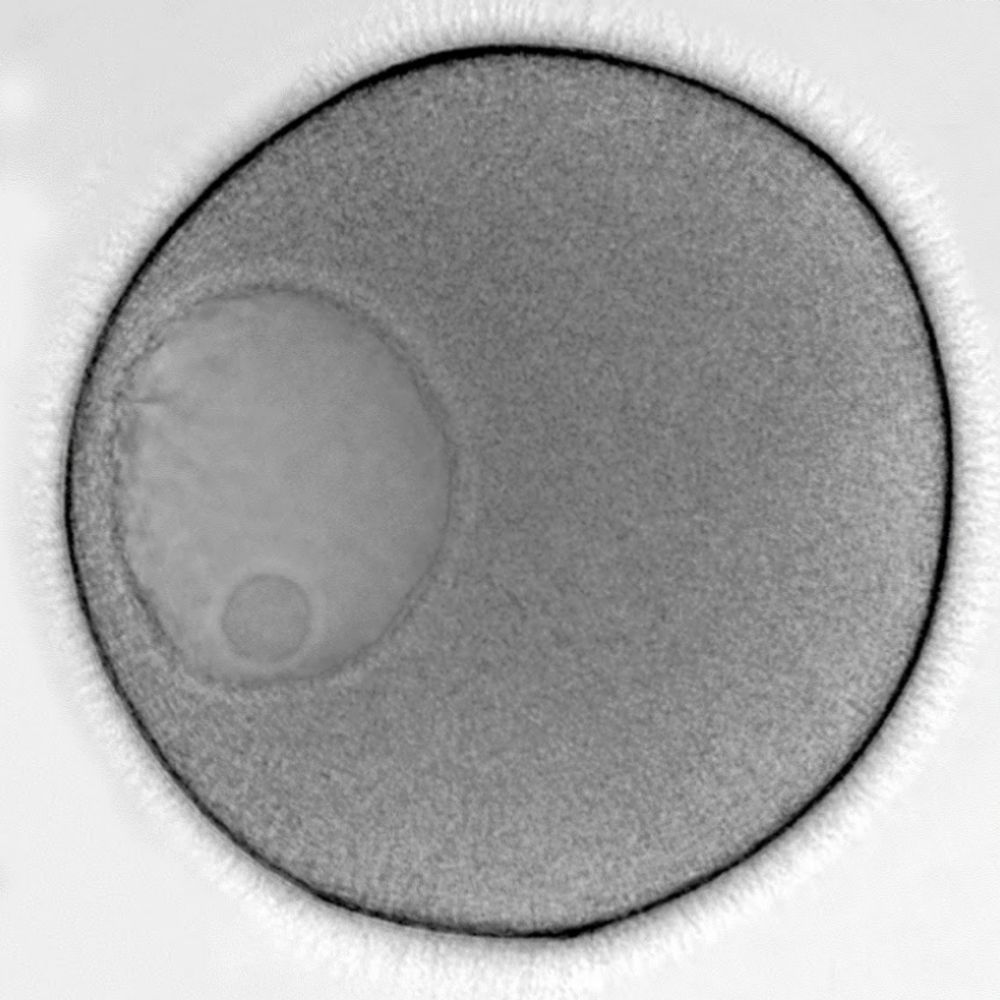
Latest work from the lab by Aude Nommick et al., in which we propose a "size-scaling" model for microtubule force exertion that regulates centrosome centration vs decentration during embryo development!
@ijmonod.bsky.social
www.biorxiv.org/content/10.6...
26.01.2026 15:45 — 👍 82 🔁 28 💬 0 📌 1

Cytoplasmic crowding acts as a porous medium reducing macromolecule diffusion | PNAS
Intracellular transport of macromolecules is crucial for the proper functioning of
most cellular processes. Although intracellular crowding is know...
Happy to highlight our collaborative work from our @ijmonod.bsky.social team with @destriano.bsky.social, B. Goyeau and M. Chabanon.
Cytoplasmic crowding acts as a porous medium that hinders macromolecular diffusivity.
Plus: a clever way to measure cell volume.
www.pnas.org/doi/10.1073/...
26.01.2026 09:42 — 👍 56 🔁 28 💬 1 📌 1
Our review on Marr's levels in embryonic development is now out in @prxlife.bsky.social !
journals.aps.org/prxlife/abst...
23.01.2026 13:12 — 👍 11 🔁 4 💬 0 📌 0


#LivingArchitectures
We put cells and cytoskeleton filaments on the architecture of the musée d'Orsay.
www.musee-orsay.fr/fr/agenda/ev...
Scientists of the #CytoMorphoLab adapted their protocols to illustrate the questions that keep them awake at night.
-> Two shows on the 24th and 25th of January.
05.12.2025 16:11 — 👍 300 🔁 102 💬 19 📌 9

Come join us in beautiful Roscoff for this Conference Jacques Monod on Developmental regulation: from molecular to ecological niches
May 18-22, 2026 Roscoff, France
Abstract deadline: January 31, 2026
Apply here: cjm.sb-roscoff.fr/en
03.12.2025 08:00 — 👍 35 🔁 28 💬 0 📌 6
Also, depending on the design one should choose a correct type of ANOVA (e.g. two-factor, mixed-design or repeated measures)
18.11.2025 08:47 — 👍 1 🔁 0 💬 0 📌 0

Finally out in #PRXLife: our theory on the effect of temperature on the completion time of large networks. Using graph theory, one can show that the Arrhenius plot is quadratic, in excellent agreement with experimental data from fly development. Read the open access paper here: go.aps.org/48brig2
14.11.2025 06:39 — 👍 16 🔁 2 💬 0 📌 0
Preprint 🚨! B cells form localized patterns in the immune synapse when mature, allowing improved affinity discrimination. How? We suggest a new mechanism using dynamic active forces and feedback! Read more @ arxiv.org/abs/2510.18771. Great colab with Shenshen Wang, Tom Chou and Tony Wong (UCLA).
24.10.2025 18:54 — 👍 22 🔁 5 💬 2 📌 0
[8/8] Curious to learn more? Check the link in the first post for the whole story ☝️
Lastly, huge kudos to Julian Voits and @ulrichschwarz.bsky.social, who independently reached similar conclusions: arxiv.org/html/2403.17... (soon in PRX Life).
22.10.2025 10:29 — 👍 2 🔁 0 💬 0 📌 0
[7/8] Our model, a step toward a deeper mechanistic understanding of how biological processes scale with temperature, offers an alternative perspective that embraces the underlying complexity of biochemical regulation.
22.10.2025 10:29 — 👍 1 🔁 0 💬 1 📌 0

[6/8] Our scaling equation – a quadratic-exponential function with single-exponential deviations at extremes – fits 100+ temperature-response curves across traits and taxa, offering a sound estimate of mean activation energy.
22.10.2025 10:29 — 👍 0 🔁 0 💬 1 📌 0
[5/8] At temperature extremes, timing deviates from the quadratic-exponential law. It becomes dominated by the slowest rate-limiting step, where forward transitions turn slower than backward ones – effectively trapping the process in a loop.
22.10.2025 10:29 — 👍 0 🔁 0 💬 1 📌 0
[4/8] Interestingly, this quadratic-exponential behavior holds within a range around the reference temperature, where forward transitions dominate and averaging applies.
22.10.2025 10:29 — 👍 0 🔁 0 💬 1 📌 0
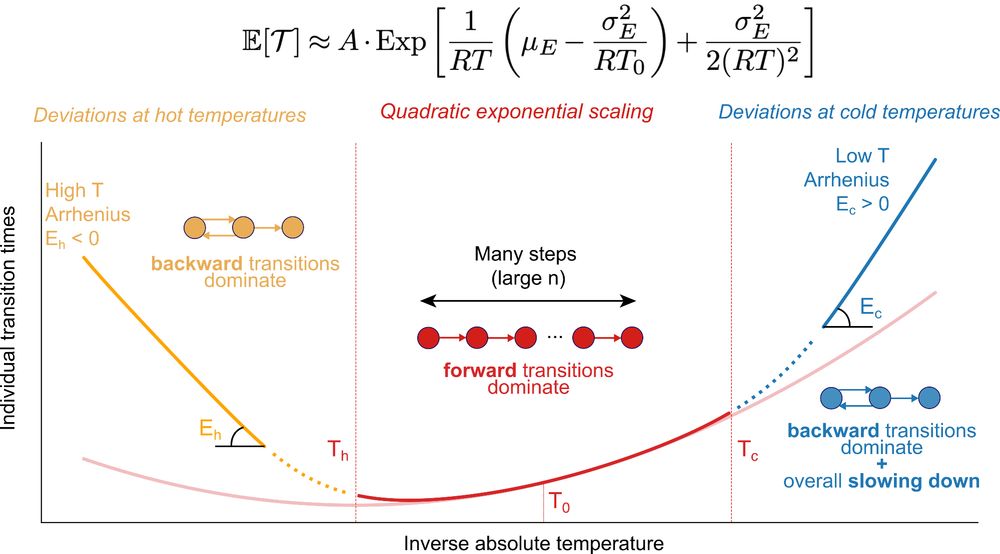
[3/8] The completion time of such multi-step processes, i.e., reaching step n from step 1, was found to follow a quadratic-exponential function of inverse temperature. This scaling, seen in experiments, naturally emerges from averaging over many independent intermediate steps.
22.10.2025 10:29 — 👍 0 🔁 0 💬 1 📌 0

[2/8] Our model is relatively straightforward: a cascade of n (reversible) Markov jump processes, each transition rate following Arrhenius-like temperature scaling, with forward transitions favored near a reference temperature.
22.10.2025 10:29 — 👍 0 🔁 0 💬 1 📌 0
[1/8] Biological processes are governed by complex biochemical networks – far beyond single reactions – and often form multi-step transition cascades. Together with Simen Jacobs, Federico Vazquez, and @lendertgelens.bsky.social, we show that modeling these as Markov chains has striking consequences.
22.10.2025 10:29 — 👍 1 🔁 0 💬 1 📌 0

🚨 Late preprint alert!
Why do biological process rates scale nonlinearly with temperature, deviating from the straight line on an Arrhenius plot? The key may lie in their inherent complexity!
More in thread and here: doi.org/10.1101/2025...
22.10.2025 10:29 — 👍 25 🔁 9 💬 1 📌 0
Last year at EMBL, Prof. McIntosh gave a historical overview of the discovery of dynamical instability, and it was one of the most insightful and fun lectures I've ever listened to. Really excited to read this piece from him.
16.10.2025 09:42 — 👍 6 🔁 2 💬 0 📌 0

Final version of our paper on ciliary metachronal waves out now in Science Advances! doi.org/10.1126/scia...
This is the main thesis work of my PhD student Rebecca Poon, who caught many #platnereis larvae and tirelessly ablated them with a laser. THREAD
15.10.2025 20:53 — 👍 39 🔁 10 💬 2 📌 2
Join us next Tuesday (30/09) for talks by @gautamdey.bsky.social @embl.org & Andreas Heim @uni-konstanz.de & Simonetta Piatti @crbm-montpellier.bsky.social
24.09.2025 11:41 — 👍 14 🔁 6 💬 0 📌 2
Congratulations, Jan! Happy to see it out; it’ll be a nice read this weekend :)
20.09.2025 07:32 — 👍 1 🔁 0 💬 0 📌 0

Please allow me to introduce... our new preprint 🎉 Together with Michael Zhao, Anna Erzberger and Alexander Aulehla, we investigate pattern formation due to aggregation in confined systems.
You can find it at arxiv.org/abs/2509.08533
@michaelzhao.bsky.social @erzbergerlab.bsky.social
18.09.2025 18:48 — 👍 28 🔁 13 💬 2 📌 0

On Thursday, Sept 25, we host Lendert Gelens (KU Leuven) for a seminar: "Beyond Arrhenius: How temperature scales biological time". He will show how biological timing changes across temperatures.
barcelonacollaboratorium.com
#seminar #KULeuven #EMBL #BCNCollaboratorium
18.09.2025 12:16 — 👍 4 🔁 2 💬 1 📌 1

In this Viewpoint, Adam Zweifach explains how to calculate how many cells to analyze per sample to achieve reasonable statistical power in #microscopy experiments. rupress.org/jcb/article/...
📕 In #Reproducibility and Best Practices in Cell Biology: rupress.org/jcb/collecti...
18.09.2025 14:03 — 👍 5 🔁 2 💬 0 📌 0
Complex behaviour is not limited to animals! Here we map the entire spectrum of waveforms dynamics on a quadriflagellate single cell with 4x 70um (!) #cilia, to a low dimensional behavioural manifold with surprising structure! #protistsonsky
All revealed in our new preprint doi.org/10.1101/2025...
23.08.2025 09:20 — 👍 88 🔁 28 💬 3 📌 2

Can a single cell learn? Even without a brain, some microbes show simple forms of cognition. Can this basal cognition be engineered? Check our new paper with @jordiplam.bsky.social on the minimal synthetic circuits & their cognitive limits. @drmichaellevin.bsky.social www.biorxiv.org/content/10.1...
10.09.2025 11:48 — 👍 110 🔁 42 💬 4 📌 6

Are you ready for a symposium dedicated to microtubule dynamics, function, and structure? 🙌
#EESMicrotubules will bring together researchers who share an interest in microtubule biology and its relevance to health and disease 🩺
💻 s.embl.org/ees26-09-bl
✒️ Submit your abstract by 11 March
11.09.2025 14:13 — 👍 13 🔁 10 💬 0 📌 0
👩🔬 The Institut Pasteur is a leading global biomedical research institute.
🔬 Explore with us the frontiers of biomedical research
🧪 Follow us to uncover groundbreaking discoveries
🌍 Join a community passionate about progress and open science
science reporter covering biomedical research at Nature | proudly Ukrainian 🇺🇦
maxkozlov.com
signal: mkozlov.01
Research Group for Multilayer Modeling and Analysis of Complex Systems: from cells to societies. Led by manlius.bsky.social at Dept. of Physics & Astronomy "Galileo Galilei", University of Padua
Professor. Institute for Molecular Science, NINS, Japan. Molecular Motors.
Lab: https://groups.ims.ac.jp/organization/iino_g/index.html
Google Scholar: https://scholar.google.jp/citations?hl=en&user=_4_iGHcAAAAJ
YouTube: https://www.youtube.com/@IINOG_IMS
Allison Bardin's lab at the Institut Curie, Paris, France.
We study stem cells and tissue homeostasis in the gut of #Drosophila melanogaster.
Posts are from Allison.
tinyurl.com/zg6y2pv
PhD candidate at Complex Systems Lab (UPF).
jordiplam.com
From embryos to equations and back.
We study how physical principles shape life, from collective DNA–protein interactions to mesoscale processes within cells and tissues.
Tweets by Grill Lab members.
https://grill-lab.org
Nonprofit advancing discovery through rapid, free sharing of scientific communications. New home of bioRxiv and medRxiv.
Thomas Surrey's lab @crg.eu
MICROTUBULES | Molecular Biochemistry | In vitro Reconstitutions
🦋 posts by lab members
Group leader at the Max Planck Institute of Multidisciplinary Sciences, Göttingen, Germany. #oocytes #cytoskeleton 🪼, ⭐️🐟, 🔬
Computational biophysics, cell motility, collective motion, soft matter, horses, cats. Associate Prof at Johns Hopkins Physics+Biophysics departments.
Theoretical biophysicist who loves to talk about science.
Homepage https://www.thphys.uni-heidelberg.de/~biophys/
Research centre focusing on life sciences, advanced materials, nanotechnologies & cybernetics 🔬 We do #CEITECScience 💚
🔗 https://www.ceitec.eu/
📍 Brno, Czech Republic
The Royal Society is a Fellowship of many of the world's most eminent scientists and is the oldest scientific academy in continuous existence.
Scientist interested in the physics of life
Researcher on Complex Systems, Nonlinear Photonics and Neuro-inspired Information Processing
Mexican Historian & Philosopher of Biology • Postdoctoral Fellow at @theramseylab.bsky.social (@clpskuleuven.bsky.social) • Book Reviews Editor for @jgps.bsky.social • https://www.alejandrofabregastejeda.com • #PhilSci #HistSTM #philsky • Escribo y edito