Excellent review on the rapidly changing state of Antarctic environments, and what that means for the rest of the globe - a must read!
www.nature.com/articles/s41...
@thale.bsky.social
Postdoc with BIOCOD (CNRS/IPSL) modelling ocean palaeoproductivity across last deglaciations. Also passionate about the hidden wonders of snow petrel vomit (ANTSIE, Durham Uni)
Excellent review on the rapidly changing state of Antarctic environments, and what that means for the rest of the globe - a must read!
www.nature.com/articles/s41...

New today: Critical research published in @nature.com on the abrupt and alarming changes being observed in #Antarctica and the surrounding Southern Ocean, led by Prof. @climatenerilie.bsky.social, with @profmattengland.bsky.social and colleagues ⬇️
theconversation.com/from-sea-ice...

Why would anyone want to be a scientist? There are the pleasures of:
1. Having the initial idea or insight,
2. Watching the idea develop into new experiments or a new model, and
3. Telling others.
Martin A. Schwartz
Check out also his Night Science podcast episode: podcasts.apple.com/us/podcast/7...
We’ve collected the oldest ice core, now it’s time to analyse it! 🔍 💻
The @newscientist.com have a new icy-cool video, speaking to BAS scientists about the Beyond EPICA project, highlighting why this work is so important in the face of climate change.
www.newscientist.com/video/249042...

Excited to share our new paper in #AnimalBiotelemetry @springernature.com!
We classified killer whale tracks into five movement modes using movement metrics and absolute space use, revealing finer-scale behaviour and insights into how they use space along the Norwegian coast 🐋🛰️🧪 tinyurl.com/y8a3wdmy
Now with correct link: doi.org/10.1038/s415...
06.08.2025 13:53 — 👍 23 🔁 13 💬 2 📌 0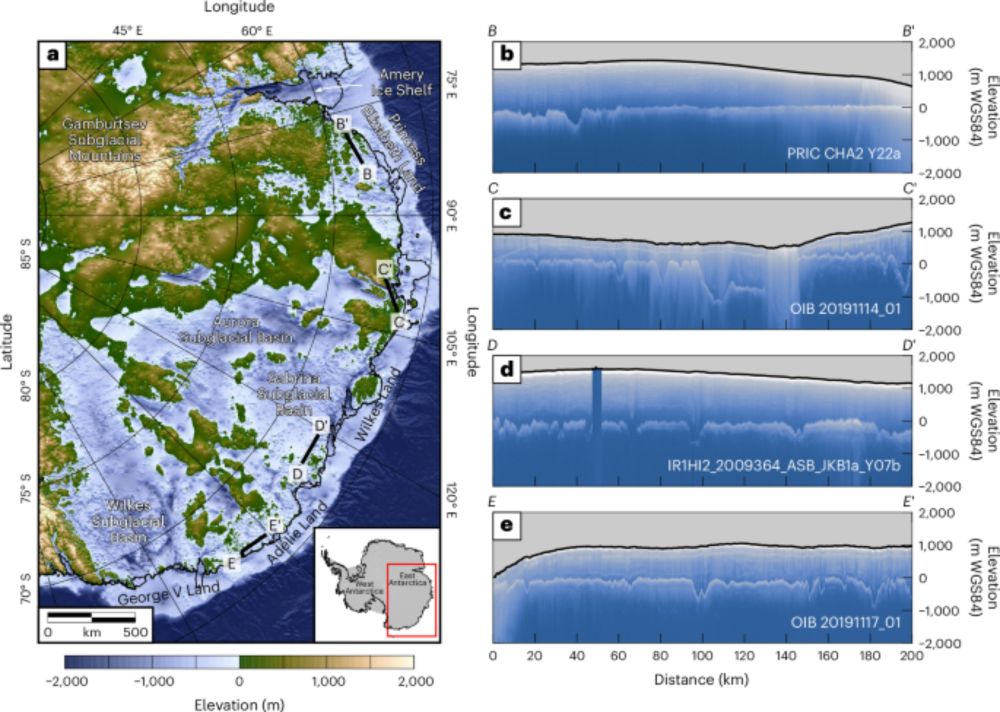
Great work by our colleagues Stewart Jamieson and Guy Paxman: "We have been using satellite data to map an ancient river landscape beneath the East Antarctic Ice Sheet:. The landscape has been frozen in time for up to 34 million years." ⚒️🧪
www.nature.com/articles/s41...
Stoked to share our Australian community’s voice on “impacts of #Antarctic #SeaIce extremes“ published in PNASNexus!
Massive kudos to Ed for spearheading this epic, super multidisciplinary work👏🥳 And so honoured to be a part of it.
doi.org/10.1093/pnas...

We look forward to welcoming the @erc.europa.eu Scientific Council to Durham next week and showcasing amazing research, like Professor @erinmcclimate.bsky.social's study on Antarctic snow petrels and sea ice evolution. Read more: bit.ly/4nde2gE
@geogdurham.bsky.social @leverhulme.ac.uk @bas.ac.uk
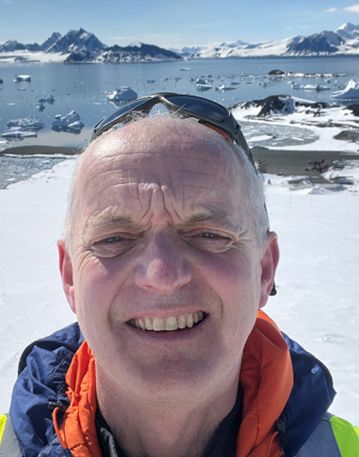
CONGRATULATIONS to our very own @mikebentley.bsky.social who has been awarded an OBE for his services to Antarctic Science! Mike has not only made an outstanding contribution to polar science, he is also a fantastic colleague and we are all delighted for him! ❄️🥳
www.durham.ac.uk/news-events/...

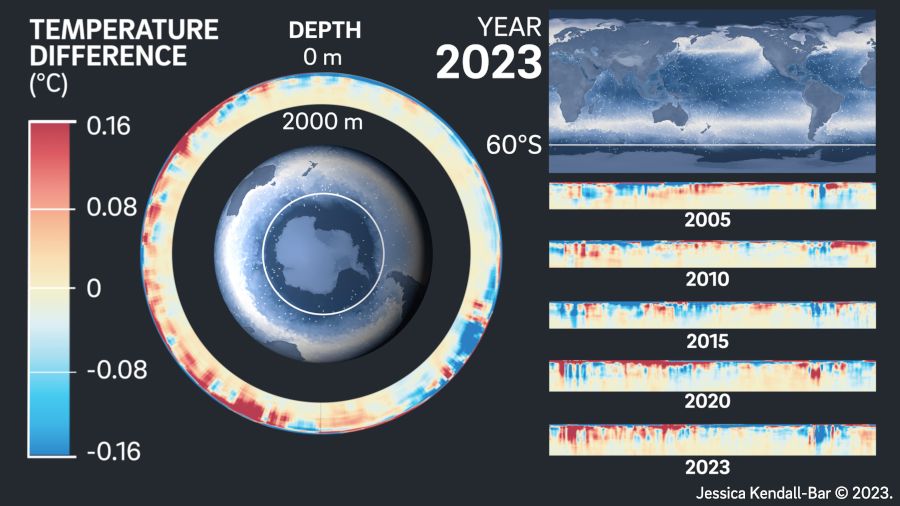

🌊 Happy #WorldOceansDay from SCAR!
Today, we celebrate the mighty Southern Ocean—a climate hero that deserves the spotlight.
To mark the day, we’re sharing three stunning data visualisations from a past EG-ABI competition, showcasing the impacts of climate change on the Southern Ocean.
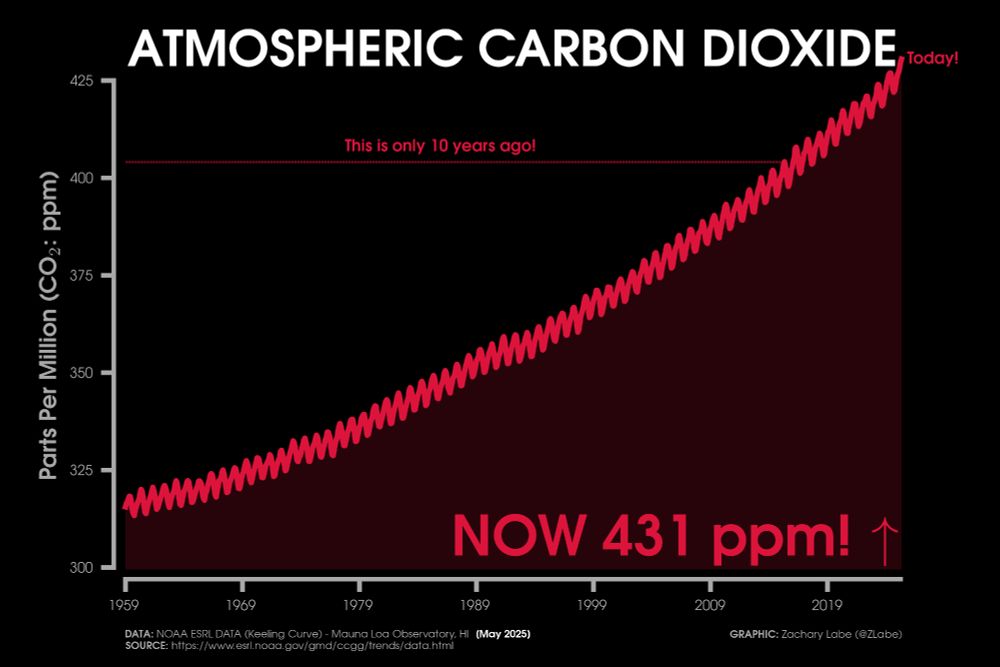
Red line graph time series of monthly carbon dioxide abundance from January 1959 through May 2025. There is a seasonal cycle and long-term increasing trend. Current levels of CO2 are at 431 ppm. This is the Keeling Curve graph. A line for CO2 10 years ago is also annotated.
🚨 Carbon dioxide (CO₂) levels set a new monthly *record high* in May 2025 - 430.51 ppm (seasonal maximum)
This is the second largest May-May increase in this dataset (3.6 ppm higher than 2024). This is not good... 🫣
Data from gml.noaa.gov/ccgg/trends/
What do sea-ice associated seabirds do during a season with little sea ice? Results from GPS tracking on snow petrels is now published, led by @elliehonan.bsky.social funded by @erc.europa.eu @leverhulme.ac.uk details here: www.antsie.webspace.durham.ac.uk/2025/06/06/snow-petrel-tracking/ 🧪🐙
06.06.2025 11:14 — 👍 17 🔁 8 💬 1 📌 0
Hot off the press! A new study on snow petrel tracking from coastal Droninng Maud Land, Antarctica, by the wonderful @elliehonan.bsky.social!
Read the paper here:
link.springer.com/article/10.1...
And a summary here(including an epic fieldwork video): antsie.webspace.durham.ac.uk/2025/06/06/s...
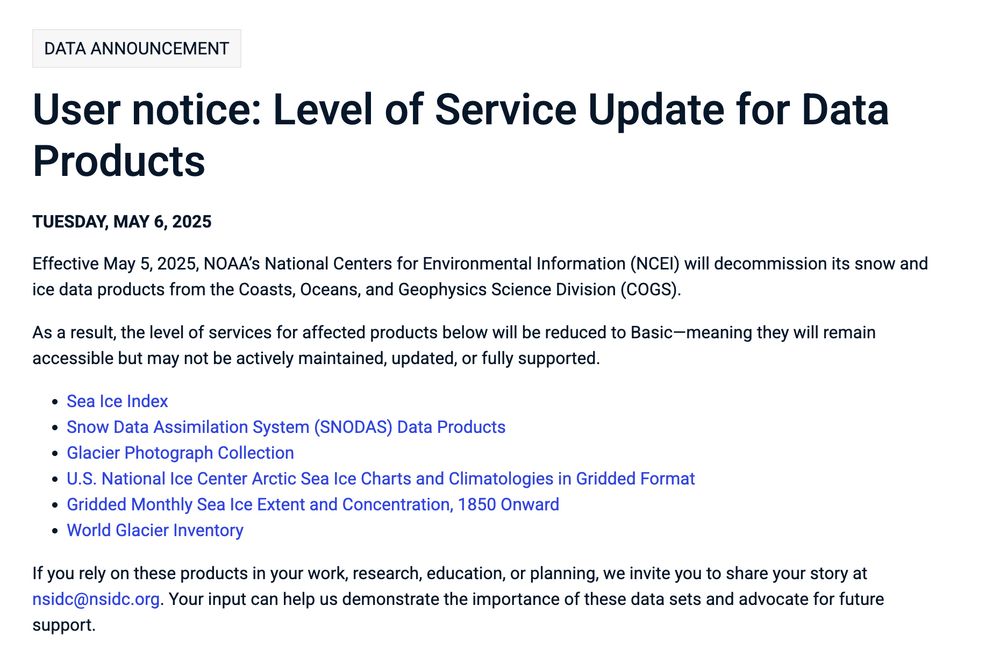
Effective May 5, 2025, NOAA’s National Centers for Environmental Information (NCEI) will decommission its snow and ice data products from the Coasts, Oceans, and Geophysics Science Division (COGS). As a result, the level of services for affected products below will be reduced to Basic—meaning they will remain accessible but may not be actively maintained, updated, or fully supported. This includes Sea Ice Index, Snow Data Assimilation System (SNODAS) Data Products, Glacier Photograph Collection, U.S. National Ice Center Arctic Sea Ice Charts and Climatologies in Gridded Format Gridded Monthly Sea Ice Extent and Concentration, 1850 Onward World Glacier Inventory. If you rely on these products in your work, research, education, or planning, we invite you to share your story at nsidc@nsidc.org. Your input can help us demonstrate the importance of these data sets and advocate for future support.
This is horrible. I don't even know what to say. Some of our most key polar data.
"As a result, the level of services for affected products below will be reduced to Basic—meaning they will remain accessible but may not be actively maintained, updated, or fully supported."
nsidc.org/data/user-re...
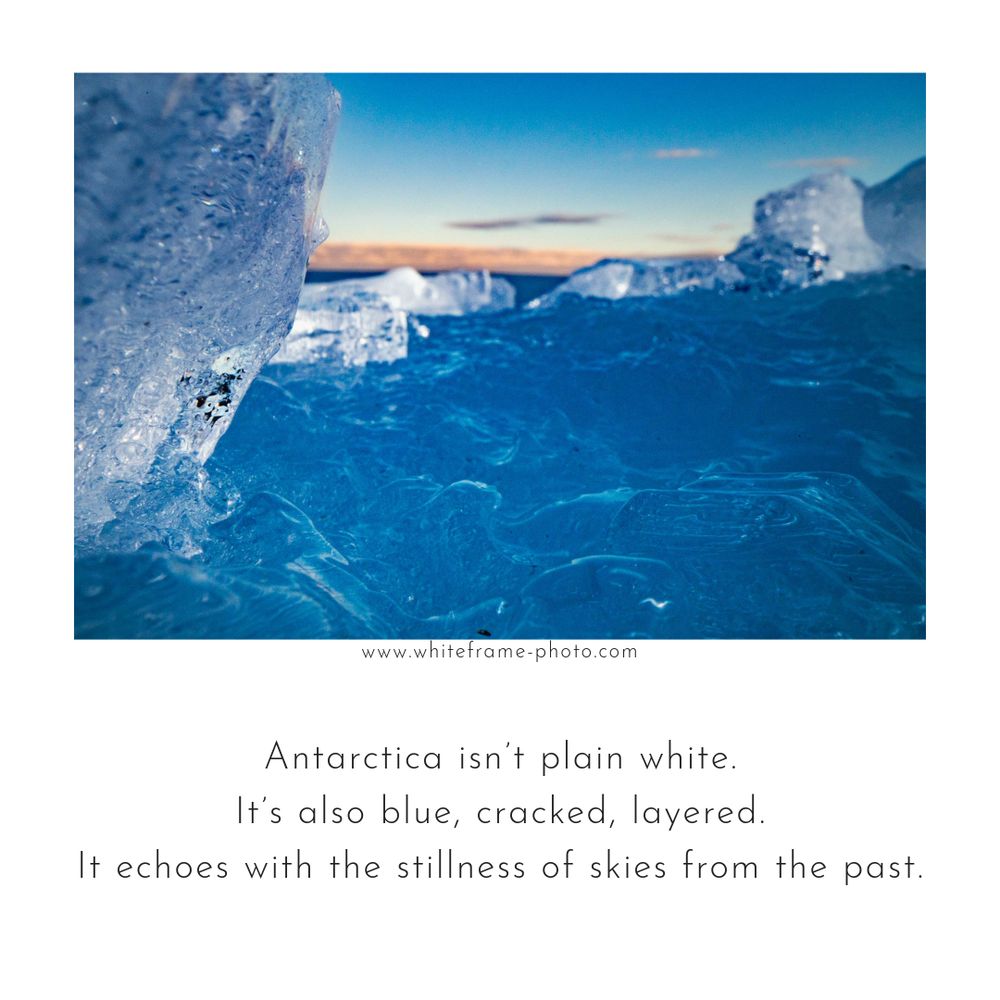
blocks of ice and warm colored clouds in Antarctica
I took this image in Antarctica — a place of harsh beauty, sometimes colorful, and always deeper than expected. Share if you like it.
#Photography #Antarctica #Fieldwork
#PolarScience #GlacierLife #BlueIce #SciencePhotography
#VisualScience #IceStories #Earth #Expedition
Why is Antarctica so important?
Antarctica might feel very remote - until you look at the planet from a different perspective. It's actually central to our world's ocean currents.
🎁 Check the alt text to dig into this diagram
🌊 This is from a new book by BAS' @oceanandice.bsky.social (et al.)

Green shrubby tree covered hill over looking border between Finland and Norway. Woman in blue coat is flying a drone.

Woman lying down in dwarf shrubs with GPS and tape measure on ground. Vibe is tired!

Woman walking out of Kevo Subarctic research station
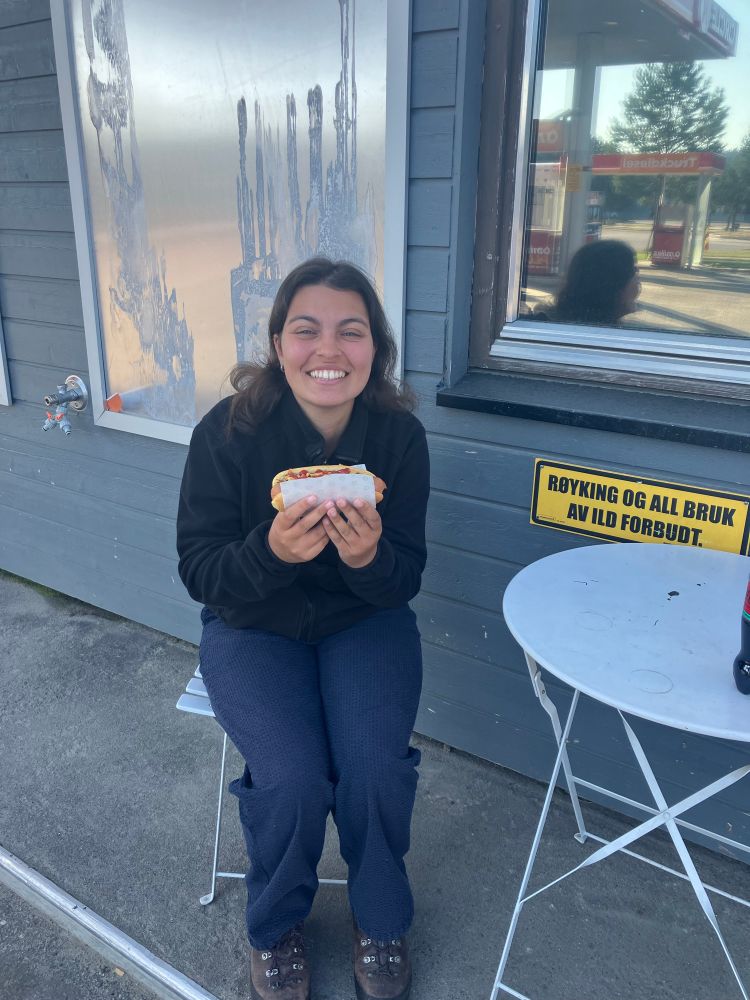
Trying the famous Norwegian petrol station hot dogs in Karasjok. Woman smiling holding hot dog!
Throwback to spending 3 weeks sampling around Kevo, Finland as part of my 1st field season for SAFE which was very kindly funded by INTERACT TA and helped by the lovely @thale.bsky.social
Also learnt that 30’C was possible at 70N! 😱😱
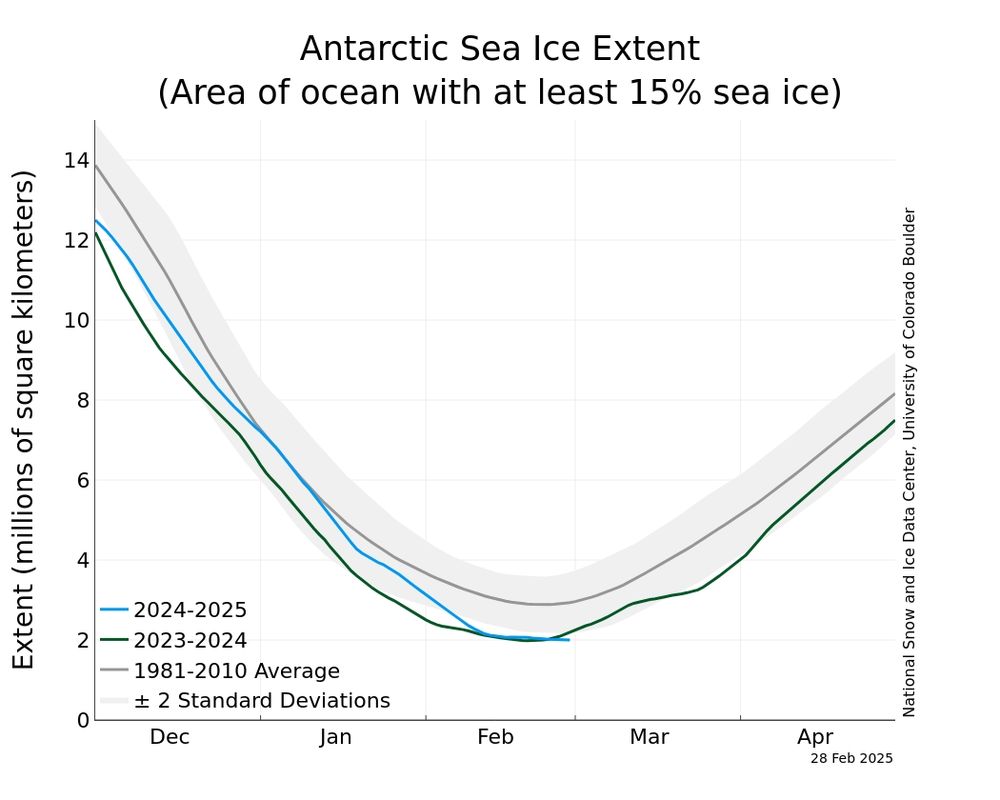
🧪🌊 🧵 As the minimum in Antarctic sea-ice extent has now dipped below 2 million km² for the third year in a row, it is looking increasingly like this is the new normal. In the 10 years up to 2015 the minimum extent averaged more than 3 million km².
Graph from @nsidc.bsky.social
1/n

Picture of scientist Dale Andersen, wearing a khaki button-down shirt and black undershirt, set against the background of a grey, cloudy sky.
https://buff.ly/4gJqFeF
The Explorers Club recognizes SETI Institute Senior Research Scientist Dr. Dale Andersen with its Finn Ronne Memorial Award. Andersen has spent nearly five decades exploring Earth's most extreme environments.
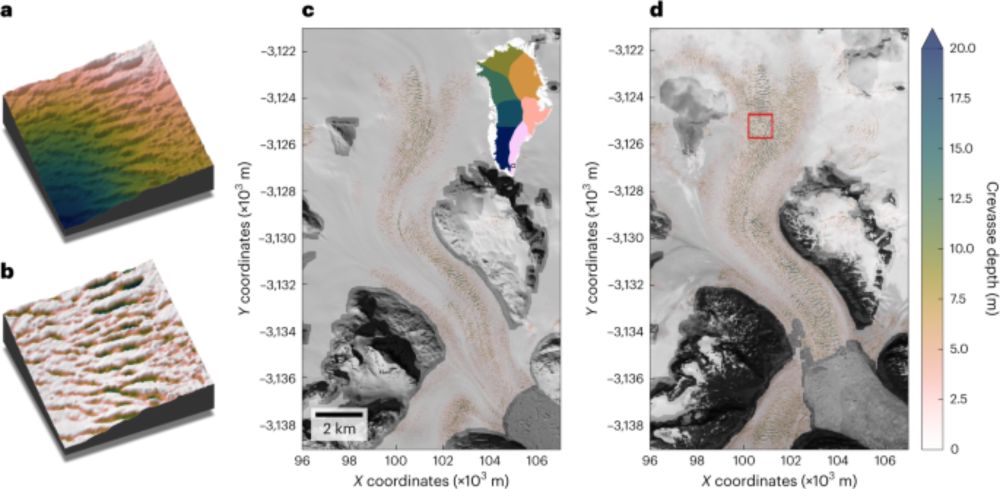
Our new paper is out in Nature Geoscience! In an ice-sheet-wide 3-D inventory of crevasses in 2016 and 2021, we find that crevasses are growing in response to ice acceleration on short timescales. @durham-university.bsky.social @byrdpolar.bsky.social @leverhulme.bsky.social
03.02.2025 10:37 — 👍 62 🔁 17 💬 3 📌 1New paper out from our team!
Satellite observations of subglacial lakes are much needed for improving knowledge of subglacial meltwater dynamics and evolution, and for improving simulating these processes in models.
#glaciology #Antarctic #remotesensing #hydrology 🛰 💧