
Wrote a little bit about some ideas on how practices of 'phenomenological density' can help us inhabit the intervals between events rather than just rushing through them.
open.substack.com/pub/creative...

@antonsaccount.bsky.social
Developing tools, algorithms and workflows for geometric rationalization, material-aware design, and digital fabrication. Also curious about embodied cognition, meaning-making, and art-science fusions.
Wrote a little bit about some ideas on how practices of 'phenomenological density' can help us inhabit the intervals between events rather than just rushing through them.
open.substack.com/pub/creative...

New piece exploring the gap between encountering ideas and integrating them, touching on: why encountering new elements ≠ forming new associations, the metabolic cost of genuine reorganization, and second-order heaps' exponents and what they reveal about learning
02.11.2025 13:05 — 👍 2 🔁 0 💬 0 📌 0
Artists and designers often speak of an aspirational goal of "getting to the point where you don't know what you're doing." Keith Sawyer's "Learning to See" made it clear to me why that state of ambiguity is so important in the creative process.
open.substack.com/pub/creative...

Been thinking about the relationship between constraints and affordances in digital design. An exploration of how deliberately limiting a system's lexicon and syntax can create the conditions for more powerful, emergent affordances to arise. creativeresiliencefusions.substack.com/p/subtractiv...
09.08.2025 15:32 — 👍 3 🔁 0 💬 0 📌 0
7/7
These axes aren't intended to be a checklist but to define a somewhat coherent space, and act more as a litmus test for an artifact's claim to human authenticity by asking "what signals are hard to counterfeit not because of technical impossibility, but due to prohibitive effort?"
6/7
Verifiable stakes
An LLM risks nothing. This axis involves signals that are costly because they put the author's reputation/intellectual position on the line. Key signals are making specific, dated, and falsifiable predictions. Or creating an "IRL Bridge" by linking text to a verifiable event.
5/7
Physical grounding
LLMs are disembodied (for now) and signals on this axis ground the intellectual work in the tangible world. This can be a tangible artifact or a "field trip" report with unique, sensory observations from a physical site that are commensurate with the experiences of others.
4/7
High-latency & cross-domain synthesis
Contrasting the fast, local recombination of LLMs with the slow/surprising synthesis of deliberate human thought. Signals include "unreasonable and novel" analogies, that is connections requiring genuine expertise in two disparate domains.
3/7
Processual transparency
LLMs generate a finished artifact, humans reveal the journey. This signal exposes the typically hidden labor of cognition. Includes artifacts like photos of whiteboard drafts, intermediate "failed" code or causal thought relationships through an annotated bibliography.
2/7
Temporal depth
An LLM has a dataset, not a biography. This vulnerability allows for signals grounded in a specific, non-fungible personal past. For instance, a specific anecdotal anchor can tie a concept to a dated, multi-sensory and verifiable event.

1/7
High-fidelity text is an increasingly unreliable proxy for judging human expertise. Here's my proposal for a set of five axes along which communication can embed computationally/biographically expensive signals that are somewhat difficult to counterfeit:
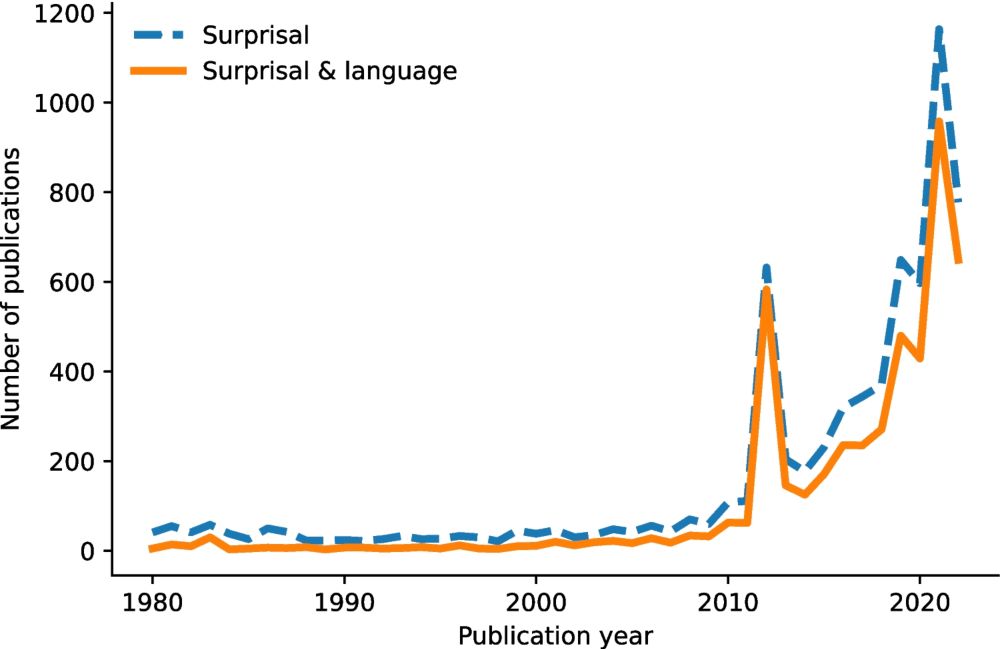
a plea to think carefully about surprisal + what it means to understand how we understand >> link.springer.com/article/10.1...
brand new paper in Computational Brain and Behaviour with @andreaeyleen.bsky.social at @mpi-nl.bsky.social

My RAND paper showed a temporary funding cut would have long-lasting effects on overall research output through its adverse impact on investment in young PIs.
onlinelibrary.wiley.com/doi/abs/10.1...