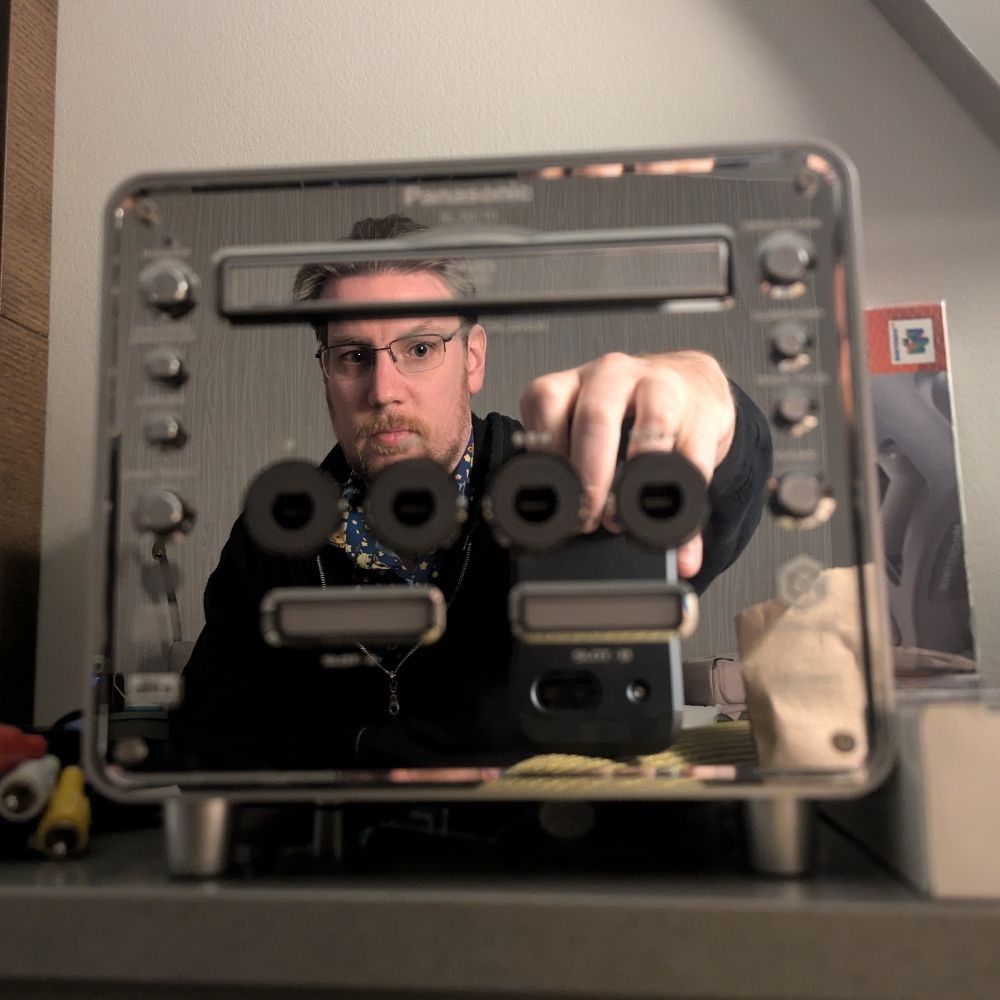
Whoever comes out with something like this, will get a few orders from me! 😂
24.02.2026 19:48 — 👍 2 🔁 0 💬 0 📌 0
Oh, ok... I thought there was some sort of switching regulator in there to obviate the need for older PSUs (which the good ones are becoming harder and harder to find these days).
23.02.2026 20:48 — 👍 1 🔁 0 💬 1 📌 0
That avoids the need to use old tired power supplies with beefy 5V rails... That is indeed genius (and a product begging to be commercialized:)!!!
23.02.2026 19:00 — 👍 1 🔁 0 💬 1 📌 0

A beige mid-tower desktop computer sits on a wooden floor, elevated on a gray plastic stand with wheels. The front panel displays the Packard Bell logo near the bottom.
The case has a classic late-1990s design with multiple drive bays stacked vertically:
At the very top is parallel Imation SuperDisk LS-120.
The top 5.25-inch drive bay contains a CD-ROM device labeled:
“5 Disc CD-ROM Mini Changer MJ-516 16X max” This is a multi-disc CD changer drive.
Below it is another removable media drive labeled:
“Iomega ditto max,” which is a tape backup drive.
Under that is a IDE Zip Drive 250MB.
Below is a traditional 3.5-inch floppy drive.
Near the bottom of the front panel are small rectangular buttons and indicator lights. Stickers on the lower front advertise technologies such as Sound Blaster and 3dfx.
The tower has a slightly textured beige finish and a simple, rounded front design typical of late 1990s consumer PCs.
Zip AND SuperDrive! This is the way!! 🙌
23.02.2026 15:58 — 👍 7 🔁 1 💬 1 📌 0

A large cardboard shipping box sits open on a table. Inside the box, centered and protected by folded cardboard inserts on the sides, is a retail product box labeled “PHOENIX – Flight & Weapons Control System.”
The product box cover has a dramatic design with warm orange and brown tones. At the top, the word “PHOENIX” appears in large gold letters. Beneath it, smaller text reads “Flight & Weapons Control System.”
The artwork shows a black flight joystick and throttle control set placed on a surface that looks like an old aviation blueprint or technical drawing. The joystick stands upright on a textured base, and the throttle unit is positioned to the left. Behind them, a stylized phoenix bird silhouette rises in smoky, glowing tones, reinforcing the product’s name.
On the right side of the box cover, a yellow badge states a rating from PC Magazine and describes it as “The next generation in flight simulation control.” In the lower-right corner, a purple and blue label reads “Advanced Gravis – For all IBM/PCs & compatible games.”

A large printed manual or product insert is open on a flat surface, viewed from above. A person’s hands hold the pages open—one hand at the top left corner and the other at the lower right. The person is wearing a black wristband or smartwatch on their left wrist.
The manual page features a large diagram of a futuristic-looking flight control device from the Advanced Gravis Phoenix system. The device is shown in a three-quarter view against a white background. It appears dark gray or black with textured grip areas and multiple colored buttons and controls.
The main illustrated unit includes:
- A central joystick-style control labeled “Flight Control Stick”
- A throttle and rudder control section
- Multiple buttons and triggers arranged along the top and sides
- Small LED indicator areas
- Labels pointing to different control groups, such as primary flight and weapons commands, secondary flight commands, tertiary flight commands, and tension adjustment controls
Thin red lines and small labels connect text descriptions to specific parts of the controller.
In the lower right corner of the page, the “Advanced Gravis” logo appears in purple text.

A person is holding a large, futuristic-looking flight control device with both hands over a desk surface: The Advanced Gravis Phoenix flight control system.
The controller is dark gray with an angular, sci-fi design. It consists of a long arm extending from a wide, textured base. The base has a triangular shape with a dotted, rubberized-looking grip surface. A thick cable exits from the rear of the base.
At the left end of the arm is a rounded control section featuring:
- A circular directional pad with orange buttons arranged in a ring
- Several small green buttons surrounding the pad
- Molded grip ridges on the underside
Along the top of the arm are several purple buttons arranged in a row. On the side of the arm are additional small purple buttons.
Extending downward from the base is a vertical control stick with a small angled handle. The handle has several small yellow buttons arranged along its face. A coiled black cable connects part of the lower assembly.
They definitely did! And my “PHOENIX Flight & Weapons Control System” is one of my most prized possessions in my vintage joysticks and game controllers collection!!
Literally the coolest looking joystick (and possibly one the best built and most advanced for its time) for the DOS flight sims era!!!
21.02.2026 00:40 — 👍 4 🔁 1 💬 1 📌 0
"As monetization and AI evolve and influence this future, we will not chase short-term efficiency or flood our ecosystem with soulless AI slop"
Short-term "efficiency" and flooding its ecosystem with soulless AI slop is Microsoft's modus operandi! And the former CoreAI boss will go against that?🤔
20.02.2026 21:21 — 👍 0 🔁 0 💬 0 📌 0

Dramatic scene of a bearded man in ancient robes standing with his arms outstretched in front of dark storm clouds, like he’s summoning something epic, and the image has big bold text at the top that says:
“LET THE LAWSUITS BEGIN!”
20.02.2026 15:33 — 👍 0 🔁 0 💬 0 📌 0
Like you, I'm still on a X570 platform (5800X3D) and I had upgraded from 32Gbs of DDR4 3200 to 64Gbs of 3600 RAM in 2023. Since I kept the old sticks, I at least have something to fall back on, if the unthinkable happens to my newer modules🙏
I never babysat 3-5 years old hardware like this before!😂
18.02.2026 17:50 — 👍 2 🔁 0 💬 0 📌 0


I was already praying for the PC hardware gods to protect my RAM modules, SSDs and GPU... Now I'm including my HDDs in those prayers too!
17.02.2026 18:54 — 👍 3 🔁 0 💬 1 📌 0
Wouldn't this chip work on later Socket 7s that can have CPU core voltage adjusted via jumpers?
(although not sure how likely it would be to have BIOS support for the Media GX anyway)
15.02.2026 17:53 — 👍 1 🔁 0 💬 1 📌 0
On my Windows 98 builds (working on a 2nd one), I stuck to Aureal Vortex 2 cards (Turtle Beach Montego) for the games I play on 98, but Audigys definitely have much cleaner sound. I'd prefer X-Fi for XP, but the Audigy has the extra flexibility to also work well on 98.
15.02.2026 17:44 — 👍 1 🔁 0 💬 0 📌 0
I know the feeling: We buy tons of gear with plans to put on period correct builds and all... But then the years go by and the boxes pile up, and we never get around to those projects 😂
I guess that's the clear sign we are on the "days are long, years are short" part of life.
15.02.2026 17:43 — 👍 1 🔁 0 💬 1 📌 0

Boxed Creative Sound Blaster Audigy 2 ZS Platinum Pro.
Big, glossy retail box with:
- Huge vertical SOUND BLASTER branding on the left (that classic blue/orange Creative aesthetic)
- Main title: Audigy 2 ZS – Platinum Pro
- Image of the external I/O hub (that gorgeous brushed-metal front box)
- PCI sound card shown underneath
- Remote control included
Logos flexing hard:
- THX Certified
- EAX Advanced HD
- Dolby Digital EX
- DTS-ES
- ASIO
- 24-bit / 192kHz / 108dB SNR
- 7.1 support
And external I/O unit. FireWire ports, optical in/out, MIDI, mic, line-level controls.

Audigy 2 ZS Platinum Pro PCI card itself.
- Model marking: SB0360
- Main DSP: Creative CA0102
- PCI interface (standard 32-bit PCI, not PCIe)
- AUX considered:
- AUX_IN
- CD_SPDIF
- Joystick/MIDI header
- Tons of analog filtering stages (electrolytics everywhere — peak early-2000s audio board design)
- Gold-plated analog outputs
- FireWire header (IEEE 1394) support for the external hub
The Platinum Pro was the top-tier package:
- External breakout box
- Proper MIDI I/O
- Optical in/out
- ASIO support for music work
- 24-bit / 192kHz playback
- 108 dB SNR
- Hardware EAX 3.0 / 4.0 acceleration
- True XP golden-age compatibility

Front panel of the Sound Blaster Audigy 2 ZS Platinum Pro external hub:
🔌 IEEE 1394 FireWire
🔆 Optical Out (TOSLINK)
🔆 Optical In
🎧 Headphone out (¼")
🎤 Mic input (¼")
🎛 Line In 1 / Line In 2
🎚 Dedicated headphone & master volume knobs
🔇 Physical Push-Mute button
🎵 CMSS toggle
IR window (for the remote)
This wasn’t just for gamers.
This was:
🎮 Hardware EAX 4.0 acceleration
🎼 ASIO 2.0 support (low-latency recording)
🎧 24-bit / 192 kHz playback
🎬 DTS-ES + Dolby Digital EX decoding
🎹 MIDI I/O (through the card header)
🎚 External control without crawling behind the PC

Rear I/O hub:
🔴 Analog
- Line In 3 (RCA L/R) – nice touch for external decks or CD players.
- Multiple ¼" TRS jacks (balanced-style layout, even if not truly balanced).
🎹 MIDI
- Full-size 5-pin DIN MIDI In
- Full-size 5-pin DIN MIDI Out
- This alone makes it cooler than 90% of consumer sound cards from that era. No breakout cable nonsense. Just plug your Roland module straight in.
🔆 Digital
- Coaxial S/PDIF In
- Coaxial S/PDIF Out
- Optical already on the front
- That’s serious flexibility for 2003. You could run MiniDisc, DAT, standalone DAC, whatever.
🔌 AD_LINK 1 & 2
Those proprietary Creative expansion connectors were for:
- Additional I/O modules
- Surround breakouts
- Specialized front panels
🔥 Dual FireWire ports
Back when:
- DV camcorders
- Early external drives
- Some pro audio gear
all relied on IEEE 1394.
This card really tried to be the Swiss Army knife of early 2000s PC audio.
I have to agree... Although, after buying this NIB as my own birthday gift last year, I ended up putting this on an XP build 🤷♂️ (so I could use it with a Mini-Disc deck with the M-crew software)
This was peak "new millennium" PC audio... Doom 3, Half-Life 2, Thief and F.E.A.R. never sounded better!
15.02.2026 16:28 — 👍 5 🔁 0 💬 1 📌 0

Yikes! What is this camera made of? Platinum or something??
15.02.2026 03:48 — 👍 0 🔁 0 💬 0 📌 0

The image shows three classic PC game boxes laid out on a gray cutting mat with measurement markings.
Left:
A large box for Delta Force: Land Warrior (by NovaLogic). The cover is mostly red and orange with a bold “DELTA” title. A yellow Best Buy $19.99 price sticker is visible near the bottom.
Center:
Halo: Combat Evolved for PC. The cover features Master Chief in green armor aiming a weapon, with vehicles and aircraft in the background. A red banner at the top says “NEW! Online Multiplayer, Maps, Weapons, and More!” A yellow Best Buy $49.99 sticker is attached to the lower center of the box. Logos for Gearbox, Bungie, and Microsoft Game Studios appear along the bottom.
Right:
Star Wars Jedi Knight II: Jedi Outcast. The cover is minimalist and dark blue with a glowing lightsaber forming a circular Jedi emblem. The title appears in silver text with “LucasArts Entertainment Company Presents” at the top.
The three boxes overlap slightly, arranged from left to right, and appear to be in good condition with original retail price stickers intact — a very authentic early-2000s retail shelf vibe.
Mail day was good! Catching up with some good old PC classics:
- Halo: Combat Evolved
- Star Wars Jedi Knight II: Jedi Outcast
- Delta Force: Land Warrior
13.02.2026 23:49 — 👍 0 🔁 0 💬 0 📌 0
How about a Number 9 Revolution IV? It's rare, but if you happen to have one (PCI/AGP/16/32MB, any of them could work here), they were one of the best 2D cards ever made (top notch RAMDAC!) w/ good DX6 & OpenGL (even MPEG-II playback) compatibility. Could be an interesting match with a Voodoo 2... 🤔
13.02.2026 23:10 — 👍 2 🔁 0 💬 1 📌 0
He is awesome! Love his content!
13.02.2026 21:03 — 👍 3 🔁 0 💬 0 📌 0
YouTube video by DOS Storm
This is The Weirdest PCI Sound Card I Could Find! (S3 SonicVibes PCI)
DOS Storm reviewed this card last year: youtu.be/VamMBzTUDlw
That was the first time I ever heard of this thing.
13.02.2026 20:46 — 👍 3 🔁 0 💬 1 📌 0
But the association of "white" with "foreigner" limits the use of the word to very specific areas of the world. So it doesn't carry the same meaning everywhere.
13.02.2026 18:19 — 👍 3 🔁 0 💬 0 📌 0
For the longest time, "gringo" was a derogative term, in most of Latin America, referring to white foreigners (mostly Americans in certain countries, but also Europeans in others). From the colonization all the way to the cold war years, gringo would often mean white people who shouldn't be trusted.
13.02.2026 18:18 — 👍 3 🔁 0 💬 1 📌 0
I guess they're implying you can buy two of these combos (for almost the same price of buying an extra stick of RAM), keep the two sticks, and then dump the leftover CPU + MoBo on eBay...
13.02.2026 16:21 — 👍 1 🔁 0 💬 0 📌 0
Is this AT or ATX? If the old speakers' cones can be replaced for something newer, then you could actually use those speakers. Is that Nakamichi drive SCSI?
13.02.2026 16:12 — 👍 0 🔁 0 💬 0 📌 0
Yeap! The Philips SAA7110 is a video decoder chip, and the AURAVISION VxP524 is a video stream processor (likely MPEG decoder). The metal shield there is a good clue of an analog video circuit (coax or s-video). So, this is likely some OEM MPEG decoder (possibly part of some VCD playback kit).
13.02.2026 02:07 — 👍 1 🔁 0 💬 0 📌 0
Got a clogged artery just by looking at it! 🤣
10.02.2026 00:34 — 👍 1 🔁 0 💬 0 📌 0
Goose bumps... Every time!
09.02.2026 17:17 — 👍 0 🔁 0 💬 0 📌 0
I wonder how much the current world political climate might be a factor in this developers' plans to finish a game trilogy about a Jewish American WWII soldier, and his rag-tag band of diverse sidekicks, in their heroic fight against N@z! world domination...
06.02.2026 21:01 — 👍 0 🔁 0 💬 0 📌 0
Same here... "soulless content factory" is spot on! 😙👌
The number of times I've seen either: a) plain wrong, misleading or carelessly conveyed information on their videos; and b) Linus “punching down” people; were just too many to let go... Once you see it, you can't unsee it.
05.02.2026 19:39 — 👍 3 🔁 0 💬 0 📌 0
And there are plenty of those (brain dead sellers and "AGP" cards) on Ebay...
05.02.2026 17:16 — 👍 1 🔁 0 💬 0 📌 0
Stock tips (not hard to memorize a few megacorps that were still small and cheap back then)...
After people saw me getting a bunch of them right in an endless row, they would be convinced that:
a) I was the luckiest man alive; or
b) I came from the future.
05.02.2026 06:32 — 👍 3 🔁 0 💬 0 📌 0

The image shows a boxed PC video game titled “Expendable” displayed upright on a desk. The game is published by Rage Software, whose logo appears in the top left corner of the box.
The front cover artwork features a futuristic armored soldier viewed from behind, wearing bulky combat gear and holding a large sci-fi weapon. The background shows explosions, enemy figures, and bright orange and blue lighting effects, giving the scene an action-heavy, late-1990s science fiction aesthetic. A targeting reticle graphic appears behind the stylized game title “Expendable”, written in metallic blue lettering across the top front.
Along the bottom left corner of the box, a “3D” badge indicates the game supports 3D graphics technology. A promotional quote is printed near the bottom front, though only partially readable from this angle.
The spine of the box is visible on the left side and also displays the game title and branding. The box appears to be a classic large-format PC game retail package common in the late 1990s and early 2000s.

Here is a concise, under-2000-character accessible description of the image:
Image Description
The image shows the contents of the PC game “Expendable” laid out on a desk with the box fully opened. The items are arranged neatly on a black desk surface with a measuring mat partially visible underneath.
On the left side is the back cover of the game box, showing promotional text, screenshots from the game, technical requirements, and logos for Rage Software. The center section contains the game jewel case, placed inside the white cardboard insert of the box. The jewel case cover displays the same futuristic soldier artwork seen on the front retail packaging.
Above the jewel case lies a printed document titled “Important Addendum – DirectX 6.0 Installation Procedure.” The document includes installation instructions and appears slightly wrinkled from handling.
On the right side is the inside cover of the box, which is mostly black with a large stylized “R” logo and the text “Rage Software PLC.”

The image shows a close-up of the side panel of a vintage PC game box, positioned on a black desk surface. The cardboard edge is slightly worn and frayed, indicating age and handling.
Printed on the side is a hardware compatibility chart arranged into two columns labeled “Manufacturer” and “Chipset.” The list details supported 3D accelerator graphics cards common in the late 1990s.
Manufacturers listed include:
- 3dfx Company
- 3D Labs
- ASUS
- ATI Technologies
- California Graphics
- Creative Labs
- Diamond Multimedia
- ELSA
- Gainward
- Guillemot
- Intel
- I-O Magic Corp.
The chipset column includes well-known early 3D graphics solutions such as:
- Voodoo Banshee, Voodoo Graphics, Voodoo 2, Voodoo Rush, Voodoo 3
- Permedia 2 and Permedia 3
- ATI 3D Rage series and Rage 128
- RIVA TNT and related NVIDIA cards
- Diamond Monster Fusion and Viper series
- Creative 3D Blaster models
- MagicRush 3D and several AGP-based graphics cards
The compatibility list continues toward the right side of the box, showing additional manufacturers and chipsets, though they are partially out of focus.

The image shows a close-up side view of a PC game box, focusing on a printed compatibility list. The box appears slightly worn, with small creases and edge wear visible along the cardboard seam.
The printed section displays two columns labeled “Manufacturer” and “Chipset.” The list identifies supported or compatible 3D graphics hardware from the late 1990s. Manufacturers shown include Matrox, Leadtek, NVIDIA, Real3D, Rendition, S3 Inc., STB Systems, Trident, Wicked3D Board Co., and others.
The chipset column lists several classic 3D accelerators such as:
- RIVA 128/ZX, TNT, TNT2
- Savage 3D, Savage 4
- Verite V2100/V2200
- G200, G400
- Video-77 and Video-87 AGP
- Wicked3D Vengeance (Voodoo 2 based)
The left portion of the box shows an additional partial compatibility list that appears to include 3dfx Voodoo series cards, though it is slightly out of focus.
Look what the cat dragged in! First time seeing a big box version of Expendable (1999)... Not even sure if this BB version was sold in the US (previous owner imported from the UK in 2002).
The list of compatible graphics cards APIs is something to behold! I have never heard of half of these... 😂
05.02.2026 00:57 — 👍 2 🔁 0 💬 0 📌 0
Etsy.com/uk/shop/YavinPaints
SubStack: https://idspispopd.substack.com/
KoFi: https://ko-fi.com/bhaal_spawn
Emperor's Hand, Doom Marine & heroine of Darkmoon. Maker of LEGO PC Cards.
✏️#TillysArt
⛓️#TillysKinks
📚#TillysCursedLibrary
🥯#MayTheBagelsBeWithYou
Hey there, Vince here with Circuit Rewind!
Retro/Modern tech hybrids? Video Games? Jankinator!? Yeah, maybe.
Though, you may know me better as Darkain or "That One Cospix Guy" ™
youtube.com/@circuitrewind
Talks a lot about old games and Japanese wrestling on YouTube, and also streams nonsense on Twitch. Now on here.
🇨🇦 I sing Jeff Chang. I design 3D printed stuff with electronics inside. I play games. 【English/中文/日本語】
Ko-Fi☕️ https://ko-fi.com/designerjeffchen
Nonprofit newsroom. Media that builds power for working people.
Join us: https://linktr.ee/moreperfectunion
The official account for Jimmy Kimmel Live with Jimmy Kimmel on ABC! We have fun. #Kimmel youtube.com/@JimmyKimmelLive
A nonprofit, nonpartisan, legal and advocacy 501(c)(4) organization. Visit our site for more about us and our affiliated organization, the ACLU Foundation.
I'm that YouTuber who taught you how dishwashers work. Guess I'm tryin' out the whole Bluesky thing now.
he/him
https://www.youtube.com/technologyconnections
Senior Correspondent @theverge.com ║ Sign up to Notepad, my weekly newsletter on Microsoft's big bets at http://theverge.com/notepad ║ Tips? msg me on Signal: tomwarren.01
Had a complete US PlayStation 1 library before it was cool. Or Expensive. Variant Hunter from game-rave.com and GameRaveTV.
https://www.playstationlibrary.com (Game-Rave.com)
https://www.youtube.com/gameravetv
Used to post Retro PC stuff at my old twitter account @albpro then in @Black92RS74 also at Youtube as RetroTinkerer (I'm deleting all my content from both accounts in Twitter)
The official Bluesky channel of the Board of Governors of the Federal Reserve System.
Privacy Policy: http://federalreserve.gov/privacy.htm
https://www.federalreserve.gov/
I write about gadgets at @Verge. Former @CNET @Gizmodo @Engadget. Avid gamer, lucky husband, happy dad! Maybe too blunt.
ASRock Inc., a global leading manufacturer of motherboards, graphics cards, mini PCs, and gaming monitors!
Official Bluesky account of TweakTown® - technology, science, space & gaming content trusted by users all around the world since 1999. https://www.tweaktown.com
Brooklyn Congressman. Democratic Leader.
Work hard. Stay focused. Deliver results #ForThePeople.
Video games & deals. I post deals which may contain affiliate links. As an Amazon Associate I earn from qualifying purchases. Epic Creator Code: Wario64
(he/him) I make podcasts and help people build and launch their indie games. https://techpod.content.town | Cohost of the Dual Boot Diaries and The Full Nerd @PCWorld.com
I've never slapped anyone / not the actor
Signal:willsmith.01
Columnist at The New York Times, host of "The Ezra Klein Show" podcast.
We’re a team of passionate people challenging the (gaming) industry with impactful products, transparency, and open communication.
Join us to the challenge 🙌
wooting.io