
A fun article about our work and the Olympics.
There's some interesting relationships between skiing and basal ganglia function. Also see the front of @cmu.edu 's homepage!
@cmuscience.bsky.social @cmu-neuroscience.bsky.social @ahmarilab.bsky.social
theconversation.com/hesitation-i...
ok. quick science tweetprint of what I really like:
1)we discovered clear, discrete pain states - not just behaviors
2)no-pain and treated-pain were not the same, in part due to intervention targeting just the affective side, not numbing everything. Also kinda makes sense in my personal experience?
I'll let Greg do the tweetprint, but he was incredible, leading a Phenomenal interdisciplinary team effort
It's open source too! As part of the paper, you can build your own behavior rig with full analysis software for a tenth the price of commercial. Pls inquire if interested

Hot off the @nature.com press!!
Our A-SOiD behavior library developed specifically for pain to quantify a new chemogenetic gene therapy that targets opioid circuit in ACC without addictive properties
@flybottleescape.bsky.social @cmu-neuroscience.bsky.social @cmu.edu
www.nature.com/articles/s41...
So proud of @mattgeramita.bsky.social and this stellar work on striatal dynamics, decisions, and impulsivity. Really pertinent for thinking about probabilistic vs deterministic frameworks too
And yes the song by @ahmarilab.bsky.social is absolutely worth listening to!

SPNs are briefly active + only for specific events. When driven randomly or for long dur, interpretation is hard. SPN attenuate response to light after a few secs (and Bstem response?)
These results indicate STR's role in policy-based RL + are at odds with basic action selection

When applied contra, ipsi, or bilaterally to left turns, the effect was the same: D1/D2 stim biased mice to turn left more often, regardless of the side of stim. Note, bias is incomplete and did not induce an action, consistent with learning but not action selection

Stim had a minimum duration of 450ms to better align to the ongoing behavior, but persisted as long as the locomotor arrest
*D1 stim biased mice to STOP MORE and remain stopped*
*D2 stim biased mice to STOP LESS and abort stops*
Peak speed was unaffected
To dissociate these models, we pitted them against each other in the classic action selection opto results:
-bilateral D1/D2 stim-> walking/stopping
-unilateral D1/D2 stim-> contra/ipsi turning
but increased activity in conjunction with a paired action: stopping or ipsi turning
Moving beyond the provocative title...
Ideas about striatal activity often lump pro-movement and pro-reinforcement findings together. More is more.
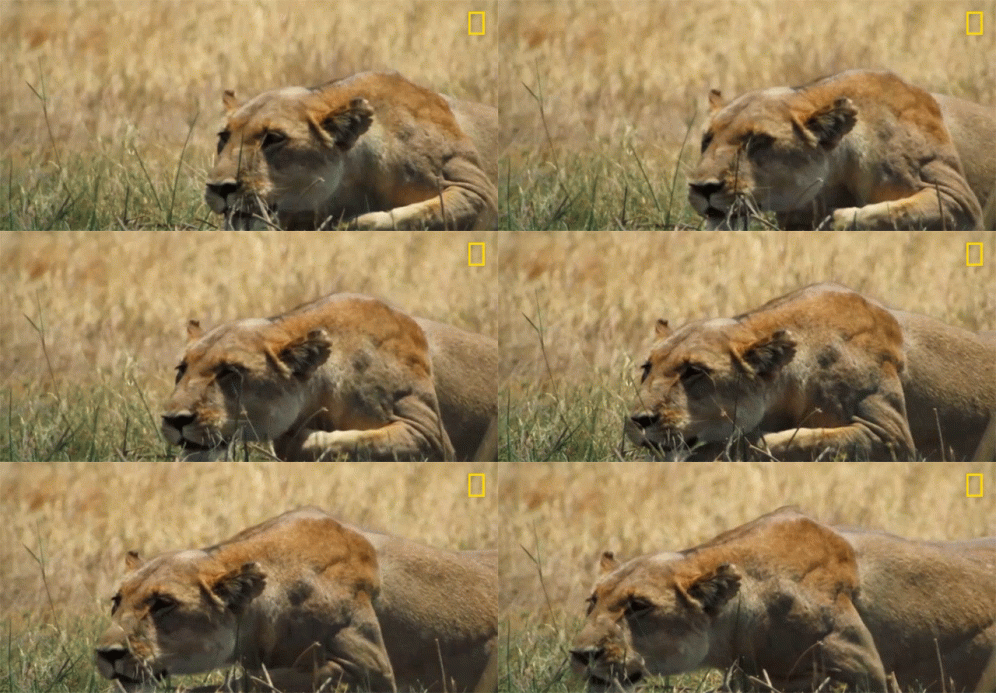
But what if you must learn to pause and move slowly, like a lion stalking its prey? The motor valence is orthogonal to the learning

I hope this new-ish paper will challenge people to think about the interpretations of our models
STRIATUM SUPPORTS REINFORCEMENT AND NOT ACTION SELECTION (!!!)
tinyurl.com/HodgeAndYttri
@cmuscience.bsky.social
@cmu-neuroscience.bsky.social
#neuroskyence
SPNs are briefly active + only for specific events. When driven randomly or for long dur, interpretation is hard. SPN attenuate response to light after a few secs (and Bstem response?)
These results indicate STR's role in policy-based RL + are at odds with basic action selection
When applied contra, ipsi, or bilaterally to left turns, the effect was the same: D1/D2 stim biased mice to turn left more often, regardless of the side of stim. Note, bias is incomplete and did not induce an action, consistent with learning but not action selection

Powerful work by soonish-defending @markolas.bsky.social that contributes to discussions of M1 computations and the role of M1 and striatum in action selection, kinematic tuning.

Even when behavior partially recovered after 10+ days, kinematic tuning in striatum did not. Several lines of evidence point to this being delayed due to remapping in cortex. Reaches were performed but were varied, in line with aberrant striatal activity

What about striatum? @markolas.bsky.social recorded daily for 20 days post lesion and found that although baseline activity was unchanged, no motor-related signals were present for those movements that did occur, either in SPNs nor FSIs.

Following lesions, for the first 8-9 days, mice could not do the task. Also, while they could walk fine-they froze in place for MINUTES when deciding to go left or right or switch their motor pattern to navigate around an easy obstacle (unrewarded).
This also went away over several days.

In an effort to bring #neuroskyence to @bsky.app I wanted to share our recent paper in Neuron
tinyurl.com/LesionsOfM1
@markolas.bsky.social and I asked what forelimb M1 contributes to striatal and behavioral dynamics using joystick tasks and CFA lesions
@cmuscience.bsky.social @the-cnbc.bsky.social
