Lol, Zillow tried to rate the climate risks facing individual properties. The real estate industry *hated* it, precisely because it worked -- it made selling risky properties more difficult. So they rebelled & Zillow caved.
Don't look up!

@laurielaybourn.bsky.social
How do we navigate uncharted climate territory? Lead: www.scri.org.uk Researcher at Chatham House, IPPR, University of Exeter
Lol, Zillow tried to rate the climate risks facing individual properties. The real estate industry *hated* it, precisely because it worked -- it made selling risky properties more difficult. So they rebelled & Zillow caved.
Don't look up!
Read the piece: strategicclimaterisks.substack.com/p/some-thing...
You can listen to all the episodes - and read the other bonus posts - at overshootpod.com
And all the episodes will soon be on YouTube. Subscribe at www.youtube.com/@OvershootPod

If it takes a village to raise a child, it takes a city to make a documentary...
In this final bonus post, read about the people, articles, books, and films that helped and inspired us as we made @overshootpod.bsky.social👇

When a government speaks responsibly about climate risks. Iceland's climate minister Jóhannsson:
"We believe that confronting climate tipping points and the risks they pose openly is not a sign of 'pessimism' or 'alarmism' but a sign of realism and responsibility."
youtu.be/B-0eQnEEsYA?...

In summer 1945, the UK prime minister wrote an extraordinarily prescient memo about the strategic consequences of the atomic bomb
Eighty years later, as a new climate reality dawns, something similar needs to happen
Read my latest @overshootpod.bsky.social bonus essay👇
Listening recommendation
www.overshootpod.com
@laurielaybourn.bsky.social does a very good job of translating "all that climate stuff" into our very own realities.

New from me: I spoke to two scientists who originally helped spread the use of carbon capture. They now say it's being misused. Here's why (gift link):
12.11.2025 11:23 — 👍 120 🔁 58 💬 6 📌 9@rahmstorf.bsky.social
12.11.2025 17:33 — 👍 0 🔁 0 💬 0 📌 0"[AMOC collapse] is a direct threat to national resilience and security" the Icelandic Climate Minister said
"It's the first time a specific climate-related phenomenon has been brought to the National Security Council as a potential existential threat"
Significant
www.reuters.com/sustainabili...
"The North Atlantic may be approaching a critical tipping point under continued climate change."
Be sure to check out the latest State of the Cryosphere report
Essential reading for anyone working on or caring about our collective security
iccinet.org/statecryo25/

❔| #TTP: Has Europe Given Up its Leadership on Climate Change? ➡️
COP30 takes place amidst increased pessimism about the world’s commitment to climate action.
Beset by a host of other challenges, can Europe still maintain a leading role?
carnegieendowment.org/europe/strat...

Read it here: strategicclimaterisks.substack.com/p/the-boldes...
06.11.2025 10:53 — 👍 1 🔁 0 💬 0 📌 0
In 1992, the English Premier League was founded and governments promised to avoid 'dangerous' climate change
One of those things didn't work out
Our next @overshootpod.bsky.social bonus essay delves deeper into carbon removals and explores why net-zero might be the most dangerous moment in history

Global GHG emissions showing a flat line at about 15MtCO2eq, where countries submitted, with a slight decline in emissions to 2035. A rising line from 35 to 55MtCO2eq shows global emissions, and the commitments at the last round of NDCs leading to flattish emissions.
Where are we on climate action?
The bottom black line is countries that submitted new commitments (on time), the dotted line is global emissions. Blue shading are the commitments.
That is the progress 10 years after Paris...
unfccc.int/process-and-...
So it's official; the world's governments have failed to take the necessary actions and we're now going to #overshoot the goals of the Paris #climate accord
How should we make sense of this moment? And where do we go from here?
@overshootpod.bsky.social offers some suggestions

There's a lot more in our report, which is published along with @ippr.org, @gsiexeter.bsky.social, and the UCL Climate Action Unit
We've also developed a toolkit. With it, you can facilitate workshops to map derailment risks and explore how to tackle them
👇
www.scri.org.uk/derailment

A static feedback loop diagram showing how climate change increases climate impacts, which require more adaptation. Adaptation can then be done in a way that either complements decarbonisation or undermines it. Decarbonisation then helps reduce climate change. If adaptation complements decarbonisation, this becomes a virtuous cycle. If it's the other way around, then the loops becomes a vicious cycle
Derailment shows that adaptation can't be seen as separate or even contradictory to decarbonisation
Spiralling climate impacts require more adaptation
But this can be done in a way that accelerates decarbonisation, reinforcing climate action even as climate consequences spiral
We need more of a conversation about how to maintain (and deepen) our collective agency even as climate consequences spiral
Our research identified many interventions
Key: a rapid increase in societal resilience...
This can be prevented if derailment risks are tackled and reinforcement opportunities for climate action - virtuous cycles - are realised
This cannot be left to chance
We call it 'derailment' as the prevailing assumption that the world has closed off temperature pathways above ~3°C cannot be held with much confidence when considering feedback loops
Instead, the world could be 'derailed' from these pathways by vicious cycles in societies (as well as in nature)
Derailment risk is when the consequences of climate change get in the way of climate action, worsening the underlying problem - a vicious cycle
Over 20 workshops and engagement with hundreds of experts and practitioners, we identified many examples of where this risk is growing
But the Spanish example shows that the opposite can also occur
Climate impacts could create anger and confusion, which is exploited to delay climate action
Impacts could also crowd out resources that would otherwise be used for climate action
We call these vicious cycles: derailment risk

A feedback loop diagram showing how climate action increases transition consequences, which could be positive and so increase climate action in a virtuous cycle
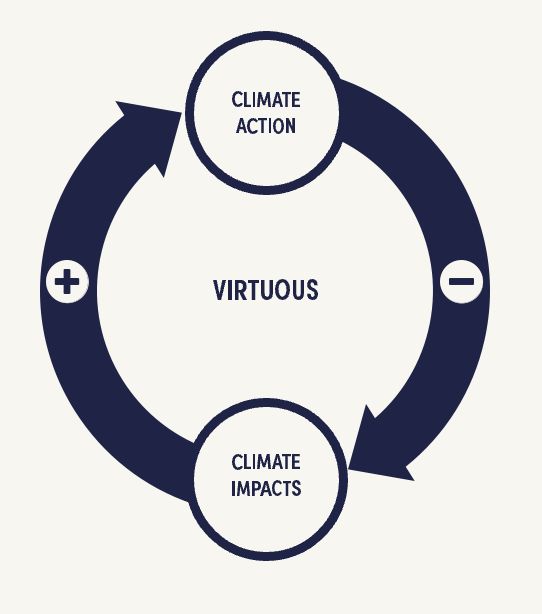
A feedback loop diagram showing how climate action decreases climate impacts, which themselves could spur more climate action in response, creating a virtuous cycle
It is often hoped that, as the world overshoots 1.5C and climate consequences escalate, virtuous cycles will reinforce climate action
Worsening impacts will act as a 'wake up', spurring more action
Producing more green tech makes it cheaper, spurring demand and more production
This is happening
There are other one-way relationships, like how climate impacts affect climate action: eg, worsening drought can decrease hydropower production
But our research showed that there is far less attention on the *feedback loops* between the consequences of climate change and climate action
Often, climate action is spoken about in one-way relationships
Action is needed to reduce the adverse impacts of climate change, with decarbonisation tackling the problem at root and adaptation increasing resilience to inevitable shocks
In turn, these actions have consequences, changing society
A year ago, Spain was hit by deadly floods
They were supercharged by climate change
Yet in their wake, climate-denying politicians gained influence - which risks undermining climate action, making people less safe
Today we publish new research on this troubling dynamic🧵
www.scri.org.uk/derailment
That should now be fixed!
27.10.2025 12:31 — 👍 1 🔁 0 💬 1 📌 0And that's not it for 𝗢𝘃𝗲𝗿𝘀𝗵𝗼𝗼𝘁: 𝗡𝗮𝘃𝗶𝗴𝗮𝘁𝗶𝗻𝗴 𝗮 𝘄𝗼𝗿𝗹𝗱 𝗯𝗲𝘆𝗼𝗻𝗱 𝟭.𝟱°𝗖 - more bonus content is coming, including essays that dive deeper into the issues we explored across the series.
Don't miss out; sign up at www.overshootpod.com