🔗 Also explore our open-access IOP Publishing study on how to quantify #Dunkelflaute events: lnkd.in/eM2AD8fP
27.05.2025 13:12 — 👍 3 🔁 0 💬 2 📌 0
@kittelmartin.bsky.social
Energy economist at Transformation of the Energy Economy at @diwberlin.bsky.social | power sector modeling | variability issues of renewables | PhD candidate at TU Berlin
🔗 Also explore our open-access IOP Publishing study on how to quantify #Dunkelflaute events: lnkd.in/eM2AD8fP
27.05.2025 13:12 — 👍 3 🔁 0 💬 2 📌 0💡 Modeling implications (ii): #Dunkelflaute detection based on VRE availability helps identifying relevant weather years.
27.05.2025 13:12 — 👍 2 🔁 0 💬 1 📌 0💡 Modeling implications (i): Model full winter periods (e.g. summer-to-summer) to capture long-lasting #Dunkelflaute events. Include multiple weather years, especially 1996/97. Note that the latter is missing from the climate-neutrality scenarios of #TYNDP.
27.05.2025 13:12 — 👍 2 🔁 0 💬 1 📌 0💡 Policy implications (ii): Policymakers must therefore prioritize investments and should consider additional deployment incentives to ensure sufficient storage capacity for dealing with rare yet extreme #Dunkelflaute events.
27.05.2025 13:12 — 👍 2 🔁 0 💬 1 📌 0💡 Policy implications (i): European integration and firm capacity reduce LDS requirements but significant investment needs remain. Note that underground hydrogen storage projects have long lead times (5-12 years).
27.05.2025 13:12 — 👍 2 🔁 0 💬 1 📌 0▶ Policy-oriented, yet moderate levels of firm zero-emission capacity in Europe (e.g. nuclear) reduce LDS needs only to a limited extent. A Germany-only scenario confirms this even for very high nuclear capacity levels beyond those ever realized in Germany.
27.05.2025 13:12 — 👍 3 🔁 0 💬 1 📌 0

▶ The combined use of short-duration flexibility options and LDS for coping with extreme #Dunkelflaute events decreases the need for electrolyzer and battery storage discharging capacity, which minimizes system costs.
27.05.2025 13:12 — 👍 3 🔁 0 💬 1 📌 0▶ LDS is a no-regret flexibility option: Even in the extreme case of perfect interconnection across Europe, 159 TWh (3% of annual demand) is still needed.
27.05.2025 13:12 — 👍 3 🔁 0 💬 1 📌 0▶ LDS needs vary substantially across weather years: The highest storage capacity required in 1996/97 exceeds the next highest required to deal with #Dunkelflaute events in 1984/85 by 42%.
27.05.2025 13:12 — 👍 3 🔁 0 💬 1 📌 0
▶ Geographical balancing helps mitigating #Dunkelflaute events, but significant LDS needs remain: Under policy-relevant interconnection assumptions, Europe would need 351 TWh (7% of annual demand) to cope with the worst event.
27.05.2025 13:12 — 👍 4 🔁 0 💬 1 📌 0

Key insights:
▶ #Dunkelflaute events drive LDS needs: Extreme events affecting multiple countries simultaneously - as occurred in the winter of 1996/97 (more info: lnkd.in/es6fwi7N) - define LDS sizing and operation.
In this study, @aroth.bsky.social, @wpschill.bsky.social, and I explore how to deal with prolonged low-availability periods in a renewable European energy system based historical weather patterns. Such periods are often referred to as #Dunkelflaute events or variable renewable energy (VRE) droughts.
27.05.2025 13:12 — 👍 3 🔁 0 💬 1 📌 0
🌬️☀️ How to deal with #Dunkelflaute events in Europe? Long-duration electricity storage (LDS) is key ⚡🔋
Check out our new pre-print “Coping with the Dunkelflaute: Power system implications of variable renewable energy droughts in Europe”: arxiv.org/abs/2411.17683
🧵A Thread 👇

Anlässlich der gerade stattfindenden Wasserstoff-Konferenz in Namiba, bei der auch Exportpotentiale nach Deutschland diskutiert werden, habe ich heute bei WDR5 die Rolle von grünem Wasserstoff in der deutschen Energiewende eingeordet. Hier der Link zum Nachhören ⬇️
www1.wdr.de/mediathek/au...
25/
- Avoid absolute thresholds, instead, scale thresholds relative to a time series’ mean for comparative analysis.
- Use multiple thresholds ranging from near-zero to the average availability to capture the full spectrum of drought events, from mild to very severe.
24/
- Choose meaningful characteristics: duration for VRE droughts and duration & energy deficit for PRL events.
- Recommended algorithms: VRE drought identification via VMBT or SPA; SPA or adjusted SPA for PRL events.
23/
- Ensure your algorithm identifies shortage unique events, avoids double-counting and overlap with adjacent events.
- It also should pool events that independently may not qualify as shortage events but are adjacent to periods of low availability or high residual load.
22/ TL;DR: how (not) to analyze VRE shortage:
- Be open about the code and analyzed data.
- Clearly specify your method for transparency and accurate result interpretation.
- Identify shortage events with variable durations —avoid fixed-duration "drought windows".
21/ VRE droughts or PRL analysis? Each has merits & drawbacks. Identifying VRE droughts typically involves fewer assumptions, offering conclusions with broader applicability. PRL events are more policy-oriented but less generalizable, requiring more assumptions and complex methods.
26.06.2024 15:11 — 👍 2 🔁 0 💬 1 📌 020/ Important limitation: Insights from PRL event analysis are specific to the assumed VRE portfolio and load and cannot be generalized. Contextualization is essential, esp. for meaningful comparisons of study findings and when communicating with policymakers or the public.
26.06.2024 15:11 — 👍 2 🔁 0 💬 1 📌 019/ Addressing critiques from the literature (oliverruhnau.bsky.social), we propose the adjusted SPA that accounts for efficiency losses from using flexibility options like long-duration storage during PRL events. This adjustment can substantially extend PRL event duration and recovery period.
26.06.2024 15:11 — 👍 2 🔁 0 💬 1 📌 018/ Here, the SPA is particularly well-suited for detecting PRL events. A neat feature: it allows for identifying the recovery period, which is the time it takes to recover the energy deficit using the VRE surplus generated after the PRL event.
26.06.2024 15:10 — 👍 3 🔁 0 💬 1 📌 0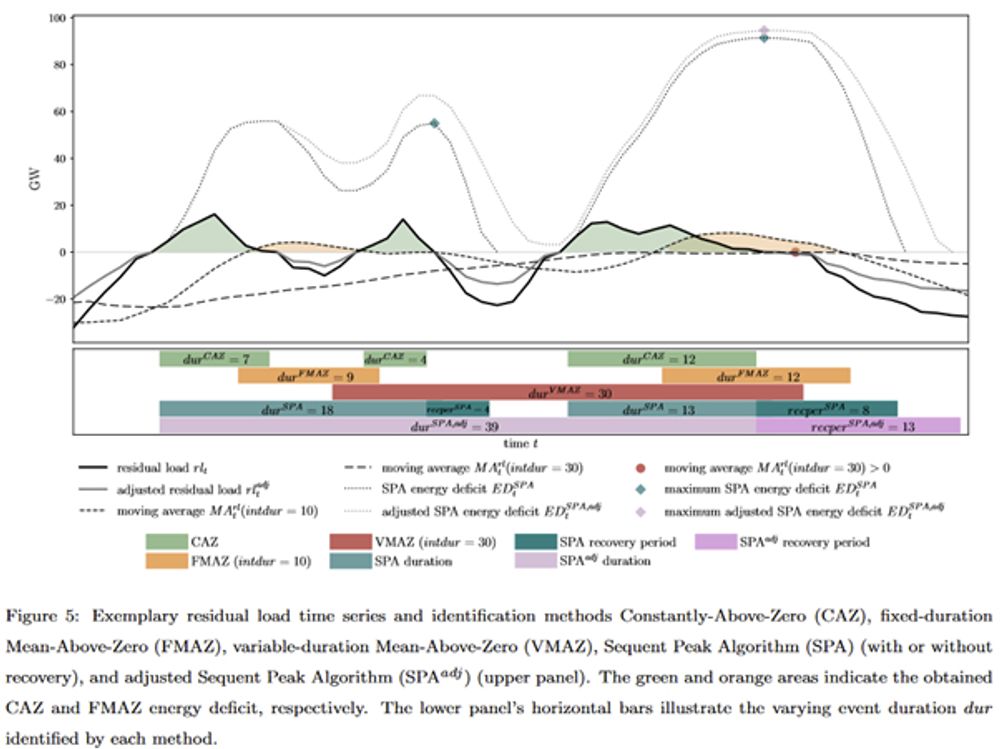
17/ When detecting the mismatch of VRE availability with demand, no deliberate threshold is needed - it is simply zero (gray line). We again formalize, compare, and critically evaluate several algorithms that work analogously to those used in VRE drought identification.
26.06.2024 15:10 — 👍 2 🔁 0 💬 1 📌 016/ Unlike VRE drought analysis, both duration and energy deficit are relevant in assessing PRL events. The energy deficit indicates the energy shortfall during such an event, directly relating to system flexibility needs, such as the required energy of long-duration storage.
26.06.2024 15:10 — 👍 2 🔁 0 💬 1 📌 015/ Let’s extend our analysis to #PositiveResidualLoadEvents (PRL), which capture compound high-demand and VRE drought events, indicating the need for firm capacity from thermal generators, or system flexibility provided by electricity storage, imports, or demand-side measures.
26.06.2024 15:09 — 👍 2 🔁 0 💬 1 📌 014/ Multi-regional analyses consider two extremes: no or perfect interconnection between regions. Remember that when interpreting VRE drought results. Drought patterns involving policy-relevant exchange fall between these extremes, requiring more complex energy system modeling.
26.06.2024 15:09 — 👍 2 🔁 0 💬 1 📌 013/ So, determining effective thresholds a priori is challenging. We'll delve deeper into this in upcoming research (stay tuned). For now, we recommend using relative thresholds between 0.1 and 0.9 times the average availability factor to capture the full spectrum of VRE droughts.
26.06.2024 15:05 — 👍 2 🔁 0 💬 1 📌 012/ Thresholds scaled to the mean availability factor, tailored to each time series, do the trick. But which threshold to use? Lower thresholds catch severe, brief & potentially isolated droughts. Higher ones may identify extended periods of below-average availability, not actual droughts.
26.06.2024 15:05 — 👍 2 🔁 0 💬 1 📌 011/ Comparative analyses across technologies or regions require a level playing field: compare based on equal energy generation, not just on plain availability factors that assume equal installed capacity.
26.06.2024 15:05 — 👍 2 🔁 0 💬 1 📌 010/ Aim to find unique droughts w/o double counting or overlapping events for precise VRE drought determination. Both our proposed Mean-Below-Threshold with variable duration (VMBT) & Sequent-Peak-Algorithm (SPA) meet these criteria, with VMBT typically exceeding SPA in duration.
26.06.2024 15:04 — 👍 2 🔁 0 💬 1 📌 0