OpenWMData
A collection of publicly available working memory datasets
Do you have an open working memory dataset and want it to be findable and reused? You can now add it to the Open WM Data Hub: williamngiam.github.io/OpenWMData! The collection of datasets tagged with useful metadata is steadily growing thanks to a small team of volunteers!
01.12.2025 23:28 — 👍 56 🔁 36 💬 3 📌 1

Transparent and comprehensive statistical reporting is critical for ensuring the credibility, reproducibility, and interpretability of psychological research. This paper offers a structured set of guidelines for reporting statistical analyses in quantitative psychology, emphasizing clarity at both the planning and results stages. Drawing on established recommendations and emerging best practices, we outline key decisions related to hypothesis formulation, sample size justification, preregistration, outlier and missing data handling, statistical model specification, and the interpretation of inferential outcomes. We address considerations across frequentist and Bayesian frameworks and fixed as well as sequential research designs, including guidance on effect size reporting, equivalence testing, and the appropriate treatment of null results. To facilitate implementation of these recommendations, we provide the Transparent Statistical Reporting in Psychology (TSRP) Checklist that researchers can use to systematically evaluate and improve their statistical reporting practices (https://osf.io/t2zpq/). In addition, we provide a curated list of freely available tools, packages, and functions that researchers can use to implement transparent reporting practices in their own analyses to bridge the gap between theory and practice. To illustrate the practical application of these principles, we provide a side-by-side comparison of insufficient versus best-practice reporting using a hypothetical cognitive psychology study. By adopting transparent reporting standards, researchers can improve the robustness of individual studies and facilitate cumulative scientific progress through more reliable meta-analyses and research syntheses.
Our paper on improving statistical reporting in psychology is now online 🎉
As a part of this paper, we also created the Transparent Statistical Reporting in Psychology checklist, which researchers can use to improve their statistical reporting practices
www.nature.com/articles/s44...
14.11.2025 20:43 — 👍 232 🔁 91 💬 8 📌 5

Models as Prediction Machines: How to Convert Confusing Coefficients into Clear Quantities
Abstract
Psychological researchers usually make sense of regression models by interpreting coefficient estimates directly. This works well enough for simple linear models, but is more challenging for more complex models with, for example, categorical variables, interactions, non-linearities, and hierarchical structures. Here, we introduce an alternative approach to making sense of statistical models. The central idea is to abstract away from the mechanics of estimation, and to treat models as “counterfactual prediction machines,” which are subsequently queried to estimate quantities and conduct tests that matter substantively. This workflow is model-agnostic; it can be applied in a consistent fashion to draw causal or descriptive inference from a wide range of models. We illustrate how to implement this workflow with the marginaleffects package, which supports over 100 different classes of models in R and Python, and present two worked examples. These examples show how the workflow can be applied across designs (e.g., observational study, randomized experiment) to answer different research questions (e.g., associations, causal effects, effect heterogeneity) while facing various challenges (e.g., controlling for confounders in a flexible manner, modelling ordinal outcomes, and interpreting non-linear models).

Figure illustrating model predictions. On the X-axis the predictor, annual gross income in Euro. On the Y-axis the outcome, predicted life satisfaction. A solid line marks the curve of predictions on which individual data points are marked as model-implied outcomes at incomes of interest. Comparing two such predictions gives us a comparison. We can also fit a tangent to the line of predictions, which illustrates the slope at any given point of the curve.

A figure illustrating various ways to include age as a predictor in a model. On the x-axis age (predictor), on the y-axis the outcome (model-implied importance of friends, including confidence intervals).
Illustrated are
1. age as a categorical predictor, resultings in the predictions bouncing around a lot with wide confidence intervals
2. age as a linear predictor, which forces a straight line through the data points that has a very tight confidence band and
3. age splines, which lies somewhere in between as it smoothly follows the data but has more uncertainty than the straight line.
Ever stared at a table of regression coefficients & wondered what you're doing with your life?
Very excited to share this gentle introduction to another way of making sense of statistical models (w @vincentab.bsky.social)
Preprint: doi.org/10.31234/osf...
Website: j-rohrer.github.io/marginal-psy...
25.08.2025 11:49 — 👍 978 🔁 286 💬 47 📌 20
ESCOP - Journal
ESCOP is a dynamic scientific society that provides a venue within which current research in cognitive psychology and neighboring disciplines can be presented, discussed and encouraged.
Here is your chance to become an associate editor of a fantastic journal! The incoming editor of @jcgntn.bsky.social, @davidecrepaldi.bsky.social, is looking for associate editors. Check out this cool opportunity to self-nominate or nominate someone you know!
www.escop.eu/about-us/jou...
19.10.2025 19:51 — 👍 2 🔁 1 💬 0 📌 0

Dariia Mykhailyshyna - Workshops for Ukraine
Feedback on the past workshops (if you want to learn how to make wordclouds, check out Text Data Analysis workshop below)
I’ll be giving a 'Workshops for Ukraine' session on Building and Customising Statistical Models with Stan and R: An Introduction to Bayesian Inference — online on Nov 13.
Open to all, with donations supporting Ukrainian organisations.
👉 sites.google.com/view/dariia-...
#stats #rstats #statssky
16.10.2025 14:27 — 👍 4 🔁 4 💬 0 📌 1
The final part of my PhD work is now published in JEP:LMC 🤩 Special thanks to my wonderful PhD supervisors @evievergauwe.bsky.social and @nlangerock.bsky.social 🤗 psycnet.apa.org/fulltext/202...
08.10.2025 09:25 — 👍 21 🔁 7 💬 1 📌 0
These results suggest that the benefits of prior knowledge, such as topic expertise, reflect contributions from long-term memory (LTM) to WM, rather than an increased efficiency of WM functions like bindings. I'd love to replicate with younger experts (could not get them!) and other WM functions! 🤩
23.09.2025 19:23 — 👍 3 🔁 0 💬 0 📌 0

A figure of the main results from Blocks 1 and 2 of the study.
Results: Expertise didn't moderate age-related slowing to establish bindings in WM, regardless of the relevance of the information (intact vs scrambled birds; Block 1). Instead, older experts showed a benefit to binding memory that disappeared when long-term memory was unreliable (high PI; Block 2).
23.09.2025 19:23 — 👍 2 🔁 0 💬 1 📌 0

A correlation matrix of the objective and subjective expertise measures on the left panel, and how the expertise groups were defined (kmeans clustering that is used in the paper) versus treating expertise as a continuous score.
How did we identify participants for these three groups? Subjective ratings clearly correlated with a perceptual discrimination task, which itself signaled a separate kmeans cluster of older experts. These experts were far superior at identifying birds vs the novices, validating the separate groups.
23.09.2025 19:23 — 👍 1 🔁 0 💬 1 📌 0

The main design of the Loaiza et al. birding study: Two blocks that both entailed a WM task that presented several bird-word pairs to participants followed by an immediate test, wherein the bird image was presented with three recall options (the correct target word from the trial, a lure word that was presented in the trial but not with that bird, and a new-to-block word).
Why does information seem so much easier to process when it coheres with our prior knowledge? We investigated this question by recruiting three groups (younger novices, older novices, and older experts in birding) to take part in a working memory (WM) study, the critical parts pictured below.
23.09.2025 19:23 — 👍 0 🔁 0 💬 1 📌 0
I am pleased to share that "the bird study" is now accepted at Psychology and Aging! A great collaboration with visiting intern Kishen Senziani, @leabartsch.bsky.social & @edamizrak.bsky.social 😀 Check out the pre-print below and a short thread on the study design and main takeaways 🧵👇
23.09.2025 19:23 — 👍 26 🔁 7 💬 1 📌 1
Congrats to @lauraklatt.bsky.social for being the #WomWoM research fairy of 2025! She is both a star researcher & incredibly generous and collegial with all in the field, especially the juniors! Thank you to everyone who sent in nominations & to @scannedfruits.bsky.social for making Laura's wand 🪄🧚♀️
15.09.2025 14:42 — 👍 17 🔁 3 💬 0 📌 0
Hey #memory folks, check out this new preprint by @joschadutli.bsky.social , @koberauer.bsky.social, and @leabartsch.bsky.social showing that elaboration benefits are likely driven by aiding in establishing efficient retrieval cues.
28.08.2025 14:57 — 👍 11 🔁 8 💬 0 📌 0
Yes, this was a really great experience! Thanks for @cvonbastian.bsky.social and @vmloaiza1.bsky.social for asking us to do this as part of #ESCOP2025! And if you are interested in having a similar workshop for your PhD Programm or similar, feel free to reach out!
12.09.2025 10:00 — 👍 15 🔁 5 💬 0 📌 0
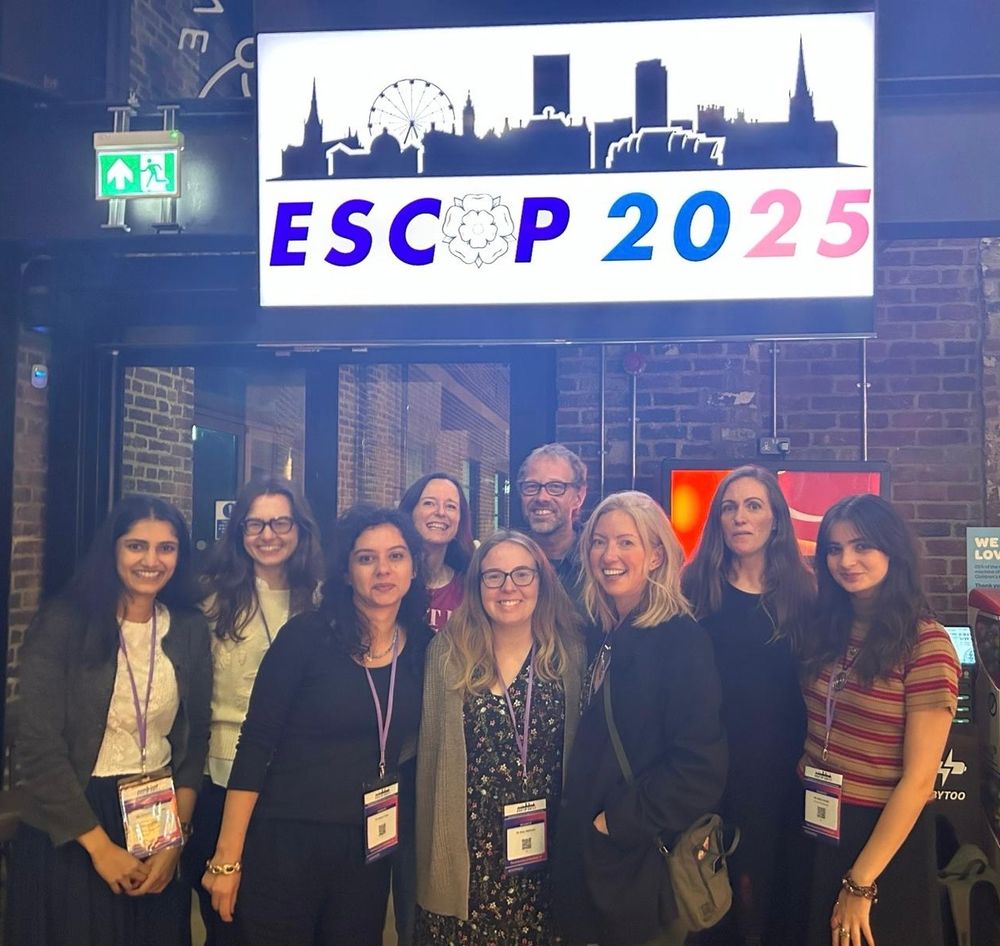
Leeds WoMCog group at the #ESCoP2025 conference in Sheffield!
05.09.2025 14:07 — 👍 21 🔁 3 💬 0 📌 0

I’m going to present at the Blitz Talk on Friday, 6pm, at #ESCOP2025 @escop.bsky.social. The very last session, yet I’m sure with a lot of excitement! Come to listen whether engaging in your hobby predict your cognitive abilities. 🧠
04.09.2025 10:42 — 👍 10 🔁 3 💬 0 📌 0
Here is the paper that @mollyadelooze.bsky.social presented this morning at #escop2025 showing source amnesia for recently presented verbal information.
03.09.2025 13:22 — 👍 16 🔁 6 💬 0 📌 0
It’s been an excellent few days in Sheffield for #ESCoP2025! I have enjoyed so many talks, posters, and chats, and have come away feeling inspired and excited about research ideas and topics happening across labs 🤩
05.09.2025 13:16 — 👍 11 🔁 3 💬 1 📌 0
maps.app.goo.gl/ZyeuVoiPSrxW...
I've saved some of my faves after over a year of living here!
03.09.2025 07:06 — 👍 1 🔁 0 💬 0 📌 0
Tomorrow afternoon I'll be presenting my symposium talk at #ESCoP2025 titled "Meaningful and familiar stimuli support visual working memory for simple features"! See you there!
02.09.2025 20:53 — 👍 19 🔁 7 💬 0 📌 0
Sure do!! 😁
01.09.2025 21:50 — 👍 1 🔁 0 💬 0 📌 0

It's all starting soon 🥳 we can't wait to welcome you all to Sheffield for #ESCoP2025 🤩 @cvonbastian.bsky.social @escop.bsky.social
01.09.2025 09:09 — 👍 22 🔁 2 💬 2 📌 0
With less than week until #ESCOP2025, we're super excited to kick-off our conference with something truly special - an Algorave! 🤩 (1/12 👀)
28.08.2025 13:44 — 👍 13 🔁 5 💬 2 📌 0
Happy first day of classes! I had a stress dream that a cacophony of errors made me so late to work that I missed today's entire graduate seminar that I'm teaching this semester. But I live less than a mile away from work 🤣
25.08.2025 13:49 — 👍 4 🔁 0 💬 0 📌 0
Annual Meeting - Cognitive Neuroscience Society
March 7 – 10, 2026 Submit a Symposium Submit a Poster CNS 2026 Annual Meeting – March 7 – March 10, 2026 We invite you to join us at the Cognitive Neuroscience Society (CNS) 2026 Annual Meeting, March...
2026 @jocn.bsky.social Travel Fellowship
@jocn.bsky.social and Cog. Neurosci. Soc. to offer a stipend of $3000, plus waived conf. reg. and waived poster submission fee to attend www.cogneurosociety.org/annual-meeti... , to one trainee based at an institution located in each of five regions:
05.08.2025 13:40 — 👍 21 🔁 21 💬 1 📌 1

Popular meme of guy holding up a sign that says "I just hope both teams lose"
Me: This project will distinguish between Theories A and B
My data:
01.08.2025 22:40 — 👍 34 🔁 2 💬 0 📌 0
📣 Tomorrow is the last day! 📣
Get those nominations in and celebrate those awesome female scientists in our field 🤩
01.08.2025 15:58 — 👍 0 🔁 1 💬 0 📌 0

Journal of Cognition
Ubiquity Press is sponsoring #ESCOP2025 this year! As the publishers of the @jcgntn.bsky.social, @escop.bsky.social's journal, we believe in supporting our publications as much as possible. @vmloaiza1.bsky.social @cvonbastian.bsky.social
journalofcognition.org
29.07.2025 12:54 — 👍 4 🔁 4 💬 0 📌 0
🚨 Just about a week left to celebrate all our fantastic female colleagues in #workingmemory by nominating them for the #WomWoM research fairy award! 🚨
25.07.2025 16:13 — 👍 8 🔁 7 💬 0 📌 0
It's only cancel culture if it comes from the democratic regions of the U.S. Otherwise it's sparkling authoritarianism.
25.07.2025 13:55 — 👍 234 🔁 51 💬 3 📌 0
I build mathematical models to understand cognition and behavior. Care about history and philosophy of science.
Tenured Senior Scientist, Department of Psychology, University of Zurich.
https://venpopov.com
The best and the worst of bsky dot app
Tag or dm for submissions
Colorado State University chapter of the American Association of University Professors (https://aaupcsu.org/).
Advancing academic freedom and shared governance.
Supporting all who engage in teaching and research in higher education.
I write about abortion every day at abortioneveryday.com Read my newsletter & find me other places here: linktr.ee/jessicavalenti
📚 My new book 'Abortion' is out now prh.com/abortion
the sky above the port was the color of television tuned to a dead channel / former IT engineer @netflix & retired #LCS commentator & multihyphenate necromancer
🌶️ 🔞 @spaceghostkari.bsky.social
https://linktr.ee/space.ghost
Associate Professor at The University of Arizona. Director of Clinical Training for our Clinical Psych Ph.D. Program. I run for fun.
Postdoc @UCSD Kiyonaga lab | working memory 🧠
PhD candidate at IFaDO, studying the interplay between attention and crossmodal feature bindings.
Lecturer (Assistant Professor) interested in Social Cognition, Communication, Cognitive Control, and Lifespan Changes | University of St Andrews | Big fan of my dog, hot chocolate, and crunchy leaves ☺️
https://www.lizziebradford.com
Globe trotter 🌍 *learning Dutch * mom to 2 Ethiopian adoptees *love my animals * Sussex Squaddie *#Genealogy *#Aviation * 📚 #BookSky *a good beer 🍻 *Harris/Walz *Magats can go fuck themselves and will be blocked. 🚫 DM's.
Lecturer and Senior Research Associate in cognitive psychology at the University of Fribourg 🇨🇭 | Interested in working memory.
Nature enthusiast 🏔️
https://linktr.ee/roxanegay
Writer, editor, publisher, professor. Some people call me a bad feminist and by some people I mean me.
PhD student at the Cognition Lab, University of Zurich
Interested in working memory, attention and computational modeling
Psychology professor and debunker, post-Soviet Jewish refugee (🇺🇦), @dr_inna on TikTok. Not a medical doctor or a therapist.
Sources and other info here:
https://linktr.ee/dr_inna
Cognitive psychologist at Bradley University researching attention, memory, cognitive control, individual differences, and whatever inspires my students (within reason)
PhD student at UChicago Psych. Interested in visual memory and its individual differences.
trans rights or gtfo. sometimes making music but i’d mostly like to be posting about sports.
sooners/niners/dodgers/thunder/highlander