New paper out in @natecoevo.nature.com showing that growth rate is as a stronger predictor of SOC than CUE. Congrats Xianjin He for leading this work!
06.02.2026 16:49 — 👍 5 🔁 0 💬 0 📌 0

Excited to convene the upcoming EGU webinar on "Mental Health in Academia: Obstacles, Advocacy and Inclusion" on 9 February at 16:00 CET.
Open to all.
👉 Register here: www.egu.eu/webinars/694...
@egu.eu @egubg.bsky.social @anabastos.bsky.social @elsa-abs.bsky.social
29.01.2026 09:32 — 👍 15 🔁 8 💬 2 📌 1
Last few hours to submit an abstract to our session on eco-evolutionary drivers of biogeochemistry #EGU26
⏰ Abstract deadline: January 15 at 13:00 CET
🔗 Session link: lnkd.in/eHV6jDrh
Co-conveners: @manzonilab.bsky.social , @bopplaurent.bsky.social, Colin Prentice, Elisa Bruni
15.01.2026 00:39 — 👍 1 🔁 0 💬 0 📌 0
If you work on how diversity and/or adaptation shape ecosystem functioning—in soils, vegetation, or aquatic systems—consider our session 😃 #EGU26
⏰ Deadline: Jan 15
🔗 Session link: lnkd.in/eHV6jDrh
Co-conveners: @manzonilab.bsky.social, @bopplaurent.bsky.social, Colin Prentice, Elisa Bruni
09.01.2026 22:59 — 👍 0 🔁 0 💬 0 📌 0
Happy New Year! 🎉
Just a quick reminder about our EGU26 session on eco-evolutionary drivers of biogeochemistry — we’d love to see your abstracts!
⏰ Deadline: Jan 15
Co-organizers: Elisa Bruni, @manzonilab.bsky.social, @bopplaurent.bsky.social, Colin Prentice
04.01.2026 09:24 — 👍 0 🔁 2 💬 0 📌 0
Session co-organizers: Elisa Bruni, @manzonilab.bsky.social, @bopplaurent.bsky.social, Colin Prentice
18.12.2025 06:45 — 👍 2 🔁 0 💬 0 📌 0

📣 EGU26 – Call for abstracts
Session: Functional diversity in motion: Eco-evolutionary drivers of biogeochemical processes across terrestrial & aquatic systems.
🎤 Solicited speakers: Jaideep Joshi & Boris Sauterey
🗓 Deadline: 15 Jan 2026
🔗 meetingorganizer.copernicus.org/EGU26/sessio...
17.12.2025 15:42 — 👍 1 🔁 1 💬 1 📌 3
Starting in 5min!
10.12.2025 15:23 — 👍 1 🔁 0 💬 0 📌 0
Session ITS5.2/BG10.2
How do scientific ideas evolve and which paradigms in Earth system science deserve a fresh look? We welcome submissions to address these questions in our #EGU26 session “Re-examining Seminal Ideas in Earth System Science” www.egu26.eu/session/57516
07.12.2025 12:27 — 👍 6 🔁 4 💬 1 📌 2
@anabastos.bsky.social @rebeccamayvarney.bsky.social @egu.eu @egubg.bsky.social
28.11.2025 09:54 — 👍 1 🔁 0 💬 0 📌 0

Excited to convene an EGU webinar on "Fostering Diversity, Equality and Inclusion in Academia" on 10 Dec at 16:30 CET.
Davide Faranda will share insights on building a more inclusive and equitable research culture across the geosciences.
Open to all.
👉 Register: www.egu.eu/webinars/
28.11.2025 09:52 — 👍 7 🔁 5 💬 1 📌 1
🎉 I'm thrilled to share that I've started a permanent research position as Chargée de Recherche (CR) at the CNRS!
@cnrs-insu.bsky.social
I'm super thankful to all my amazing colleagues and friends who gave feedback and encouragement during the application process 💚
29.10.2025 14:48 — 👍 13 🔁 0 💬 1 📌 0
Congratulations Kyle!!! (love the soil mates 🤣🥰)
24.07.2025 10:26 — 👍 1 🔁 0 💬 0 📌 0
Thank you for sharing Brian!
17.07.2025 17:11 — 👍 1 🔁 0 💬 1 📌 0

Wondering where to submit your abstract for #AGU25 @agu.org?
Check out our session co-organized with @kristenobacter.bsky.social (UMass), Ulas Karaoz and Nicola Falco (Berkeley Lab).
In-person invited speakers: @andreasrichter.bsky.social (U of Vienna) & Amilcare Porporato (Princeton) 🤩
16.07.2025 08:33 — 👍 6 🔁 4 💬 1 📌 1
I'd love that! I'm based in Paris. Would that work for you?
06.07.2025 06:02 — 👍 0 🔁 0 💬 1 📌 0
Working on microscale microbial functions and/or scaling up?
Submit to our Elementa special feature!
🔗 lnkd.in/gChyjaiM
📝 Rolling publication
📅 Final deadline: Sept 20, 2025
🌍 Contributions welcome from soil, ocean & human systems.
04.07.2025 16:15 — 👍 5 🔁 3 💬 0 📌 0
🙏 co-authors: @scott-saleska.bsky.social , Steve Allison, Philippe Ciais, @chopinyang.bsky.social , Mike Weintraub and Régis Ferrière.
20.06.2025 16:34 — 👍 1 🔁 0 💬 0 📌 0
6. Conclusion
Microbial eco-evolution could destabilize soil carbon.
Models that ignore it risk underestimating climate-carbon feedbacks.
We hope this work opens the door to more theory-driven, evolution-aware Earth system models. (7/7)
20.06.2025 16:34 — 👍 1 🔁 0 💬 1 📌 0

5. Global heterogeneity of the eco-evolutionary effect
We wondered if we could replace eco-evolution with a constant correction. Answer: no. Its effect is uneven—negligible in warm regions, but up to 2× more soil C loss in cold ones. Why? Optimal enzyme allocation responds nonlinearly. (6/7)
20.06.2025 16:34 — 👍 2 🔁 0 💬 1 📌 0

4. Implication for global soil C projections
We thought that microbial adaptation would buffer warming-induced soil C loss. But because it amplifies enzyme production (as shown above), we found that adaptation aggravates the loss—by x1.8 globally. (5/7)
20.06.2025 16:34 — 👍 1 🔁 0 💬 1 📌 0
3. Experimental validation
We reviewed 13 warming studies:
✅ 9 matched our predictions (6 eco-evolution, 3 physio)
❌ 3 didn’t show increased enzyme production (though evidence was weaker).
Overall, warming tends to increase microbial investment in resource acquisition. (4/7)
20.06.2025 16:34 — 👍 1 🔁 0 💬 1 📌 0

2. Evolutionary result
We found that in hostile environments (e.g. high mortality, slow uptake), selection favors direct investment in biomass over the riskier strategy of enzyme production. Since warming mainly increases uptake rate, we predicted it would favor stronger enzyme producers. (3/7)
20.06.2025 16:34 — 👍 1 🔁 0 💬 1 📌 0

1. The eco-evolutionary model
We added a trade-off to a classic microbe-soil C model and used adaptive dynamics to evolve enzyme allocation. To prevent freeloaders from taking over, we included implicit spatial structure. Bonus: enzyme production emerges—it’s no longer a free parameter. (2/7)
20.06.2025 16:34 — 👍 1 🔁 0 💬 1 📌 0
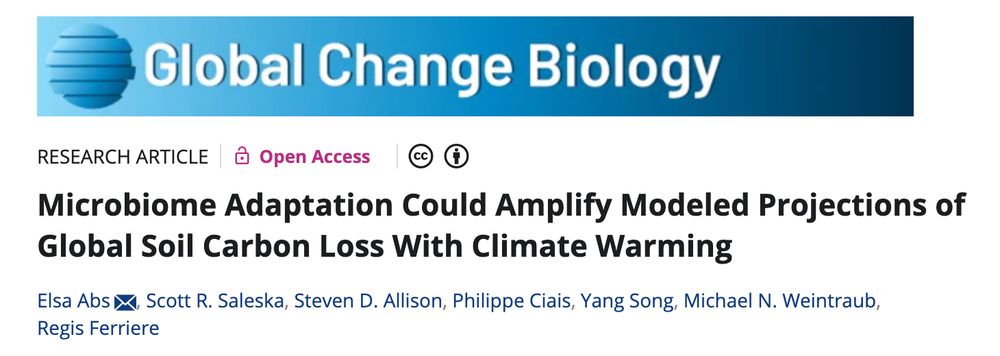
New paper out in Global Change Biology 🤩
doi.org/10.1111/gcb....
We built the first soil carbon model that includes microbial eco-evolution using game theory — and found that adaptation could nearly double global soil carbon loss by 2100. Here is how👇(1/7)
20.06.2025 16:34 — 👍 35 🔁 15 💬 2 📌 2
🙏 co-authors: @scott-saleska.bsky.social, Steve Allison, Philippe Ciais, @chopinyang.bsky.social, Mike Weintraub and Régis Ferrière.
20.06.2025 16:26 — 👍 0 🔁 0 💬 0 📌 0
6. Conclusion
Microbial eco-evolution could destabilize soil carbon.
Models that ignore it risk underestimating climate-carbon feedbacks.
We hope this work opens the door to more theory-driven, evolution-aware Earth system models. (7/7)
20.06.2025 16:26 — 👍 0 🔁 0 💬 1 📌 0
5. Global heterogeneity of the eco-evolutionary effect
We wondered if we could replace eco-evolution with a constant correction. Answer: no. Its effect is uneven—negligible in warm regions, but up to 2× more soil C loss in cold ones. Why? Optimal enzyme allocation responds nonlinearly. (6/7)
20.06.2025 16:26 — 👍 0 🔁 0 💬 1 📌 0
4. Implication for global soil C projections
We thought that microbial adaptation would buffer warming-induced soil C loss. But because it amplifies enzyme production (as shown above), we found that adaptation aggravates the loss—by x1.8 globally. (5/7)
20.06.2025 16:26 — 👍 0 🔁 0 💬 1 📌 0
Researcher. Computer scientist. Woman in science.
Computational biology, bioinformatics, microbial ecology.
She/Her.
Bordeaux, France
https://cfrioux.github.io
#HelloESR
PhD Student in Soil Environmental Microbiology
@meebangor.bsky.social at Bangor Uni, UK
Carbon storage - C cycle - SOM - Omics
I am a microbial ecologist studying soils to the sea. Join me in leveraging science to address major societal challenges including the sustainability of human and environmental health in the face of rapid global change. I enjoy gardening and running.
Complex systems. Microbial ecology.
Ecosystem scientist and computational modeler. Living in Knoxville, TN, formerly of Madison, WI
Climate scientist @ Stockholm University 🌍 🌳 🍂 #WomenInSTEM (She/her)
Biodiversity | Ecology | Physiology | Theory | Climate Change | Macroecology | Scaling | biendata.org; Prof. EEB Univ of Arizona, External Prof Santa Fe Institute, Assoc Res Oxford Univ UK; Proud father, 🌵🇺🇸🇬🇧🇸🇪🌲 Gift med en svensk
Soils, Microbes, Ecosystems, Climate Change!
TER@CeMESS: Terrestrial Ecosystem Research Group, Centre for Microbiology and Environmental Systems Science.
Scientific Officer
JRC- European Commission
Soil carbon, biogeochemical cycles, modelling 🤔
@ec.europa.eu
Ecology, soil biogeochemistry
Researcher of soil-plant-atmosphere interactions, volunteer geoscientists, EDI activist, parent
Relaying microbiology news, articles and comments relevant to aspects on bacteria, fungi, viruses and other microbes / microorganisms. Microbes are 💪
PostDoc UC Berkeley @schmidtdse.bsky.social | Fire recovery, Climate and Model Uncertainty | Editor-in-chief @egubg.bsky.social | On a quest for climate literacy 🌿
Climate and carbon cycle scientist. I help make computer models of the biosphere and experiment on them so that we don't have to on the real one.
https://scholar.google.com/citations?user=fB5Lnz4AAAAJ
Rédacteur en chef Sciences et Médecine au Figaro, mais pas que ça
Journaliste @liberation.fr
Journaliste climat @mediapart.fr • Auteur de "Le Mensonge Total" (2024), de "Criminels climatiques" (2022) et de "Une Histoire Populaire du Football" (2018).
Journaliste au service #Planète au Monde. Rubrique #climat, COP, mobilisations, réchauffement et apocalypses diverses. Mes tweets sont en poils de yak.
Postdoctoral researcher at @exeter.ac.uk. Climate-carbon interactions in high-latitude ecosystems.