Worth it!
08.02.2026 10:33 — 👍 1 🔁 0 💬 0 📌 0
Agreed. One of the most astonishing pictures that I have ever seen. It was the background for my desktop for years. It has only got better with JWST.
29.01.2026 21:22 — 👍 1 🔁 0 💬 0 📌 0
I didn't realise that you did a podcast! Thanks for this.
31.12.2025 10:18 — 👍 0 🔁 0 💬 1 📌 0
Kudos!
30.12.2025 09:23 — 👍 1 🔁 0 💬 0 📌 0
Nice mosaic. I will be interested in seeing the final product. Is this one night's work?
30.12.2025 07:14 — 👍 1 🔁 0 💬 1 📌 0

See my inadequate description of the starless version of this photo. In this one we we the stars and there are lots of them because we are on the edge of the Milky Way
Here's the Tarantula nebula...with stars this time. #astronomy #astrophotography #seestar #tarantulanebula
29.12.2025 08:28 — 👍 5 🔁 0 💬 0 📌 0
Love it and the information that goes with it. Can I ask: is this one photo or a mosaic? Cheers
28.12.2025 22:44 — 👍 2 🔁 0 💬 1 📌 0

The centre of the Tarantula Nebula is very bright and it looks like it has a number of clouds exploding from the centre bright region.
This is a starless view of the Tarantula nebula, found around 160,000 light years from earth. If you want more information the Wikipedia entry is illuminating. #astrophotography #astronomy #seestar
26.12.2025 11:07 — 👍 18 🔁 1 💬 0 📌 0

The picture shows two images taken with the Seestar S50 telescope. The one on the left shows the central star surrounded by a dark pink half halo. On the right of it is a dark are then a brigher area which looks like a horn (upside down). It is a stack of 12 photos taken over two minutes.
The second photo is the same nebula but it is a stack of 1200 images taken over 10 hours. It shows much more detail in the halo - swirling clouds of dust, still mainly pink but with reds, greys and whites mixed through it. The 'horn on the right now also has much more detail and it now looks like a scary face with half a mouth and one eye!
The difference between taking an image of the Orion Nebula (M 42) for two minutes and taking if for ten hours! Both done with the Seestar S50 and are taken eighteen months apart! #seestar #astronomy #astrophotography #orionnebula #M42
21.12.2025 09:15 — 👍 5 🔁 0 💬 0 📌 0

This is print of a female superb wren by Rachel Hollis. It is a small bird but fills up this screen. It is predominately plain brown in colour, with a white breast and reddish bill and lores. Her long tail points up at almost 90 degrees to her body.
Just recieved some greeting cards from @rachelhollisart.bsky.social in the post. Thanks so much Rachel.
This female superb wren was the first one I saw and it looks stunning. As a bird lover, I can highly recommend her work.
12.11.2025 02:15 — 👍 13 🔁 2 💬 1 📌 0
I have just done a Southern Hemisphere version of this galaxy using a Seestar, and I was satisfied with it until I saw this...
29.10.2025 07:42 — 👍 0 🔁 0 💬 0 📌 0
Looks pretty straightforward. Thanks for this!
17.10.2025 23:08 — 👍 1 🔁 0 💬 0 📌 0
How did you process this image, btw? I'm sitting on 10 hours of Seestar images for the Sculptor galaxy, and I'm looking for ideas. Cheers.
17.10.2025 21:33 — 👍 0 🔁 0 💬 1 📌 0
Eight hours! Kudos. And what a nice looking result.
16.10.2025 09:45 — 👍 1 🔁 0 💬 1 📌 0
YouTube video by The Space Koala
Seestar EQ Mode Trick: How I Get a Perfect Polar Alignment Everytime
Hey #seestar users. Here is the latest Space Koala video on how to get the polar alignment as accurate as possible in EQ mode.
youtu.be/mdaczIbmDbM?...
#astrophotography #astronomy
05.09.2025 12:17 — 👍 2 🔁 1 💬 0 📌 0
Glorious colours!
04.09.2025 10:46 — 👍 1 🔁 0 💬 0 📌 0
I understand almost none of this but even I can recognise this is a monumental piece of work. Congratulations.
28.08.2025 23:08 — 👍 2 🔁 0 💬 0 📌 0
Fantastic. Also, congratulations on 50 years in astrophotography. It shows.
28.08.2025 00:06 — 👍 1 🔁 0 💬 1 📌 0
Wow. Love it. Thanks for the explicatory second image.
26.08.2025 02:44 — 👍 1 🔁 0 💬 0 📌 0
You have a lot of detail here for 23 minutes! Shame about the satellite. Vive le Seestar!
26.08.2025 02:42 — 👍 1 🔁 0 💬 0 📌 0
Could you keep us up to date? I'd love to see what I am missing!
24.08.2025 08:48 — 👍 2 🔁 0 💬 0 📌 0
Or the Gulf of Carpentaria
24.08.2025 08:47 — 👍 4 🔁 0 💬 1 📌 0
Hey Darren. Did you take a photo of M13 with your RedCat? If so, can you upload it here? As a Seestar owner, I would like to see the difference.
24.08.2025 08:41 — 👍 1 🔁 0 💬 1 📌 0
Thanks. I'm using a Seestar S50 myself. However, I admire the amount of time you are spending on getting your images. It's been worth it!
24.08.2025 06:28 — 👍 1 🔁 0 💬 1 📌 0
The central part looks like a cup!
Btw, what is the name of your tiny smart telescope?
24.08.2025 03:46 — 👍 1 🔁 0 💬 1 📌 0

I've done another, much better version. Slightly different angle for some reason.
19.08.2025 03:23 — 👍 4 🔁 0 💬 0 📌 0
Worth it! What an image.
15.08.2025 08:27 — 👍 1 🔁 0 💬 1 📌 0

The Eye of God or NGC 7293 really does have an eye shape. The central part is a circular shape with a green hue. There is another middle circle outside of this with a light coloured dust and then the outer part gives it the eye shape and is a darker orange colour. There are a moderate number of stars through and around the nebula.
This is a Seestar version of the Eye of God or NGC 7293. It is a plantary nebula, found about 650 light years from Earth. 🔭#astrophotograpy #seestar #astronomy
15.08.2025 07:08 — 👍 8 🔁 0 💬 1 📌 0
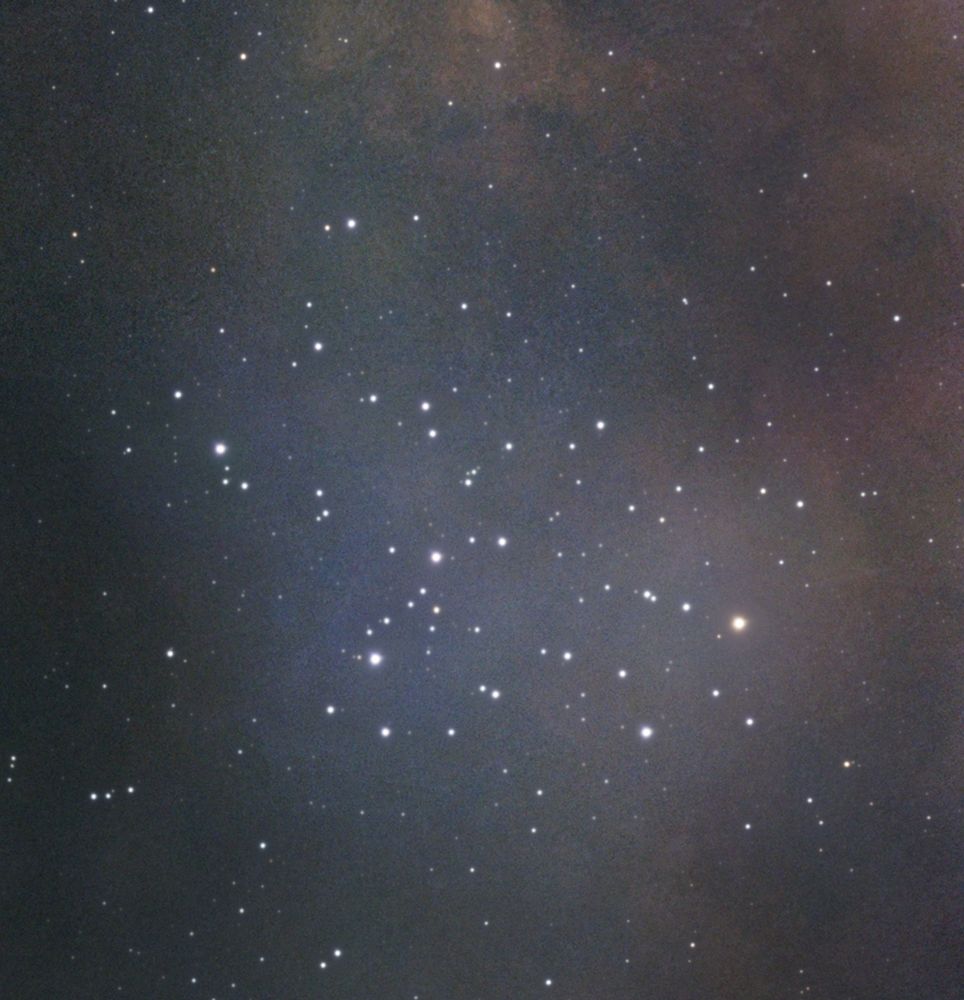
M6 in this image is a group of around 20-30 stars that are about 1600 light years from Earth. It is not a tight cluster, and some of the stars form V shapes. They are surrounded by a blue nebulosity. In the top right-hand corner is more nebula, although it is more of a traditional brown-orange colour.
This is a trial of one of my first star clusters, M6. I've done a bit to try and highlight the nebulosity around the stars, but I might have overdone it. Still, it looks nice. 🔭 #astrophotograpy #astronomy
04.08.2025 01:22 — 👍 7 🔁 0 💬 0 📌 0
Editor of The Bulwark
https://www.thebulwark.com/
Host of a Secret Podcast.
Also a super double-secret podcast you can't find.
Host of the Bulwark Podcast
MSNBC political analyst.
Punching bag on FYPod with Cameron Kasky.
Church of Jokic.
Nola Dad.
Weak and Gay.
Political analysis and reporting free of tribal prejudices. Sign up for our newsletters here: https://thebulwark.com/subscribe
Natural History Photographer, rock drummer, moths, fungi, entomology and science driven conservation. Amateur mycology and microscopy.
Book nerd: Fantasy, nature, physics, biology, mycology, military history and too many more.
Astronomy educator and writer in Southern California.
I post space images with breakdowns, astronomy fun facts, and articles on various space topics.
Amid the Stars is a guided stargazing experience in the San Bernardino Mountains.
amidthestarstours.com
Painter, sculptor and potter. Glacier National Park is my emphasis subject where my gallery/studio/home is near.
Birds • Art • Nature history
I'm exploring the world of birds through art 🐦
To see my art only, go to the Media tab :)
https://ivetasaviary.com/
https://www.instagram.com/ivetasaviary/
A legacy of discovery. A future of innovation.
Health contributor/reporter at Guardian US, contributing editor at the New Republic, freelance elsewhere. Arctic obsessive and book enthusiast.
Email: melodyschreiber@proton.me
Signal: melodyschreiber.06
Newsletter: notadoctor.news
The European Southern Observatory designs, builds & operates world-class observatories on the ground for the benefit of society. More info on eso.org
Amateur Astrophotographer in Munich, Germany.
Building fundamental knowledge about the origin, evolution, and future of our planet since 1949 (lamont.columbia.edu).
Innovative education, groundbreaking research, and essential solutions for climate and sustainability (climate.columbia.edu).
Our mission is to lead on world-class research, policy, training and innovation that supports effective action on climate change.
World-leading centre for policy-relevant research and training in climate change and the environment based at the London School of Economics and Political Science and chaired by Lord Nicholas Stern. Posts by Merlin Sibley
We're committed to advancing our understanding of Earth system science, from the ocean to the exosphere, for the betterment of our planet. 🌎 Operated by UCAR and #NSFfunded.
Interdisciplinary research partnerships generating sustainable solutions to global challenges. Newsletter: http://bit.ly/2yVFYz6, YESI 🎬: https://ow.ly/8u2A50Tz00M
SCRI is a think-and-do tank for navigating the next chapter of the climate crisis, producing insights and tools for navigating non-linear and cascading climate risk.
Find out more: https://www.scri.org.uk/
Science, analysis, and news around climate change's impacts on the economy, focusing on growth, inflation, investment, companies, consumers #ClimateRisk #ClimateImpacts