Read the full paper below, where it made the cover of Applications in Plant Sciences!
09.12.2025 15:02 — 👍 0 🔁 0 💬 0 📌 0
This approach was developed by Reed Benkendorf, graduate of the @ChicagoBotanic / @northwesternu Graduate Program in Plant Biology and Conservation, in collaboration with fellow alumna Emily Woodworth and Garden scientists Paul CaraDonna, Ph.D., Jeremie Fant, Ph.D., and others.
09.12.2025 15:01 — 👍 0 🔁 0 💬 1 📌 0
🪻To verify this method, genomic sequence data were compared against microscopic examination of pollen and field observations. Results were more ecologically accurate with the filtered database than with sequence data alone.
09.12.2025 15:01 — 👍 0 🔁 0 💬 1 📌 0
🌼 Researchers at @ChicagoBotanic have come up with a powerful way to address these challenges. By using data detailing which species may be flowering in an area when a pollen sample from a bee is collected, we can filter sequence databases & narrow down the plants that the bees most likely visited.
09.12.2025 15:01 — 👍 0 🔁 0 💬 1 📌 0
However, this method relies on existing DNA sequence databases, and if a plant is missing or deviates from the reference sequence, it can be difficult to conclusively determine the pollen sources.
09.12.2025 15:01 — 👍 0 🔁 0 💬 1 📌 0
🧬 How? Metabarcoding! This is a technique where short regions of DNA that are shared between species are analyzed, and based on small variations in these sequences, scientists can determine which plants the pollen on a bee came from.
09.12.2025 15:01 — 👍 0 🔁 0 💬 1 📌 0

Cover of Applications in Plant Sciences, with cover photo by Jane Ogilvie. Bee visiting a flower.
🧪 Thanks to advances in DNA sequencing, we can now tell which flowers a bee has visited based on the pollen they’re carrying! 🐝
📸 by Jane Ogilvie
09.12.2025 15:01 — 👍 7 🔁 2 💬 1 📌 0

Rethinking Lawns
Exploring lawn alternatives for biodiversity support, climate change resilience, and infrastructure improvements
Their test plots can be found at the Garden and in select Chicago Park District parks and natural areas. Read more below:
05.12.2025 16:02 — 👍 1 🔁 0 💬 0 📌 0
At @ChicagoBotanic, the Rethinking Lawns project is reimagining our urban and residential spaces from the ground up by testing which species are best suited to deliver key ecosystem services that we miss out on with our typical Kentucky Bluegrass lawns.
05.12.2025 16:02 — 👍 2 🔁 0 💬 1 📌 0
If we covered less of our soil with cement or turfgrass, and instead planted it with deep-rooted species, we could absorb more rainwater, store more carbon, improve air quality, and reduce the urban heat island effect.
05.12.2025 16:02 — 👍 0 🔁 0 💬 1 📌 0
The theme of World Soil Day 2025 is “Healthy Soils for Healthy Cities.” Next time you’re walking through an urban area, take a look at how much of the ground is covered by pavement, buildings, sparse grass, or even bare soil.
05.12.2025 16:02 — 👍 0 🔁 0 💬 1 📌 0
Since it can take up to 1,000 years to produce 2-3 cm of soil, it’s a lot easier to prevent degradation than to reverse it. By implementing sustainable soil management practices, we can reduce the incidence of erosion and pollution, as well as improve water infiltration and carbon storage.
05.12.2025 16:02 — 👍 0 🔁 0 💬 1 📌 0
According to the Food and Agriculture Organization (FAO) of the UN, over 95% of our foods depend on healthy soil, yet a whopping 33% of the soil on Earth is in some state of degradation.
05.12.2025 16:02 — 👍 1 🔁 0 💬 1 📌 0
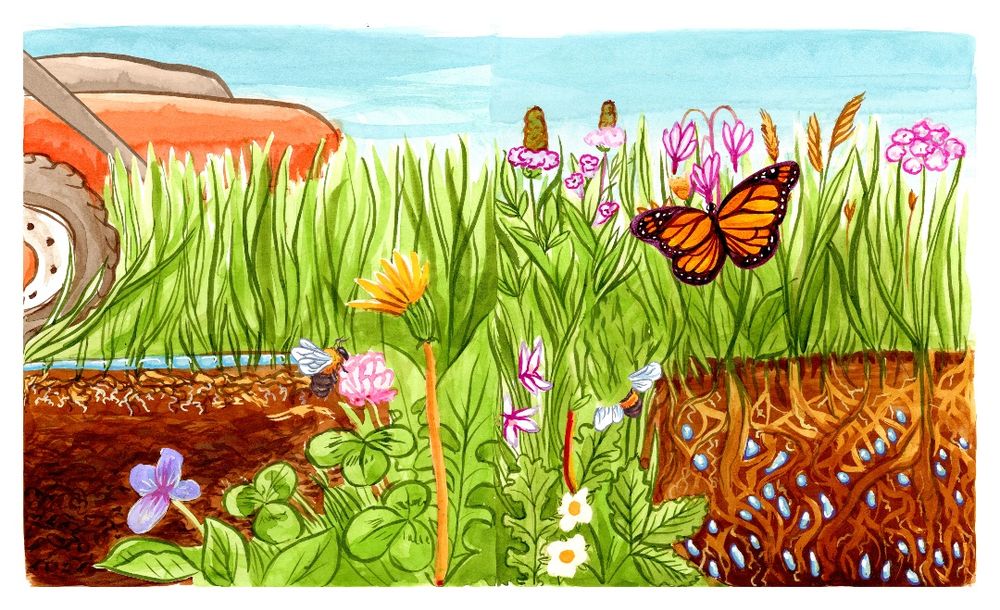
Illustration by Liz Anna Kozik, Ph.D., depicting a conventional lawn compared to one planted with native vegetation.
December 5th is World Soils Day! 🤎 The UN declared today World Soils Day back in 2014 to promote greater awareness of humans’ reliance on healthy soils and the need for action to stop the degradation of our soil.
Illustration by Liz Anna Kozik, Ph.D.
05.12.2025 16:02 — 👍 1 🔁 0 💬 1 📌 0

Oak woodland post-prescribed burn.
In recent years, there has been a return of fire to the land to help maintain thriving, diverse natural areas. This Thanksgiving, take a moment to remember the rich history of Indigenous land stewardship which long predates the modern field of ecology.
28.11.2025 03:01 — 👍 1 🔁 0 💬 0 📌 0
The expansion of permanent settlements and agriculture led to fire suppression, leaving remaining natural areas disconnected from each other and the processes that keep them healthy.
28.11.2025 03:01 — 👍 1 🔁 0 💬 1 📌 0
Indigenous Peoples in the Midwest set fires for hunting, managing resources, and more. The fires disappeared as the US government and settlers violently removed the Indigenous Peoples stewarding the land.
28.11.2025 03:01 — 👍 1 🔁 0 💬 1 📌 0
Burning clears accumulated dead plant material and returns nutrients to the soil more quickly, and the darkened ground absorbs more heat from the sun. In the spring, these conditions help seeds germinate and give established plants a head start.
28.11.2025 03:01 — 👍 1 🔁 0 💬 1 📌 0

Stewardship and Ecology of Natural Areas (SENA) Program intern conducting a prescribed burn in a woodland area at Chicago Botanic Garden.
When woody plants encroach on prairies and open oak woodlands, they reduce the amount of sunlight available and crowd out plants that need a lot of sunlight. Prescribed burns can help prevent this.
28.11.2025 03:01 — 👍 1 🔁 0 💬 1 📌 0
Though we might think of fire as destructive, it plays an important role in maintaining the prairie and oak woodland ecosystems at the Garden.
28.11.2025 03:01 — 👍 1 🔁 0 💬 1 📌 0

Stewardship and Ecology of Natural Areas (SENA) Program intern conducting a prescribed burn in a woodland area at Chicago Botanic Garden.
Fire in the natural areas @ChicagoBotanic isn’t cause for alarm—prescribed burns are a crucial land management strategy with a centuries-long history. 🔥
28.11.2025 03:01 — 👍 5 🔁 2 💬 1 📌 0

New Roots for Restoration Biology Integration Institute
Advancing the understanding of diverse perennial systems in nature and agriculture
This research aims to support the development of more sustainable perennial crop systems and the restoration of degraded prairies. Read more about the work of the BII below.
26.11.2025 15:02 — 👍 0 🔁 0 💬 1 📌 0

Ph.D. candidate Jacob Zeldin harvesting reproductive biomass from native plant plots.
🌼 Groups of prairie plants with different levels of diversity are grown in another set of plots to evaluate how their traits vary with plant community composition and across soil conditions. Their influence on the soil ecosphere is measured as well.
26.11.2025 15:02 — 👍 1 🔁 0 💬 1 📌 0

Research Assistant Emma Fetterly and volunteers harvesting biomass.
🌾 In Mettawa, Kernza (a perennial intermediate wheatgrass) is grown with alfalfa, testing a vision of sustainable agriculture that has greater diversity, with reduced inputs.
26.11.2025 15:02 — 👍 2 🔁 0 💬 1 📌 0
This information can enhance breeding of perennial crops and improve selection of biodiverse plants for restoration projects.
26.11.2025 15:02 — 👍 0 🔁 0 💬 1 📌 0

Volunteers at the Mettawa field site.
Through a broad range of projects, researchers investigate variation in perennial plants’ aboveground and belowground traits, as well as their interaction with surrounding plants and the soil environment.
26.11.2025 15:02 — 👍 0 🔁 0 💬 1 📌 0
The BII is a collaboration of over 100 scientists from nine academic institutions, including @ChicagoBotanic, conducting interdisciplinary research to improve our understanding of perennial plant systems in agriculture and nature.
26.11.2025 15:02 — 👍 0 🔁 0 💬 1 📌 0

Site manager Liz Vogel and a team of volunteers.
Here, researchers have spent the summer collecting plant trait data, harvesting biomass, and doing lots and lots of weeding, with the help of a great team of volunteers.
26.11.2025 15:02 — 👍 0 🔁 0 💬 1 📌 0

Measuring plant height in native plant plots.
🧪 🍁 As fall approaches, so does the end of the research field season! Our field site in Mettawa, IL, is home to several projects with the New Roots for Restoration Biology Integration Institute (BII).
26.11.2025 15:02 — 👍 4 🔁 0 💬 1 📌 0
🌈 grassland-prairie gal in CO
🧶🎨🌱 fiber artist, printmaker, drawer of plants
grow regionally native plants to keep the music of birds & insects alive in our landscapes 🎵🎶
🌻🐝🌼🐜🌳🦫🌾🐛🪻🦋🌸🦇🌼🪰🌲🐦
Digital Ecologies is an interdisciplinary, international research group broadly examining the digitisation of more-than-human worlds.
🇧🇪🇫🇷🇩🇪🇳🇴🇱🇺🇺🇦🇬🇧
Website: http://www.digicologies.com/
Publishing plant science research since 1875. University of Chicago Press Journal. Posts by EIC Chris Caruso.
Research scientist at The Nature Conservancy - Nachusa Grasslands Preserve (Illinois, USA), grassland restoration, soil ecology, natural areas management, science. Views expressed here are my own.
working on theory of host-associated microbiota diversity ( and a few side-quests ) at the crc1182 in kiel - a kite fellow they/them/dey/deren
bobweek.github.io
ethical hedonist | arte ultra | evolutionary biologists | private citizen at bsky | will worry about humanity for as long as humanity worries about soccer | born about 100 ppms less of CO2 ago
Plant systematist, herbarium director, naturalist, in the Chicago suburbs; posts reflect my views, not my employer's.
Recent book: Oak Origins: From Acorns to Species & the Tree of Life
https://press.uchicago.edu/ucp/books/book/chicago/O/bo236998258.html
Professor passionate about student success & team science #firstgen #Brassica enthusiast walking Dogs of the Plant World
#Agriculture #Food #HigherEd #EduSky #Agsky #SciComm & more
#Soil #Crop #Science ; opinions mine
PhD in Plant and Pollinator Evolution🌸🐛
Chicago Botanic Gardens🌷
Field Museum of Natural History🦕
Research Scientist 🌾 Adj Professor
Scicomm 🌾 Env/Sci History 🌾 Comics
history, plants, & goldenrod 🌾🏳️🌈🌾
https://liz.kozik.net
she/her
@negauneeinstitute.bsky.social 🌿 Chicago Botanic Garden 🌿
https://rethinkinglawns.com
Squid biologist
Science communicator
Artist
Philadelphian
I run @SkypeAScientist.bsky.social
Creator of the SquidMobile
https://linktr.ee/Sarahmackattack
{she/her}
AS♻️🧠 BS 🦁🦋 & PhD (2027)🐝🌻👥️ Personal goals: human rights and living authentically. ✨️ Career goals: conservation, community engagement, and research. 🌍
http://www.sharronzmiller.com/
Intergovernmental Platform on #Biodiversity & Ecosystem Services. Denialism/trolling/profanity may result in banning. Re-skoots ≠ endorsements.
www.ipbes.net
linktr.ee/ipbes
maps, travel, i18n, ML
he/him
🇨🇶
🌱🌾Plant roots + nutrient uptake + beneficial microbes🦠| dabbing into bacteriophages for plant health| Head of research Root Dynamics Group @ IBG 2 - Plant Sciences, @fz-juelich.de | 🇲🇰
Climate journalist @grist.org and @wbez.org
Tree hugger and native plant lover who bleeds Green and White!
We are a grassroots community organization with a mission to empower our neighbors with the knowledge and resources needed to grow native plants. https://forms.gle/pCv6BcUCjv8SWtAK6
native plant nerd. avid hiker, birder, + photographer. horse, dog, goat and gecko guardian. equine hoof care practitioner. Plant Biotechnology student. 🏳️🌈