happy bird day!
09.02.2026 05:14 — 👍 2 🔁 0 💬 1 📌 0

Heads we win, tails you lose: AI detectors in education
The increasing use of generative artificial intelligence (AI) in student assessment has led to institutional reliance on detection tools. Unlike plagiarism detection, AI detection relies on unverif...
"Heads we win, tails you lose" is now live in its peer-reviewed form. This article represents a gamut of perspectives from pro-AI to staunchly opposed. What unites us all is shared condemnation of the use of AI-detection software in education contexts
doi.org/10.1080/1360...
29.01.2026 22:37 — 👍 7 🔁 5 💬 2 📌 1

Looking down at a table with a potted jade, coffee and magazine: History, from the Royal Australian Historical Society. My fingers are touching the bottom left corner of the magazine.

The magazine is now open and you can see the title “an (un) ordinary farmhouse near Tamworth: refuge and danger in the family home” and there’s a photo of a woman outside on a mat with three young children and a car behind them on the other side of a fence
Publication alert! 🚨
“An (un) Ordinary Farmhouse near Tamworth: Refuge and Danger in the Family Home” has been published by the Royal Australian Historical Society.
I talk about gothic literature, family violence and how even unremarkable houses can be important
www.rahs.org.au/history-maga...
27.01.2026 22:24 — 👍 11 🔁 7 💬 1 📌 0

Text-based image on cream background, displaying the names of contributors who have written essays for Issue one of Exhume in order of publication: Jane Costessi, Neo Xia, Amanda Tink, Julia Garas, Jess Cook, Tara East, Ash McIntyre and Tenille McDermott.
A big thank you to all our Issue 1 contributors and readers! We’ve shared some final reflections on putting together Exhume’s inaugural issue over on our Substack: exhume.substack.com/p/thank-you-...
27.01.2026 02:04 — 👍 1 🔁 1 💬 0 📌 0

Without intervention, we risk hardcoding human misogyny into the digital infrastructure of everyday life.
👉 Read the full story: theconversation.com/most-ai...
27.01.2026 00:54 — 👍 6 🔁 4 💬 0 📌 0

Text-based image on cream background. Under the green and blue heading “Exhume Issue 1: Meet our contributors” is the name Tenille McDermott, highlighted in green. To the right is an image of Tenille, captured mid-interview, holding a microphone, notes and a book.

Text-based image on cream background featuring an introduction of Tenille: Tenille McDermott (she/her) is a writer and PhD candidate exploring the intersection between time, narrative, and machine-generated text. She is the co-editor of Sūdō Journal, and the co-host and co-producer of the podcast Edits & Annotations, a project of the Roderick Centre for Australian Literature and Creative Writing. She was the recipient of a 2025 Katharine Susannah Prichard Writers Centre Fellowship and longlisted for the 2025 AAWP/Westerly Life Writing Award.

Text-based image on cream background advertising Tenille’s Exhume piece. Under the heading “Issue 1” is the title “ChatGPT in Deep Time: Technology and Temporality in Kate Mildenhall’s The Hummingbird Effect. Underneath, on a blue background, is the book cover of The Hummingbird Effect which is light blue and features yellow wings.
Tomorrow, we will be posting the last piece of Issue 1: “ChatGPT in Deep Time: Technology and Temporality in Kate Mildenhall’s The Hummingbird Effect” by Tenille McDermott.
23.01.2026 02:00 — 👍 1 🔁 2 💬 0 📌 0

Books to read this Invasion Day via @magabalabooks.bsky.social
www.magabala.com/collections/...
23.01.2026 05:10 — 👍 16 🔁 8 💬 0 📌 2

Text-based image of a pull quote from Ash’s Exhume piece entitled “The Author is Dead. Long Live the Witness: Why Climate Fiction is an Ethical Act, Not Just a Story” displayed on a cream background with a green abstract border. The quote reads: By weaving scientific ideas into human-scale stories, these novels work on us emotionally as well as intellectually. Fiction, then, becomes a kind of ethical experiment: an invitation to feel differently, and perhaps to live differently, in the face of ecological crisis.
Now live on our Substack: “The Author is Dead. Long Live the Witness: Why Climate Fiction is an Ethical Act, Not Just a Story” by Ash McIntyre
exhume.substack.com/p/the-author...
20.01.2026 02:09 — 👍 1 🔁 1 💬 0 📌 0

Photo of an underground cave with orange-brown rock walls and beige-pink floor. Black text on a transparent brown background reads, ‘to dream of a world where we’re not the last / because i want survival to feel like a given, not / something begged for—‘ 'transistor' by mk zariel.
The first piece in our brand new EUPHORIA series is 'transistor' by mk zariel.
Read the full poem at enbylife.net/2026/01/19/t...
@mkzariel.bsky.social
19.01.2026 01:37 — 👍 4 🔁 4 💬 0 📌 0


To celebrate the publication of The Library That Made Me: 200 Years of the State Library of NSW, an illustrious line-up of contributors reflect on the libraries that shaped them as readers and writers.
Get tickets: www.sl.nsw.gov.au/events/libra...
19.01.2026 03:00 — 👍 16 🔁 4 💬 0 📌 0

Red background with flying folders marked by question marks. Text reads: what is an information trail?

Grey text book on red background. Text reads: Information Trails on AustLit are curated and themed collections of related works, gathered together for you to explore. In 2026, we'll be releasing twenty-five trails for twenty-five years. Curious about Australian film? In love with romance? Seeking literary scandals? Fascinated by picture books? Wondering what Australian authors say about techno-futures? Look no further!

Grey text box on red background. Text reads: These information trails are NOT 'best of' lists! Rather, they celebrate the depth and diversity of Australian literature and story-telling while showcasing the impressive collection of data that is housed within AustLit. These lists have been compiled by interns, volunteers, and former staff members, as well as the current AustLit team, bringing a diversity of perspectives to the vast information available in the database.

Grey text box on red background. Text reads: Interested in what we'll be posting and when? Check out our social media calendar! Our 2026 information trails will mark key dates and events, but some simply explore the one million works we've recorded on the database over the past quarter of a century. Want to learn more about Australian literature or our anniversary?
This week, we'll be posting the first of our anniversary information trails. So in advance, here's a pithy explanation of what an information trail on AustLit is!
You can access our anniversary pages & social media calendar at this link:
www.austlit.edu.au/25th-anniver...
Design by Monica Clayton.
19.01.2026 02:24 — 👍 2 🔁 4 💬 0 📌 0

Text-based image on cream background. Under the green and blue heading “Exhume Issue 1: meet the contributors is the name Ash McIntyre. Next to that is an image of Ash eating a bowl of pasta at a restaurant.

Text based image on cream background which reads: Ash McIntyre (she/her) is an academic and artist with a PhD in Literature from the University of Newcastle, where she currently lectures. Her research explores the intersections of literary ecocriticism, Anthropocene fictions, and literary activism, with a keen interest in interdisciplinary approaches that extend into soundscape ecology and gender studies. Ash is fuelled by a three-coffee-per-day limit, the endless promise of her towering 'to read' pile, pasta, and a resting attitude of over-enthusiasm for her work.

Text-based image advertising Ash McIntyre’s Exhume piece entitled “The Author is Dead. Long Live the Witness: Why Climate Fiction is an Ethical Act, Not Just a Story.” Underneath are the book covers of James Bradley’s novels Clade and Ghost Species, as well as Inga Simpson’s The Last Woman in the World an The Thinning on a blue background.
Live tomorrow: “The Author is Dead. Long Live the Witness: Why Climate Fiction is an Ethical Act, Not Just a Story” by Ash McIntyre
exhume.substack.com
19.01.2026 02:36 — 👍 1 🔁 1 💬 0 📌 0

Text-based image showing a quote from Tara East’s Exhume piece on a cream background with a green abstract border. It reads: Across these two works, Arnott offers a way to reimagine fairy tales and mythologies in the Australian landscape. However, he does not simply overlay this existing land with familiar European tales, instead, he has drawn upon the tradition to create his own, unique fairy tale works that are both surprising and inventive.
Tara East’s “Magical Navigation: Writing Magic into the Australian Landscape,” which explores Robbie Arnott’s use of magic and fairy-tale elements in Flames (2018) and The Rain Heron (2020), is now available to read on our Substack.
exhume.substack.com/p/magical-na...
17.01.2026 10:01 — 👍 2 🔁 1 💬 0 📌 1

Brightly coloured calendar showing the celebrations for AustLit's 25th birthday.
Curious about how AustLit is celebrating its 25th birthday? Our social media calendar will tell you all! Download a copy to follow along as we create new trails, celebrate research projects, and provide search tips--or maybe come to our trivia night?! #AustLit25
www.austlit.edu.au/25th-anniver...
12.01.2026 23:44 — 👍 7 🔁 5 💬 0 📌 0
oh no haha
13.01.2026 05:30 — 👍 0 🔁 0 💬 0 📌 0

Text based image on cream background with green abstract border displaying a pull quote from Bianca’s Exhume piece “Text and Testimony” which reads: In highlighting the influence of environment and circumstance, Gorrie and Thunig expose the ongoing impacts of colonialism as a system of power to be reckoned with in the conversation about sexual violence.
"Text and Testimony: Australian #MeToo Memoirs" by Bianca Martin is now live on our Substack:
exhume.substack.com/p/text-and-t...
10.01.2026 02:08 — 👍 1 🔁 1 💬 0 📌 0

Text and Testimony: Australian #MeToo Memoirs
Bianca Martin questions why Indigenous voices have been overlooked in #MeToo memoirs
My piece for @exhumelit.bsky.social is live today! So grateful for all the feedback I received while writing & editing. I'm pretty happy with the final piece and so happy to have such a great home for these ideas that I've been developing over the past 12 months.
exhume.substack.com/p/text-and-t...
10.01.2026 04:48 — 👍 1 🔁 0 💬 0 📌 0

The Great Palestinian Silence
It seems everyone is tweeting about freedom of speech. So let me tell you a story about freedom of speech and the exceptional case of Palestine. In the days leading up to Israel’s proposed annexati…
No Adelaide Writers Week for me. I can’t in any good conscience now appear at a festival seeking to mute a very necessary public conversation … Randa Abdel-Fattah is an important voice. Here’s something I published from her on, guess what, Palestinian marginalisation. meanjin.com.au/latest/the-g...
08.01.2026 07:33 — 👍 1050 🔁 347 💬 56 📌 19

Universities and the arts after Bondi: from definitions to “ambient antisemitism” - Overland literary journal
The Adelaide Festival’s decision to dump Palestinian academic Randa Abdel-Fattah from its upcoming Writers’ Week gives us a grim foretaste of the Australian cultural landscape in 2026.
“The Adelaide Festival’s decision to dump Palestinian academic Randa Abdel-Fattah gives us a grim foretaste of the Australian cultural landscape in 2026.”
David Brophy on “ambient antisemitism” and the institutional mechanisms for curtailing protest and political expression.
08.01.2026 22:52 — 👍 43 🔁 28 💬 0 📌 6

Purple and green themed social media graphic announcing ‘#EnbyLife Journal Submissions Open.’ Bold green and purple text reads, ‘Submission dates: 1–7 January 2026. Categories: poetry, microfiction, art. Theme: Euphoria.’ Decorative white star and flower shapes are scattered throughout the graphic. Website: enbylife.net and handle @enbylife at the bottom.
#EnbyLife Journal closes for submissions on 7 January (wherever you are in the world)!
January’s theme is EUPHORIA. Send us your poetry, microfiction (under 100 words), and art.
Head to enbylife.net/submissions for more info.
07.01.2026 00:31 — 👍 4 🔁 5 💬 0 📌 0

Text-based image featuring a pull quote from Julia Garas’ Exhume piece entitled “Memory and Manus Island.” With an abstract green border, the following quote is displayed on a cream background: No Friend but the Mountains gives agency back to refugees imprisoned in Australian detention centres by prioritising a place and identity that is not given space in the national narrative. It also challenges the insular settler imagination of Australia.
Julia's piece is now live: exhume.substack.com/p/memory-and...
06.01.2026 01:12 — 👍 1 🔁 3 💬 0 📌 0

Text based image with a blue heading underlined in green, reading Exhume Issue 1: Meet our contributors. At the bottom of the image is the name “Julia Garas” and an image of Julia, who is smiling and wearing a brown shirt.

Text based image which reads: Julia Garas (she/her) did her PhD at Curtin University in Perth, Western Australia where she currently works as a sessional academic. Her research areas include contemporary Australian literature and television, national memory, national identity and decolonial theory. She has been published in Limina Journal and is a regular book reviewer for Westerly.

Text based image advertising Julia’s Exhume piece entitled “Memory and Manus Island: Reading Refugee Resistance in No Friends But the Mountains.” Underneath is an image of the books cover featuring a black and white close up of Boochani’s face, displayed on a blue background.
Happy new year, everyone!! We’re back tomorrow with the first essay of Issue 1 Part 2!
Julia Garas reads Behrouz Boochani’s No Friend But the Mountains (2018) as an example of refugee resistance writing and places it in conversation with a history of Australian refugee detainment.
05.01.2026 02:29 — 👍 5 🔁 3 💬 0 📌 0
I had to do it and accidentally clicked 'do not accept' or whatever and have left that for 2026 me to figure out
28.12.2025 04:02 — 👍 1 🔁 0 💬 0 📌 0
this is brilliant
19.12.2025 06:07 — 👍 0 🔁 0 💬 0 📌 0
wait is the site still running? that would be very tempting
19.12.2025 01:21 — 👍 0 🔁 0 💬 1 📌 0

Text based image showing a pull quote from Amanda Tink’s Exhume Piece, entitled “Portrait of the Autist Erased. Which reads: The erasure of Murray’s autism, though not acceptable, was perhaps understandable in 1974 when “Portrait of the Autist” was published. Fifty years on, there is an urgent need to question this attitude and ask: who does it serve?
Amanda’s “Portrait of The Autist Erased” is now live on our Substack!
Thank you to everyone who followed Part I of issue I. We will be back with Part II on 6 Jan!
16.12.2025 02:30 — 👍 1 🔁 1 💬 0 📌 0

Text-based image with the heading “Exhume Issue 1: Meet the contributors.” Below is the name Amanda Tink, highlighted in green, and a black and white photo of Amanda.

Text based image displaying the text: Dr Amanda Tink is Postdoctoral Research Fellow at UniSA Creative, University of South Australia, and Adjunct Research Fellow at Western Sydney University's Writing and Society Research Centre. She is a proud disabled person with research interests in Australian disabled authors, crip poetics and memoir, and the Nazi genocide of disabled people. Her PhD thesis "Never Towing a Line: Les Murray, Autism, and Australian Literature" details how Murray's autism and his experiences of being disabled influenced his poetry.

Text-based image which feature the heading “Issue 1.” Underneath it says, “Read Amanda’s Exhume piece: Portrait of the Author Erased.” Underneath, on a blue background, is the cover of Les Murray’s Collected Poems, which features a black and white photo of Murray sitting in a chair.
Before we take a short break over Christmas, one more brilliant essay will be posted on our Substack tomorrow. In it, Amanda Tink revisits the poems of Les Murray through an autistic lens.
15.12.2025 04:59 — 👍 1 🔁 2 💬 0 📌 0
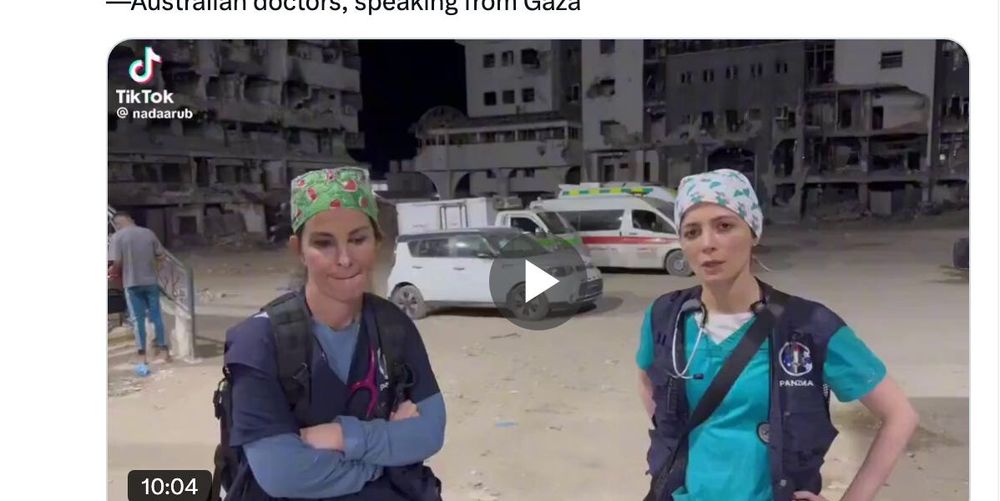
Christos Tsiolkas Is Switched Off In the Genocide
Amid the massacres, he moans
I’ve removed the paywall on this essay about the unhinged Zionist rubbish recently spouted by Christos Tsiolkas. sakr.substack.com/p/christos-t...
13.12.2025 03:34 — 👍 65 🔁 24 💬 8 📌 2

Text based image featuring a pull quote from Neo’s Exhume piece “Flesh and Cog,” which reads: Ireland shows how our flesh becomes the primary battlefield for both oppression and, ultimately, resistance. Reading him today, it’s clear his critique was prescient. He was diagnosing our current struggle half a century early: the conflict between our physical selves and the abstract logic of data.
You can now read Neo’s fascinating exploration of David Ireland’s The Industrial Prisoner (1971) and A Woman of the Future (1979) on our Substack!
exhume.substack.com/p/flesh-and-...
13.12.2025 02:18 — 👍 1 🔁 2 💬 0 📌 0
Wordy emigre. Means well. Talks to microphones. Writes. Wokish. he/him
https://greenworlds.substack.com/
Writer from Manchester. LIKE A CAT LOVES A BIRD, my biography of Muriel Spark, is out soon (pre-order at the link below!) 🐈⬛
https://lnk.to/LikeaCatLovesaBird
Instagram.com/drjamesbailey
academic, annoying woman, animal lover.
PhD Sociology
PASS Program Team Leader - University of Tasmania.
Hiking Ocean Nature (she/they)
Australia's First Muslim Literary Journal + Arts Space.
Illuminated by the lantern lit 1400 years ago.
Literature, Community, Events.
🔗 www.conduitmp.com
Snake Milker / Mattress Grave / METH-DTF / SEX SHOPS OF SHERMAN OAKS, XEROX OVER MANHATTAN, BELFIE HELL, YEEZUS IN FURS, NAPALM RECIPE, POLICE FORCE AS A CORRUPT BREEZE.
PhD Candidate in Australian Media, Gender & Cultural History | Researching print media representations of sexual assault | Reader 📖
C21 Literature: Journal of 21st-century Writings is the official journal of @bacls.bsky.social. The journal is dedicated to examining the genres, forms of publication, and circulation of 21st-century writings. Published by @openlibhums.org
Southerly is Australia’s oldest literary journal. Founded in 1939, it is the journal of The English Association (Sydney).
Writer, magazine publisher, bad gardener.
Based in France.
killyourdarlings.com.au
Researching how community groups in regional Australia are using digital technology to publish and distribute books. 2023-2025.
https://linktr.ee/communitypublishinginaus
he/him
PhD candidate in Criminology, researching young people's encounters with criminal law
🌈 🍉 | views own | 📍CBG
https://markly0.wordpress.com & https://www.tiktok.com/@mly2365
She/Her. Academic @ UniMelb 🫠 I am a feminist media studies researcher who examines postfeminism, young people, & pop culture.
Old Fat ADHD Queer in Australia. Opinions my own and not my employer etc - she/her 🏳️🌈
Orange
Associate Professor of History, University of Stavanger & Current Debates Editor, The Journal of Imperial and Commonwealth History @jich.bsky.social. PhD International History, LSE @lsehy.bsky.social.
Raised on Coast Miwok land, longtime resident on Ramaytush Ohlone land, writer, climate person, feminist, wanderer. Just started a newsletter at MeditationsInAnEmergency.com.
academic, knitter, neo-Victorian convalescent
She/her. Senior Lecturer in Cultural Studies ~ femininities, queer theory, beauty culture, crushes. Writer, advocate, infamous bisexual, wannabe poet. Views my own and not that of my university. Another world is possible 💅🏻🙇🏻♂️
www.hannahmccann.com.au
Film/TV critic, copyeditor, author and shadow academic on Wurundjeri Woiwurrung country