A year ago today I joined some of the incredible @changingrealities.bsky.social parents at Downing Street who shared what changes are needed to end child poverty - incl why the two-child limit must be scrapped. It’s brilliant to see yesterday’s announcement after so much hard work from so many.
27.11.2025 13:03 — 👍 16 🔁 5 💬 0 📌 1

The two-child limit failed – all it did was increase poverty
The controversial policy was a product of the UK’s austerity period.
All the 2 child limit did was to "increase poverty" explains @ruthpatrick0.bsky.social
We didn't hear nearly enough this week about the 2CL being an abject failure on its own terms. A different kind of conversation about social security is badly needed
theconversation.com/the-two-chil...
28.11.2025 09:06 — 👍 2 🔁 3 💬 1 📌 0
The fight to end child poverty goes on. But today we must celebrate. It will make a real, lasting difference to families the breadth of the UK and I’m so grateful to everyone in @changingrealities.bsky.social & @cpaguk.bsky.social who have advocated tirelessly for its full abolition
26.11.2025 14:37 — 👍 39 🔁 15 💬 2 📌 0
Today we have the official government statements on digital ID and I would add a few things to what I am seeing on here. 1) The UK is an ID-poor country. The relative difficulty of getting a recognised ID, and the share of citizens without a recognised ID would be unthinkable in continental Europe.
26.09.2025 07:54 — 👍 9 🔁 3 💬 1 📌 0
https://journals.sagepub.com/doi/full/10.1177/08969205241267302
Our paper ‘You Can’t Sacrifice Nothing’: Exploring the lived realities of chronic poverty in a cost-of-living crisis through participatory research t.co/ppoYu0wQXm was based on our collaborative research with West Cheshire Inspirers
06.10.2025 20:11 — 👍 4 🔁 1 💬 1 📌 0
We can all agree that the current systems of Special Educational Needs support are failing but the next step is to agree what change is needed to build a better, more inclusive system that works for all children
www.changingrealities.org/writings/wha...
[short 🧵, launching new @changing_r note]
23.09.2025 06:21 — 👍 10 🔁 5 💬 1 📌 1

As they arrive at the Labour Party Conference, we're greeting Keir Starmer and his MPs with a message that demands a screen bigger than 21,000 mobile phones*:
"What was the point of winning the general election if not to lift kids out of poverty?"
1/3
29.09.2025 07:26 — 👍 41 🔁 23 💬 2 📌 0

Chart showing limitations to paid work disabled people and carers can do.
The top set of bars shows that nearly one-third (31 per cent)
of disabled people in low-to-middle income families are not working at all due to ill-health.
But among those in work, more than half report that their physical health limits the type or
amount of work they can do (58 per cent and 54 per cent respectively) or that their mental
health affects their ability to accomplish as much as they would otherwise be able to (51
per cent). Similarly, among low-to-middle income carers who provide care for someone they
live with, the impacts of caring responsibilities go beyond the one-third (34 per cent) who
are unable to work at all: among those who are in work, two-fifths (41 per cent) say they are
unable to work as much as they would like due to providing care
More than half of disabled people who are in paid work report limitations to the amount or type of work they can do.
The reasons for limited access to paid employment are varied, as shown in the chart.
Read more ➡️ buff.ly/kNMSUQa
22.07.2025 11:32 — 👍 7 🔁 5 💬 0 📌 0
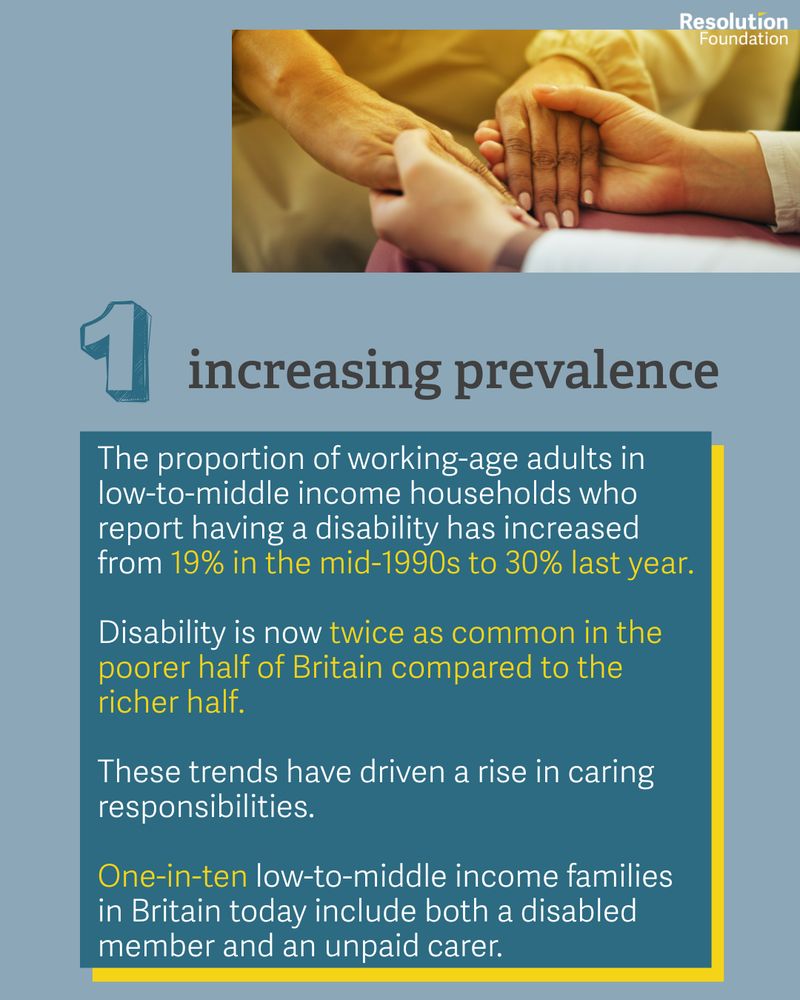
The proportion of working-age adults in low-to-middle income households who report having a disability has increased from 19% in the mid-1990s to 30% last year.
Disability is now twice as common in the poorer half of Britain compared to the richer half.
These trends have driven a rise in caring responsibilities.
One-in-ten low-to-middle income families in Britain today include both a disabled member and an unpaid carer.
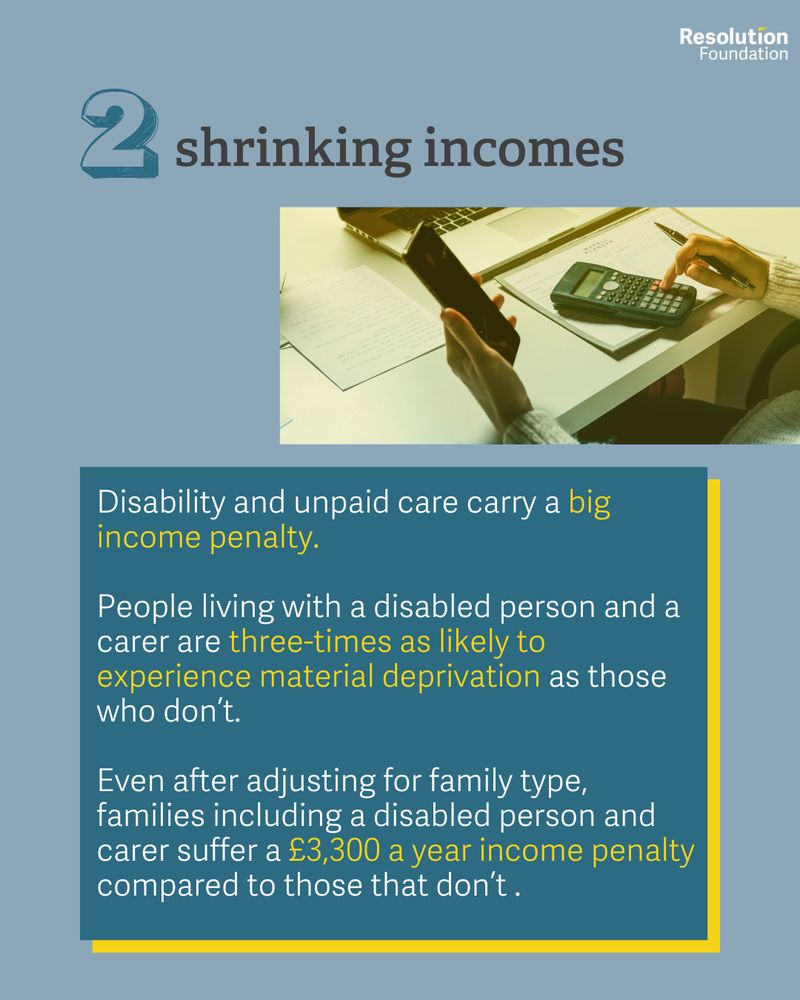
Disability and unpaid care carry a big income penalty.
People living with a disabled person and a carer are three-times as likely to experience material deprivation as those who don’t.
Even after adjusting for family type, families including a disabled person and carer suffer a £3,300 a year income penalty compared to those that don’t .
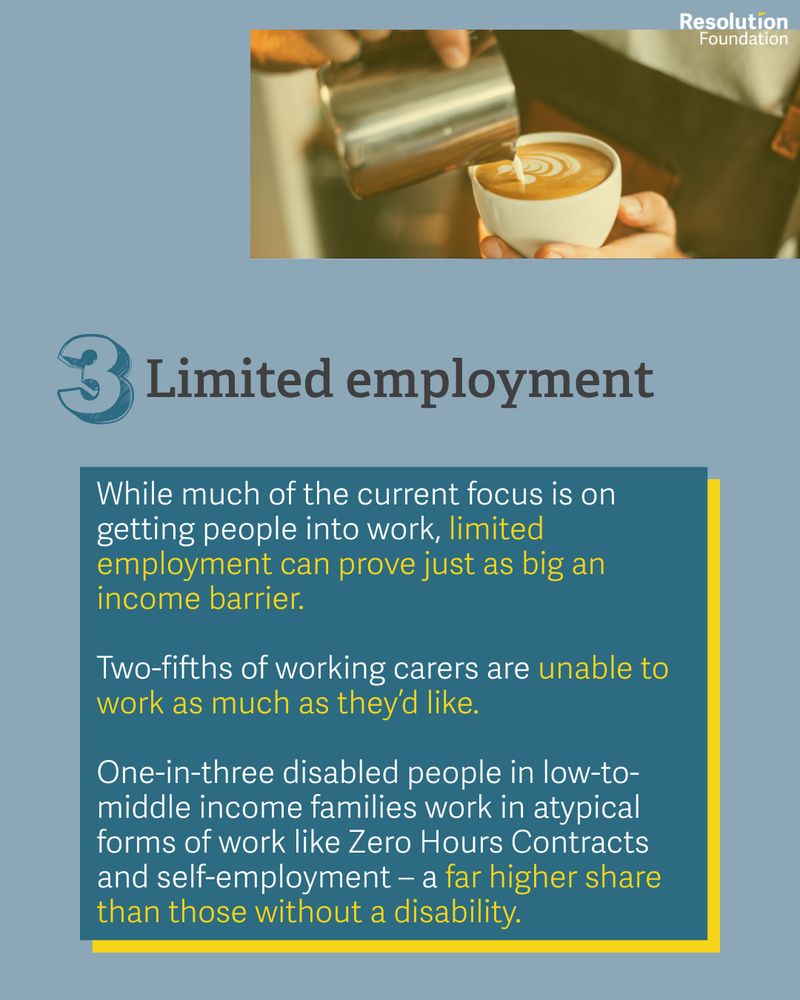
While much of the current focus is on getting people into work, limited employment can prove just as big an income barrier.
Two-fifths of working carers are unable to work as much as they’d like.
One-in-three disabled people in low-to-middle income families work in atypical forms of work like Zero Hours Contracts and self-employment – a far higher share than those without a disability.
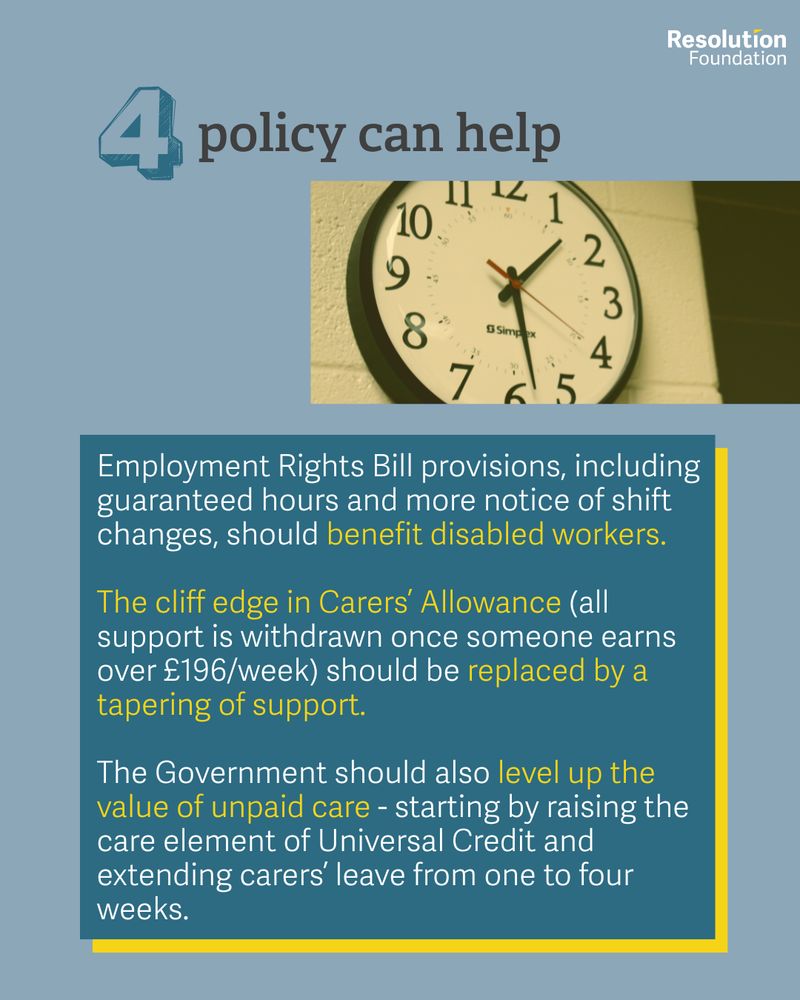
Employment Rights Bill provisions, including guaranteed hours and more notice of shift changes, should benefit disabled workers.
The cliff edge in Carers’ Allowance (all support is withdrawn once someone earns over £196/week) should be replaced by a tapering of support.
The Government should also level up the value of unpaid care - starting by raising the care element of Universal Credit and extending carers’ leave from one to four weeks.
How do disabilities and caring responsibilities affect British families?
Read 'Don't forget about us' to learn more ➡️ buff.ly/kNMSUQa
17.07.2025 12:31 — 👍 7 🔁 5 💬 0 📌 0
We seem to be entering a dark period. Disabled people always faced prejudice, but it's so dangerous when public figures fuel it, amp up suspicion & the idea disabled people are either faking or burdens. Compassion & justice are our core values, we need to stay true to them. 1/2
13.07.2025 12:42 — 👍 124 🔁 34 💬 3 📌 1

The divergence in child versus pensioner income trends over both halves of the 2020s is also not new. In 2002-03 pensioners and children had very similar typical equivalised household incomes, but between then and 2023-24 the median pensioner income grew by 32 per cent and the child figure by 7 per cent (with the typical working-age income growing by 8 per cent). In cash terms, the equivalised household income gap between pensioners and children has grown from roughly zero in the early 2000s to over £5,000 by 2023-24 and potentially over £7,000 by 2029-30. As we explore below, this is also reflected in poverty figures.
The typical pensioner and typical child’s household income were once very similar, but have diverged.
In cash terms, the equivalised household income gap between pensioners and children has grown from roughly zero in the early 2000s to over £5,000 by 2023-24 and potentially over £7,000 by 2029-30.
12.07.2025 09:34 — 👍 6 🔁 4 💬 0 📌 1
Great video from our friends @savechildrenuk.bsky.social
The government must scrap the two-child limit.
10.07.2025 15:05 — 👍 74 🔁 42 💬 2 📌 1

Over 1.6 million children live in families made poorer by the two-child limit on benefits – new data
The two child limit and benefit cap leave many families living with extreme financial insecurity.
It hasn't made much of a splash, but new figures out today show that close to 1.7 million children live in families affected by the two-child limit. This can & must change as @kittyjstewart.bsky.social and I argue in @theconversation.com theconversation.com/over-1-6-mil...
10.07.2025 18:00 — 👍 35 🔁 24 💬 1 📌 0
@easp-spa-2025.bsky.social has left me feeling really inspired after hearing about so much fantastic research going on. Also enjoyed presenting my findings on the scope for #solidarity in the face #stigma for people living in #poverty and reliant on social security benefits
11.07.2025 08:05 — 👍 9 🔁 0 💬 0 📌 0

Conference lanyard

Abstract of Paper
Stigma functions as a divisive mechanism to craft and augment inequalities in power through driving
support for increasingly punitive social policies, weakening social solidarity and eroding the potential for
collective resistance. In liberal welfare regime types such as the UK, welfare support is residualised and
deeply intertwined with stigma. Under such conditions, examining how individuals and communities
navigate and challenge these dynamics is important. This paper draws on PhD research – a qualitative
project with women claiming social security benefits in the UK – to contribute to understandings of how
stigma, as an assault on collective, class-based solidarities, is experienced, resisted and responded to.
On the one hand, participants rejected individualising, blaming narratives, and indicated the potential of
community solidarity and cohesion in challenging stigma. Nonetheless, the findings also revealed a
contradictory tendency towards the partial acceptance and internalisation of dominant stigmatising ideas
and, connected to this, the defensive practice of ‘othering’ fellow claimants, reflecting the divisive and
corrosive power of stigma in weakening social solidarity and limiting the complete rejection or disavowal
of stigmatising discourses. By interrogating the intersection of stigma and the structural erosion of welfare
support and drawing on empirical research findings, this paper contributes to critical debates on social
policy, offering insights into how neoliberal frameworks exacerbate social fragmentation and how
alternative forms of solidarity might emerge in response.
11.07.2025 08:05 — 👍 9 🔁 0 💬 1 📌 0
Guardian columnist and journalist. Commentator of the Year 2024. Author of Who Wants Normal? and Crippled.
E: frances.ryan.freelance@guardian.co.uk
Senior editor, @prospectmagazine.co.uk | Co-host, The Prospect Podcast | Ex: NS, Haaretz, TBI | UK, Israel/Palestine, feminism, politics, Ursula K Le Guin | Sign up to my newsletter: http://thebacklash.substack.com |
Director IPPR Scotland
Views my own
There’s Nothing About us Without us
Every day massive, life changing, decisions are made by those in power without us
Together, people like us can use the power of collective action to bring about change
Join us
https://squarepegsuk.substack.com
Researching the organisation of labour markets | SETU Ireland Lecturer in Management + Organisations
Britain's community reality-check newsletter. Independent. Fact-reporting. Fully sourced. Print copies crowdfunded and delivered door-to-door by volunteers.
art & architectural historian / visual, material & religious culture
Companion blog to the Journal of Social Policy, Social Policy & Society, and the Journal of International & Comparative Social Policy, published by Cambridge University Press for the Social Policy Association.
We work and advocate with children, families & community partners to reduce childhood poverty and tackle its devastating impact so that the full potential of all young lives can be realised!
Writes the most popular UK politics Substack (samf.substack.com)
Sunday Times bestselling book "Failed State" out now. (An Economist and Financial Times Book of the Year for 2024).
Senior fellow: Institute for Government
The Economic Statistics Centre of Excellence (ESCoE) is a research centre hosted at King's College London and supported by the ONS.
We provide research on economic statistics for the modern economy. 📈
Politics, Groups, and Identities is an official journal of the Western Political Science Association. Visit our homepage: https://www.tandfonline.com/journals/rpgi20
recoveryinthebin.org
A critical theorist and activist collective of survivors, service users, disabled people.
United Nations Humanitarian Chief.
Ex Principal, Hertford College, Oxford; Ambassador, No 10, NYU Prof.
Diplomat, writer, educator, humanitarian.
Our research seeks to uncover how people interact within civil society organizations and how those interactions can strengthen organizations, promote civic engagement, and improve the quality of life in communities.
Bluesky account of the ECPR Standing Group Migration and Ethnicity
Convenors: @danielavintila.bsky.social, Verena Wisthaler, Roberta Perna, @sumpierrez.bsky.social, Nawal Shaharyar.
https://ecpr.eu/Group/migration-ethnicity
Tech, policy, politics.
Political editor @ The New World
Opinion @ The i Paper
Fellow @ Demos
PhD researcher @ UCL Laws
newsletter @ techtris
Latest book: The Other Pandemic – How QAnon Contaminated The World. 🏳️🌈
https://www.jamesrball.com/
Medical Anthropology& Humanities, Research Fellow, Univ of Manchester, CHSTM | Medical uncertainty| Autism| Gender (https://research.manchester.ac.uk/en/persons/cinzia.greco)
Editor Anthropologie&Santé (https://journals.openedition.org/anthropologiesante/)
Sociologist - citizenship/Brexit/migration/media/raceðnicity/work
Lecturer in Sociology at the University of Chester/collaborateur scientifique at GERME laboratory, Université libre de Bruxelles
University of Chester Social Science researchers @nancycevans.bsky.social, Holly White, Kim Ross & Jenn Robinson using #co-production and public sociology to amplify lived experience and challenge social injustice.