I propose “de-muliebriate” (to reduce in muliebrity).
16.02.2026 15:37 — 👍 0 🔁 0 💬 0 📌 0
I've long enjoyed your wit in short-form posts, and here I really valued your openness. Thank you for it.
29.12.2025 18:51 — 👍 1 🔁 0 💬 1 📌 0
Something I posted in 2010:
"These days, when I see anti-Semitism, it’s like seeing a Swanson TV dinner with Salisbury steak, peas, and apple cobbler in a three-compartment foil tray. I’m like, ‘They still MAKE that stuff? It’s so boring.’”
I said "anti-Semitism," but I could have said "racism."
28.12.2025 01:02 — 👍 0 🔁 0 💬 0 📌 0
Thank you for writing this paper.
12.12.2025 23:58 — 👍 0 🔁 0 💬 1 📌 0
He's right. 𝘛𝘩𝘦𝘳𝘦 𝘈𝘳𝘦 𝘔𝘰𝘯𝘴𝘵𝘦𝘳𝘴 (2013) deserves FAR more good attention.
It has all the things that make zombie movies potentially great, without the thing that makes them bad (they inevitably try to have fun with gun violence; this one doesn't, at least not yet, with 30 minutes to go).
13.11.2025 04:49 — 👍 1 🔁 1 💬 0 📌 0
Republican rhetoric all week was clearly aiming to either depress turnout or inspire visible maga pushback. Neither happened and the press doesn’t seem particularly interested in exploring the implications of that.
19.10.2025 19:43 — 👍 2563 🔁 505 💬 21 📌 28
That was me! Thank you, Ms. Davulis.
18.10.2025 22:38 — 👍 1 🔁 0 💬 1 📌 0

Side one of sign: Stephen King's "Misery" book cover Photoshopped to say "No Kings, Less Misery."
Side two of sign: Stephen King's "It" book cover Photoshopped to say "Kings Ain't It."
Signs made for tomorrow.
Because every season is spooky season!
17.10.2025 23:41 — 👍 3 🔁 2 💬 0 📌 0
Most papers presenting psychological questionnaires don't specify whether respondents should see the title of the questionnaire. And papers rarely say whether respondents did see the titles.
Everybody who uses questionnaires: how do you handle titles when the questionnaire gives no guidance?
18.09.2025 19:48 — 👍 2 🔁 1 💬 1 📌 0
Paper says: "...individuals with SUD exhibit marked deficits in liking. This may explain why patients with SUD experience a reduction in the ability to experience pleasure from natural rewards."
Nope. That is not what incentive-sensitization theory says, nor is it what SUDs usually entail.
02.09.2025 21:23 — 👍 1 🔁 0 💬 1 📌 0
Very anecdotally, I feel I've seen it, but I agree that it's not well established empirically.
07.08.2025 01:12 — 👍 4 🔁 0 💬 1 📌 0
Without having looked for it, we found evidence for what's sometimes called "aversive transmission": people who see the effects of addiction in their parents may sometimes make a point of avoiding risky substance-related behaviors. Humans do things that nonhumans don't do.
07.08.2025 00:55 — 👍 2 🔁 0 💬 1 📌 0

Text excerpts from "Latent Classes of Adverse Childhood Experiences (ACEs) and Adult Substance-use Problems and Psychosocial Outcomes: Complex and Heterogeneous Associations." (International Journal of Mental Health and Addiction)
I’m proud of the way this paper turned out. We said:
--Stop revictimizing people. Don’t say, “You were sexually abused, so you’re more prone to iatrogenic addiction, so we won't prescribe opioids for your pain.”
--Monitor whole communities.
link.springer.com/article/10.1007/s11469-025-01527-w
07.08.2025 00:36 — 👍 8 🔁 2 💬 1 📌 0
When I see IRT used on psychological/psychiatric inventories, I question "difficulty." Low correct-response rates reflect difficulty if items measure knowledge or skill. But symptom/trait/state endorsement? Low "yes" rates may mean many things--not a construct called "difficulty." Change my mind.
08.07.2025 22:44 — 👍 2 🔁 0 💬 0 📌 0
![Micro interventions based on real-time monitoring of affective instability: a proof-of- concept study.
Merlijn Olthof et al.
Excerpt 1 of 3:
Design: We used a quasi-randomized within-person experimental design for testing the micro-intervention effects during increased EWMSD [exponentially weighted moving standard deviation of affect ratings] vs. control periods (with EWMSD below the threshold). At the start of the study, participants were assigned at random to one of two phases: the experimental phase (micro-intervention is applied when there is increased EWMSD) and the control phase (micro-intervention is applied semi-randomly).
[David’s comment: This is the appropriate control for Forer effects, and no one else ever uses it!]
Excerpt 2 of 3:
Interestingly, from the data viewing sessions, we also learned that there was a large heterogeneity in how persons experienced - and reacted to - the intervention and burst measurements. While some persons were really enthusiastic about the intervention, others found it annoying or confronting because they found that they had no time to engage in the intervention. Some persons never actually performed the activity they selected, some nearly always performed it in the next 30 minutes, but others used it as 'a reminder'…
[David’s comment: This is the kind of frankness we need more of.]
Excerpt 3 of 3:
These results can inform future research, which, who knows, may at some point be able test the hypothesis that we were after.
[David’s comment: OK, marry me.]](https://cdn.bsky.app/img/feed_thumbnail/plain/did:plc:7o2boh56sjssyukc6qat5uu6/bafkreifesxbw3k4cmcf3pqh4guujgoj4nbsvvwh6gilry5rklqevvpl7ky@jpeg)
Micro interventions based on real-time monitoring of affective instability: a proof-of- concept study.
Merlijn Olthof et al.
Excerpt 1 of 3:
Design: We used a quasi-randomized within-person experimental design for testing the micro-intervention effects during increased EWMSD [exponentially weighted moving standard deviation of affect ratings] vs. control periods (with EWMSD below the threshold). At the start of the study, participants were assigned at random to one of two phases: the experimental phase (micro-intervention is applied when there is increased EWMSD) and the control phase (micro-intervention is applied semi-randomly).
[David’s comment: This is the appropriate control for Forer effects, and no one else ever uses it!]
Excerpt 2 of 3:
Interestingly, from the data viewing sessions, we also learned that there was a large heterogeneity in how persons experienced - and reacted to - the intervention and burst measurements. While some persons were really enthusiastic about the intervention, others found it annoying or confronting because they found that they had no time to engage in the intervention. Some persons never actually performed the activity they selected, some nearly always performed it in the next 30 minutes, but others used it as 'a reminder'…
[David’s comment: This is the kind of frankness we need more of.]
Excerpt 3 of 3:
These results can inform future research, which, who knows, may at some point be able test the hypothesis that we were after.
[David’s comment: OK, marry me.]
Unsuccessful trial, good preprint. I fervently hope the final sentence makes it through peer review.
28.06.2025 18:22 — 👍 5 🔁 0 💬 0 📌 0
For me, the transformation of a grim industrial/parking space underneath I-83 into a venue for many dozens of local artists/craftspeople was...inspiring, lovely. It was also noisy (due in part to the nearby bandstand), but that was OK. I admired the act.
25.05.2025 02:05 — 👍 2 🔁 0 💬 0 📌 0
Tweets from June 8, 2020.
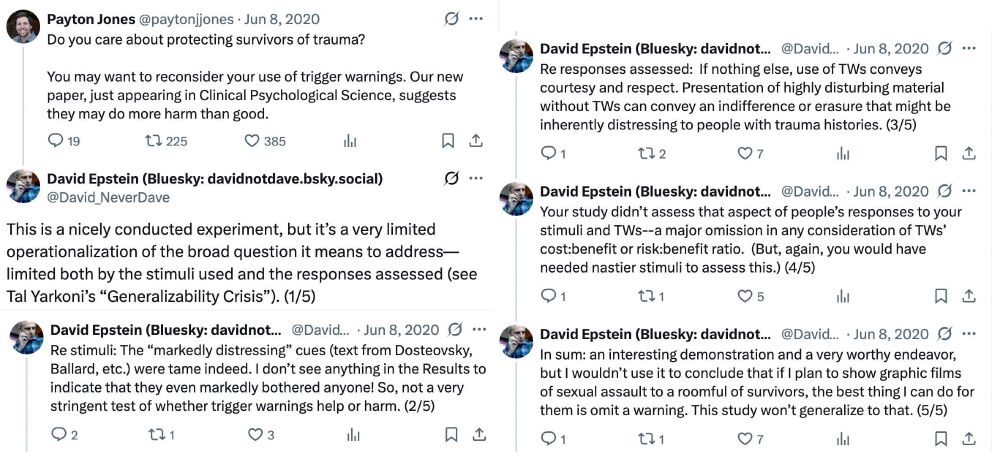
Payton Jones: “You may want to reconsider your use of trigger warnings. Our new paper, just appearing in Clinical Psychological Science, suggests they may do more harm than good.”
Me, in a series of five replies: “This is a nicely conducted experiment, but it's a very limited operationalization of the broad question it means to address— limited both by the stimuli used and the responses assessed….The "markedly distressing" cues (text from Dosteovsky, Ballard, etc.) were tame indeed. I don't see anything in the Results to indicate that they even markedly bothered anyone! So, not a very stringent test of whether trigger warnings help or harm. Re responses assessed: If nothing else, use of TWs conveys courtesy and respect. Presentation of highly disturbing material without TWs can convey an indifference or erasure that might be inherently distressing to people with trauma histories. Your study didn't assess that aspect of people's responses to your stimuli and TWs--a major omission in any consideration of TWs' cost:benefit or risk:benefit ratio. (But, again, you would have needed nastier stimuli to assess this.) In sum: an interesting demonstration and a very worthy endeavor, but I wouldn't use it to conclude that if I plan to show graphic films of sexual assault to a roomful of survivors, the best thing I can do for them is omit a warning. This study won't generalize to that.”
Pinker's assertion about trigger warnings (that they "can do more harm than good") is based on research that doesn't generalize to the intended situations, as I told the author five years ago.
24.05.2025 16:08 — 👍 99 🔁 6 💬 2 📌 0
I've been telling people how the use of full labeling on an ordinal response scale can clarify what you get from a survey/EMA item. I didn't mean this.
23.05.2025 21:28 — 👍 4 🔁 0 💬 1 📌 0
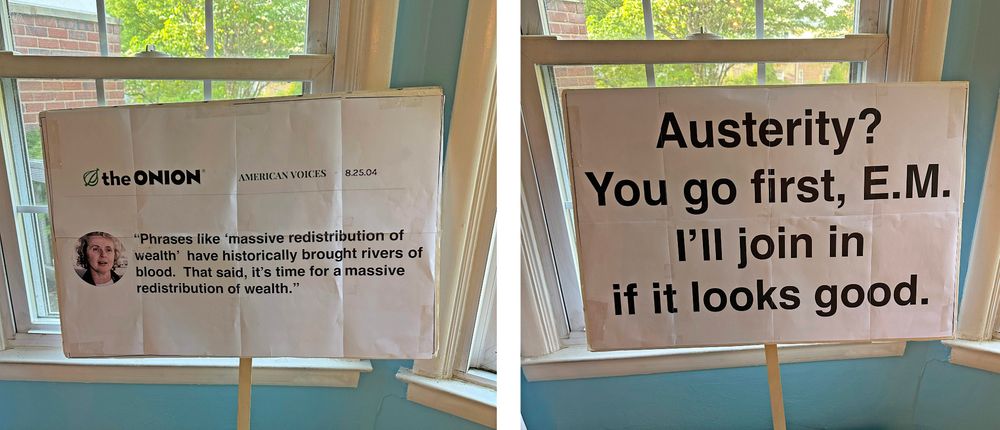
Side one of sign, from an old issue of the Onion's "American Voices" feature: "Phrases like 'massive redistribution of wealth' have historically brought rivers of blood. That said, it's time for a massive redistribution of wealth."
Side two of sign: "Austerity? You go first, E.M. I'll join in if it looks good."
New weekend of Tesla Takedown protests, new two-sided sign.
(I'm reading 𝘍𝘶𝘯𝘯𝘺 𝘉𝘦𝘤𝘢𝘶𝘴𝘦 𝘐𝘵'𝘴 𝘛𝘳𝘶𝘦, Christine Wenc's excellent book about the history of The Onion.)
02.05.2025 22:50 — 👍 4 🔁 1 💬 0 📌 0
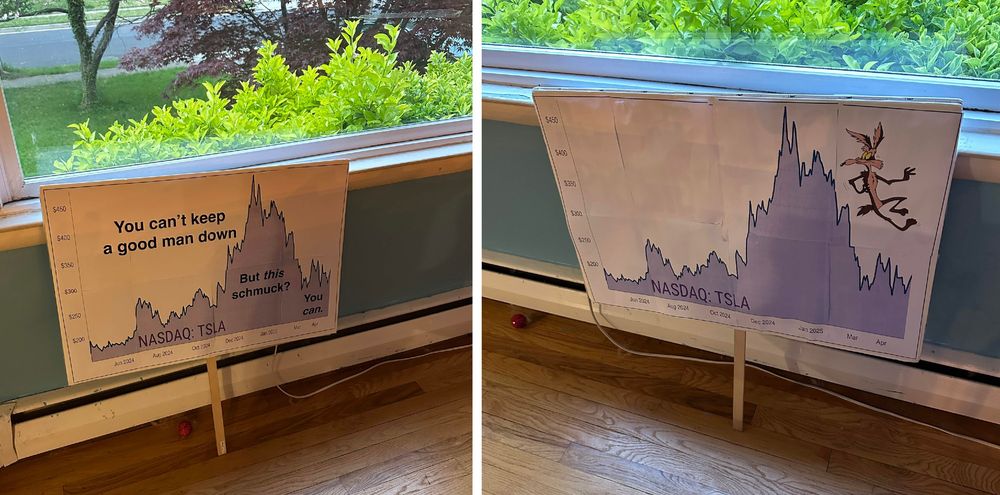
Graph of Tesla stock freefalling: "You can't keep a good man down. But THIS schmuck? You can."
New sign made for tomorrow's Tesla Takedown. As a scientist, I've had it drummed into me--you're always supposed to show data.
26.04.2025 00:07 — 👍 5 🔁 0 💬 0 📌 0
Just looked at a questionnaire that has: "I feel blue"; "I feel downhearted"; "I feel sad"; "I feel gloomy"; "I feel depressed"; "I feel low." Plus: "I am quick tempered"; "I have a fiery temper"; "I am a hot-headed person"; "I fly off the handle."
"Dear participant: I don’t respect your time."
11.04.2025 21:58 — 👍 2 🔁 0 💬 1 📌 0
Barnum/Forer effect by proxy: That's when researchers think a published scale measures their construct of interest because the scale has exactly the right title (plus the usual reliability metrics and validity claims). The items on the scale are weird and repetitious, but only respondents see it.
11.04.2025 20:41 — 👍 0 🔁 0 💬 1 📌 0
Correction: Woodlawn, not Catonsville.
05.04.2025 20:56 — 👍 2 🔁 0 💬 0 📌 0
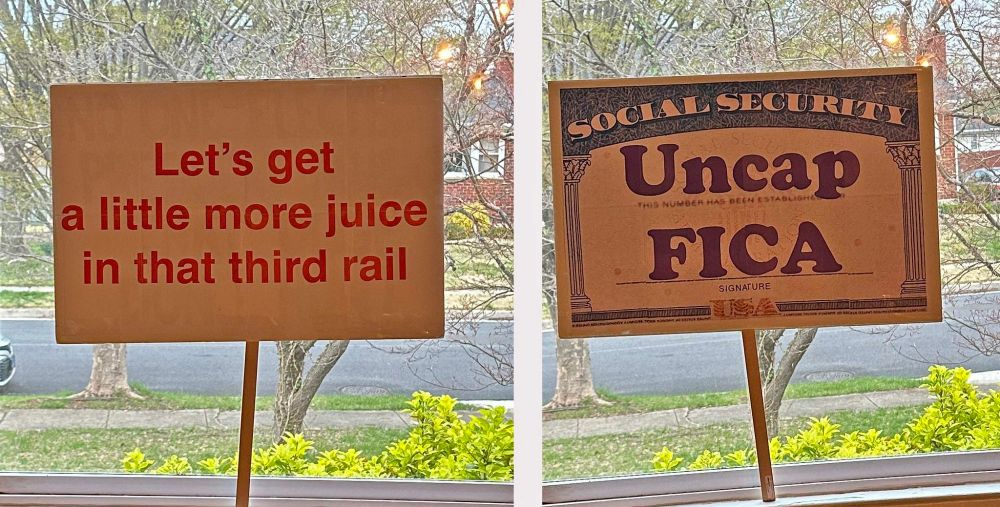
Side one of sign: "Let's get a little more juice in that third rail."
Side two of sign: "Uncap FICA."
My two-sided sign for today's "Hands Off" protest outside the Social Security Administration building in Catonsville, MD.
The Baltimore Banner put the crowd at "over 300," but I think it was 𝘰𝘷𝘦𝘳 over that. And Catonsville is but a suburb.
05.04.2025 20:52 — 👍 14 🔁 2 💬 1 📌 0
There’s more to it, but perhaps one piece of what we’re seeing in national politics is the outcome of a tech/business culture in which affirmative meanings started inhering in word “disrupt.” I was raised to have that word default to the pejorative.
03.04.2025 22:07 — 👍 3 🔁 1 💬 0 📌 0
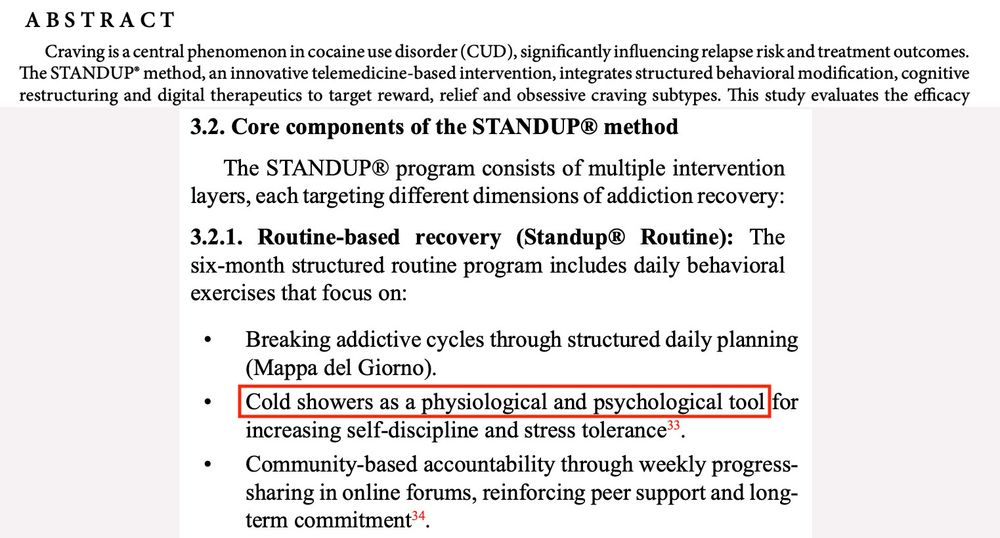
Abstract:
Craving is a central phenomenon in cocaine use disorder (CUD), significantly influencing relapse risk and treatment outcomes. The STANDUP® method, an innovative telemedicine-based intervention, integrates structured behavioral modification, cognitive restructuring and digital therapeutics to target reward, relief and obsessive craving subtypes.
The six-month structured routine program includes daily behavioral exercises that focus on:
• Breaking addictive cycles through structured daily planning (Mappa del Giorno).
• Cold showers as a physiological and psychological tool for increasing self-discipline and stress tolerance.
Going cold, turkey.
I saw this paper on April 1, but it was not published on April 1.
01.04.2025 22:29 — 👍 0 🔁 0 💬 0 📌 0
It's great to see moves toward assessing SUD symptoms/criteria in their dynamic flux, potentially as outcome measures to match inclusion criteria. I did that with the old SDSS (a DSM-IV-based addiction interview with a past-30-day time frame) but this is more sophisticated and more promising.
31.03.2025 15:26 — 👍 1 🔁 0 💬 0 📌 0
Alcohol use disorder symptoms are kinda detectable in daily life (but it depends on how they are operationalized)
Kevin King
Dani Kang
Megan Schultz
Christine Lee
Jonas Dora
Cassandra Boness
Ashley Watts
This title made me happy out of all proportion to the stimulus. I want to thank it.
Right now it's only a preprint. Together, psychological-science Bluesky, we can commit to editor/reviewer stances that might bring it all the way to publication. And that would be kinda great.
30.03.2025 03:18 — 👍 13 🔁 1 💬 1 📌 0
I look forward posting more of my lightly rebarbative know-it-all comments on addiction research and the behavioral sciences in general. That was always the crux of my being on Twitter-then-BlueSky. But...priorities.
15.03.2025 19:50 — 👍 4 🔁 0 💬 0 📌 0
Situationist Cybernetics. Researching AI & Culture at the University of Cambridge Digital Humanities. Affiliated Researcher, Machine Visual Culture Research Group (Max Planck Institute, Rome). Aim to be kind. cyberneticforests.com
Eisner-winning, Lambda-nominated author of BODY HORROR, GENTRIFIER, SWEET LITTLE CUNT, and UNMARKETABLE and host of the true-crime audio series MY INEVITABLE MURDER. Runs a hot sauce concern for "fun." SVA Faculty.
Cognitive💭 Computational🧑💻 Neuroscientist🧠
Physiology of neural selectivity, attention, decision-making
Swimming 🏊🏻 hiking ⛰️ ecology 🏞️ greenery 🌿 enthusiast
http://d-ferro.github.io; http://gin.g-node.org/56fe 🗣️it en es fr
@crmatematica.bsky.social; @upf.edu
Cognitive scientist studying how we see + think @ Johns Hopkins University. 🇨🇦
Lab: https://perception.jhu.edu/
clinical psychologist and psychology professor at Saginaw Valley State University in Michigan; here to learn; interested in psychotherapy, existential psych research, and undergrad teaching; my views only; he/him
Democrat, free world, facts, truth, justice, nature, renewable energy. 🇪🇺🇳🇱🇺🇦
Scientist exploring the addicted brain. Mom. Traveler. European by heart.
🚀 space 💊 medicine 🧪 science 🍑 Southern politics 📺 FOX senior correspondent 🎤 Huntington’s disease research advocate 🧬
New media artist, Berklee prof, bumbling around the metaverse
Practicing medicine. Journalism grad. #1 Andor fan. Based in PNW.
Check out my curated comic book feed Comics on Sky here: https://bsky.app/profile/did:plc:txaxiqiyu6hvox4ngqy23gnt/feed/aaacvhmb4u7na
Itinerant writer, amateur anthropologist, professional nomad. Pragmatic Progressive. Ohio expat. CWA-NewsGuild 32035. #SubmissionIsFutile
THE BROTHER ROAD on apple podcasts. https://podcasts.apple.com/us/podcast/the-brother-road/id1868070633
Cat poster. Self-taught professional software developer, exF2P MTG Arena Challenger, ex wr holder speedrunning HotD2_100%, ex streamer, ex melee player.
Grilling, coding, gaming, magic: the gathering, other tcgs, and my kitty, Ricky 😻
30, he/him
Pro-Democracy progressive American, very very very very anti-Trump and his army of MAGA goons. Mother of two daughters and scared out of her mind for what's next. Daughter of two retired, long-time Federal employees. Baltimore resident, DC native.
Voice actor. Musician. Cat dad. Toy robot enthusiast. Recovering cynic.
Just another jerk taking pride in his work.
http://www.thombowers.com
http://www.sonsofnothing.com
http://www.thespoonradio.com
Twitter's official Dorothy L. Sayers stan account, 2018-24, now on Bluesky. New Englander in Quebec. Eph '00/YDS '04. Mom, priest (the sweary kind), writer (ask me about my musical!), doula. Yes, my grandma shot a Nazi. She/her. INTJ/5w4.
Academic, animal lover, V word, wannabe statistician, addicted to cats and travel. Currently working in psychology research with the Translational and Applied Research Group (TARG) at the University of Bristol, UK.
Graduate student at the University of Ottawa
Health Psychologist focused on the effects of tobacco/nicotine and other drugs, crossfitter, baked goods lover