Newton's Avatar

Newton

@cp-newton.bsky.social

Newton is a broad-scope physics journal launched in 2025. Editor-in-Chief: Elisa De Ranieri, Cell Press

177 Followers  |  6 Following  |  85 Posts  |  Joined: 13.12.2024  |  1.5488

Latest posts by cp-newton.bsky.social on Bluesky

Preview
Giant nonlinear transport response in a magnetic semiconductor induced by electrostatic gating Normally, a material’s resistance is the same when measured left to right or right to left. Chou et al. discovered that this symmetry breaks down in a magnetic transistor, where the silicon in conventional transistors is replaced by a magnetic semiconductor. The device shows a directional preference for electron flow only when a gate voltage is applied, revealing an interplay among magnetism, electric field, and electronic band structure. This resistance asymmetry could also enable rectification for energy harvesting or wireless signal detection.

Online now: Giant nonlinear transport response in a magnetic semiconductor induced by electrostatic gating #newton #physics

12.12.2025 15:39 β€” πŸ‘ 0    πŸ” 0    πŸ’¬ 0    πŸ“Œ 0
Preview
Dirac fermions meet Kondo lattice In the van der Waals material CeTe3, two kinds of electronic states of Dirac electrons and heavy fermion state coexist and interact with each other. Zeng et al. revealed that the effective mass and mobility of carriers change at the Kondo and NΓ©el temperatures, as determined by optical conductivity and quantum oscillation measurements.

Online now: Dirac fermions meet Kondo lattice #newton #physics

11.12.2025 15:38 β€” πŸ‘ 0    πŸ” 0    πŸ’¬ 0    πŸ“Œ 0
Preview
Peeling layers reveal hidden quantum states in kagome materials Flat-band kagome materials exhibit a unique interplay between geometric frustration and strong electron correlations. Huang et al. demonstrate that exfoliating Nb3Cl8 flakes introduces strain, stabilizing a high-temperature phase with spin fluctuations that persist down to cryogenic temperatures. This finding has implications for future research into hidden quantum phases and the exotic properties of kagome materials.

Online now: Peeling layers reveal hidden quantum states in kagome materials #newton #physics

08.12.2025 15:38 β€” πŸ‘ 0    πŸ” 0    πŸ’¬ 0    πŸ“Œ 0
Preview
Kondo-coupled van der Waals antiferromagnet with high-mobility quasiparticles CeTe3 is a rare example of a van der Waals Kondo antiferromagnet that overcomes the traditional correlation-mobility trade-off. Zeng et al. reveal a dual mechanism of mass enhancement driven by Kondo coupling and magnetic order, with a mobility exceeding 3,000 cm2/Vs. The coexistence of strong correlations, magnetism, and high mobility in atomically thin CeTe3 opens new avenues for correlated 2D quantum transport and spintronic applications.

Online now: Kondo-coupled van der Waals antiferromagnet with high-mobility quasiparticles #newton #physics

25.11.2025 15:38 β€” πŸ‘ 1    πŸ” 0    πŸ’¬ 0    πŸ“Œ 0
Preview
A bright, silicon-based entangled photon source for metropolitan quantum communication Quantum networks require the distribution of entangled photons over long distances, a task primarily achieved using bulky crystal sources. Du et al. report a compact, CMOS-compatible silicon chip that generates bright, telecom-wavelength entangled photons and demonstrate their high-fidelity distribution through 93 and 155 km of deployed metropolitan fiber.

Online now: A bright, silicon-based entangled photon source for metropolitan quantum communication #newton #physics

20.11.2025 20:38 β€” πŸ‘ 0    πŸ” 0    πŸ’¬ 0    πŸ“Œ 0
Preview
Janus bound states in the continuum and robust unidirectional guided resonances induced by shear Low-symmetry structures offer powerful means to control light’s polarization, phase, and far-field radiation, yet mirror-symmetry breaking typically relies on asymmetric geometries. Ji et al. present a universal symmetry-breaking strategy via shear rather than asymmetric structures. This approach enables Janus bound states in the continuum, robust unidirectional guided resonances, and super-non-radiative polarization singularities within geometrically symmetric structures. This work redefines symmetry control in optics, unlocking opportunities for asymmetric emission and chiral photonics.

Online now: Janus bound states in the continuum and robust unidirectional guided resonances induced by shear #newton #physics

19.11.2025 20:38 β€” πŸ‘ 0    πŸ” 0    πŸ’¬ 0    πŸ“Œ 0
Preview
Unlocking new pathways for chiral plasmonics via spinning and orbiting nanostructures Chirality plays an important role in light-matter interactions; however, the chiroptical responses of natural structures and materials are typically very weak. Zou et al. demonstrate a geometric spin-orbit hybridization approach to create three-dimensional plasmonic nanostructures with tunable circular dichroism and enhanced optical chirality density, enabling potential applications in polarization detection, chiral light sources, and optical sensing and sorting.

Online now: Unlocking new pathways for chiral plasmonics via spinning and orbiting nanostructures #newton #physics

19.11.2025 15:38 β€” πŸ‘ 0    πŸ” 0    πŸ’¬ 0    πŸ“Œ 0
Preview
Acoustic realization of monoatomic topological space-time crystals Topological space-time crystals featuring intertwined spatiotemporal translation symmetries have emerged as new topological phases that go beyond the established Floquet-Bloch framework. Here, Tong et al. report an acoustic realization of monoatomic topological space-time crystals, achieved by combining passive acoustic cavity-tube structures with active circuit couplings. The experiments demonstrate pivotal oblique energy-momentum Brillouin zones and nontrivial Ο€-gap edge states in space-time crystals, opening new avenues for further exploration of novel non-equilibrium topological phases of matter.

Online now: Acoustic realization of monoatomic topological space-time crystals #newton #physics

19.11.2025 00:29 β€” πŸ‘ 0    πŸ” 0    πŸ’¬ 0    πŸ“Œ 0
Preview
Entanglement distribution over 155 km metropolitan fiber using a CMOS-compatible silicon chip Transmitting entangled states over long distances is crucial for quantum networks. Du et al. demonstrate polarization entanglement distribution using a CMOS-compatible silicon chip. The device delivers entangled photon-pair brightness three times higher than in previous reports with high fidelity. After addressing phase drift and chromatic dispersion, entangled photon pairs were distributed over 93 and 155 km of deployed fiber. These results show that silicon chips can perform competitively compared to bulk crystal sources for quantum networks with integrated nanophotonic platforms.

Online now: Entanglement distribution over 155 km metropolitan fiber using a CMOS-compatible silicon chip #newton #physics

18.11.2025 20:39 β€” πŸ‘ 0    πŸ” 0    πŸ’¬ 0    πŸ“Œ 0
Preview
Tunable bouncing behavior of liquid-liquid compound drops Drops impacting solid surfaces typically exhibit either rebound suppression or rebound enhancement, two outcomes regarded as mutually exclusive. Tang et al. investigate liquid-liquid compound drops and uncover a tunable transition between these behaviors, governed by the volume fraction of dispersed droplets. In such drops, energy dissipation is significant when the dispersed droplets remain separated but is substantially reduced once they enter a jammed state. These findings offer valuable insights into drop impact dynamics and enable precise control of complex drops.

Online now: Tunable bouncing behavior of liquid-liquid compound drops #newton #physics

17.11.2025 15:38 β€” πŸ‘ 0    πŸ” 0    πŸ’¬ 0    πŸ“Œ 0
Preview
Thermodynamic limits in far-from-equilibrium molecular templating networks In cellular systems, nucleic acid templates catalyze the formation of protein and RNA molecules. Qureshi et al. analyze the behavior of catalytic molecular templating networks and bound the accuracy of such templating networks via functions of the maximal difference in free-energy changes between possible assembly pathways. Surprisingly, systems that operate at the bounds exist in a pseudo-equilibrium, balancing forward and backward transitions, unlike the behavior observed in biology.

Online now: Thermodynamic limits in far-from-equilibrium molecular templating networks #newton #physics

14.11.2025 20:38 β€” πŸ‘ 0    πŸ” 1    πŸ’¬ 0    πŸ“Œ 0
Preview
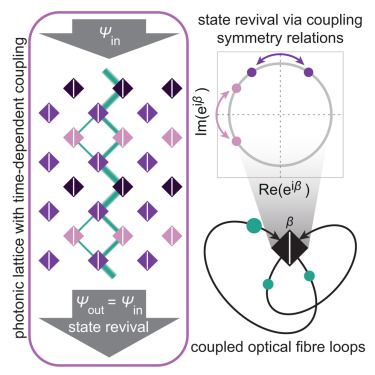
Symmetry-enforced state revival in time-varying photonic lattices State revivals are theoretically and experimentally studied in discrete-time quantum walks with a time-dependent coin. Steinfurth et al. identified a set of symmetry-driven principles underlying these revivals, leading to a modulation protocol that provides both precise control and adaptability, offering insights into complex systems and advancing quantum-inspired technologies.

Online now: Symmetry-enforced state revival in time-varying photonic lattices #newton #physics

14.11.2025 15:39 β€” πŸ‘ 0    πŸ” 0    πŸ’¬ 0    πŸ“Œ 0
Preview
Continuous transition and gapless roton inside fractional quantum anomalous Hall states Low-energy excitations are crucial for understanding exotic phases and transitions in quantum many-body systems. Lu et al. numerically reveal a microscopic mechanism for a transition from an isotropic fractional quantum anomalous Hall (FQAH) state to a translation-symmetry-breaking FQAH, driven by the magnetoroton mode softening at finite momentum. The process maintains the Hall conductivity, with a robust charge gap at the quantum critical point. This scenario could serve as a general scheme for various FQAH systems.

Online now: Continuous transition and gapless roton inside fractional quantum anomalous Hall states #newton #physics

13.11.2025 20:38 β€” πŸ‘ 1    πŸ” 0    πŸ’¬ 0    πŸ“Œ 0
Preview
Composition-controllable topological nodal-line semimetals in covalent organic frameworks Covalent organic frameworks (COFs) typically display insulating behavior characterized by distinct energy bands, often modeled as composite bands from simple bands above and below the Fermi level. Cai et al. designed a disilabenzene-linked COF topological nodal-line semimetal, represented by a six-band model using 1,4,5,8,9,12-hexabromoazatriphenylene and silicon. This work showcases a strategy for constructing multiple organic topological semimetals through the interweaving simple bands.

Online now: Composition-controllable topological nodal-line semimetals in covalent organic frameworks #newton #physics

13.11.2025 15:38 β€” πŸ‘ 1    πŸ” 0    πŸ’¬ 0    πŸ“Œ 0
Preview
Suppression of structural and magnetic phase transitions in layered exfoliated kagome semiconductor Nb3Cl8 Precise identification and control of structural phases in flat-band kagome materials are key to manipulating their emergent quantum states. Huang et al. employ Raman spectroscopy as a nanoscale probe to distinguish Ξ±- and Ξ²-phase Nb3Cl8. Crucially, exfoliation-induced strain in thin flakes suppresses both structural and magnetic transitions, stabilizing the high-temperature Ξ±-phase down to 2 K. This work establishes a framework for interpreting correlated phenomena in this kagome semiconductor and offers valuable insights into the design of future strain-engineered two-dimensional quantum devices.

Online now: Suppression of structural and magnetic phase transitions in layered exfoliated kagome semiconductor Nb3Cl8 #newton #physics

07.11.2025 15:39 β€” πŸ‘ 0    πŸ” 0    πŸ’¬ 0    πŸ“Œ 0
Preview
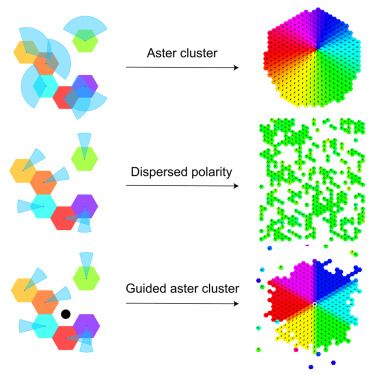
Collective behavior of the non-reciprocal vision cone XY lattice-gas model Visual perception is a common factor affecting how organisms interact with one another in nature. Du et al. introduce a non-reciprocal XY lattice-gas model to explore how vision-cone interactions shape the collective behavior in selfish energy-driven systems. They show that active particles tend to aggregate into an aster cluster over a wide range of vision cones, and aster formation can be guided by the introduction of an attractive anchor, revealing the underlying mechanisms of certain β€œselfish herd” behaviors.

Online now: Collective behavior of the non-reciprocal vision cone XY lattice-gas model #newton #physics

30.10.2025 19:38 β€” πŸ‘ 0    πŸ” 0    πŸ’¬ 0    πŸ“Œ 0
Preview
Orbital Hall conductivity and orbital diffusion length of vanadium thin films by Hanle magnetoresistance Orbitronics exploits the orbital motion of electrons and has recently emerged as an alternative to conventional electronics. Aguilar-Pujol et al. show that vanadium, a light 3d metal with weak spin-orbit coupling, can generate orbital currents. Measuring changes in resistance under a magnetic field provides evidence of this behavior and arises as a suitable method to characterize a broad class of materials with either strong or weak spin-orbit coupling.

Online now: Orbital Hall conductivity and orbital diffusion length of vanadium thin films by Hanle magnetoresistance #newton #physics

30.10.2025 14:39 β€” πŸ‘ 0    πŸ” 0    πŸ’¬ 0    πŸ“Œ 0
Preview
Light-matter interactions in 3D chiral plasmonic nanostructures with geometric spin-orbit hybridization Chirality is ubiquitously observed in nature. Inspired by the spin and orbital motion of light, Zou et al. introduce a geometric spin-orbit hybridization framework to design chiral nanostructures. This approach enables enhanced circular dichroism and optical chirality density, which are crucial for various applications. Numerical demonstrations are shown for a polarization-sensitive thermal detector and a nano-needle with a strong, broadband chiral response. This framework establishes a versatile platform for engineering chiral nanostructures for advanced chiral light-matter interactions.

Online now: Light-matter interactions in 3D chiral plasmonic nanostructures with geometric spin-orbit hybridization #newton #physics

29.10.2025 14:38 β€” πŸ‘ 0    πŸ” 0    πŸ’¬ 0    πŸ“Œ 0
Time-temperature-moisture superposition principle of hydrophilic polymer amorphous cellulose Understanding the mechanical behaviors of hydrophilic polymers, such as amorphous cellulose, is crucial for foreseeing application scenarios and designing advanced materials. Liu et al. establish a time-temperature-moisture superposition principle to understand how temperature and water alter the mechanical response of amorphous cellulose at the molecular level, providing a predictive understanding of its mechanical properties and functions.

Online now: Time-temperature-moisture superposition principle of hydrophilic polymer amorphous cellulose #newton #physics

28.10.2025 14:38 β€” πŸ‘ 0    πŸ” 0    πŸ’¬ 0    πŸ“Œ 0
Preview
Mapping the three-dimensional structure of faceted gold mesocrystals using coherent X-ray diffraction imaging Understanding the structure-property relationship of self-assembled superstructures requires non-destructive 3D structural analysis, which can then facilitate the development of mesocrystals with collective and emergent properties. Hinsley et al. employ coherent X-ray diffractive imaging to resolve the positions and orientations of the constituent gold octahedral nanoparticles in multiple self-assembled mesocrystals as well as defects within the mesocrystal lattice structure.

Online now: Mapping the three-dimensional structure of faceted gold mesocrystals using coherent X-ray diffraction imaging #newton #physics

21.10.2025 19:38 β€” πŸ‘ 0    πŸ” 0    πŸ’¬ 0    πŸ“Œ 0
Preview
The role of dewetting in droplet-substrate interactions The current fundamental understanding of dewetting is predominantly restricted to liquid films, and its role in mediating droplet dynamics remains unclear. In this perspective, Pengcheng Sun and Zuankai Wang provide a critical assessment and discuss the potential for future applications of the role of dewetting in mediating droplet dynamics, offering new insights into the long-standing problem of dewetting dynamics.

Online now: The role of dewetting in droplet-substrate interactions #newton #physics

21.10.2025 14:39 β€” πŸ‘ 1    πŸ” 0    πŸ’¬ 0    πŸ“Œ 0
Preview
Macroscale heat conduction gets an anomalous makeover Fourier’s law governs heat flow at the macroscopic level but fails at the nanoscale, where thermal conductivity can depend on system size. Writing in Newton, Wang et al. bring this β€œanomalous” heat conduction to the macro world. Using active thermal metamaterials with tunable embedded sources, they demonstrate size-dependent conductivity, bridging the gap between two distinct physics domains.

Online now: Macroscale heat conduction gets an anomalous makeover #newton #physics

20.10.2025 14:38 β€” πŸ‘ 0    πŸ” 0    πŸ’¬ 0    πŸ“Œ 0
Preview
Efficient wireless power transfer enabled by anti-PT-symmetric nonlinear feedback Wireless power transfer faces efficiency and tuning challenges over distance, and higher-order systems often require multiple coils, increasing complexity and energy loss. Wang et al. demonstrate a synthetic-dimension-based meta-coil that realizes high-order anti-PT symmetry for wireless power transfer. Incorporating nonlinear saturation gain enables adaptive frequency locking and robust efficiency across varying distances without active tuning, offering a compact and efficient solution for next-generation wireless energy systems.

Online now: Efficient wireless power transfer enabled by anti-PT-symmetric nonlinear feedback #newton #physics

17.10.2025 23:29 β€” πŸ‘ 0    πŸ” 0    πŸ’¬ 0    πŸ“Œ 0
Preview
Ultrafast electron dynamics in a planar d-wave altermagnet Most current storage uses ferromagnetic materials with aligned spins but face speed and scalability limitations due to magnetic stray fields. Antiferromagnets avoid this issue but are more challenging to control. Altermagnets, which combine spin-split bands with compensated magnetizationβ€”once thought to be unique to antiferromagnetsβ€”offer a promising alternative. Weber et al. theoretically explore ultrafast spin dynamics in a prototypical altermagnetic candidate material. They show that in altermagnets, optically excited spins can persist long enough for experimental detection, paving the way for potential ultrafast spintronic devices.

Online now: Ultrafast electron dynamics in a planar d-wave altermagnet #newton #physics

17.10.2025 19:38 β€” πŸ‘ 0    πŸ” 0    πŸ’¬ 0    πŸ“Œ 0
Preview
A twist on active polymers While a passive polymer cannot spontaneously fold without attraction, Caprini et al. show that a polymer made from chiral active monomers spontaneously self-wraps. When all monomers rotate with the same handedness, an effective attraction emerges between faraway monomers, allowing the polymer to remain self-wrapped.

Online now: A twist on active polymers #newton #physics

17.10.2025 14:38 β€” πŸ‘ 0    πŸ” 0    πŸ’¬ 0    πŸ“Œ 0
Preview
Critical size scaling and saturation phenomenon in non-Hermitian topological sensors Non-Hermitian topological sensors (NTOSs) offer ultrasensitive detection but face scalability limits. Rafi-Ul-Islam et al. reveal why signal amplification saturates in point-gap topology and derive critical size and energy. Line-gap topology avoids saturation, while unidirectional coupling enhances tunability. A topolectrical circuit design translates energy shifts to impedance peaks, enabling robust, low-cost sensing. These insights optimize NTOSs for photonics and quantum applications, advancing non-Hermitian physics.

Online now: Critical size scaling and saturation phenomenon in non-Hermitian topological sensors #newton #physics

14.10.2025 14:38 β€” πŸ‘ 0    πŸ” 0    πŸ’¬ 0    πŸ“Œ 0
Preview
From structural reconstructions to properties and applications of two-dimensional moirΓ© superlattices This perspective highlights how atomic reconstruction in moirΓ© superlattices of two-dimensional materials governs domain topology, polarization patterns, and electronic transport. By comparing rotation- and dilation-driven reconstructions, it shows how symmetry breaking and interlayer coupling produce distinct domain architectures and functional responses. This perspective also discusses how these processes enable functional applications such as ultra-low-power memory and neuromorphic computing, offering a framework for engineering reconfigurable quantum devices through moirΓ© superlattice design.

Online now: From structural reconstructions to properties and applications of two-dimensional moirΓ© superlattices #newton #physics

10.10.2025 19:38 β€” πŸ‘ 0    πŸ” 0    πŸ’¬ 0    πŸ“Œ 0
Preview
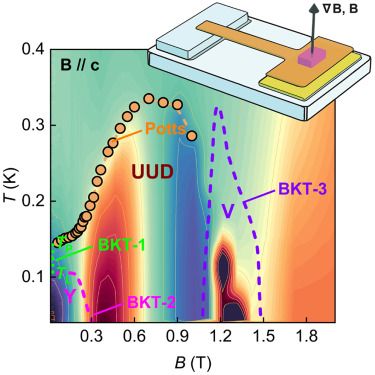
Field-tunable BKT and quantum phase transitions in spin-12 triangular lattice antiferromagnet The cobalt compound Na2BaCo(PO4)2 (NBCP) is the first to realize a spin-12 easy-axis triangular lattice antiferromagnet, hosting spin supersolidity and topological phase transitions. Using a newly developed high-sensitivity gradient force magnetometer, Zhang et al. mapped the magnetic phase diagram of NBCP at temperatures as low as 30 millikelvin. The results reveal BKT transitions and field-tunable quantum phase transitions, along with a giant magnetocaloric effect. These findings establish NBCP as an ideal platform for studying frustrated quantum magnetism.

Online now: Field-tunable BKT and quantum phase transitions in spin-12 triangular lattice antiferromagnet #newton #physics

10.10.2025 14:38 β€” πŸ‘ 0    πŸ” 0    πŸ’¬ 0    πŸ“Œ 0
Preview
Spinning states with a quantum turntable The coherent transfer of quantum information between different points in space is challenging. Ymai and Wilsmann et al. show that a spinning tetrahedral arrangement of optical traps realizes a quantum turntable that can coherently transfer the quantum states of magnetic atoms, including entangled states, around the axis of rotation with high fidelity.

Online now: Spinning states with a quantum turntable #newton #physics

08.10.2025 14:38 β€” πŸ‘ 2    πŸ” 1    πŸ’¬ 0    πŸ“Œ 0
"The editorial team at Newton congratulates Drs. John Clarke, Michel Devoret, and John Martinis on receiving the 2025 Nobel Prize in Physics. Their discoveries in the early 1980’s helped bring the elusive principles of quantum mechanics within the grasp of our everyday experience. By using electronic circuits with superconducting elements, they demonstrated both quantum tunnelling and energy quantisation on a macroscopic scale. Awarded in the centenary year of quantum mechanics, this Nobel Prize highlights the enduring impact of the theory on both our understanding of nature and the technologies that shape our future."
-Elisa De Ranieri, Editor-in-Chief, Newton.

"The editorial team at Newton congratulates Drs. John Clarke, Michel Devoret, and John Martinis on receiving the 2025 Nobel Prize in Physics. Their discoveries in the early 1980’s helped bring the elusive principles of quantum mechanics within the grasp of our everyday experience. By using electronic circuits with superconducting elements, they demonstrated both quantum tunnelling and energy quantisation on a macroscopic scale. Awarded in the centenary year of quantum mechanics, this Nobel Prize highlights the enduring impact of the theory on both our understanding of nature and the technologies that shape our future." -Elisa De Ranieri, Editor-in-Chief, Newton.

The #Newton editorial team wishes heartfelt congratulations to the winners of the 2025 #NobelPrize in Physics, Drs. John Clarke, Michel H. Devoret, and John M. Martinis!

You can view research published in #CellPress related to this year's Nobel winners here: www.cell.com/nobelprize


07.10.2025 17:05 β€” πŸ‘ 0    πŸ” 0    πŸ’¬ 0    πŸ“Œ 1

@cp-newton is following 6 prominent accounts