Looking for books to get for #climate curious friends & family this Christmas🎄?
Here are 6 of my favourites reads this year.
First up, Yale University historian Sunil Amrith's relentlessly edifying 'The Burning Earth'. A staggeringly comprehensive account of how we got to where we are! 🧵
03.12.2025 05:18 — 👍 130 🔁 64 💬 3 📌 7

⚠️ When “technology will save us” becomes a climate risk!
A new paper from great colleagues takes a careful look at techno-optimism — the belief that technology will largely solve climate change — and what it means for real-world climate action.
(1/4)👇
osf.io/preprints/ps...
19.11.2025 16:26 — 👍 206 🔁 98 💬 16 📌 14
🎉 You’ve exceeded even our most optimistic expectations — we received 107 intervention proposals.
THANK YOU!
🕵 Our advisory board will now begin reviewing all interventions.
🔗 More information: janpfander.github.io/trust_climat...
13.11.2025 10:52 — 👍 7 🔁 2 💬 0 📌 1

Title page of the paper "Techno-optimistic scientists take fewer climate action"
🚨Techno-optimistic scientists take fewer climate actions
In a new preprint, @colognaviktoria.bsky.social, @maiensachis.bsky.social, @jmbh.bsky.social & I examine techno-optimism among 9,199 scientists and how it relates to their civic engagement and lifestyle choices🧵
🔗 Link: tinyurl.com/hh94huzv
14.11.2025 09:20 — 👍 74 🔁 32 💬 2 📌 6

I've finally got around to curating a selection of films about the #climate crisis 🎥
There's lot of mediocre climate films out there, but for me these stand out head & shoulders above the rest 🎞️
They make excellent resources for classrooms, lecture halls, or community cinema's 🎬
Thread:🧵Plz RT
01.11.2025 10:16 — 👍 582 🔁 396 💬 20 📌 39
This! 🔥👇 Couldn't agree more, thank you @kristiansn89.bsky.social
16.10.2025 13:19 — 👍 8 🔁 1 💬 0 📌 1

🔥 The never-ending narrative…
This week, I’ve once again heard prominent climate researchers dismiss individual action as either irrelevant or a distraction instigated by the fossil fuel industry.
Here’s a 🧵 on why this argument frustrates me to no end and why I think it misses the bigger picture.
15.10.2025 11:50 — 👍 139 🔁 63 💬 8 📌 18

👉 Learn about our submission criteria and how to contribute on our Call for Collaborations page: janpfander.github.io/trust_climat...
🙌 This project is led by @janpfa.bsky.social and myself at @eawag.bsky.social and @madalina.bsky.social and @smconstantino.bsky.social at Stanford.
15.10.2025 09:37 — 👍 3 🔁 2 💬 0 📌 0
🔍 What We’re Looking For
We are seeking short, text-based informational interventions that could increase trust in climate scientists. The most promising interventions will be selected by the study leads and an advisory board. Deadline for submission is November 11, 2025.
15.10.2025 09:37 — 👍 2 🔁 0 💬 1 📌 0
🤝 Collaborate with us
We invite researchers at any career stage as well as practitioners to submit intervention ideas to increase trust in climate scientists in the US. Successful contributors will receive co-authorship. Interventions can be submitted by individuals or teams.
15.10.2025 09:37 — 👍 2 🔁 1 💬 1 📌 0
🚀 What is a megastudy?
A megastudy is a large-scale online experiment designed for robust, replicable results.
15.10.2025 09:37 — 👍 2 🔁 0 💬 1 📌 0
🌎 Why trust in climate scientists?
Across 55 countries, trust in climate scientists was the strongest predictor of belief in climate change and support for climate policy (Todorova et al., 2024). Yet, climate scientists tend to be less trusted than scientists of other disciplines.
15.10.2025 09:37 — 👍 3 🔁 1 💬 1 📌 0
Climate science is facing significant opposition in the US. Today we are launching the collaborative Strengthening Trust in Climate Scientists Megastudy 📈 Find out more and join our efforts 👇🧵
15.10.2025 09:37 — 👍 44 🔁 14 💬 1 📌 2

Quasi-universal acceptance of basic science in the United States - Jan Pfänder, Lou Kerzreho, Hugo Mercier, 2025
Substantial minorities of the population report a low degree of trust in science, or endorse conspiracy theories that violate basic scientific knowledge. This m...
How much do people really reject science?
New paper out doi.org/10.1177/0963...
In four studies, we asked Americans—including flat Earthers, climate change deniers and vaccine skeptics—whether they accepted basic scientific facts.
The result? A surprisingly high level of agreement. 👇
05.09.2025 11:17 — 👍 43 🔁 15 💬 3 📌 4
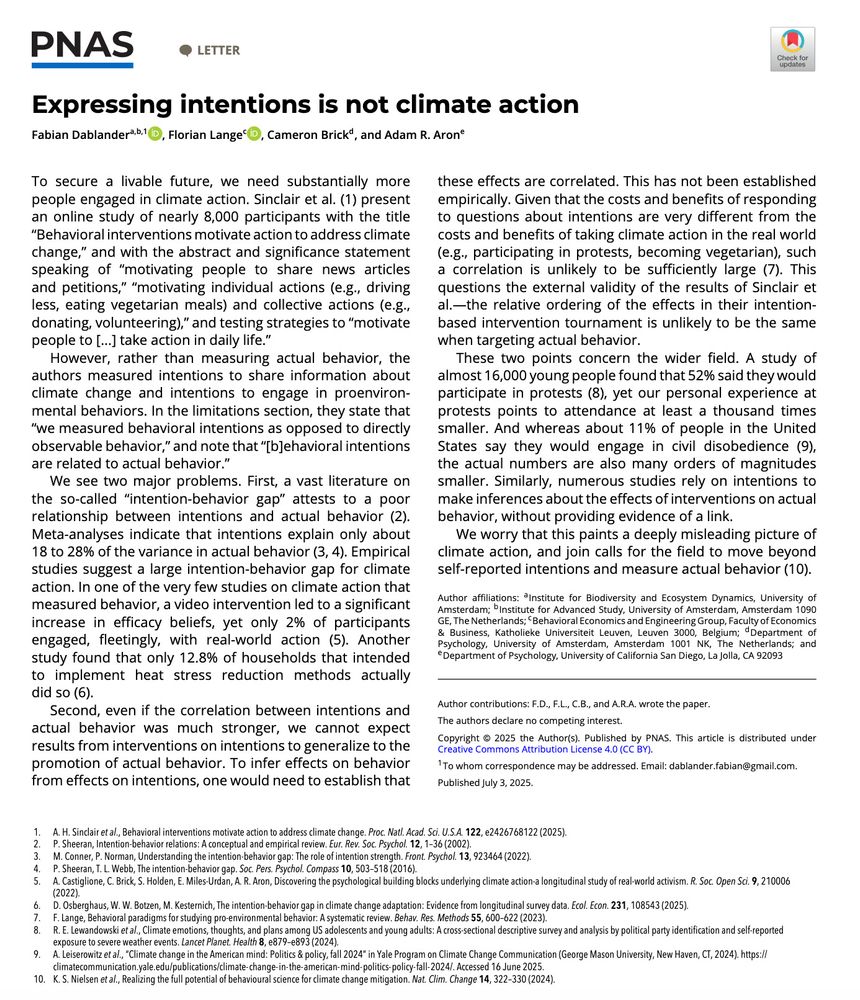
Expressing intentions is not climate action letter published in PNAS: https://www.pnas.org/doi/10.1073/pnas.2512457122
In our now published letter in @pnas.org, we raise two wider issues for behavioral science:
1) Intentions are poor predictors of behavior
2) Effects on intentions need not generalize to effects on behavior
We join calls for researchers to measure actual behavior: www.pnas.org/doi/10.1073/...
07.07.2025 12:50 — 👍 84 🔁 31 💬 4 📌 0
Thanks for asking! We did not establish causation. Indeed, we note in the paper that the reverse causal relationship is also possible (as you suggest) and that future work should examine the nature and direction of this relationship.
02.07.2025 19:13 — 👍 3 🔁 0 💬 0 📌 0
🌪️Experiencing extreme weathers had no direct effect on climate policies support.
n = 1295: 🇺🇸 🇬🇧 🇩🇪 🇦🇺
EXPECTING more severe weather events in the future did.
In sum:
Expectation (not experience) predicts climate policy support!
doi.org/10.1016/j.je...
27.04.2025 17:32 — 👍 9 🔁 3 💬 0 📌 0
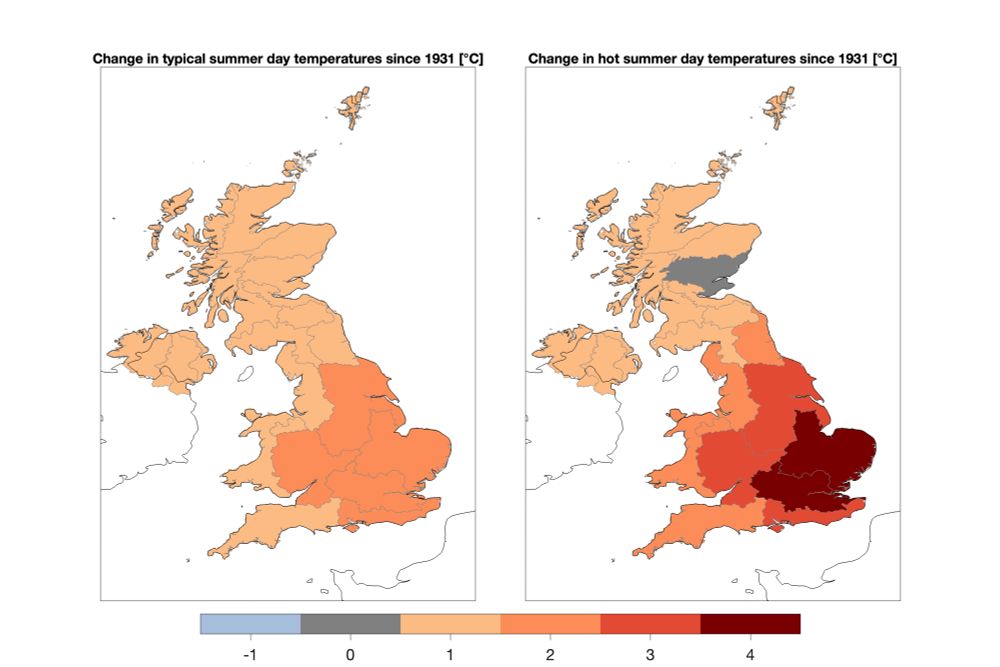
UK maps showing changes in temperatures for typical summer days and hot summer days.
1°C of global warming does NOT mean that heatwaves 'just' get hotter by 1°C.
Over large parts of the UK, global warming means that heatwaves are 3-4°C warmer, with worse consequences for people and ecosystems.
02.07.2025 08:32 — 👍 449 🔁 186 💬 14 📌 6
This study was a huge collaborative, and truly interdisciplinary, effort 🙏 Huge thanks to my co-authors @simonameiler.bsky.social @samluethi.bsky.social @nielsmede.bsky.social @johnbesley.bsky.social @cameronbrick.bsky.social @marinajoubert.bsky.social @maibached.bsky.social and many others! 7/7
01.07.2025 10:38 — 👍 9 🔁 1 💬 1 📌 0
Making the link between climate change and extreme weather events more salient could increase climate policy support. The current heatwaves in many parts of the world provide a window of opportunity for communicators to increase subjective attribution and potentially climate action ☝️🌍 6/7
01.07.2025 10:38 — 👍 11 🔁 4 💬 1 📌 0
Note: Our data does not allow us to make conclusions about individual-level exposure, i.e., we don't know whether respondents were directly affected. A recent study found pos. relationships between individual-level exposure and climate risk perceptions osf.io/preprints/ps... @fdabl.bsky.social 5/7
01.07.2025 10:38 — 👍 5 🔁 1 💬 1 📌 2
However, population-level exposure to most events was unrelated to climate policy support. Interestingly, and in line with previous studies, only population-level exposure to wildfires was positively related to climate policy support. 4/7
01.07.2025 10:38 — 👍 4 🔁 1 💬 1 📌 0
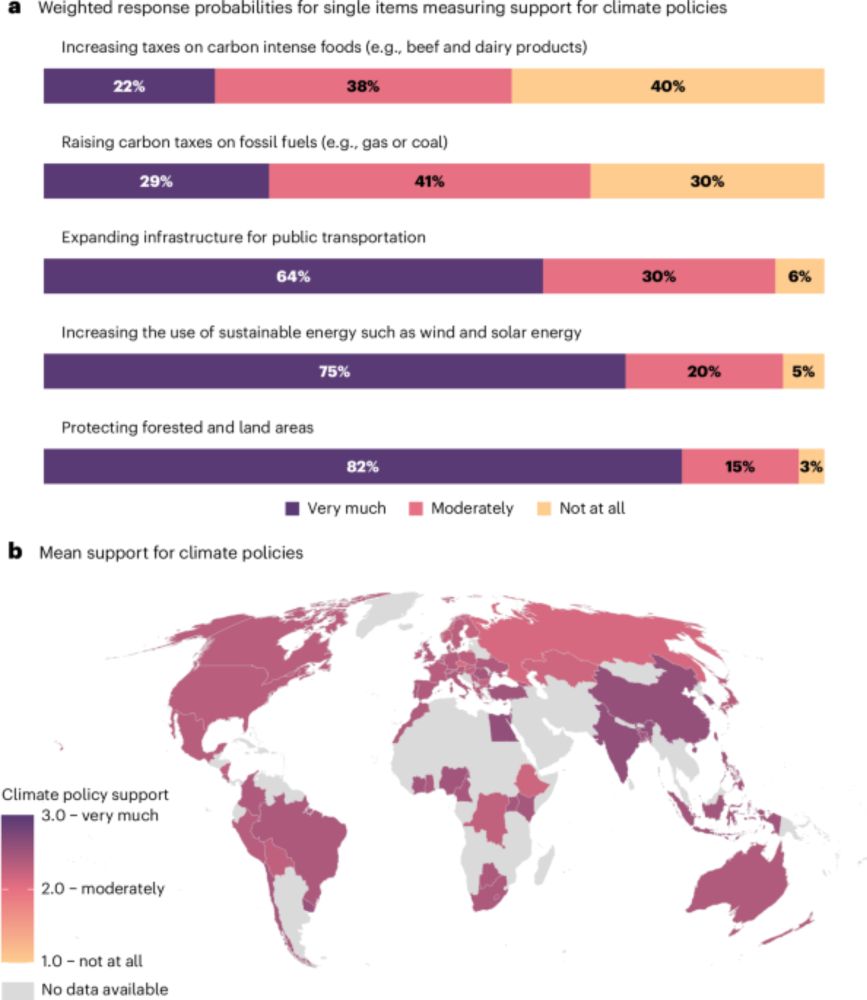
We found that subjective attribution was well above the scale midpoint in all countries and confirm previous findings that a majority support climate policies. We also provide global evidence that subjective attribution predicts climate policy support. 3/7
01.07.2025 10:38 — 👍 4 🔁 1 💬 1 📌 0
We created a measure of exposed population to different types of extreme weather event (e.g., heatwaves) over the last decades across 68 countries. We then triangulated this data with survey responses on subjective attribution of extreme events to climate change and climate policy support. 2/7
01.07.2025 10:38 — 👍 5 🔁 1 💬 1 📌 0
Huge congratulations, Matt!! 🎉
24.06.2025 20:58 — 👍 1 🔁 0 💬 1 📌 0

Looking for two post-docs to join our Public Engagement Lab at Stellenbosch University ...
23.05.2025 09:25 — 👍 7 🔁 3 💬 0 📌 0
Sustainable Consumption | Environmental Psychology
PhD Researcher, Consumer Psychology & Marketing, University of Amsterdam | MSc. Social Psychology, VU Amsterdam '21 | BA Psychology, Koc University '19
https://www.linkedin.com/in/sezin-ekinci/
Professor of economics and head of the research group "Sustainable Use of Natural Resources". Researching adaptation to climate change, resource governance and aspects of human behavior related to sustainable development. bjoernvollan.wordpress.com
SocPsych Ph.D. Student - Princeton Uni, Uni of Lisbon
Lay beliefs about (psych) science
Twitter/X: @cruz_fcorreia
Scientist at Eawag, Health and Environmental Psychologist
• Planetary Health
• Risk perception
• Distributive fairness
• Policy acceptance
• Water reuse
Climate Risk Scientist | Quantum Physicist | CLIMADA principal developer | Lecturer at ETH Zürich | Nature activist | Opinions my own |
Associate Prof at Uni of Southampton; USSR-born; speaker of several languages
www.lalamuradova.com
Empathy in Politics • Democracy • Climate Change • Democratic Innovations • Emotions • Deliberation • Autocracies
🏋♀️📚⛰️🕺
phd student https://janpfander.github.io/
Established researcher at ETH Zurich and Project Director at Open Energy Transition
Postdoc @ University of Kent & CONSPIRACY_FX ERC project
Social Psychology | Conspiracy Theories | Ambivalence
3rd-party punishment | #OpenScience
Economist and social science aficionado using experiments and data to find what works in public and social policy @ KOF Swiss Economic Institute ETH Zurich www.andreasbeerli.com
Environmental economist and Assistant prof. at CREST and ENSAE, Paris
Climate policy, air pollution, health
Prev.: IFS, Misum; PhD from PSE & Cired
Posts in English & French
website: https://marionleroutier.github.io/
Max Weber Fellow at European University Institute
PRIME Fellow at FU Berlin/WZB Berlin Social Science Center
Protest | political participation | representation | European politics | computational social science
More:
schuermannl.github.io
Science writer and researcher, focused on our home planet 🌏 Washington, DC area. Currently @projectdrawdown.bsky.social, previously NASA, World Resources Institute. Opinions my own.
https://emilyscassidy.github.io/
Physicist. Computational Social Scientist. Interested in the structures of polarization.
Central European University & Institute for Sustainable Resources, UCL.
maxfalkenberg.com
Mostly climate change & public opinion.
Book: The Climate Majority http://amzn.to/3h73dfm
🇱🇧🇫🇷, born at 364 ppm || PhD Student in Climate Science at ETH Zürich || data science, climate science, energy and policy || he/him
Sharing hope and debunking FUD against electric vehicles and renewable energy. Director NEONresearch.nl @TUeindhoven Founder Zenmo.com.
Associate Professor in Psychology
- Environmental and social psychology
Academic nomad | Wandering neuroscientist | Climate worrier | Assistant Professor @ Leiden University, views very obviously mine | https://anneurai.net/
staff writer @ The New Republic